Coordinated Product and SC Design. Slides3
 Call Kai
 Learn
Learn Practice Test
 Spaced Repetition
 Match
Match Flashcards
 Knowt Play
1/37

Earn XP
Description and Tags
Slides3
Name | Mastery | Learn | Test | Matching | Spaced | Call with Kai | Chat |
|---|
No analytics yet
Send a link to your students to track their progress
38 Terms
What are the two distinct chains in organizations
Supply chain and development chain
What does the supply chain focus on?
The flow of physical products from suppliers through manufacturers and distributors to retailers and customers
What does the development chain focus on?
Focuses on new product introduction and involves product architecture, make or buy decisions, and design processes.
Characteristics of supply chain
Predictability, product variability, economies of scale, lead time

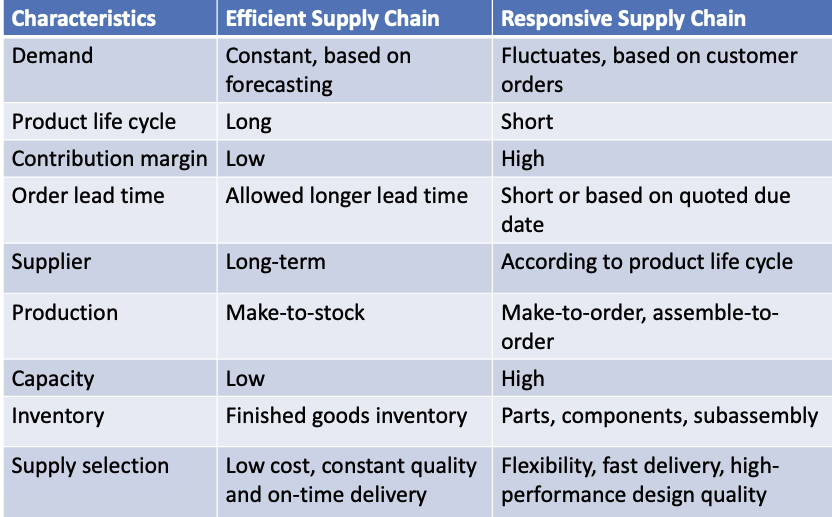
The characteristics of efficient supply chain (top to bottom)
constant,
long,
low
longer lead time,
long term
make-to-stock
low
FG
low cost, constant quality, on-time delivery


The characteristics of responsive supply chain (top to bottom)
Fluctuates based on customer orders
short
high
short
according to product life cycle
make to order, assemble-to-order
high
parts, components, subassembly
flexibility, fast delivery , high performance design
Characteristics of development chain
Technology clock speed make/buy decisions, product structure
Functional products
satisfy basic needs, static over time, stable demands, long life cycles
Innovative products
Offer higher profit margins, unpredictable demands, short life cycles

General characteristics of functional products
Slow, predictable with low product variablity


General characteristics of innovative products
Fast unpredictable, based on availibility

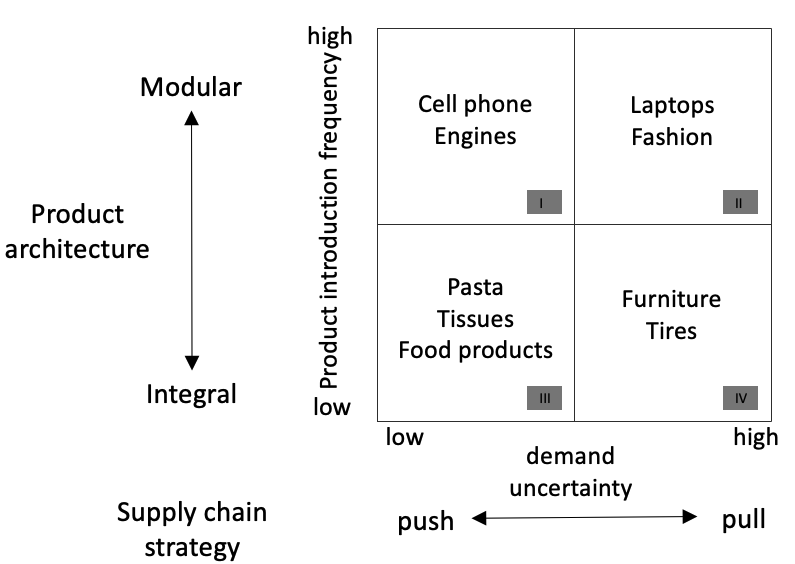
Metrics of functional and innivative product characteristics
Look at chart


Products in the SC
I Cell phones
II Laptops
III Pasta
IV Furniture
Efficient Supply chains
Functional stable SCs that aim at creating the highest cost efficiencies.
How are efficient supply chains maintained
pursuing scale economies, optimization techniques, information linkages.
Responsive supply chains
Works for stable, innovative products. Aimed at flexibility to changing customer demands.
How is a responsive supply chain maintained
build to order and mass customization
Risk-Hedging supply chain
Used for evolving functional products. Aimed at pooling and sharing resources to reduce risk.
How is a risk hedging supply chain maintained
Multiple supply sources, increased saftey stock with inventory pooling.
Agile supply chains
Used for innovative evolving products. Aimed at responding flexibly to customer needs, while hedging risk with inventory pooling.
How are agile supply chains maintained
Responsiveness to unpredictable demand and minimizing supply disruptions.
Modular product
a product assembled from different modules, with different options for each module.
Modular process
Each product goes through discrete set of operations, semi finished products stored at intermediate stages
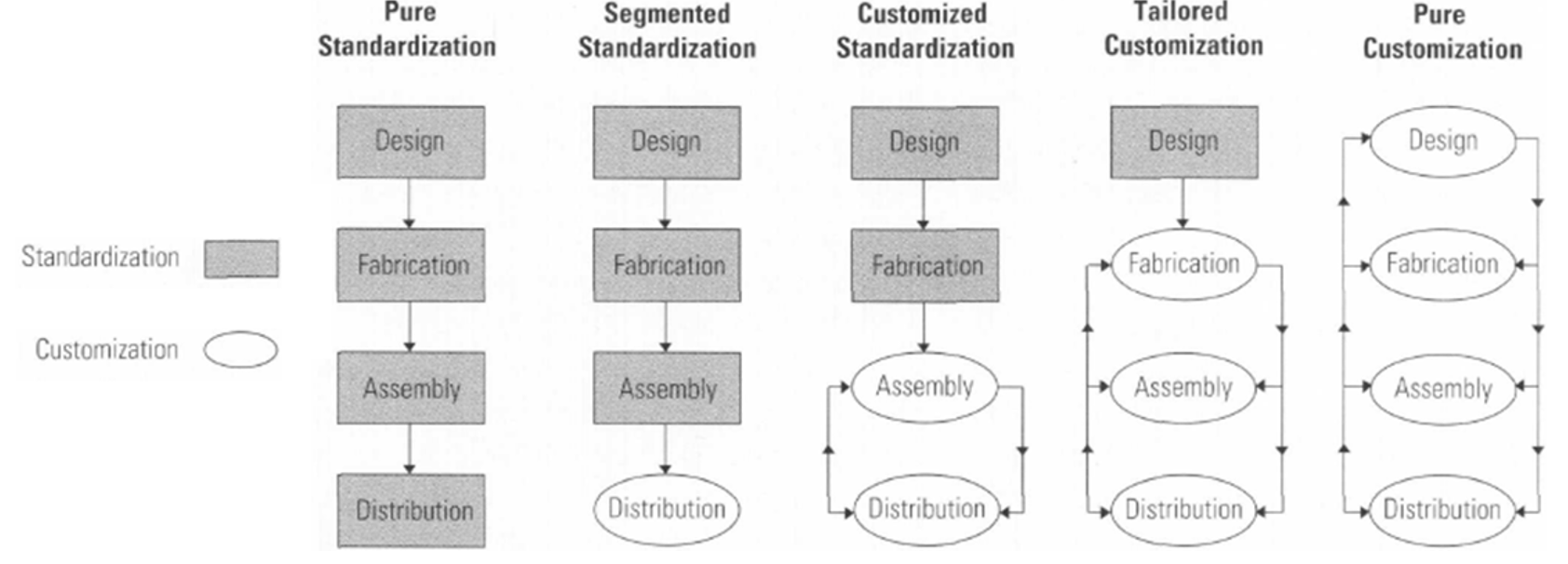
Proccess standardization
Making a generic product and differentiating as late as possible (postponement). Used when product is modular and process is modular
Re-sequencing
Modifying the order of product manufacturing steps
Delayed differentiation
A strategy that keeps products standard until modification is required.
Postponement benefits
Less inventory, logistics costs, production lead time; better forecast,
costs of postponement
new process development, increasing manufacturing cost and order lead time.
Downward substitution definition and benefit
Substitute higher-feature products for lower-feature products. Allows for flexibility and reduces overall stock.
Part standardization and modular relationship
Maximizing component commanility across products. Used for modular products with non-modular processes.
Product standardization and modular relationship
Carrying a limited number of products in inventory. Used when product is non modular and process is non modular.
Procurement standardization
Leveraging equipment and part commonality across products. Used when product is non-modular and the process is modular
Mass customization principales
Modular product design
Modular process design
Agile supply network
Product modularity design principles
Commonality and postponement of modules
Process modularity design principles
Re-sequencing
Re-sequencing of processes, postponement of processes, process standardization
Agile network design
postponement of modules and processes. Decoupling points by inventory stocking
Four pillars of mass customization
Instantaneous, costless, seamless, frictionless.

Different customization strategies
look at picture