Vascular System
 Call Kai
 Learn
Learn Practice Test
 Spaced Repetition
 Match
Match Flashcards
 Knowt Play
1/12

There's no tags or description
Looks like no tags are added yet.
Name | Mastery | Learn | Test | Matching | Spaced | Call with Kai | Chat |
|---|
No analytics yet
Send a link to your students to track their progress
13 Terms
What are the 3 protective layers of protective covering for the brain?
dura mater
arachnoid mater
pia mater
What is the dura mater?
most superficial and consists of 2 layers
outer (periosteal/endosteal layer) is more inelastic than inner meningeal layer
outer layer (meningeal layer) only in cranium (not in the spinal cord) and contains meningeal arteries
epidural space between the layers and intended to create sinuses (sinus = layers of dura are separated)
What is the dura mater split into?
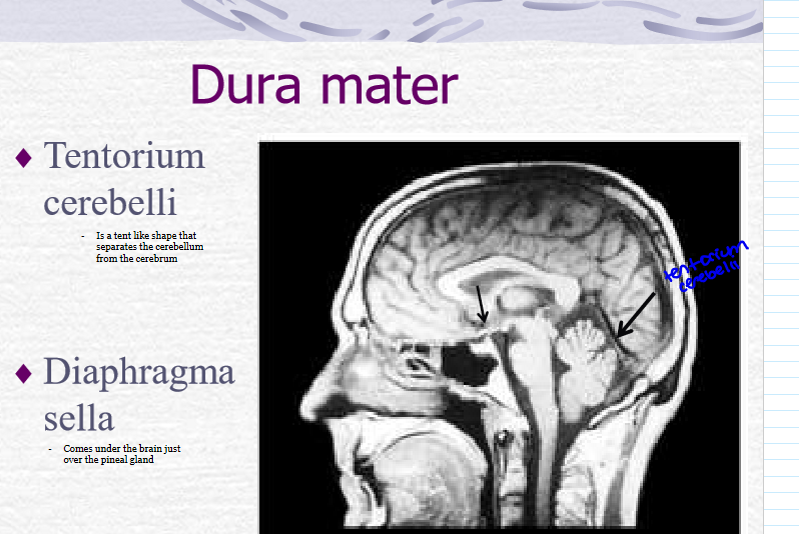
falx cerebri which is the portion down the longitudinal fissure wrapping between hemispheres of cerebrum
falx cerebelli separates the 2 sides and wrapping of the cerebellum
tentorium cerebelli which is a tent like shape that separates the cerebellum from the cerebrum
diaphragma sella that comes under the brain just over the pineal gland
What is the arachnoid mater?
middle layer that contains spider-like webbings and blood vessels pass through that space in the subarachnoid space
What is the pia mater?
highly vascular that follows the contours of the brain and forms the choroid plexus in ventricles to help create CSF
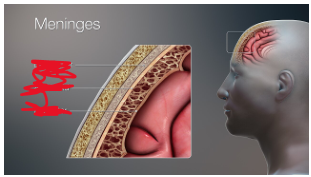
Identify the layers


Identify the 2 structures of the dura mater here
4 = falx cerebri and 1 = falx cerebelli

Identify the 2 structures of the dura mater
Why is the vascular system important for the brain?
brain has very little storage capacity for nutrients but needs glucose and oxygen, has a high metabolic rate, and brain doesn’t store energy (need specific amounts and proportions or else if affects function)
vascular system is central to keep the brain alive
What is the difference between arteries and veins?
arteries = takes oxygenated blood from the heart and around the body
veins = returns deoxygenated blood to the lungs and heart
Note: every place there is an artery there is a vein
capillaries = allows the communication between the arteries and veins (interface)
Posterior Supply vs. Anterior Supply
posterior = providing blood to the back part of brain to the following structures: cerebellum, brainstem, occipital lobe, cochlea
anterior = providing blood to the front part of the brain to the following structures: lateral and medial surfaces of frontal, parietal, temporal lobes, and retina
How does the posterior supply deliver blood?
blood starts from the heart and goes up the aorta and you will either go to the right or left subclavian artery to cross over, goes up the vertebral arteries then it goes up to the basilar artery to merge at the base of the brain and then you have lots of options
you can split off into the pontine arteries to go to the pons
you can go to the posterior part of the cerebrum through the posterior cerebral artery to to the occipital lobe
you can also go to the cerebellum through cerebellar arteries like the posterior inferior cerebellar artery or you can go to the anterior inferior cerebellar artery
you can also go the superior cerebellar artery to go to the top of the cerebellum