Case 8: Malcolm Lowry - Alcohol Use Disorder
 Call Kai
 Learn
Learn Practice Test
 Spaced Repetition
 Match
Match Flashcards
 Knowt Play
1/44

There's no tags or description
Looks like no tags are added yet.
Name | Mastery | Learn | Test | Matching | Spaced | Call with Kai | Chat |
|---|
No analytics yet
Send a link to your students to track their progress
45 Terms
Endogenous Reward System
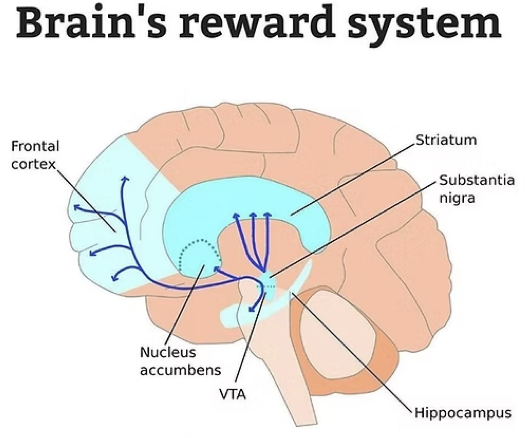
Mesolimbic dopaminergic reward pathway
Motivation centre reinforcing behaviours causing satisfaction
Endogenous Reward System: Parts
Ventral tegmental area (VTA)
Nucleus accumbens (NAc)
Modulating areas
Endogenous Reward System: VTA
Region in midbrain
Contain dopamine
Endogenous Reward System: NAc
Region in forebrain
Contain GABAergic neurons
Part of limbic system
Endogenous Reward System: Modulating Areas
Prefrontal Cortex: Decision-making
Amygdala: Emotions/fear
Hippocampus: Memory
Thalamus
Endogenous Reward System: Normal Function
For survival
Stimulus perception = Dopamine relese from VTA → NAc = Increase motivation for action
Perform action/behaviour = NAc releases signals to
VTA: Disinhibit dopamine neurons = Positive reinforcement
Hypothalamus: Stimulate GABAergic neurons = Aversive response
Repeating behaviour = Long-term potentiation (association between stimulus + response) = Behaviour → Habit requiring less conscious effort
Alcohol: Description
CNS depressant
Alcohol: Absorption
Small intestine
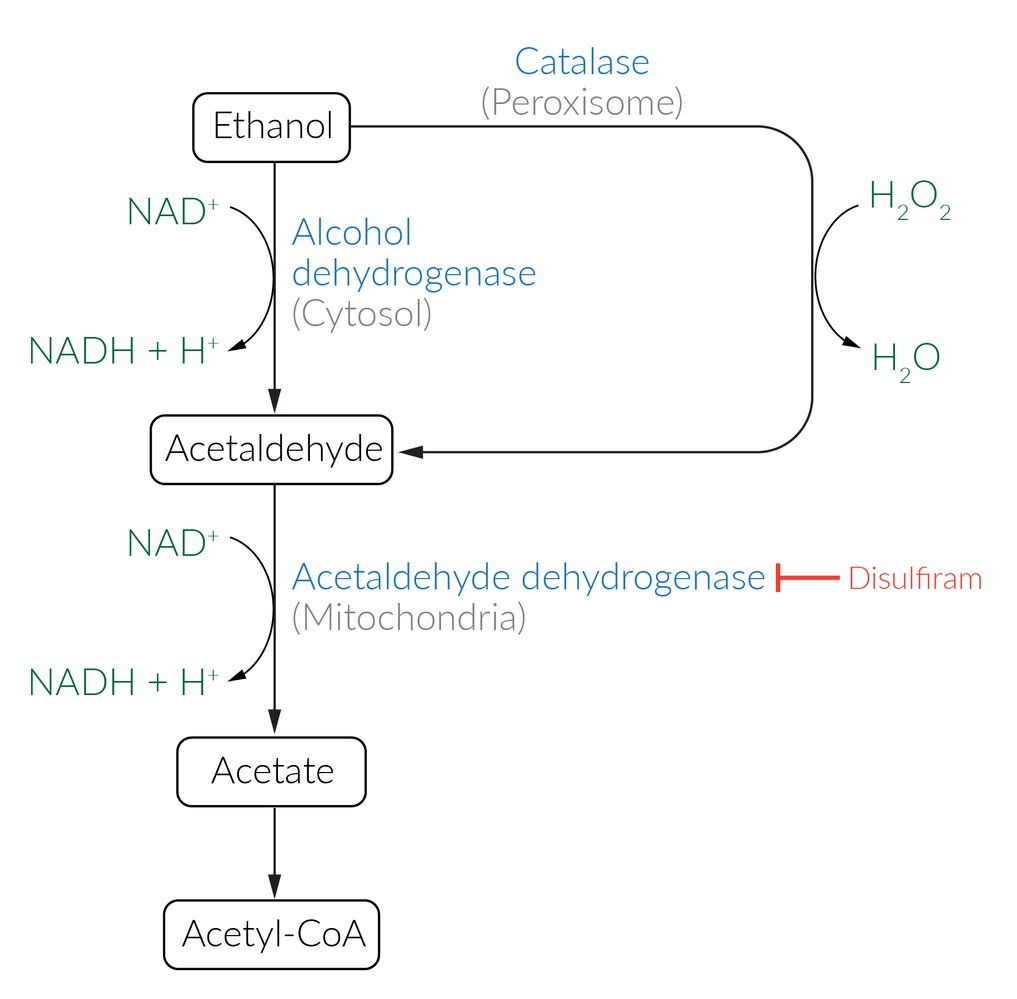
Alcohol: Metabolism
Liver
Alcohol Dehydrogenase: Ethanol oxidation → Acetaldehyde
Acetaldehyde Dehydrogenase: Acetaldehyde oxidation → Acetate
Rate-limiting step
Slower than alcohol dehydrogenase
Thiokinase: Acetate + coenzyme A → Acetyl-CoA
Substance Use Disorder (SUD): Description
Chronic condition with uncontrolled substance use patterns causing physical, psychological, and social impairment/distress
Types:
Alcohol use disorder (AUD)
OUD
Tobacco use disorder (TUD)
Cannabis use disorder (CUD)
AUD: Tolerance
Increasing alcohol amounts for same effect
AUD: Withdrawal
Signs + symptoms from reducing/stopping alcohol intake
AUD: Dependence
Dysregulated alcohol use from repeated/continuous use
SUD: Epidemiology
More common in men
Most common substance: Alcohol + nicotine
Risk Factors:
Family history
Psychiatric disorders
SUD: Etiology
Genetics
Neurobiological factors
Psychosocial factors
SUD Etiology: Neurobiological Factors
Dopamine receptor mutation = Increased density
Decreased dopamine metabolism efficacy
SUD Etiology: Psychosocial Factors
Childhood factors
Observational Learning: Observing role models (parents, peers using drugs without perceiving negative consequences
Social pressure to use from peers
High ACEs
Low SES
Stress
SUD: Pathophysiology
Dysregulated endogenous reward system
Operant conditioning
SUD Pathophysiology: Dysregulated Endogenous Reward System
Hyperstimulation: Drugs cause increased/prolonged dopamine release from VTA → NAc
Perceptual Narrowing: Dopamine signals from drugs override natural rewards = Strong desire (craving)
Chronification: Repeated stimulus (drug) + response (high dopamine) = Positively reinforce neural pathway = Build habit
Tolerance: Downregulate dopamine receptors = Same dose causes decreased pleasure = Increase craving (strong habit)
SUD Pathophysiology: Operant Conditioning
Positive Reinforcement: Drugs → Euphoria (increase dopamine) = Repeated use to feel better
Negative Reinforcement: Drugs → Remove withdrawal pain + anxiety = Repeated use to stop feeling bad
SUD: Diagnostic Criteria
DSM-5
≥2 within 1 year: CHEW REACH TW
Impaired control
C: Craving
H: High amounts + longer time
E: Efforts to cut down fail
W: Wasting time on substance-related activities
Social impairment
R: Relationship problems
E: External role problems
A: Activities reduced
Risky use
C: Continuing despite awareness of problem
H: Hazardous situations
Pharmacological indicators
Tolerance: Increasing dose to achieve desired effect
Withdrawal: Symptoms from stopping drug
Opposite of intoxication effects
NONE from hallucinogens + inhalants
SUD: Investigations
Neurological exam
Alcohol Misuse: Investigations
CAGE questionnaire
Cut down
Annoyed
Guilty
Eye-opener
AUDIT-C
Alcohol Dependence: Investigations
SADQ (Severity of Alcohol Dependence Questionnaire)
Alcohol Withdrawal: Investigations
CIWA (Clinical Institute of Withdrawal Assessment)
Score symptom severity
AUD: Investigations
Blood tests
LFTs
AUD: Blood Tests
CBC + differentials
Thrombocytopenia
Increased MCV
Disrupted erythropoiesis
Decreased folate cycling
PT/INR
Increased: Alcohol-associated hepatitis
Electrolytes
Decreased
Acid-base disturbances
Alkolosis
Alcoholic ketoacidosis
Blood alcohol level + ethanol metabolites
Creatinine
Increased: Alcohol-induced kidney damage
AUD: LFTs
AST/ALT ≥ 1-1.5
Alcohol-associated hepatitis
AST ≤ 400 U/L
GGT: Increased
Normal: 5-85 IU/L
SUD: Treatment/Management
Acute
Nonpharmacological
Pharmacological
SUD Management: Acute
5As
Counselling
Withdrawal
Benzodiazepines: First-line
Ex: Lorazepam, oxazepam, diazepam
Anticonvulsants: Second-line
Ex: Valproic acid, lamotrigine
SUD Management: Nonpharmacological
Lifestyle changes
Healthy eating
Vit supplements (B1, B6, folic acid)
Smoking cessation
Reduce relapse triggers
Psychotherapy
CBT
AA
SUD Management: Pharmacological
GABA analog
Opioid agonists
Opioid antagonists
Nicotinic receptor agonists
Atypical antidepressants
SUD Management: GABA Analog
Ex: Acamprosate
MOA: Decrease CNS glutamate receptor activity
Indications: AUD maintenance
SUD Management: Opioid Agonists
Ex: Methadone, buprenorphine + naloxone
MOA:
μ-opioid receptor agonist
N-methyl-D-aspartate (NMDA) receptor antagonist
Indications: OUD induction + maintenance
SUD Management: Opioid Antagonists
Ex: Naltrexone
MOA: CNS μ-opioid receptor antagonist = Decrease craving
Indications: AUD, OUD maintenance
SUD Management: Nicotinic Receptor Agonists
Varenicline
MOA: Partial nicotine receptor agonist = Decrease cravings + withdrawal
Nicotine Replacement Therapy
MOA: Short-acting nicotine receptor agonist = Decrease withdrawal
Indications: TUD
SUD Management: Atypical Antidepressants
Ex: Bupropion
MOA: Inhibit norepinephrine + dopamine reuptake inhibitors = Decrease cravings + withdrawal
Indications: TUD
AUD: Complications
Alcoholic ketoacidosis
Wernicke encephalopathy
Increased infections
Alcoholic Ketoacidosis: Pathophysiology
Alcohol disrupt glucose metabolism + starvation = Increase ketone bodies + normal/low glucose = HAGMA
Alcoholic Ketoacidosis: Treatment
Acute
Thiamine: Prevent Wernicke encephalopathy
IV dextrose
Correct electrolyte imbalances
Wernicke Encephalopathy: Pathophysiology
Severe thiamine/B1 deficiency = Decreased cerebral glucose metabolism + mitochondrial dysfunction = Neuronal injury
Prolonged = Korsakoff syndrome (irreversible)
Wernicke Encephalopathy: Clinical Presentation
Confusion
Oculomotor dysfunction
Gait ataxia: Wide base + small steps
Korsakoff Syndrome: Clinical Presentation
Amnesia + Confabulation
Producing false memories to fill in gaps
Personality changes
Disorientation
Wernicke Encephalopathy: Treatment
Acute: IV thiamine
BEFORE IV dextrose/glucose (worsen encephalopathy)
AUD Complications: Increased Infections
Aspiration pneumonia
Cellulitis
Sepsis
TB