bio 181 unit 1
 Call Kai
 Learn
Learn Practice Test
 Spaced Repetition
 Match
Match Flashcards
 Knowt Play
1/8

Earn XP
Description and Tags
basic chemistry, macromolecules
Name | Mastery | Learn | Test | Matching | Spaced | Call with Kai | Chat |
|---|
No analytics yet
Send a link to your students to track their progress
9 Terms
matter
anything that occupies space and has mass
comprised of atoms, the fundamental units of life
atom
consists of a nucleus with neutrons and protons, surrounded by electrons
atomic number: number of protons
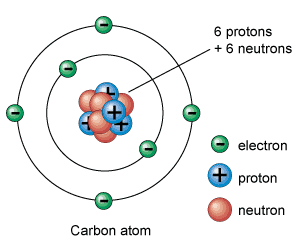
the “big four” elements
carbon, oxygen, hydrogen, nitrogen
make up the bulk of living cells
human body comprised of 65% O, 18% C, 10% H, and 7% other elements
electron
negative charge
more or less than the usual number creates an ion (cation +, anion -)
metals donate e-, nonmetals accept e-
valence electrons: outermost shell; responsible for bonding

isotope
atom with a different number of neutrons than its number of protons
some isotopes are radioactive
adding neutrons to an atom’s nucleus can make it unstable, causing it to fall apart (decay) and release energy
half life
atomic bonding
ionic bond: involves the transfer of one or more electrons from one atom to another
metal and nonmetal
covalent bond: when two atoms share electrons
nonmetal with nonmetal
can be polar or nonpolar

polarity
polar: electrons are distributed unequally about an atom
caused by a difference in electronegativity between atoms
positive (s+) and negative (s-) regions
nonpolar: electrons are distributed equally about an atom

water properties
cohesion: natural attraction of water molecules to each other through hydrogen bonding; sticking together
frozen water floats because it is less dense than liquid water
hydrogen bonds hold molecules apart as water freezes
ice insulates the water below it, helping aquatic organisms survive
water is a great solvent due to its polarity
water has a high specific heat (amount of energy needed to raise the temp of a substance by 1’C)
absorbs large amounts of heat well; evaporation
