Biological Bases of Behavior Unit 1 AP Psych (Nervous System & Hindbrain)
 Call Kai
 Learn
Learn Practice Test
 Spaced Repetition
 Match
Match Flashcards
 Knowt Play
1/51

There's no tags or description
Looks like no tags are added yet.
Name | Mastery | Learn | Test | Matching | Spaced | Call with Kai | Chat |
|---|
No analytics yet
Send a link to your students to track their progress
52 Terms
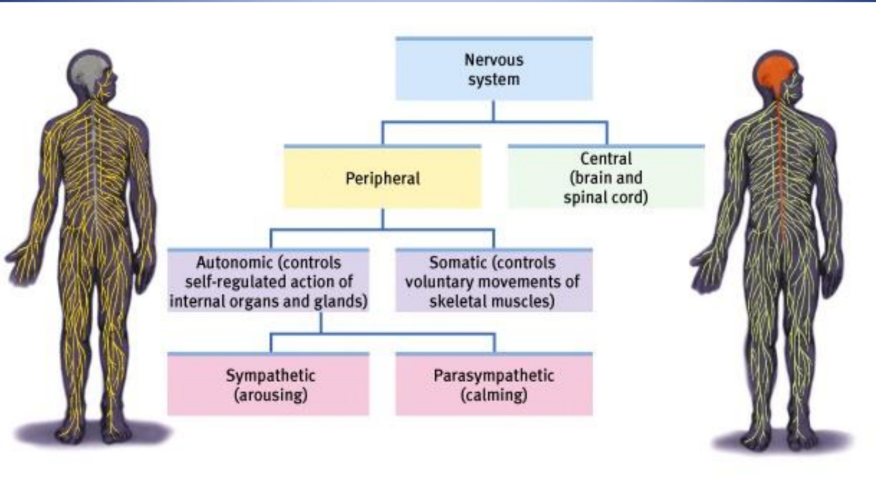
Central Nervous System (CNS)
The brain and spinal cord
Peripheral nervous system
Sensory and motor neurons that connect the CNS to the rest of the body
What is the PNS divided into?
Somatic Nervous System
Autonomic Nervous System
Somatic Nervous system
Controls voluntary muscle movement
motor cortex
The somatic nervous system uses?
Uses motor neurons
The neurons that carry outgoing information from the CNS to the muscles and glands
Autonomic Nervous System
Part of the peripheral nervous system that controls the glands and muscles of the internal organs
Controls the automatic functions of the body
What categories is the autonomic nervous system divided into?
Sympathetic
Parasympathetic
Sympathetic nervous system
Division of ANS that arouses the body, mobilizing its energy in stressful situations
What does the sympathetic nervous system do?
Automatically accelerates heart rate, breathing, dilates pupils, slows down digestion
Parasympathetic nervous system
Division of the autonomic nervous system that calms the body, conserving its energy
Automatically slows the body down after a stressful event
What does the parasympathetic nervous system do?
Heart rate and breathing slow down, pupils constrict and digestion speeds up
The nervous system
The brain
Made up of neurons (which are made throughout lifetime) and glial cells
Glial cells
Structural support for neural cells
Cerebrospinal fluid
Provides nourishment & cushion for brain
Ways of studying the brain
Accidents
Lesions
Electroencephalogram (EEG)
Computerized axial tomography (CAT/CT scan)
Magnetic resonance imaging (MRI)
Positron emission tomography (PET) scan
Functional MRI (fMRI)
Accidents
Think Phineas Gage
Lesions
The removal or destruction of part of the brain
Electroencephalogram (EEG)
Detects brain waves
Computerized axial tomography (CAT/CT scan)
Uses x-rays to produce a three dimensional picture of the brain
Magnetic resonance imaging
Uses magnetic fields to create a more detailed image than a CAT scan
Positron Emission Tomography (PET) Scan
Lets research see what areas of the brain are most active during certain tasks
Functional MRI (fMRI)
Can tie brain structure to brain activity during cognitive tasks
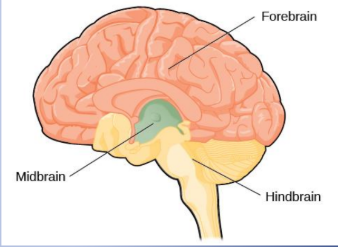
What are the 3 parts of the brain?
Hindbrain
Midbrain
Forebrain
Brainstem includes?
Midbrain
Pons
Medulla Oblongata
Brainstem
Involved in the autonomic control of salivation, respiration, heartbeat, digestion
Hindbrain
Medulla oblongata
Pons
Cerebellum
Where is the medulla oblongata located?
Located at the base of the brainstem
What does the medulla oblongata do?
Involved in heart rate, breathing, & BP
Pons
Connects hindbrain, midbrain and forebrain, together
Involved in facial expressions
Effects REM
Where is the cerebellum located?
Located in the back of our head “little brain”
What is the cerebellum responsible for?
Responsible for muscle control including balance and movement
Midbrain
Coordinates simple movements with sensory information
Midbrain
Reticular activating system
Reticular activating system
Involved in arousal, alertness, and sleep-wake cycles
Forebrain
Thalamus
Limbic System
Hippocampus
Amygdala
Hypothalamus
Thalamus
Receives sensory information and sends them to appropriate areas of forebrain
Then transmits replies to cerebellum and medulla
Everything but smell!
Limbic System
Neural structures at border of brainstem and cerebral hemispheres (doughnut-shaped)
The limbic system is?
The emotional control center of the brain
What is the limbic system made up of?
Hypothalamus
Amygdala
Hippocampus
Hippocampus
Involved in memory processing
Amygdala
Vital for our basic emotions
Hypothalamus
Controls:
Body temp
Hunger
Thirst
Sexual Arousal (libido)
The endocrine system
Endocrine System
The body’s “slow” chemical communication system
What does the endocrine system include?
Pituitary gland
Adrenal gland
Ovaries & testes
Hormones
Chemical messengers that are manufactured by the endocrine glands, travel through the bloodstream, and affect other tissues.
Adrenaline
Secreted in large amounts when an individual is stimulated by fear, anxiety, or a similar stress-related reaction
Released mainly thru the activation of nerves connected to the adrenal glands
Leptin
Manufactured & secreted by fat cells
Leptin receptors have been found in the hypothalamus
Food intake is reduced when the receptors are stimulated
Ghrelin
Secreted by endocrine cells in the stomach
Binds to growth hormone receptors in the hypothalamus and pituitary gland
Stimulates appetite and the release of growth hormone.
Melatonin
Produced by the pineal gland
Implicated in the initiation of sleep and in the regulation of the sleep wake cycle
Oxytocin
Produced in the hypothalamus
Facilitates social affiliation
Promotes good feelings such as trust and bonding