BIOL 243 Theme 1C
0.0(0)
Studied by 1 person Call Kai
 Learn
Learn Practice Test
 Spaced Repetition
 Match
Match Flashcards
 Knowt Play
Card Sorting
1/8

Earn XP
Last updated 2:11 AM on 2/24/23
Name | Mastery | Learn | Test | Matching | Spaced | Call with Kai | Chat |
|---|
No analytics yet
Send a link to your students to track their progress
9 Terms
1
New cards
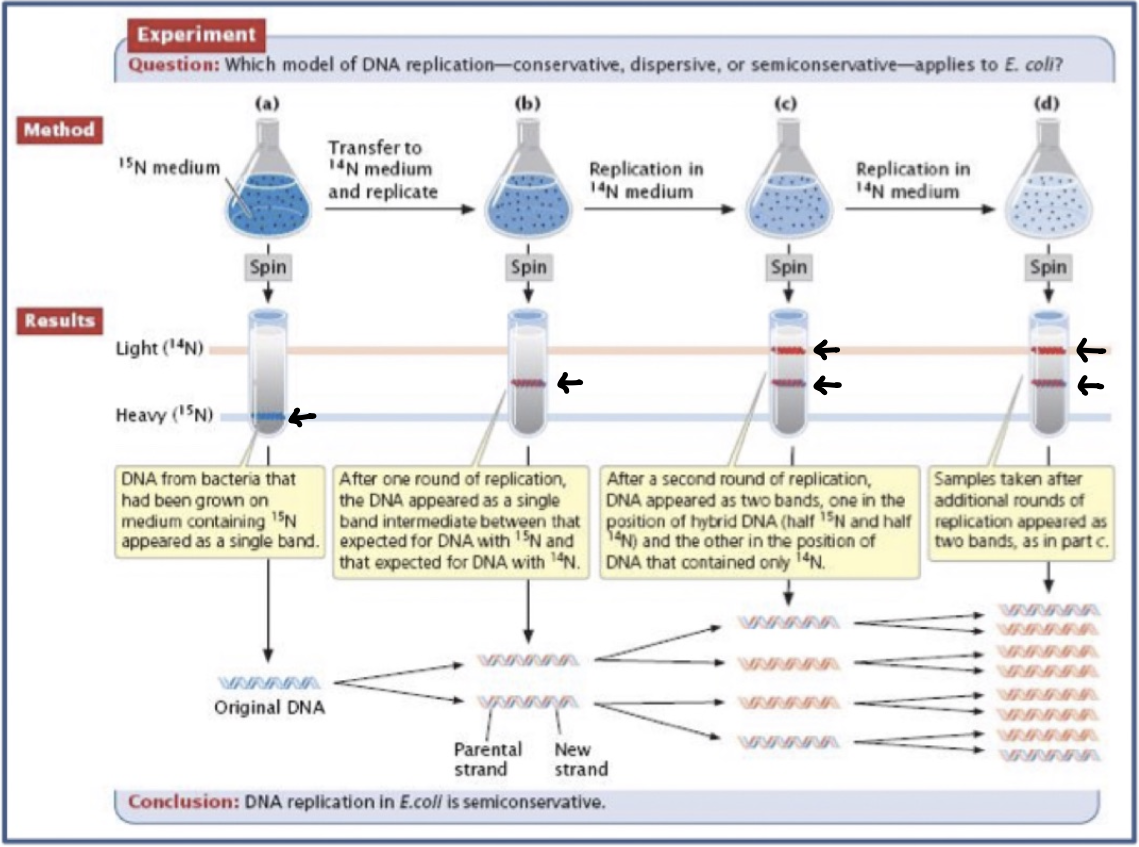
Meselson and Stahl Experiment
* proved DNA replication is semiconservative
* track parental + newly-synthesized DNA strands over several gens w nitrogen isotopes
* N isotopes incorporated into DNA molecules via nitrogenous bases
Experiment
1. Grew E.coli bacteria in culture medium with heavy 15N isotope (nitrogenous bases of DNA now entire DNA labelled with I5N)
2. Transferred bacteria to culture medium with light 14N isotope
3. After each round of replication after transfer, took sample of cells + extracted DNA
4. Mixed DNA samples with CsCI and centrifuged mixture at very high speed; during centrifugation CsCl forms density gradient and DNA double helices moves according to density
* track parental + newly-synthesized DNA strands over several gens w nitrogen isotopes
* N isotopes incorporated into DNA molecules via nitrogenous bases
Experiment
1. Grew E.coli bacteria in culture medium with heavy 15N isotope (nitrogenous bases of DNA now entire DNA labelled with I5N)
2. Transferred bacteria to culture medium with light 14N isotope
3. After each round of replication after transfer, took sample of cells + extracted DNA
4. Mixed DNA samples with CsCI and centrifuged mixture at very high speed; during centrifugation CsCl forms density gradient and DNA double helices moves according to density
2
New cards
Meselson and Stahl Experiment Image
DNA replication semiconservative: each daughter strand remains paired with its complementary parental strand
3
New cards
DNA replication
* DNA helicase unwinds double helix by breaking hydrogen bonds
* RNA primase lays down RNA primer for DNA polymerase
* single-stranded binding pattern stabilizes ssDNA before replocation by preventing reannealing
* Topoisomerase prevents twisting ahead of replication fork during unwinding; removes super coils that form ahead of the replication fork, relieves torque of mainly circular DNA
* DNA PoI III extends RNA primer; synthesizes DNA by adding nucleotides to new DNA strand
* DNA helicase continues to unwind; leading and lagging strand synthesis by DNA Pol III
* DNA PoI I removes RNA primer of Okazaki fragments and fills in gap with dNTP's (fills gaps with DNA)
* sliding clamp attaches DNA Pol III to DNA template, replication is more efficient
* DNA ligase seals the nicks by reforming the phosphodiester bond
* RNA primase lays down RNA primer for DNA polymerase
* single-stranded binding pattern stabilizes ssDNA before replocation by preventing reannealing
* Topoisomerase prevents twisting ahead of replication fork during unwinding; removes super coils that form ahead of the replication fork, relieves torque of mainly circular DNA
* DNA PoI III extends RNA primer; synthesizes DNA by adding nucleotides to new DNA strand
* DNA helicase continues to unwind; leading and lagging strand synthesis by DNA Pol III
* DNA PoI I removes RNA primer of Okazaki fragments and fills in gap with dNTP's (fills gaps with DNA)
* sliding clamp attaches DNA Pol III to DNA template, replication is more efficient
* DNA ligase seals the nicks by reforming the phosphodiester bond
4
New cards
Replication forks
sites of DNA synthesis, the synthesis of the 2 new strands from templates occurs concurrently at the forks
* DNA polymerase can only synthesize in 5’-3’ direction
* one strand synthesized continuously - leading strand
* other strand synthesized discontinuously - lagging strand; synthesized in small DNA fragments (Okazaki fragments)
* occurs at forks because this is where double helix has been unwound and separated to create an area where DNA polymerases and the other enzymes involved can use each strand as a template
* DNA polymerase can only synthesize in 5’-3’ direction
* one strand synthesized continuously - leading strand
* other strand synthesized discontinuously - lagging strand; synthesized in small DNA fragments (Okazaki fragments)
* occurs at forks because this is where double helix has been unwound and separated to create an area where DNA polymerases and the other enzymes involved can use each strand as a template
5
New cards
End replication problem
* requirement for RNA primer to initiate all new DNA synthesis leads to problem in fully replicating 3’ ends of linear chromosomes ·
* DNA pol can’t fill in gaps at chromosomal ends thus additive loss at chromosomal ends for every round of DNA replication/cell division
* genes at end of chromosome can be deleted leading to death of the organism
* DNA pol can’t fill in gaps at chromosomal ends thus additive loss at chromosomal ends for every round of DNA replication/cell division
* genes at end of chromosome can be deleted leading to death of the organism
6
New cards
End Replication solution
solution = telomeres
* noncoding single-stranded DNA added to 3' end of chromosomes by telomerase (enzyme that restores shortened telomeres)
* usually repeats of 5-8 G's and T's
* telomeres worn away after each DNA replication/cell division (instead of chromosomes)
* when telomere region gone, cell stops dividing
* noncoding single-stranded DNA added to 3' end of chromosomes by telomerase (enzyme that restores shortened telomeres)
* usually repeats of 5-8 G's and T's
* telomeres worn away after each DNA replication/cell division (instead of chromosomes)
* when telomere region gone, cell stops dividing
7
New cards
Polymerase Chain Reaction
DNA replication and amplification in a test tube (without cloning), special case of DNA replication in which DNA polymerase replicates just a portion of a DNA molecule rather than whole
* Template DNA (1 copy) → denature → primer anneal → strand extension → repeat for 30 cycles
* Primers made of DNA, not RNA
* Left primer binds to 1 strand, right primer binds to opposite strand of original DNA
* Only target sequence - sequence between primers - is amplified exponentially
* DNA polymerase reads template 3'-->5'
* PCR allows extremely small DNA samples to be amplified to high conc. for analysis
* Ex. DNA from root of single human hair, small amount of blood or saliva
* Template DNA (1 copy) → denature → primer anneal → strand extension → repeat for 30 cycles
* Primers made of DNA, not RNA
* Left primer binds to 1 strand, right primer binds to opposite strand of original DNA
* Only target sequence - sequence between primers - is amplified exponentially
* DNA polymerase reads template 3'-->5'
* PCR allows extremely small DNA samples to be amplified to high conc. for analysis
* Ex. DNA from root of single human hair, small amount of blood or saliva
8
New cards
DNA repair → proofreading activities of DNA polymerases
* DNA Pol III makes new strand in 5 to 3' direction
* optimum confirmation of the active site incoming nucleotide allows catalysis of correct base pair but mistakes still happen (1/10 000)
* DNA PoI III detects mistake uses 3’ to 5' exonuclease activity to remove most recent mismatched nucleotides
* DNA Pol IlI nucleotide replaces correct nucleotide and resumes synthesis of new DNA strand (5’ to 3’)
* Polymerases a proofreading exonuclease mismatches to 1/10 000 000
* optimum confirmation of the active site incoming nucleotide allows catalysis of correct base pair but mistakes still happen (1/10 000)
* DNA PoI III detects mistake uses 3’ to 5' exonuclease activity to remove most recent mismatched nucleotides
* DNA Pol IlI nucleotide replaces correct nucleotide and resumes synthesis of new DNA strand (5’ to 3’)
* Polymerases a proofreading exonuclease mismatches to 1/10 000 000
9
New cards
DNA Mismatch Repair (MMR)
* MMR covers for replication errors not corrected by proofreading
* Recognition of mismatch damage by DNA binding proteins Muts and MutL
* MutH endonuclease nicks (cuts 1 strand) daughter strand several nucleotides away from mismatch
* Exo1 5'-3' exonuclease excises region of daughter strand surrounding the mismatch
* DNA Pol III fills gap and repairs mismatch
* Nick left after gap is sealed by DNA ligase
* Recognition of mismatch damage by DNA binding proteins Muts and MutL
* MutH endonuclease nicks (cuts 1 strand) daughter strand several nucleotides away from mismatch
* Exo1 5'-3' exonuclease excises region of daughter strand surrounding the mismatch
* DNA Pol III fills gap and repairs mismatch
* Nick left after gap is sealed by DNA ligase