Chapter 2 The nature of Molecules and Properties of Water
 Studied by 0 people
 Call Kai
 Learn
Learn Practice Test
 Spaced Repetition
 Match
Match Flashcards
 Knowt Play
1/81

There's no tags or description
Looks like no tags are added yet.
Name | Mastery | Learn | Test | Matching | Spaced |
|---|
No study sessions yet.
82 Terms
What is the charge of a proton?
positive
What is the charge of a neutron?
no charge
What is the charge of an electron?
negative
The number of electrons is equal to the number of....?
Protons
C is the ________ for carbon.
symbol
6 is the _______ _______ of carbon.
atomic number
12.01 is the _______ _____ of carbon.
Atomic weight
The equation to calculate the atomic mass is
# of protons + # of neutrons
The equation to calculate the number of neutrons is
atomic weight - atomic number
silver (Ag), atomic weight 107, atomic # of 47... What is the number of protons?
47 protons
silver (Ag), atomic weight 107, atomic # of 47... What is the number of electrons?
47 electrons
silver (Ag), atomic weight 107, atomic # of 47... What is the number of neutrons?
60 neutrons (107 - 47)
The number of protons is equal to the number of .....?
Electrons
What is it called when atoms have the same number of protons and electrons but a different number of neutrons?
Isotopes
Isotopes facts
- can be unstable
- nucleus breaks apart
- radioactive
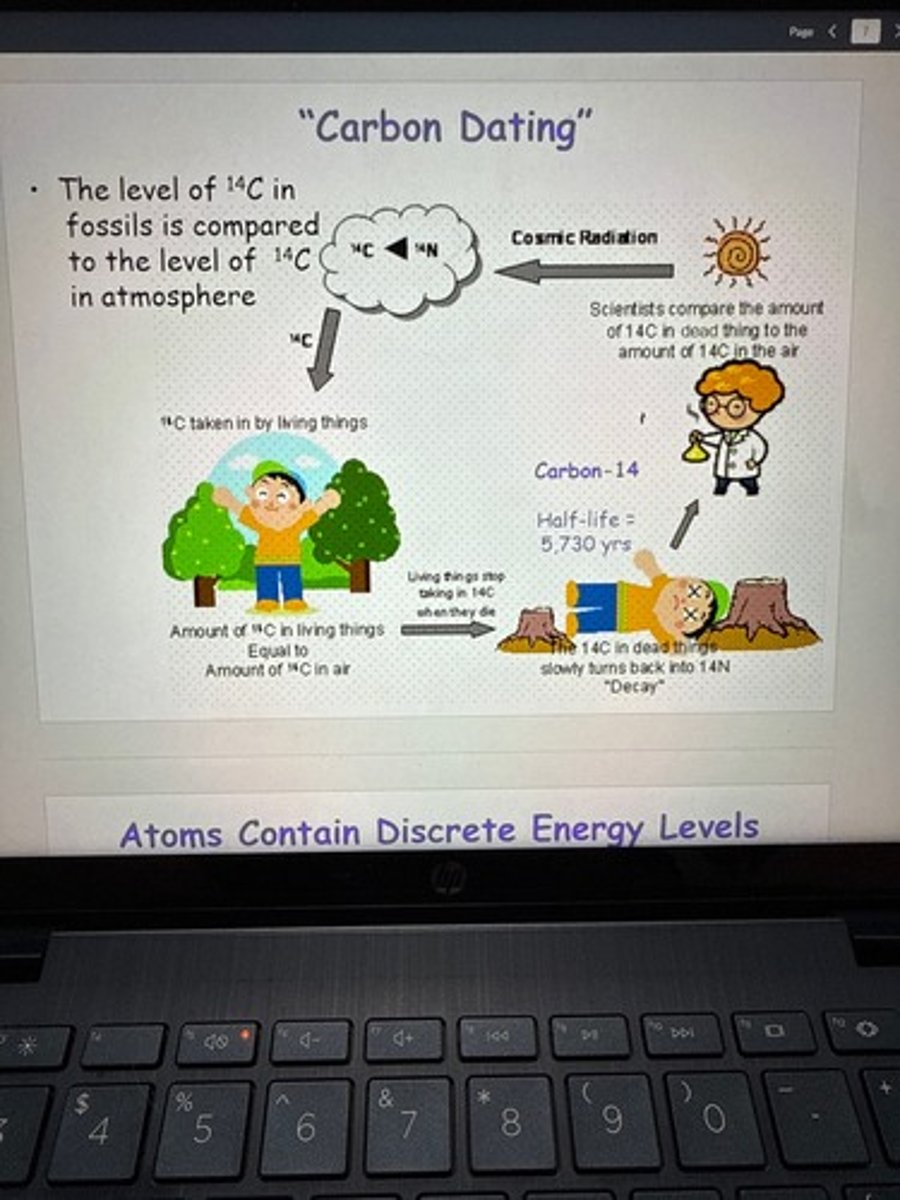
What is carbon dating?
Of the three subatomic particles only ________ are directly involved in chemical activity of an atom.
Electrons
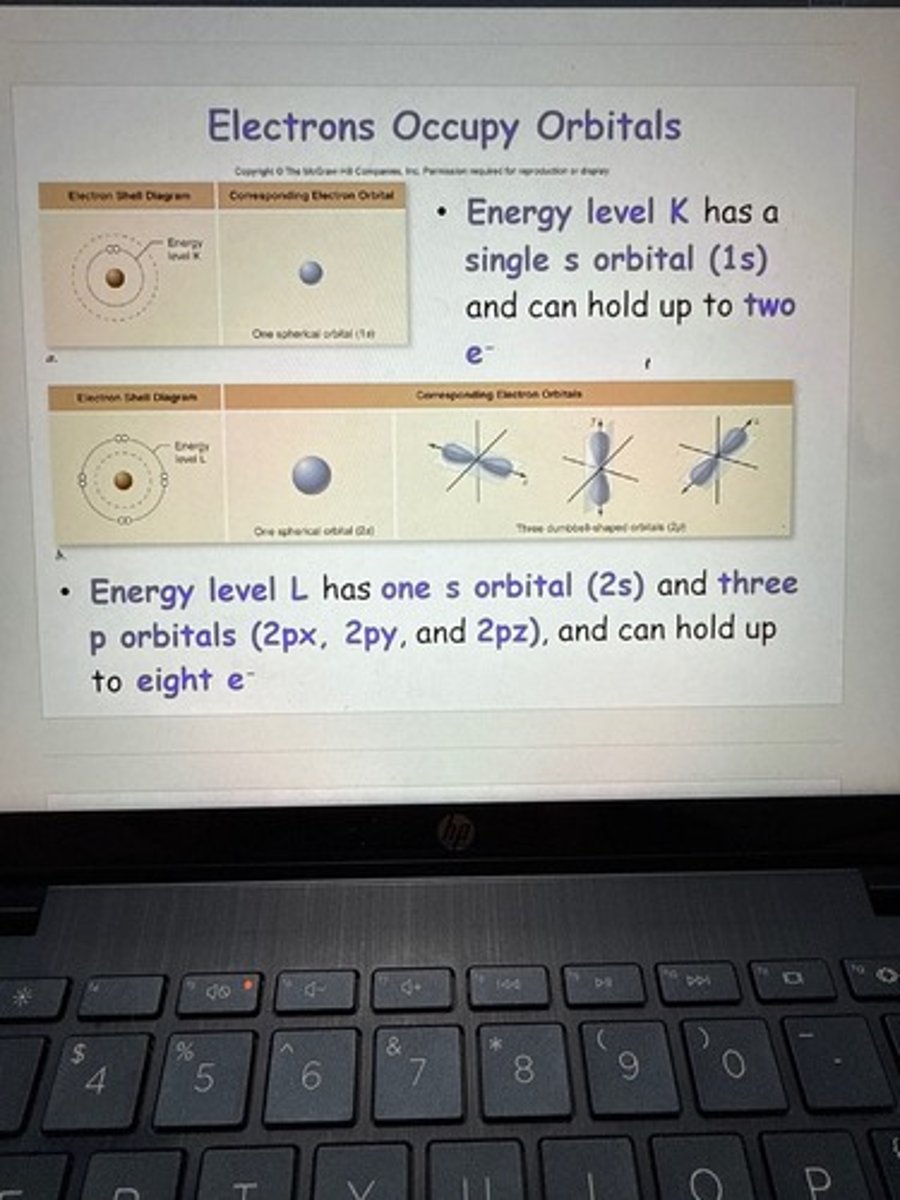
Electrons have different _______ _____ such as K,L,M,N
energy levels (shells)
Electrons from the nucleus have more or less energy?
More
Energy levels indicate
the amount of energy that an electron has.
The number of electrons in the outermost shell, called the _______ ______, determines the chemical properties of the atom.
valence shell
Atoms whose valence shells are not full (have unpaired electrons) tend to interact with other atoms participating in chemical reactions.
Electrons orbit around the nucleus in ______ such as s,p,d,f.
orbitals
no orbital can contain more than __ electrons.
2
Look into electron orbitals
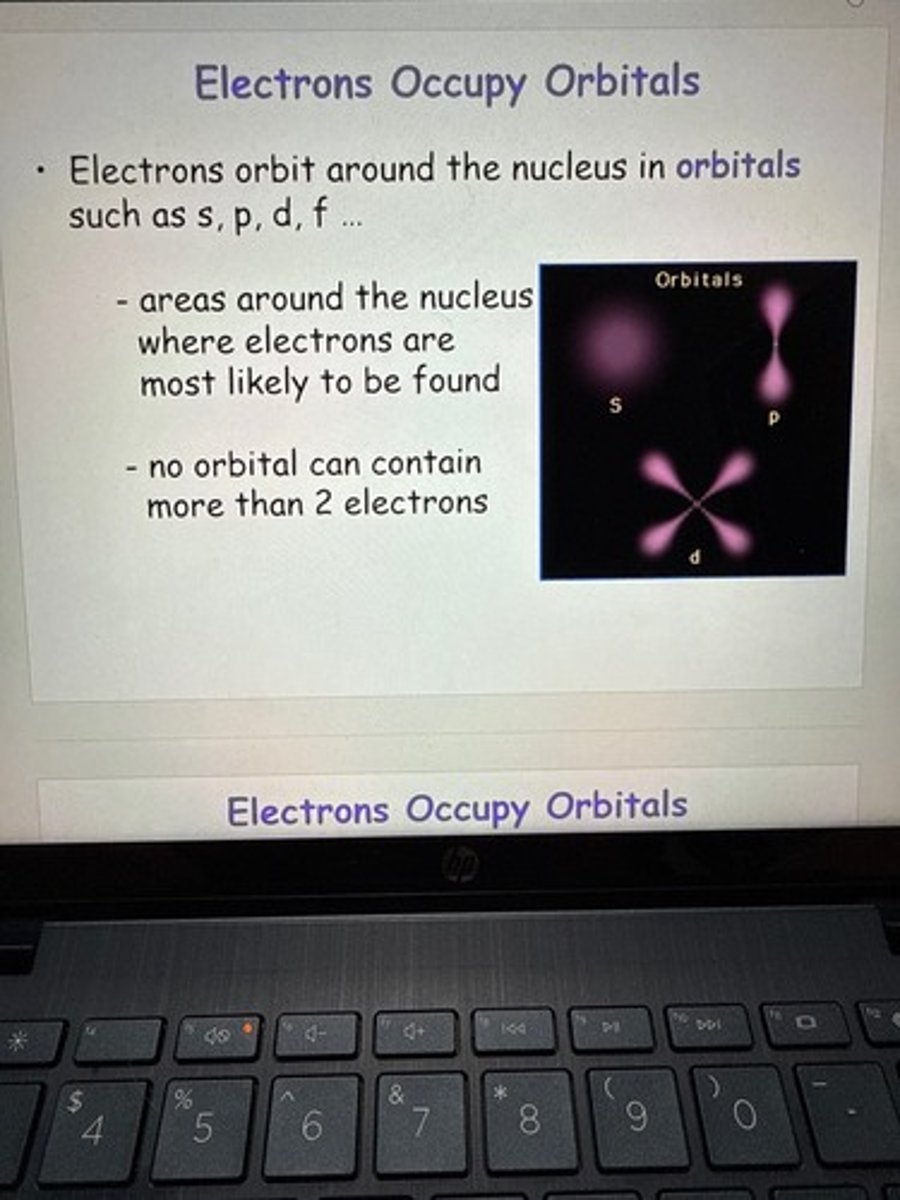
Study electron orbitals
When electrons absorb light energy (photons) they....
move to a higher energy level.
When electrons lose or emit energy (heat or light) they.....
move closer to the nucleus
_____ form when an atom gains or loses electrons.
Ions
What is a positively charges ion resulting from the loss of electrons?
Cations
What is a negatively charged ion resulting from the gain of electrons?
Anions
Aluminum +3 (Al3+) with atomic number of 13 has how many electrons?
10
Oxidation
compound A loses electrons
Reduction
Compound B gains electrons
Atoms with incomplete outer shells tend to react so both atoms end up with completed outer shells.
What are atoms made of?
protons, neutrons, electrons
Chemical bonds may react with each other by _____,_____, or ______ electrons.
sharing, donating, or receiving
Covalent bond
- sharing of electron pairs
- strong
Ionic bond
-Attraction of opposite charges
-Strong
Hydrogen bond
-Sharing of H atom
- Weak
Hydrophobic interactions
-Forcing of hydrophobic portions of molecules together in presence of polar substances
-weaker
Van der Waals attraction
-Weak attractions between atoms due to oppositely polarized electron clouds
what is formed between two oppositely charged ions (cations and anions)?
ionic bonds
What is it called when two atoms share one or more pairs of outer- shell electrons?
covalent bonds
Single covalent bond
H-H
Double covalent bond
O=O
Nonpolar Covalent bond
C-C
what is the atoms attraction (pull) for shared electrons
electronegativity
Polar covalent bond
O-H
What forms between hydrogen atoms and one molecule and an electronegative atom (O,N,F) of another molecule
Hydrogen bonds
The formation and breaking of chemical bonds
Chemical reactions
The rate of the chemical reaction depends on what three factors?
-catalysts
-temperature
-concentrations of reactant vs products
Products is on the right of left of the reaction?
right
Reactants are on the right of left of the reaction?
left
H2O is
cohesive and adhesive
______ is when H2O molecules stick to other H2O molecules by hydrogen bonding.
- In relation to surface tension
-cohesion
______ is when H2O molecules stick to other polar molecules by hydrogen bonding.
- in relation to capillary action
adhesion
Cohesive and adhesive properties of water work together to move water from the roots to the leaves of plants.
H20 is a high specific heat which means
a large amount of heat (energy) is needed to raise the temperature of water.
H2O has a high heat of vaporization which means
-a lot of heat (energy) is necessary to turn liquid water into vapor.
-allows living things to release excess body heat via sweating.
Frozen H2O (ice) is more or less dense than liquid H2O?
less dense
Bodies of water freeze from the top down
H2O is a universal solvent it dissolves polar molecules and ions (solutes)
hydrophilic means
water loving
hydrophobic means
water fearing
pH equation =
-log [H+]
A substance that minimizes changes in pH is?
A buffer
A buffer donates H+ when the solution becomes too
basic
A buffer accepts H+ when the solution becomes too
acidic
Atoms are made of?
Protons, neutrons, and electrons
What is the difference between the atomic number and atomic mass?
-Atomic mass is the same as atomic weight
-Atomic number is the amount of protons present
Acidosis
-excess acid in the body
-can disrupt bodies acid base levels
-can cause health issues
Alkalosis
-excess base (alkali) in the body
-elevated blood pH.
What causes blood acidosis vs alkalosis?
Acidosis: blood becomes too acidic/blood pH drops below 7.35 (hypoventilation)
Alkalosis: blood becomes to basic/blood pH rises above 7.45 (hyperventilation)
What is the difference between oxidation and reduction?
Oxidation involves loss of electrons.
Reduction involves gain of electrons.
remember LEO says GER
-LEO- Lose Electrons - Oxidation
-GER- Gain Electrons- Reduction
What is the difference between electron energy levels and orbitals?
Energy levels indicate the amount of energy that an electron has, but orbitals are where electrons are most likely located around the nucleus.
What is the difference between polar and non polar covalent bonds?
Polar covalent bonds involve unequal sharing of electrons (example: O-H) while non-polar covalent bonds involve equal sharing. (Example C-C)
How does the specific heat of water help our cells?
The specific heat of water allows our cells to absorb and transfer heat effectively.
How are chemical reactions controlled?
catalysts, temperature, and concentrations of reactants vs. products
What happens to water when it freezes?
it expands and becomes less dense
How do buffers work?
Acts by donating H+ when the pH becomes too basic, and accepts H+ when it becomes too acidic.
What is a hydrophobic exclusion?
Hydrophobic exclusion is when hydrophobic molecules (oil) exclude themselves from H20 instead of being dissolved in it.