autotrophs vs heterotrophs
 Studied by 0 people
 Call Kai
 Learn
Learn Practice Test
 Spaced Repetition
 Match
Match Flashcards
 Knowt Play
1/13

Earn XP
Description and Tags
+ respiration (photosynthesis)
Name | Mastery | Learn | Test | Matching | Spaced |
|---|
No study sessions yet.
14 Terms
In bacteria, what is the differentiating characteristic between aerobic respiration and anaerobic respiration?
In aerobic respiration, the final destination of electron transfer is Cyto and oxygen reduces into H2O. In anaerobic respiration, the final destination of electron is nitrate reductase in which nitrate is reduced into nitrite + H2O.
methanogens can be autotrophs. What differentiates autotrophs from methanogens/what are its characteristics?
autotrophs get reducing power as H2 → e- + H+
autotrophs get carbon by CO2 fixation
autotrophs get PMF by ETC
autotrophs get ATP from PMF (ATP synthase)
define (organo) heterotrophs
they get high-energy molecules and mass from other living things
photoautotroph vs chemoautotroph
photoautotrophs fix carbon from CO2 and get energy from light— not from inorganic oxidation. chemoautotrophs fix carbon from CO2 and get energy from inorganic oxidation— not from light
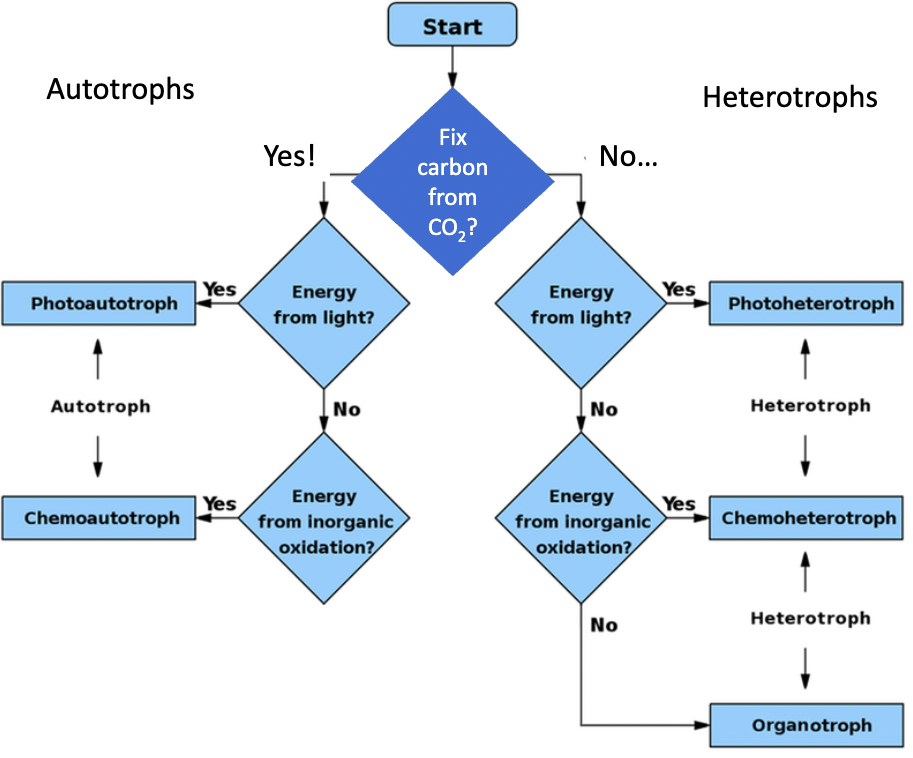
compare and contrast photoheterotroph, chemoheterotroph, and organotroph. what are we?
heterotrophs don’t fix carbon from CO2. photoheterotrophs get energy from light. chemoheterotrophs don’t get energy from light, but from inorganic oxidation. organotrophs don’t get energy from light nor inorganic oxidation. we are organotrophs.
light energy is used to make both what?
light energy is used to make both ATP and reducing power (NADH/NADPH)
degradative pathways (catabolic rxns) vs biosynthetic (anabolic) rxns
catabolic rxns store electrons (NADH) and energy (ATP). anabolic rxns use ATP to push biosynthesis and NADH or NADPH to reduce, recycling ADP and NAD+.
light vs dark reactions
light reactions are a way to get highly reducing electrons donated to the ETC without having to find/harvest a strong electron donor
dark reactions use ATP and NADH to reduce CO2 and generate glucose
what are 5 main parts of light reactions
energy is captured from the sun and is used to excite electrons
the electrons travel through ETC and pump protons, making ATP via ATP synthase
high energy electrons are transferred to carriers (NADP+) to make NADPH
original lower-energy electrons must be replace from some external electron source.
CO2 is fixed onto organic molecules and reduced with high energy electrons (from NADPH) and energy (from ATP hydrolysis) → storage for of fuel (e.g. sugars), which can be tapped again as needed through fermentation or respiration
what are 3 ways light energy can be converted into chemical energy?
when a pigment molecule absorbs a photon the energy can be released as another, lower energy photon (fluorescence)
when a pigment molecule absorbs a photon the energy can be transferred directly and completely to another nearby pigment (resonance)
when a pigment molecule absorbs a photon the energy can be used for a chemical reaction (e- transfer = redox)
cyclic photosynthesis
e- ends up where it started— back in chlorophyll. the electron from P840(red) takes a path home to P840(ox), generating ATP along the way via ETC, proton pumping, ATP synthase, eventually turning P840(ox) back into P840(red)
what is special about green sulfur bacteria?
It can use e- and light to make proton motive force and ATP or they switch to making NADPH (they make what they need when they need it)
what is the main purpose of dark reactions?
Using the ATP and e- donors from light reaction, CO2 is captured from the air and converted into organic material
what is great about oxygenic photosynthesis and what process is used?
in oxygenic photosynthesis, out source of electrons (water) never runs out