9. How to Select an RGP Material - Contact Lenses I Summer 2026
 Call Kai
 Learn
Learn Practice Test
 Spaced Repetition
 Match
Match Flashcards
 Knowt Play
1/81

There's no tags or description
Looks like no tags are added yet.
Name | Mastery | Learn | Test | Matching | Spaced | Call with Kai | Chat |
|---|
No analytics yet
Send a link to your students to track their progress
82 Terms
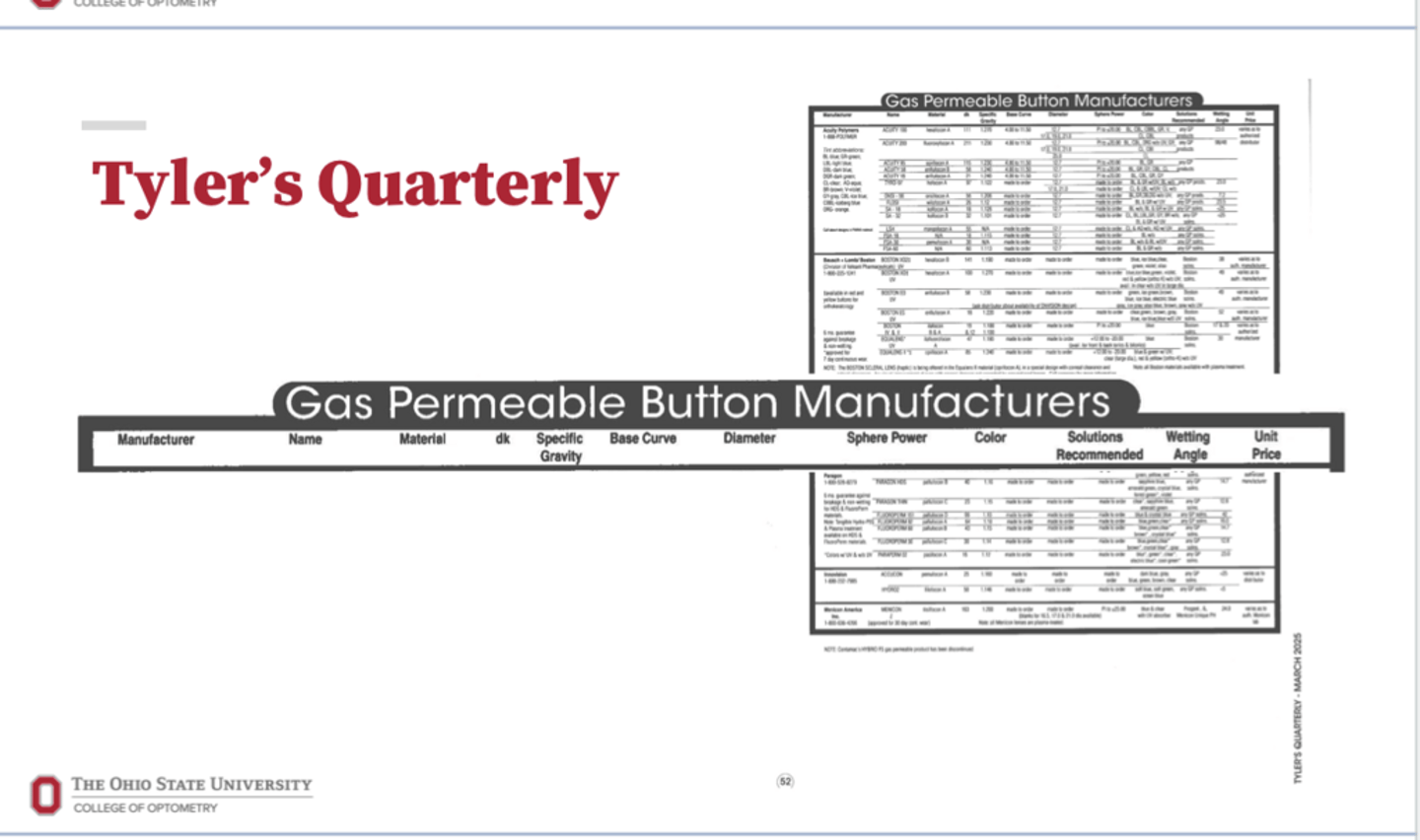
Tyler's Quarterly Gas Perm Button Manufacturers (Pic)
Tyler's Quarterly Gas Perm Button Manufacturers (Pic)
Is considering what your patient needs when deciding an RGP Material important?
Yes
What are some needs of patients that must be considered when deciding an RGP Material?
-Overnight wear?
-Only wear during the day?
-Dry eye?
-Do they have a lot of astig?
Is the Dk/t different in RGPs vs soft lenses?
No -- the Dk/t is the same as soft CLs
What is the Dk needed for no daily wear corneal swelling?
25
What is the Dk needed to limit overnight swelling to normal (4%)?
85-135
Why are RGPs better for the cornea than soft CLs?
-More tear exchange under the RGP than soft lenses (25% more)
-The lens is smaller & does not cover the entire cornea
What are the 3 components of durability in an RGP lens?
-hardness
-modulus
-toughness
True or False:
Most GPs are quite scratchable
true
Where do scratches usually occur?
usually on the front surface of the RGP
How can scratches be prevented on RGPs?
can be prevented by proper handling
How is Hardness of an RGP measured?
By the Rockwell indentation method usually (drop a ball on the lens)
Is hardness predictive of dimensional stability?
No -- lenses do not stay the same over time. The plastic will change shape
What is the modulus of a RGP?
stiffness of a lens
Why is modulus important in RGPs?
In order to mask astigmatism
How is modulus determined?
by polymer chemistry
More cross linking of polymers in a RGP = (improved/worsened) durability
improved
More cross linking of polymers in a RGP = (more/less) O2 transmission
less
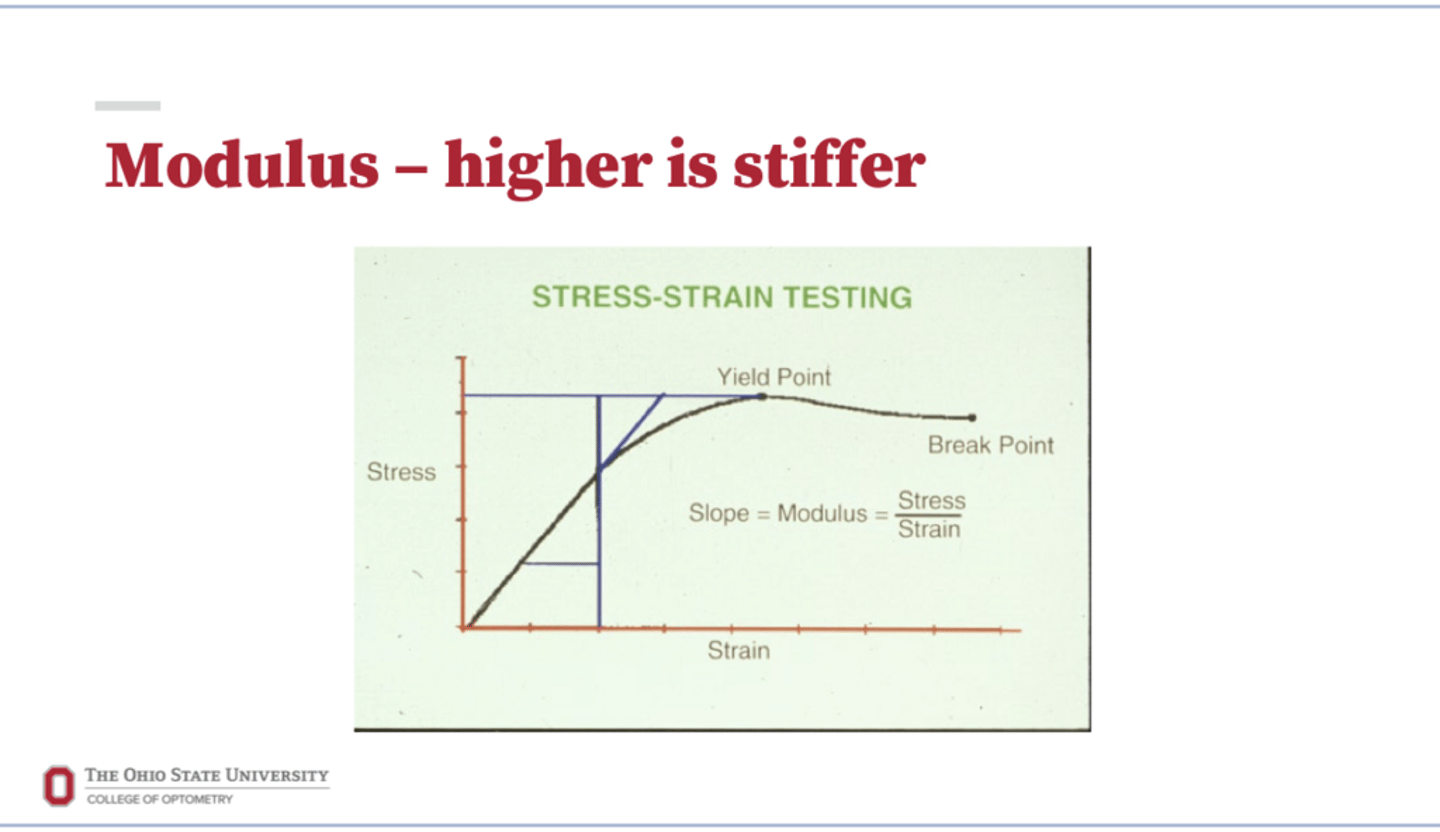
Modulus -- Higher is Stiffer (Pic)
Modulus -- Higher is Stiffer (Pic)
What is the break point of an RGP?
The point in which a lens will break
If patients are breaking their lenses frequently, what change may need to be made to the lens material?
Lower Dk -- material is not stiff enough and modulus needs to be increased
What is toughness of an RGP?
resistance of a material to breakage
How to reduce breakage of an RGP?
-Increase thickness
-More cross linking
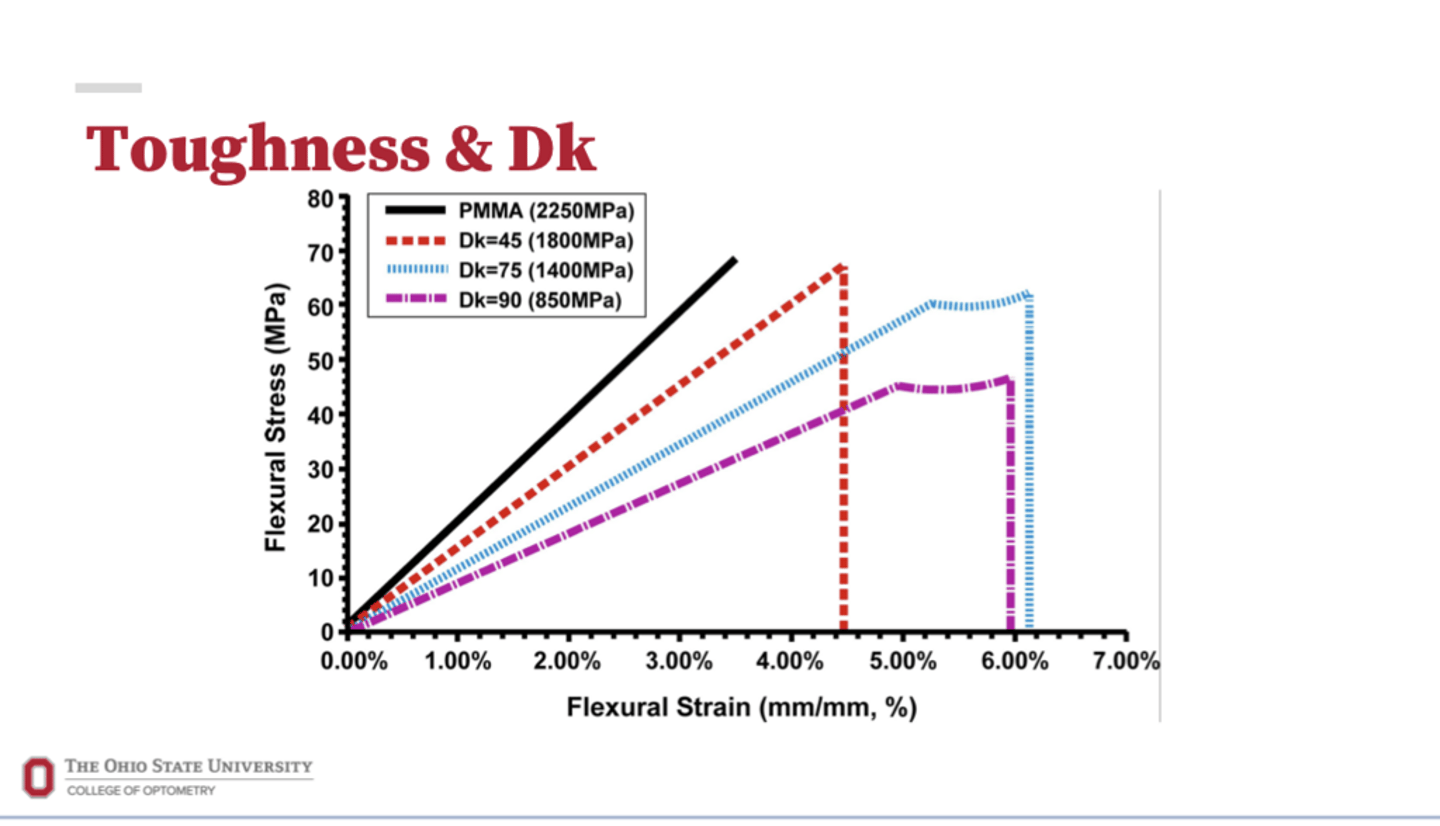
Toughness & Dk (Pic)
Toughness & Dk (Pic)
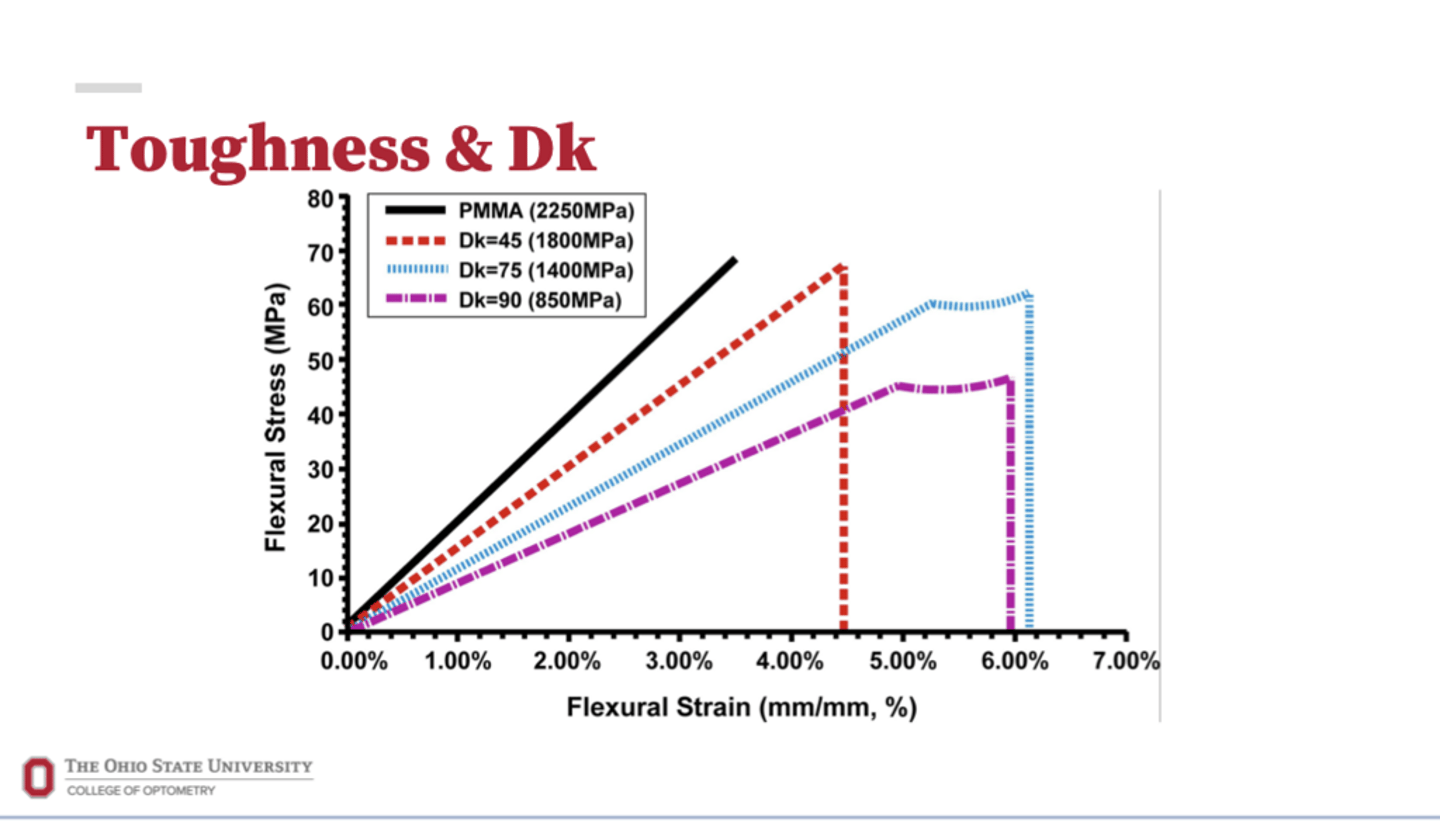
PMMA (does/does not) bend
does not
**Lowest Dk
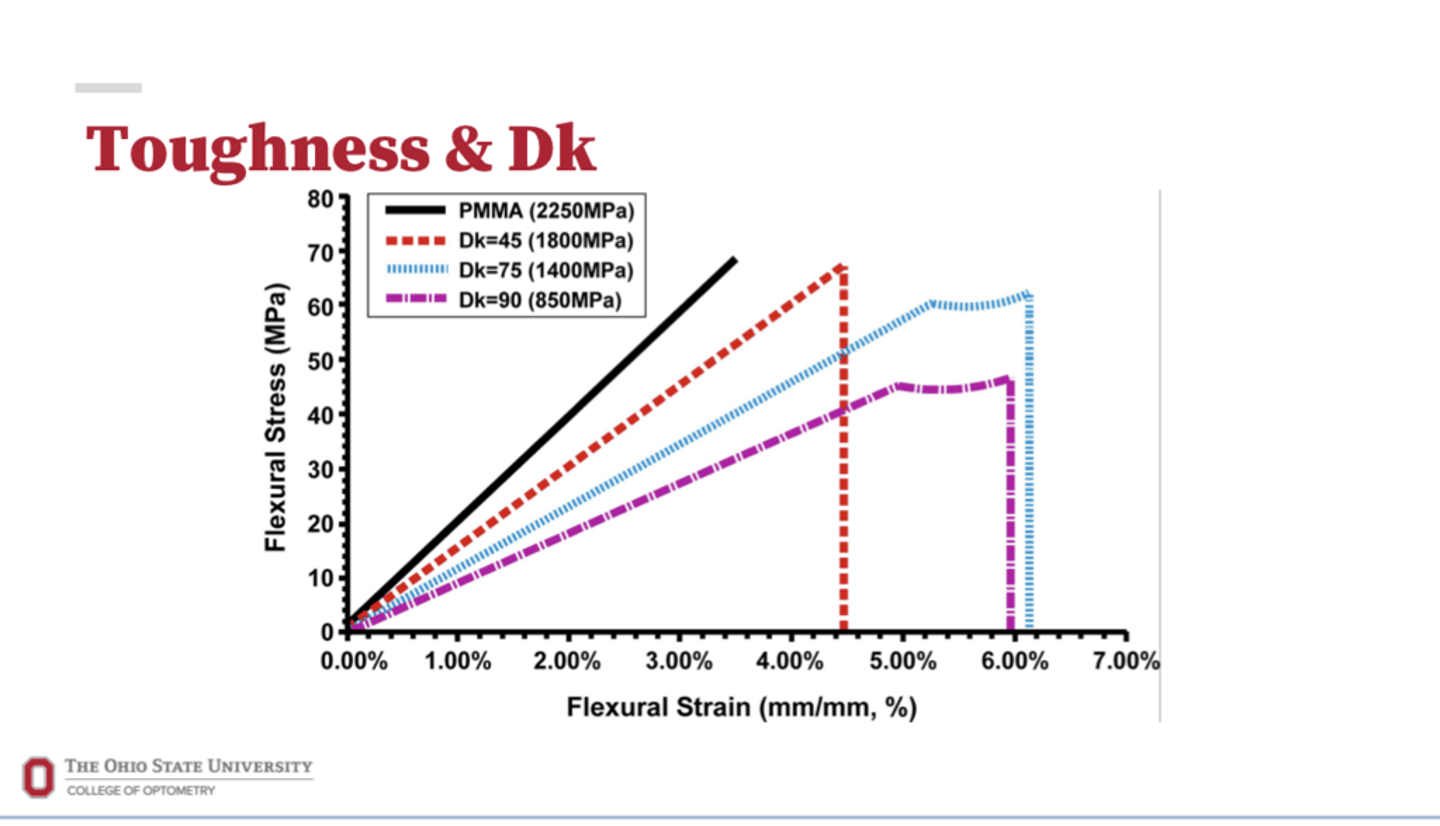
As the Dk increases in an RGP lens, the modulus of the lens will be (greater/less)
less
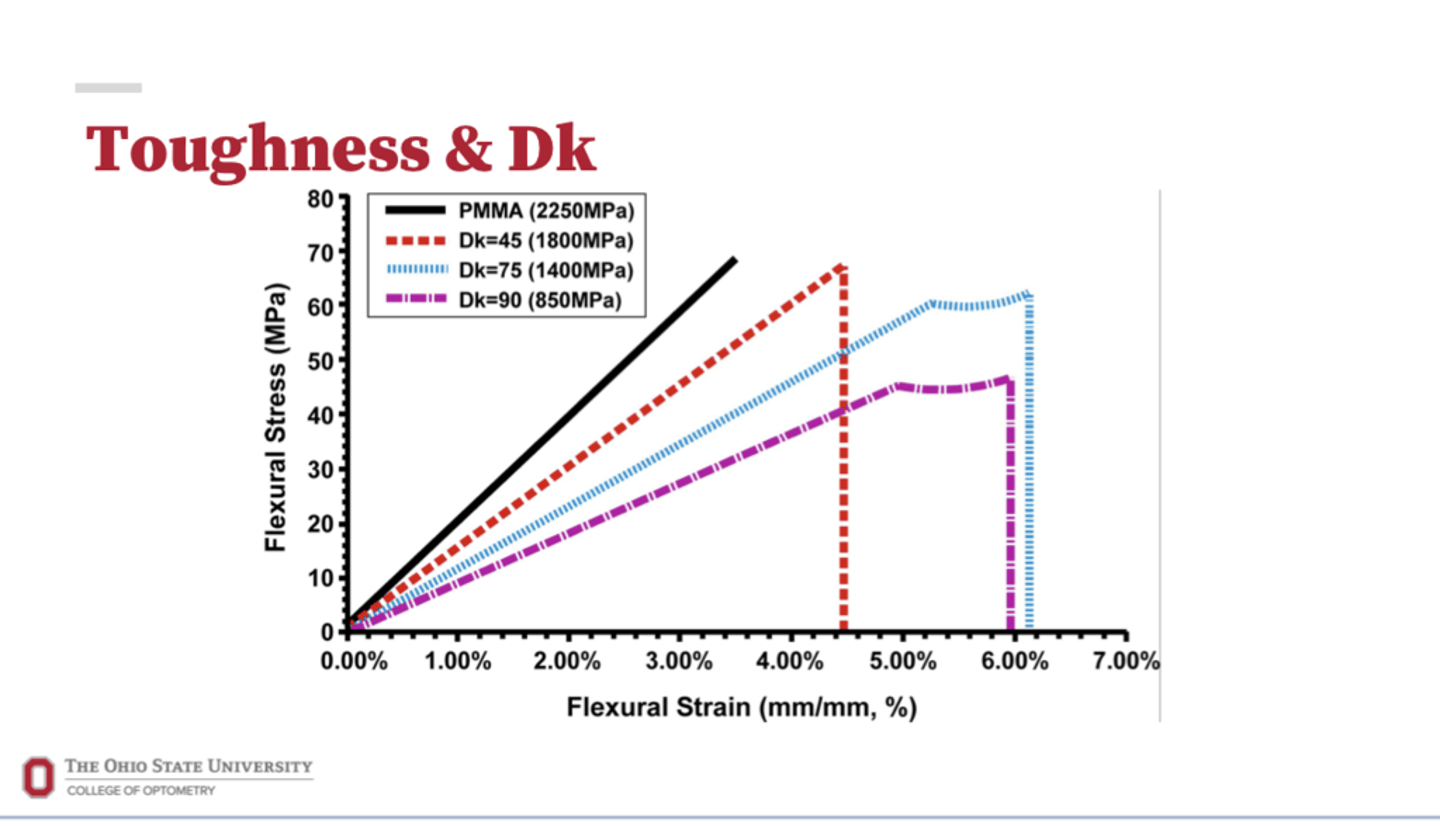
As the Dk increases in an RGP lens, the lenses will be (more/less) likely to break
more
____ makes RGPs flexible and weak
Silicone
Why does silicone make RGPs flexible and weak?
poor ability to resist flexure
Chips in the edge of RGPs can make them very vulnerable to ______ regardless of material properties
cracking
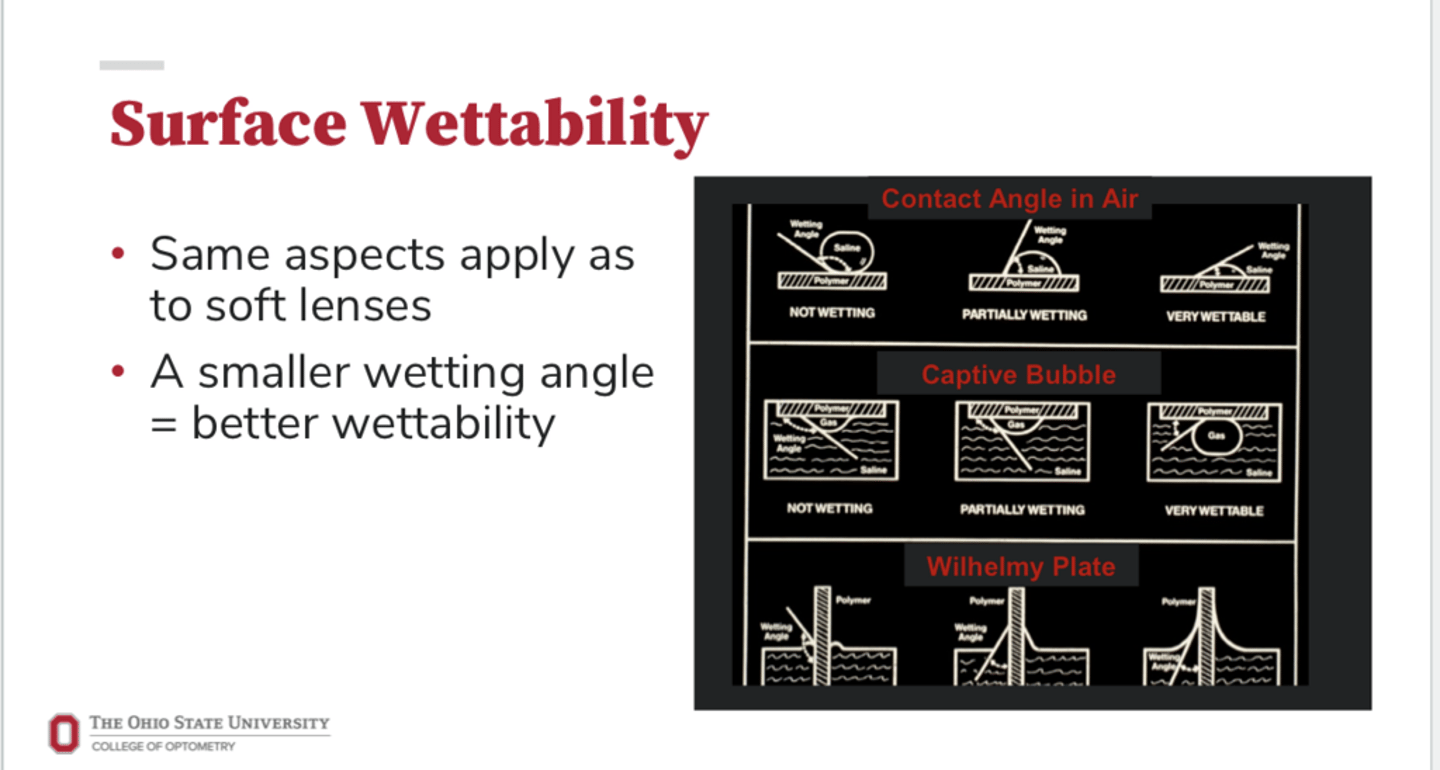
Does surface wetability also apply to RGPs?
Yes -- same as soft CLs
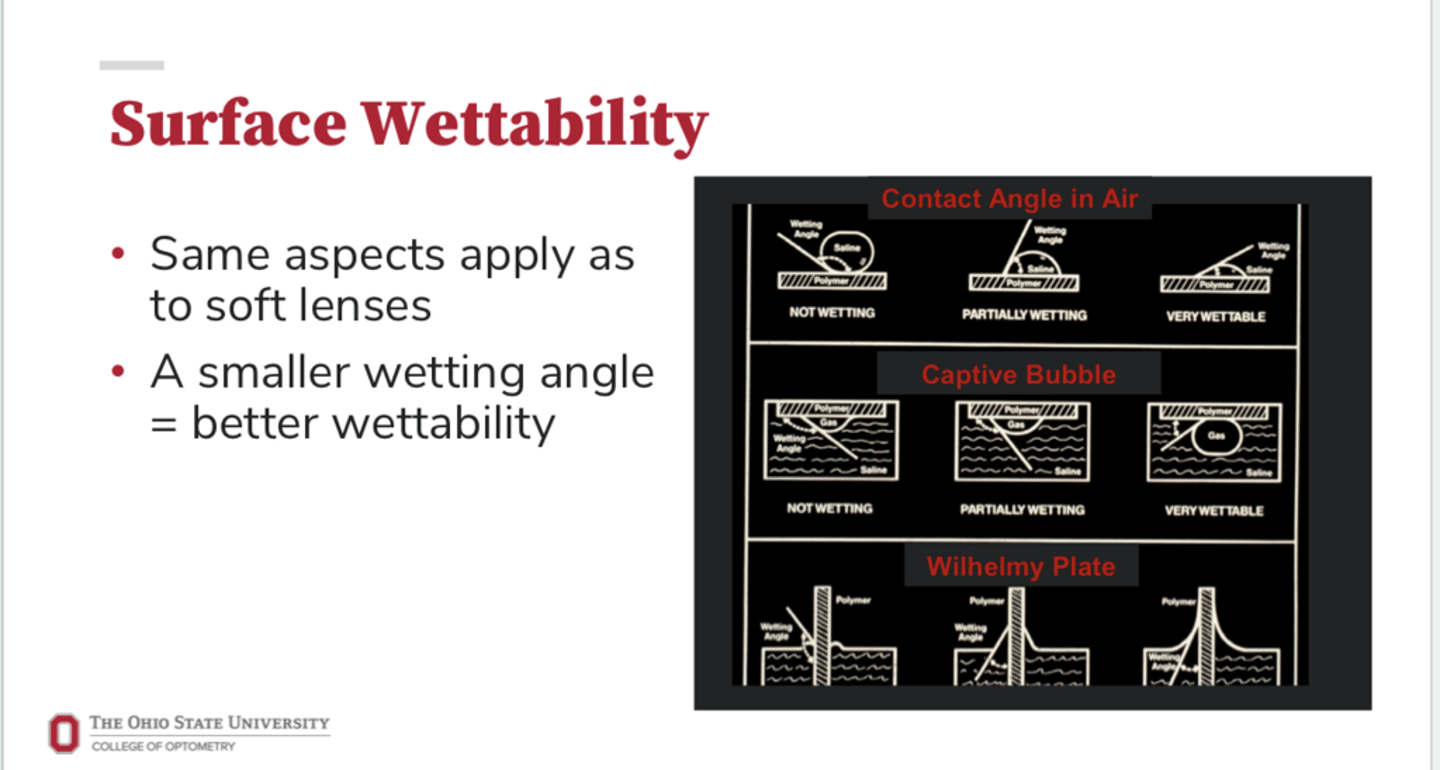
A (smaller/larger) wetting angle will equal a better wettability
smaller
True or False:
Lab tests are great indicators of on eye wettability
false -- poor indicators
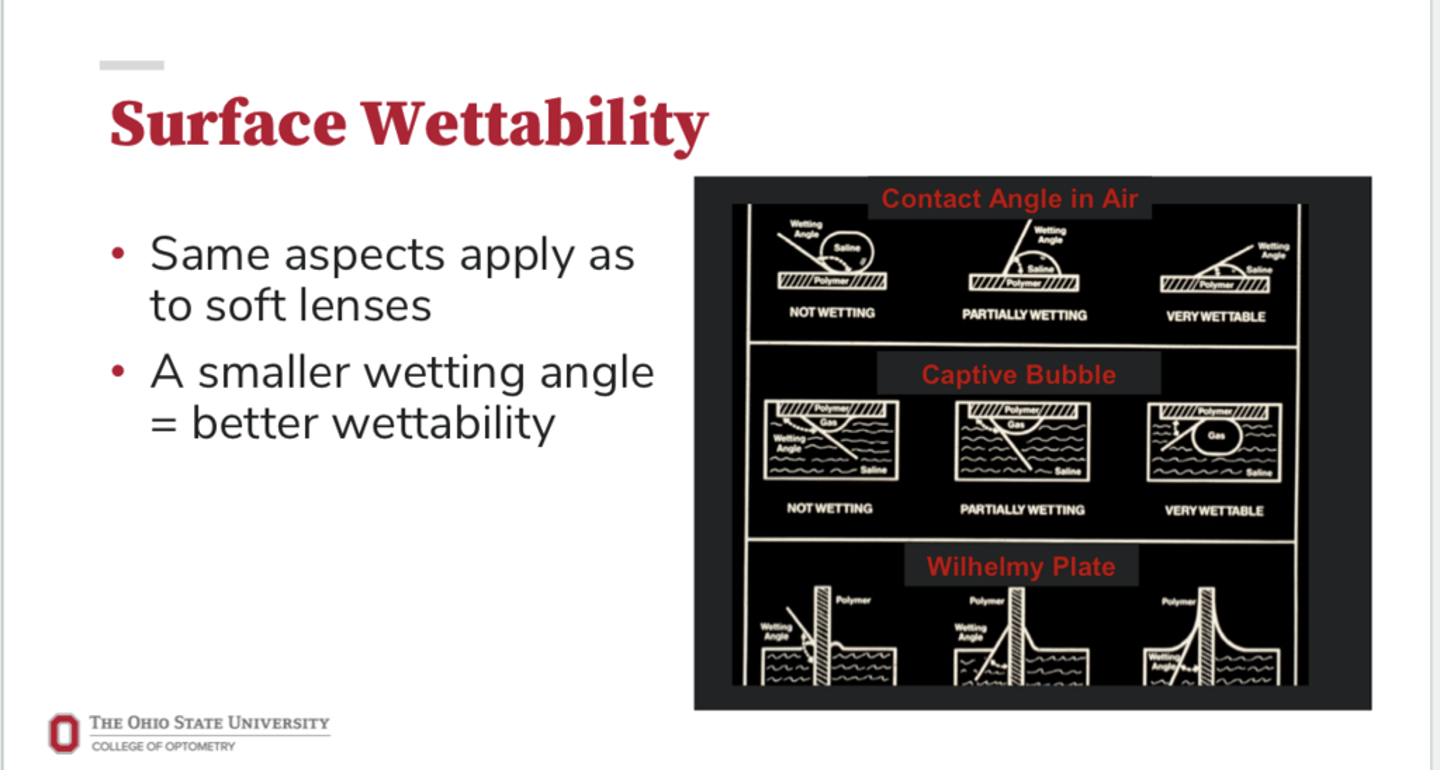
What is on-eye wettability impacted by?
-Binding to the eye, proteins, and lipids
-Surface treatments (plasma, PEG)
What are the forces that are acting on an RGP Lens?
-surface tension
-lid interactions
-gravitational (center of mass, mass, gravity)
What is the function of surface tension?
suctions a lens to the eye
What creates surface tension on an RGP?
Interaction of water molecules between lens and cornea
There is a _____ at the edge of the lens that is d/t the edge lift
tear meniscus
What is an effect of too much edge lift?
Surface tension will draw water under lids & can dry out the cornea
What are the impacts to a upper lid attached fit of an RGP?
-Can hold a GP lens up
-Moves lens in a vertical direction during a blink
What are the impacts of a lower lid interaction with an RGP fit?
can push up on bottom of a GP lens
What is center of mass also referred to as?
center of gravity
Center of Mass is the ____ point of the lens
balancing
What does center of mass influence?
the lens position on the eye and the stability of fit
A center of mass that is ______ the lens helps the lens position better
further behind
What happens if a center of mass is closer to the back surface of a lens?
the lens will drop
What are the factors that lead to a center of mass that is further from the back surface of the RGP lens?
-minus power
-LARGER LENSES *****
-thinner lenses
How to make lenses thinner?
lenticular
How does a lenticular improve fit of an RGP?
-improve center of mass
-improve edge thickness
Thinner lenses with a lenticular will move the center of mass where?
backwards
(Plus/minus) lenses are more likely to drop on the eye
plus
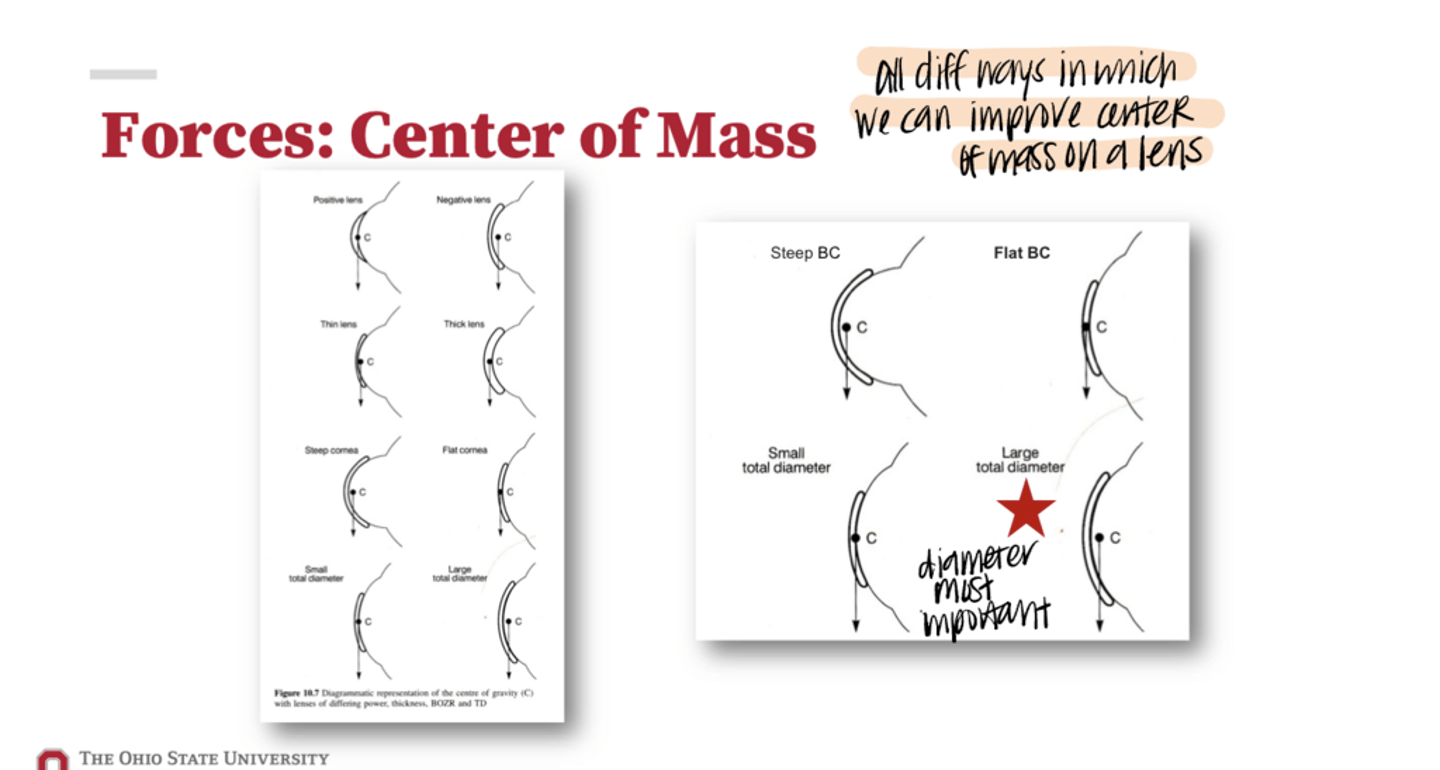
Diameter is ____x more important than center thickness or power when determining the center of mass on an RGP lens
4-7x
Center of Mass (Pic)
Center of Mass (Pic)
What is the equation for mass of an RGP?
volume * specific gravity
What is the specific gravity of a RGP?
a dimensionless ratio of a substance's density compared to a reference substance
If we want to alter the mass of an object, we must change the ______
specific gravity
If the contact lens drops low on the cornea, we will want to choose a lens with a (higher/lower) specific gravity meaning (more/less) mass
lower; less
If the contact lens rides high on the cornea, we will want to choose a lens with a (higher/lower) specific gravity meaning (more/less) mass
higher; more
_____ lenses may benefit from a higher specific gravity measurement
Prism ballast
There is more transmission of light though a (CLs/spec)
Cls
True or False:
Some RGPs have a UV filter
true
The index of refraction is (more/less) important in Cls than specs
less
True or False:
Index of refraction is very similar in all RGP materials
true
All RGP materials are _____
plastics
What was the 1st RGP material?
PMMA
What are the thermoplastics available for RGP materials?
-PMMA
-Silicone Acrylates
-Fluorosilicone Acrylates
What are the pros of PMMA?
-readily machined
-low cost/cheap
-fairly wettable
-easy to care for
What is the con of PMMA?
zero O2 transmissibility
What is the backbone of silicone acrylates?
methyl methacrylate
What is the Dk of Silicone Acrylates?
12-60 (low to medium)
What are the surface characteristics of silicone acrylate lenses?
-surface is negatively charged d/t monomer
-Hydrophobic
-Lipohillic
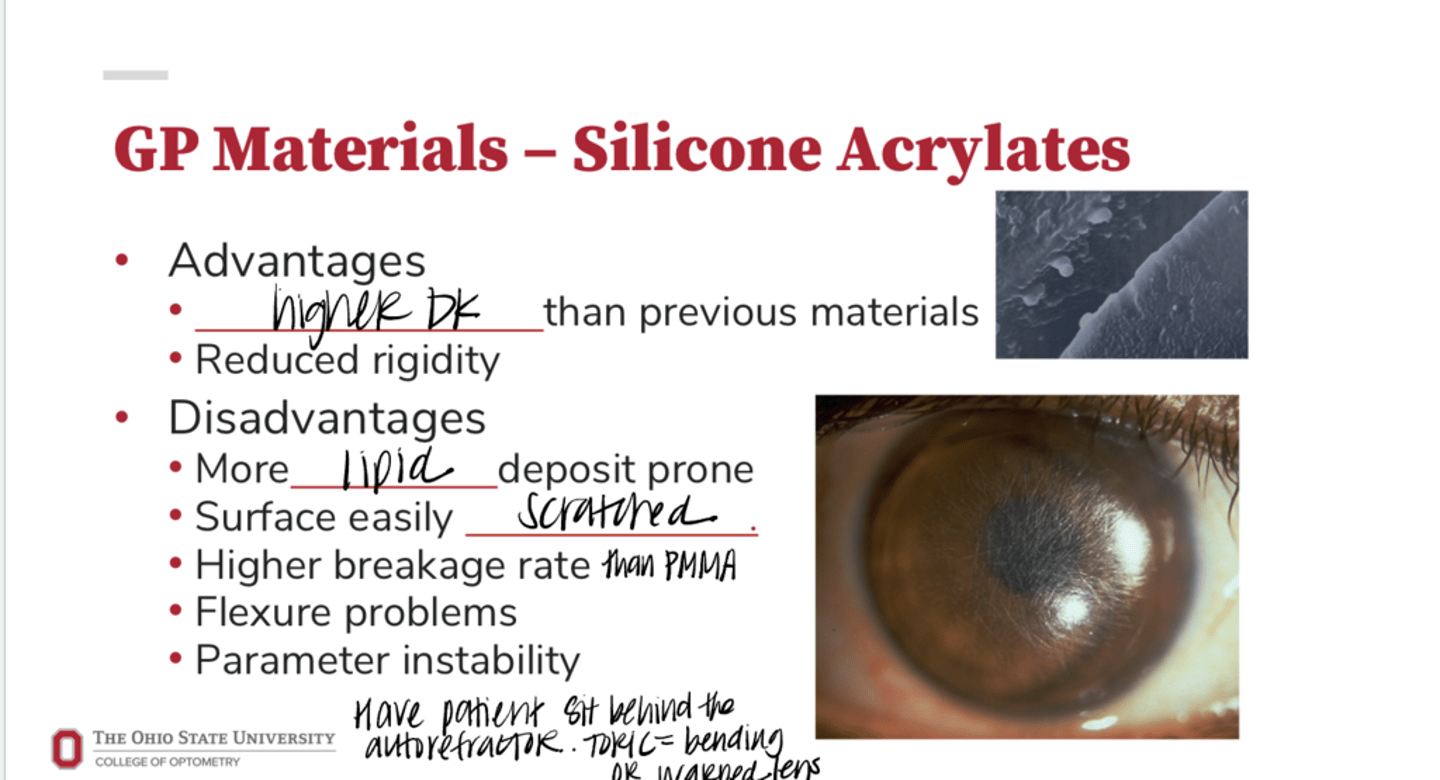
What are the advantages to the silicone acrylates?
-Higher Dk than PMMA
-Reduced rigidity
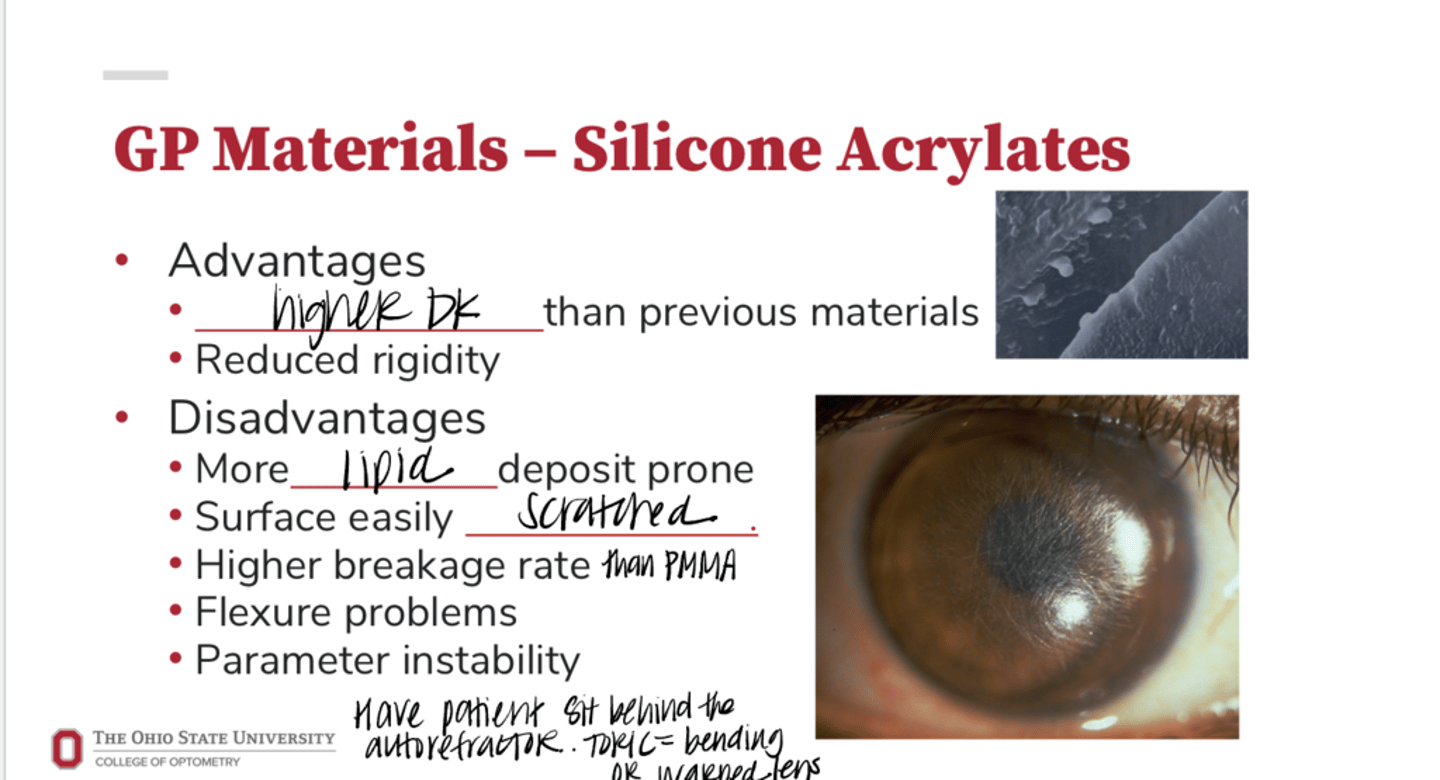
What are the disadvantages to the silicone acrylates?
-more lipid deposit prone
-surface easily scratched
-higher breakage rate than PMMA
-flexure problems/bending on the eye
-parameter instability
What type of monomer is added to silicone acrylate to create fluorosilicone acrylates?
fluorine monomer
Fluorosilicone acrylates have a _____ surface charge
lower
What is the Dk of fluorosilicone acrylates?
40-100+ (medium to high)
What are the advantages of fluorosilicone acrylates?
-Higher Dk than previous materials
-Fewer lipid deposits d/t lower surface charge
-Better wetting
What are the disadvantages of fluorosilicone acrylates?
-Surface is very easily scratched
-Greater lens flexure compared to PMMA
What was the 1st hyper-permeable lens?
Menicon Z (superfluorosilicone acrylate)
Superfluorosilicone acrylate lenses have a very (high/low) Dk
high
What is the monomer that is added to the Superfluorosilicone acrylate lenses?
silylstyrene
Superfluorosilicone acrylate lenses are FDA approved for up to ________
30 nights of wear