Art History II, Exam 1
 Call Kai
 Learn
Learn Practice Test
 Spaced Repetition
 Match
Match Flashcards
 Knowt Play
1/54

There's no tags or description
Looks like no tags are added yet.
Name | Mastery | Learn | Test | Matching | Spaced | Call with Kai | Chat |
|---|
No analytics yet
Send a link to your students to track their progress
55 Terms

Bonaventura Berlinghieri, St. Francis Altarpiece, 1235
13th Century Italian Art
-Style: Maniera Greca
-Technique/material: Tempera on wood panel
-Subject and function: St. Francis Altarpiece
-How it differs from Maniera Greca: Preaching to the Birds (left) and Receiving the Stigmata (right)

Giotto, Lamentation, Arena Chapel, 1305
14th Century Italian Renaissance
-Style: Naturalism
-Technique/material: Fresco
-Subject: The mourning of Christ’s death; Christ himself
-Sense of depth (recession into space)
Tempera
pigments ground up, binded by egg yolk
-crumbly, shiny texture
-very brittle
Fresco
painting on wet plaster;
-matte or flat results
-have to work fast (no corrections)
Maniera Greca
“Greek Style”
-Mostly seen in 13th century; influenced by Byzantine art
-Frontality and flatness of figures and space
-Lack of modeling
-Gold grounds (Gold-leaf backgrounds)
-Symmetry
Linear Perspective
Mathematical perspective system developed in the Renaissance to accurately depict a 3D scene
Medici family
Wealthy family (oligarchy) known for their artistic patronage; fueled the Renaissance
-Flaunted their wealth and power
Altarpiece
A painted or carved work of art placed above and behind the altar of a Christian church.
-May be single panel or comprised of multiple sections, as a diptych (2-part); triptych (three-part) or polyptych (multisectioned)
-Materials: Wood, panel, paint
-Devotional purposes (Ensure salvation)
Naturalism
Art that attempts to depict natural world as it appears (Associated with Giotto)
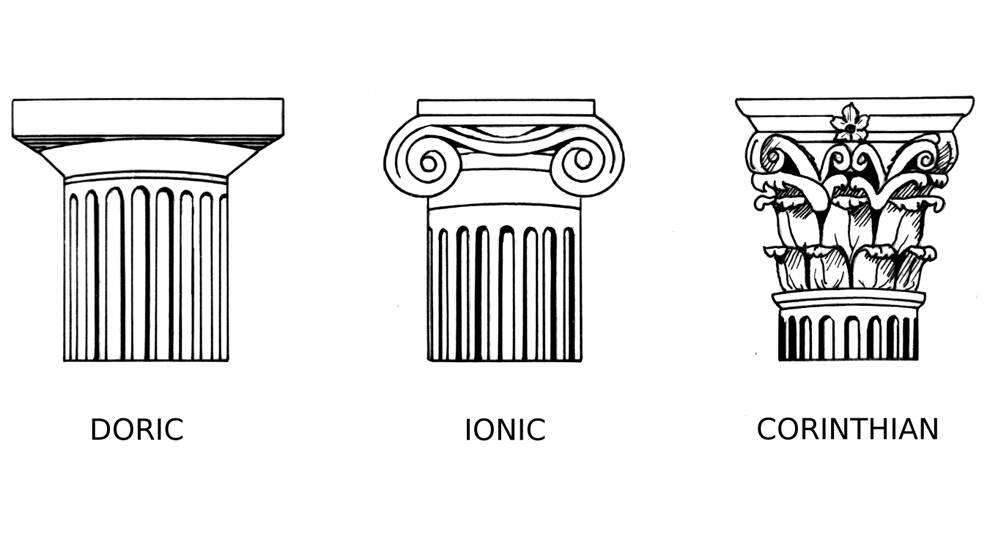
Doric (Classical Orders)
Originated in western mainland Greece. Oldest and simplest out of the three orders;
-Simple unadorned capital, no column base, and a frieze marked by alternating triglyphs and metopes

Ionic (Classical Orders)
Originated in eastern Greece.
-Slender and graceful order, characterized by scroll-shaped ornaments called volutes on the capital, fluted column shafts, and a distinct base

Corinthian (Classical Orders, Architecture)
The last developed order.
-most ornate and decorative order, featuring a slender shaft and a capital elaborately carved with stylized acanthus leaves

Barrel vault
A continuous arched ceiling or roof structure formed by extending an arch along a length, creating a tunnel-like space
-Seen in Roman architecture

Coffers
a series of sunken panels in the shape of a square, rectangle, or octagon in a ceiling, soffit or vault
-Seen in ancient Greek and Roman architecture
Oil painting
mixture of powdered pigment and oil (usually a drying oil such as linseed)
-Didn’t gain traction until the 15th century; Jan van Eyck developed the original ideas of oil paint and was the face of early Renaissance art
-Glossy, higher colour saturation and opacity
-ability to add greater depths to paintings and allowed for corrections
Pietà
“Pity” or “Compassion;”
-subject in Christian art that depicts the Virgin Mary cradling the dead body of Jesus Christ after his crucifixion

Pope Julius II
“The Renaissance pope;” Known for his art patronage for the Vatican
-Commissioned: Sistine Chapel Ceiling, St. Peter’s
Basilica, Papal Apartments, Tomb of Julius II
Vitruvius
Ancient Roman architect and engineer during the 1st century BC; states that all buildings should have three attributes: "strength", "utility", and "beauty”
-Inspired Alberti (architect), and da Vinci (painter)

Pilasters
rectangular architectural element that projects slightly from a wall to look like a flat column (column, wall decoration); usually decorative in Classical architecture
-In Alberti’s Palazzo Rucellai, pilasters are used to support entablatures
Contrapposto
“Opposite;” naturalistic standing position of the human body, with weight leaning on one leg and a shift in the body
-Dynamic and asymmetrical; not stiff
Palazzo
“Palace;” Grand urban residence or palace built for wealthy, noble, or ruling families in Italy
Momento mori
theme of artwork designed to remind the viewer of their mortality and of the shortness and fragility of human life; “remember you must die”
-Seen in Masaccio’s Holy Trinity: “I was once what you are, and what I am, you also will be.”

Donatello, David, 1446
Early Italian Renaissance/15th century
-Style: First free-standing nood male sculpture since Antiquity
-Technique/material: Bronze sculpture
-Subject: David
-Patron: Medici Family (Kept privately in Palazzo de Medici)
-Example of contrapposto
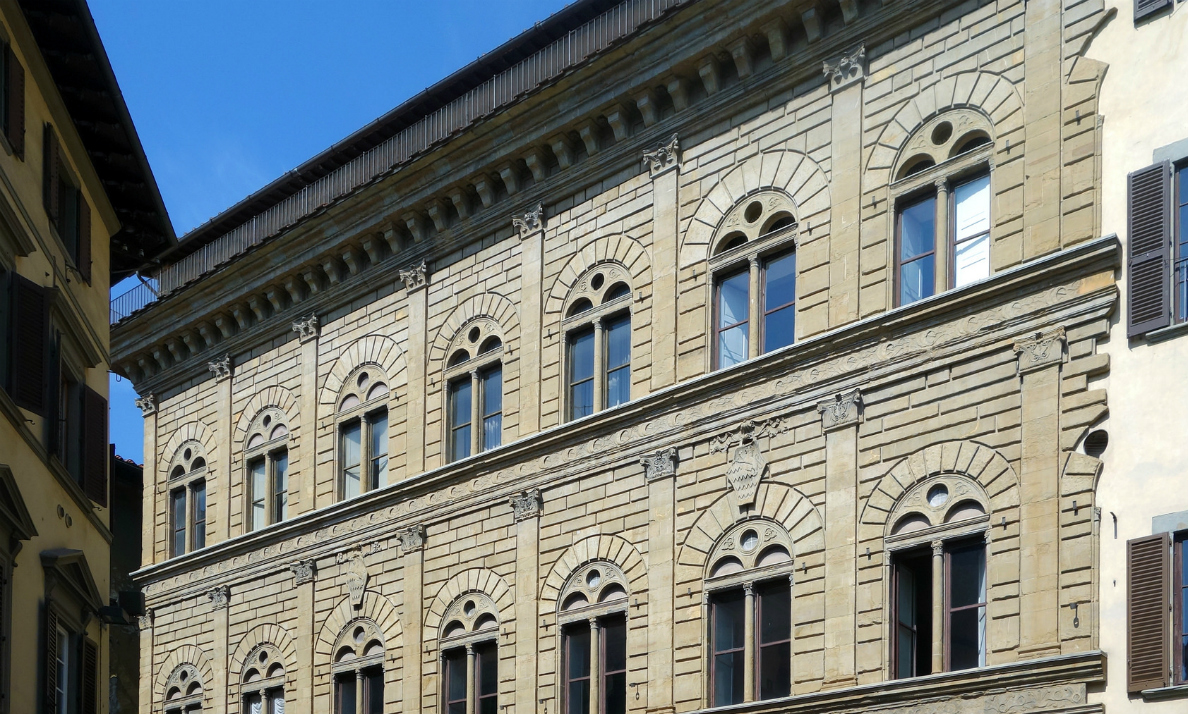
Leon Battista Alberti, Palazzo Rucellai, 1446
Early Italian Renaissance/15th century
-Style: Tuscan Doric, New Order, Corinthian (influenced by classical architecture)
-Technique/material: Pilasters, entablatures, cornice, arches
-Patron: The Rucellai family, wealthy wool merchants

Masaccio, Holy Trinity, 1425
Early Italian Renaissance/15th century
-Style: Naturalism
-Technique/material: Fresco; considered the first Renaissance painting to utilize linear perspective successfully
-Subject: The Holy Trinity, with the Virgin Mary and Saint John, and the donor (patron) and his wife
-Message: momento mori; “I was once what you are, and what I am, you also will be” seen next to skeleton
Which painting exhibits MANY characteristics of the maniera greca style?
Berlinghieri, St. Francis Altarpiece
Which work has figures that are more three-dimensional and modeled in light and dark, creating more volume and mass. In short, the figures in this work are much more realistic.
Giotto, Lamentation
Which work is asymmetrical?
Giotto, Lamentation
In Berlinghieri's altarpiece, the central figure of St. Francis is flanked by vignettes that depict important scenes from the saint's life.
True
Which work is an example of an altarpiece?
Berlinghieri, St. Francis
Which painting depicts figures mourning the death of Christ?
Giotto, Lamentation
Which work is an example of a fresco?
Giotto, Lamentation
Which work is beginning to show more recession into space?
Giotto, Lamentation
Maniera greca style consists of
all of the above
Berlinighieri's painting, St. Francis Altarpiece, exhibits many elements of the maniera greca style. But the painting also gives hints to a new more naturalistic style. Where do we see those hints/premonitions?
all of the above
Which work used an experimental fresco technique, resulting in its deterioration less than twenty years after it was completed?
Leonardo's Last Supper
Which work utilizes linear perspective?
both
Which work exhibits many maniera greca characteristics?
neither

Which work is on the wall of a refectory in a monastery?
Leonardo's Last Supper

How do we know who Judas is in The Last Supper?
his face is in shadow and his arm reaches across the table
The patron and his wife are included in the composition of the Holy Trinity.
True
The architecture in Masaccio's Holy Trinity is heavily inspired by medieval architecture (Romanesque and Gothic)
False; It is inspired by classical architecture (Antiquity, building designed by Alberti)
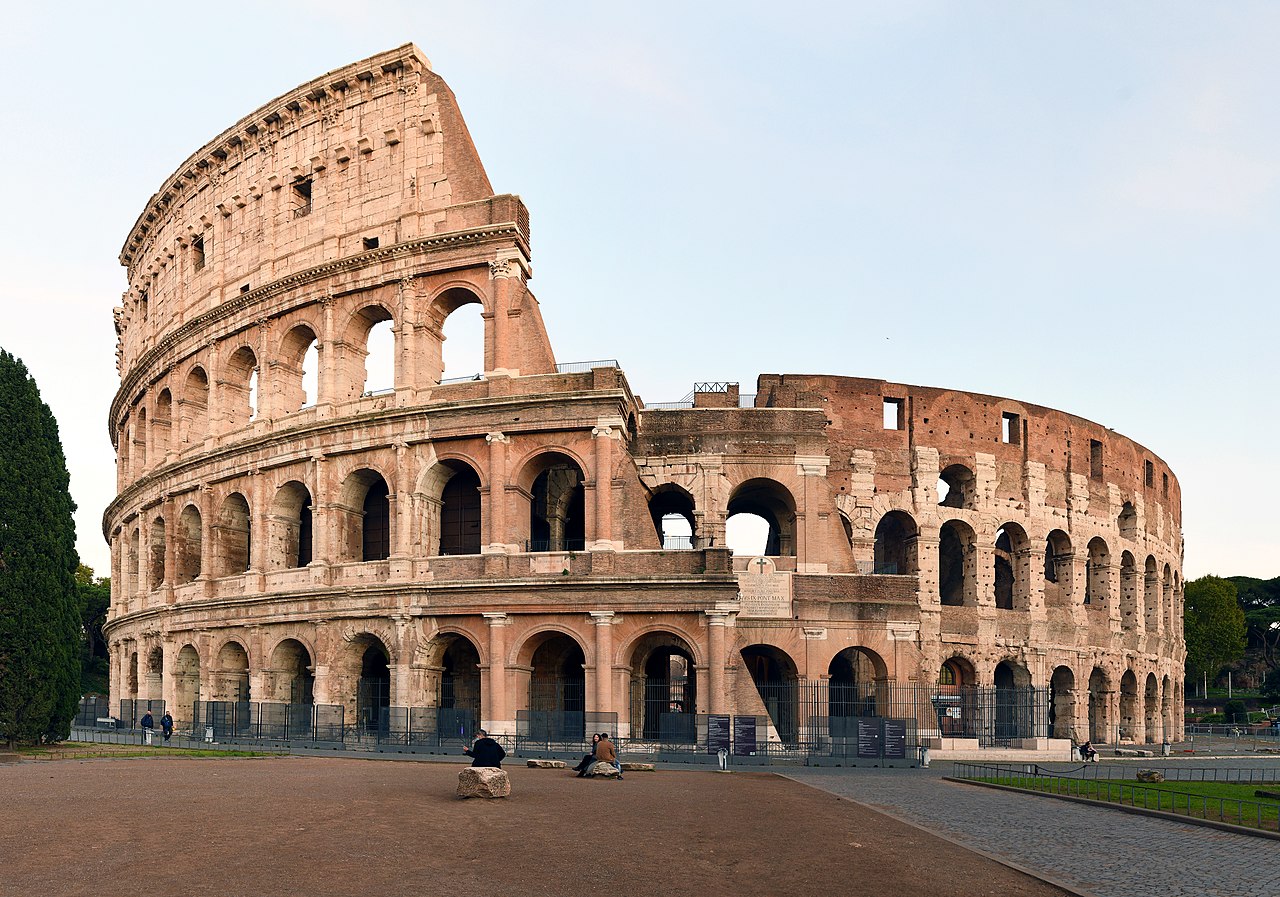
Which ancient Roman building is Alberti especially influenced by?
Colosseum
The Palazzo Rucellai is a church.
False; It is a palace

What is one of the classical influences in the facade of the Palazzo Rucellai?
arches

Leonardo, The Last Supper, 1498
High Renaissance/16th century
-Location: Santa Maria delle Grazie, Milan refectory (dining hall/room)
-Style: Naturalism
-Technique/material: Experimental fresco, deteriorated quickly; coffered ceiling, utilized linear perspective
-Subject: Jesus and his apostles after he announced that he would be betrayed
-Focal point: Triangular composition, a lot of numerological symbolism; 4 groups of 3s
-Patron: Duke of Milan, Ludovico Sforza

Raphael, School of Athens, 1510
High Renaissance/16th century
-Location: Stanza della Segnatura, Vatican (Fresco set in rome)
-Material: Fresco
-Theme: Truth
-Statement: The status of artists in the
Renaissance
-Subject: Many of great thinkers of the antiquity era: Plato, Aristotle, etc. can also be interpreted as different artists: da Vinci, Raphael himself

Michelangelo, Pietà, 1500
High Renaissance/16th century
-Location: St. Peter’s, Vatican
-Material: Marble statue/sculpture
-Patron: Cardinal Jean de Bilheres-Lagraulas, the French
ambassador in Rome
-Subject: Pietà, or Mary holding Christ’s dead body

Robert Campin, Merode Altarpiece, 1425
Northern Renaissance
-Triptych of the Annunciation
-Material: oil paint on wood panel
-Subject: Mary and Joseph receiving news from Archangel Gabriel that Mary will carry the Son of God.
-Composition: Recession into space; Linear perspective; Proportions
-Patron: Peter Inghelbrecht and his wife (left panel of altarpiece)

Jan van Eyck, Arnolfini Wedding, 1434
Northern Renaissance
-Material: oil on wood panel
-Subject: Giovanni Arnolfini and his bride
-Composition:
-Patron: Arnolfini

Rogier van der Weyden, Deposition, 1443
Northern Renaissance
-Material/technique: oil on wood panel; originally a triptych altarpiece
-Location: Archer’s Guild of Louvain for the Church of Notre Dame
-Difference between Italian and Northern Renaissance: medium, space, detail, realism, emotion
-Focal points: Christ, St. John the Baptist, Mary Magdalene, balanced but asymmetrical composition; white accents (Humanism, realism vs. abstraction)

Bosch, Garden of Earthly Delights, 1515
Northern Renaissance (Dutch)
-Material/technique: oil on wood panel, triptych altarpiece (When panels are closed, reveals “Creation of the World”
-Message: Warning against weakness of mankind and inevitable fate in hell

Matthias Grünewald, Crucifixion from the Isenheim Altarpiece (closed), 1510
Northern Renaissance
-Material/technique: oil on wood panel; polyptych altarpiece
-Location: Antonite Hospital chapel
-Tone: Emotionalism, grotesque (rotting)
-Subject: Christ’s crucifixion; suffering, death
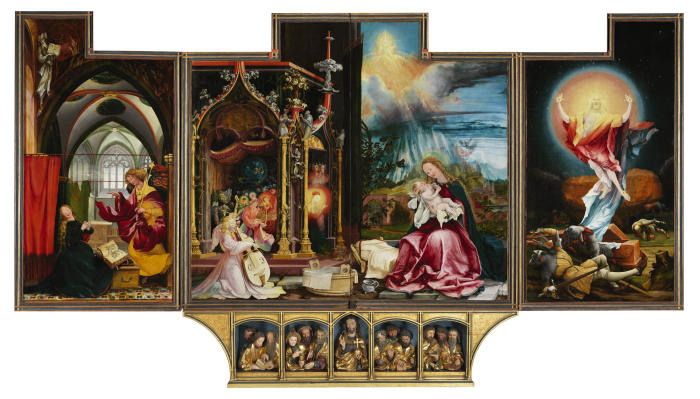
Matthias Grünewald, Isenheim Altarpiece (open), 1510
Northern Renaissance
-Material/technique: oil on wood panel; polyptych altarpiece
-Location: Antonite Hospital chapel
-Message/themes: Annunciation, Incarnation, and Resurrection
Northern Renaissance
-oil paint
-details
-iconography (visual symbolism, themes, and imagery used by artists to convey hidden or deeper meanings)
-combination of secular (not related to religion) and sacred