ICU Pharmacology: Critical Care Medications & Hemodynamics
 Call Kai
 Learn
Learn Practice Test
 Spaced Repetition
 Match
Match Flashcards
 Knowt Play
1/167

There's no tags or description
Looks like no tags are added yet.
Name | Mastery | Learn | Test | Matching | Spaced | Call with Kai | Chat |
|---|
No analytics yet
Send a link to your students to track their progress
168 Terms
What is an agonist in pharmacology?
A drug that binds to a specific cellular receptor and produces a predictable physiological response.
What is an antagonist (blocker)?
A drug that competes for the same receptor site and exerts an opposite action to another drug.
What are vasoactive medications?
Drugs that affect the tone of blood vessels.
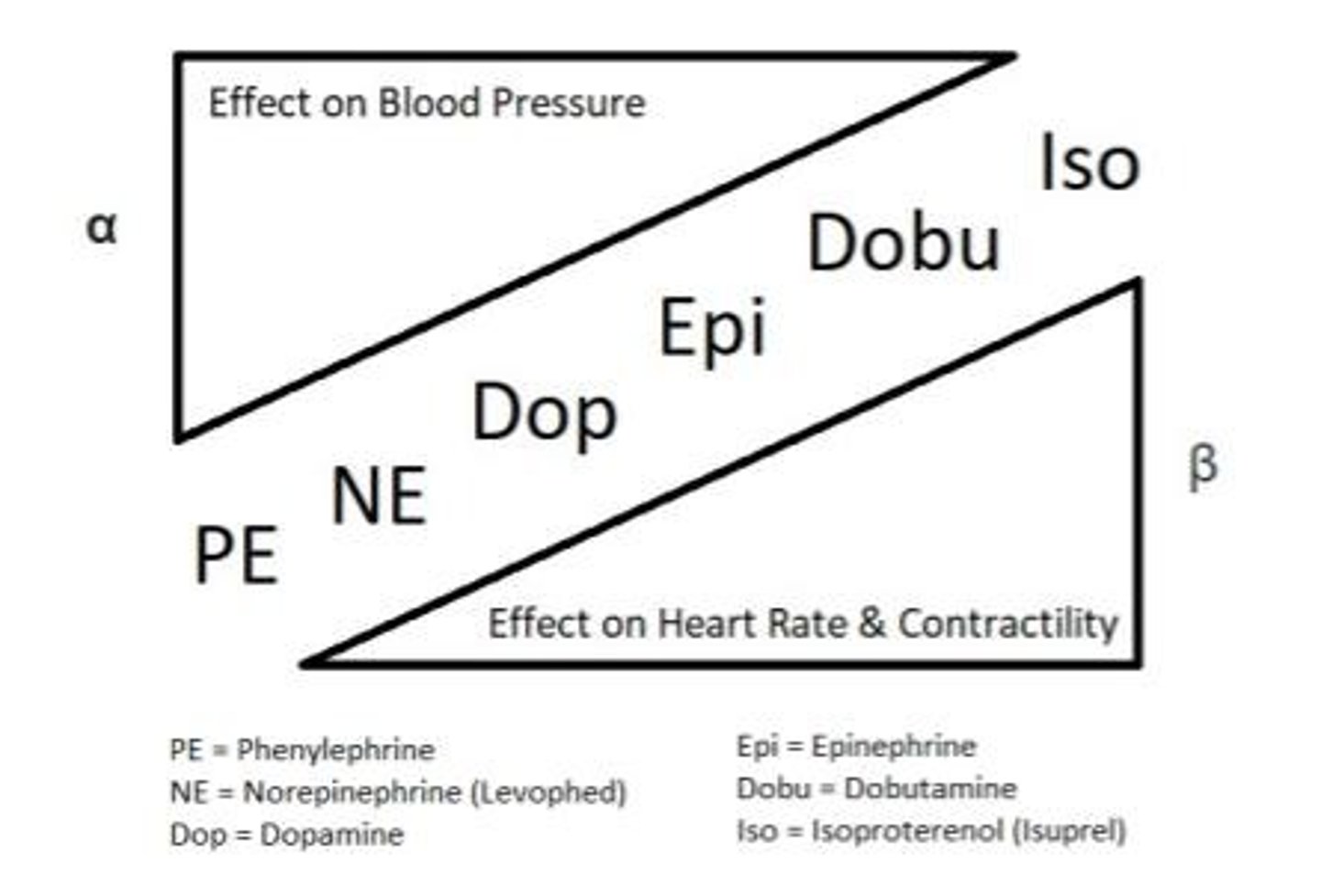
What is the function of a vasopressor?
Causes vasoconstriction, increasing blood pressure.
What does an inotrope do?
Affects the force of muscular contraction; positive inotropes increase contractility, negative inotropes decrease it.
What is the role of a chronotrope?
Affects heart rate; positive chronotropes increase rate, negative chronotropes decrease it.
What are crystalloids?
A primary type of IV fluid used in critical care, classified by tonicity.
What are isotonic crystalloids?
Solutions with the same concentration of solutes as blood plasma, expanding extracellular fluid volume without significant fluid shifts.
Give examples of isotonic crystalloids.
0.9% NaCl (Normal Saline), D5W (5% Dextrose in Water), Lactated Ringer's (LR), Plasmalyte.
What are hypotonic crystalloids?
Solutions with a lower concentration of solutes than plasma, causing fluid to shift into the cells.
What is an example of a hypotonic crystalloid?
0.45% NaCl (Half-Normal Saline).
What are hypertonic crystalloids?
Solutions with a higher concentration of solutes than plasma, causing fluid to shift out of the cells.
What is an example of a hypertonic crystalloid?
3% NaCl (Hypertonic Saline).
What is the primary function of the autonomic nervous system (ANS)?
Controls involuntary functions and is a major target for emergency medications.
What neurotransmitters are primarily used by the sympathetic nervous system (SNS)?
Norepinephrine, Epinephrine, and Dopamine.
What is the effect of activating alpha-1 receptors?
Leads to vasoconstriction.
What is the role of beta-1 receptors?
Found in the heart; activation increases heart rate and contractility.
What does activation of beta-2 receptors cause?
Bronchodilation.
What neurotransmitter does the parasympathetic nervous system (PNS) primarily use?
Acetylcholine.
What is the effect of atropine?
Increases AV node conduction and is indicated for hemodynamically significant bradycardia.
What are the effects of anticholinergic drugs?
Increased heart rate, bronchodilation, decreased GI secretions, and pupil dilation.
What is the nickname for the sympathetic nervous system?
Fight or Flight.
What is the nickname for the parasympathetic nervous system?
Rest and Digest.
What are the main receptor types in the sympathetic nervous system?
Alpha and Beta receptors.
What are the main receptor types in the parasympathetic nervous system?
Nicotinic and Muscarinic receptors.
What is the effect of beta-blockers?
Block beta-1 receptors to slow heart rate and lower blood pressure.
What is the classification of antiarrhythmics?
Vaughan Williams Classification, including Class I (Sodium Channel Blockers), Class II (Beta-Blockers), Class III (Potassium Channel Blockers), Class IV (Calcium Channel Blockers).
What is an example of a Class I antiarrhythmic?
Procainamide.
What is an example of a Class II antiarrhythmic?
Metoprolol.
What is an example of a Class III antiarrhythmic?
Amiodarone.
What is an example of a Class IV antiarrhythmic?
Diltiazem.
What is the action of Amiodarone?
Prolongs refractory period and decreases SA and AV conduction.
What are the potential hazards of Amiodarone?
Bradycardia, heart block, long QT, hypotension.
What is the initial dose of Adenosine for SVT?
6 mg rapid IV push followed by rapid NS flush.
What is the action of Adenosine?
Slows conduction through the AV node and interrupts re-entry pathways.
What are the indications for Nitroglycerine?
Preload reduction, hypertension control, chest pain management.
What is the action of ACE inhibitors like Ramipril?
Prevent Angiotensin I from converting to Angiotensin II, decreasing vasoconstriction.
What are common side effects of ACE inhibitors?
Dry cough and life-threatening angioedema.
What do ARBs do?
Block Angiotensin II receptors, allowing vessels to dilate.
What is the action of Loop Diuretics like Furosemide?
Inhibit sodium reabsorption in the Loop of Henle.
What is a major risk associated with Potassium-Sparing Diuretics?
Risk of hyperkalemia.
What is the action of Beta-Blockers?
Lower BP by decreasing cardiac contractility and heart rate.
What are the indications for Thrombolytics like tPA?
Used in emergency situations to dissolve existing clots.
What is the antidote for Opioids?
Naloxone (Narcan).
What is the antidote for Heparin?
Protamine Sulfate.
What is the antidote for Warfarin?
Vitamin K / PCC.
What is the action of Antiplatelets like Aspirin?
Prevent platelets from sticking together to form a clot.
What are the indications for using Digoxin?
Used for heart failure and certain arrhythmias.
What is the action of Calcium Channel Blockers?
Slow conduction through the AV node and are used for rate control in Atrial Fibrillation.
What are the potential hazards of Nitroglycerine?
Severe hypotension, headache, dizziness.
What is the action of Adrenergics like Clonidine?
Decreases peripheral vascular resistance.
What is the role of Thiazide Diuretics?
Often the first-line treatment for hypertension.
What is the action of Gabapentinoids?
Used for pain management.
What are common medications in Pain Management?
Opioids (Morphine, Fentanyl), NSAIDs (Ibuprofen, Ketorolac).
What is the action of Bronchodilators?
Used to open airways in respiratory conditions.
What is the purpose of corticosteroids in respiratory treatment?
Reduce inflammation in the airways.
What is the action of Mucolytics?
Help to thin and loosen mucus in the airways.
What are opioids used for?
Pain management
Name three examples of opioids.
Morphine, Hydromorphone (Dilaudid), Fentanyl
What do NSAIDs stand for?
Nonsteroidal Anti-Inflammatory Drugs
List three examples of NSAIDs.
Ibuprofen (Advil), Naproxen (Aleve), Ketorolac (Toradol)
What are gabapentinoids used for?
Neuropathic pain management
Name two examples of gabapentinoids.
Gabapentin (Neurontin), Pregabalin (Lyrica)
What is the function of muscle relaxants?
To relieve muscle spasms
Provide two examples of muscle relaxants.
Cyclobenzaprine (Flexeril), Baclofen
What is the role of bronchodilators?
To relax and open airways in the lungs
Name a short-acting beta2 adrenergic agonist.
Ventolin
What are inhaled corticosteroids used for?
To reduce inflammation in the airways
Give an example of an inhaled corticosteroid.
Flovent
What are the indications for antibiotics?
To treat bacterial and microbial infections
What class of antibiotics do penicillins belong to?
Beta-lactams
Name a common side effect of aminoglycosides.
Ototoxicity (hearing damage)
What is the mechanism of action for fluoroquinolones?
Interferes with bacterial DNA replication
What is the purpose of epinephrine in anaphylaxis?
To rapidly reverse severe allergic reactions
What are PPIs used for?
To reduce stomach acid production
What is the function of diuretics?
To increase urine production and reduce fluid retention
What does the term 'inotropic' refer to?
Drugs that affect the strength of myocardial contractions
What are positive chronotropes?
Drugs that increase heart rate
Name a negative inotropic agent.
Beta-blockers (e.g., Metoprolol)
What is the role of corticosteroids in anaphylaxis treatment?
To reduce inflammation and immune response
What is the mechanism of action for sulfonamides?
Inhibits folic acid synthesis required for bacterial growth
What are the nursing considerations for tetracyclines?
Avoid dairy, iron, and antacids; administer with water
What is naloxone used for?
To reverse opioid overdose
What are the indications for using antivirals?
To treat viral infections
What is the purpose of mucolytics?
To thin mucus in the airways
What is the primary use of antiemetics?
To prevent nausea and vomiting
What do chronotropic agents affect?
The heart rate by influencing electrical impulses at the SA node.
What are negative chronotropes?
Agents that decrease the heart rate, such as Beta-blockers, Digoxin, and Acetylcholine.
What do dromotropic agents affect?
The conduction velocity of electrical impulses through the heart's conductive tissue, specifically the AV node.
What are positive dromotropes?
Agents that speed up the conduction of electrical impulses, such as Isoproterenol.
What are negative dromotropes?
Agents that slow down conduction speed, useful for rate control in conditions like Atrial Fibrillation.
What is unique about Digoxin?
It has a positive inotropic effect but negative chronotropic and dromotropic effects.
What is the mechanism of action of Cardiac Glycosides like Digoxin?
They inhibit the sodium-potassium ATPase pump, increasing intracellular calcium to enhance contraction.
What are signs of Digoxin toxicity?
Nausea, blurred/halo vision, cardiac arrhythmias, and confusion.
What is the antidote for Digoxin toxicity?
Digoxin Immune fab.
What do Phosphodiesterase Inhibitors like Milrinone do?
Increase intracellular cAMP to allow more calcium for contraction and cause vasodilation.
What are the adverse effects of Phosphodiesterase Inhibitors?
Ventricular dysrhythmias and hypotension.
What is the Vaughan Williams Classification?
A system that categorizes antidysrhythmic drugs based on their effect on the cardiac action potential.
What is the action of Class Ia antidysrhythmic drugs?
They block sodium channels to reduce myocardial excitability.
What is the primary use of Class Ib antidysrhythmic drugs?
They are used exclusively for ventricular dysrhythmias.