Learn: Biomaterials: Exam 1
 Call Kai
 Learn
Learn Practice Test
 Spaced Repetition
 Match
Match Flashcards
 Knowt Play
1/94

There's no tags or description
Looks like no tags are added yet.
Name | Mastery | Learn | Test | Matching | Spaced | Call with Kai | Chat |
|---|
No analytics yet
Send a link to your students to track their progress
95 Terms
Biomaterial
A material intended to interface with biological systems to evaluate, treat, augment, or replace any tissue, organ, or function of the body
Biomaterial science
study of biomaterials and their interactions with the biological environment
Biocompatability
the ability of a material to perform with an appropriate host response in a specific application
metals
inorganic materials possessing non-directional metallic bond (highly mobile electrons)
characteristics of metals
load bearing implants and internal fixation devices; potential high tensile strength, high fatigue and high yield strengths
ceramics
inorganic compounds that contain metallic and non-metallic elements; for which inter-atomic bonding is ionic or covalent, and which are generally formed at high temperatures
glass
an inorganic product of fusion that has cooled to a rigid condition without crystallization; an amorphous solid
glass-ceramic
Polycrystalline solids prepared by the controlled crystallization (devitrification) of glasses.
Bioactive material
A material that elicits a specific biological response at the interface of the material, resulting in the formation of a bond between the tissues and the material.
Polymers
Organic materials; long chains that are held by directional covalent bonds.
elastomers
Sustain substantial deformation at low stresses and return rapidly to their initial dimensions upon release of stress.
Hydrogels
Ability to swell in water and to retain a significant fraction of water within their structures without completely dissolving.
composites
Consists of two or more chemically distinct components, one of which often a polymer.
synthetic polymers
Can be easily mass produced and sterilized; physical, chemical and mechanical properties can be tailored to specific applications.
naturally derived polymers
Have chemical composition similar to the tissue they are replacing; low mechanical properties.
hydrophobic
water-fearing
hydrophilic
water-loving
anisotrophy
Mechanical properties in different directions.
engineering stress
σ = F/A₀
engineering strain
ε = (li − lo)/lo
shear stress
T = F/A₀
shear strain
γ = tan q
hooke's law (tension)
σ = Eε
modulus of elasticity (youngs modulus)
slope of stress/strain curve (stiffness)
Hooke's Law (Shear)
τ = Gγ
shear modulus
G in hookes law
yielding
onset of plastic deformation
Stress-Strain Curve

fractures in metals
Occurs when noticeable necking starts.
fracture in polymers
Occurs when polymer backbone chains are aligned and about to break.
ductility
Calculated as % elongation or % area reduction.
((Lf-Lo)/Lo) x 100
hardness
resistance to permanently indenting the surface
toughness
total area under the stress/strain curve
large hardness means
Resistance to plastic deformation or cracking in compression; better wear properties.
thermal stress
σ = Eαl(T₀ − Tf) = EαlΔT
brittle fracture
no warning
ductille fracture
warning/necking before fracture
Griffith Theory
Crack propagation occurs when the released elastic strain energy is at least equal to the energy required to generate new crack.
fatigue fracture
Occurs suddenly after the material has been subjected to many cycles of altering stress or strain.
fatigue failure steps
Crack initiation
Crack propagation
Final failure
fatigue limit
Endurance limit, where S-N graph becomes horizontal.
fatigue strength
stress level that will cause failure after a given number of cycles.
fatigue life
Number of cycles required to cause fatigue fracture at a specified stress
creep
Deformation of a sample under constant load over time.
creep test
Performed by exerting a constant (usually tensile) load on the specimen, at a fixed temperature.
stage 1; primary creep
Creep (strain) rate decreases as strain increases with time; due to repositioning within the material in response to loading
stage 2; secondary creep
Equilibrium within material substructure; balance between recovery = strain hardening; strain rate minimum
stage 3; tertiary creep
Strain rate increases; defects appear inside the material.
nabarro-herring creep
Atomic diffusion is in the opposite direction resulting in an elongation of the grain along the line of applied stress.
coble creep
Vacancies migrate along the grain boundaries rather than through the bulk of the grain.
stress relaxation
Time dependent mechanical property, is the decrease in stress seen over time under constant strain.
below Tg (glass transition)
Chains in amorphous region are not able to rotate or slide, no time-dependent deformation
above Tg (glass transition)
Polymer chain can move past each other, time-dependent deformation indicative of viscous flow
viscoelastic material
Exhibit both viscous and elastic properties
Maxwell Model
Proposes a spring and dashpot in series
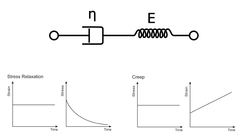
Maxwell Model Strength
Correctly predicts exponential decrease in stress over time during stress relaxation.
Maxwell Model Limitation
Incorrectly predicts Newtonian flow and linear increase in strain during creep
Voigt Model
Uses same component as the Maxwell model, but in different order (parallel)

Voigt Model Strength
Correctly predicts exponential strain increase over time during creep.
Voigt Model Limitation
Does not predict decrease in stress during stress relaxation.
elastic material
Material returns to its original shape when the external force is removed, given that the material does not exceed the elastic limit
viscous material
Material viscosity is the resistance of a fluid to deform
structural properties
Stiffness and maximum force; energy and elongation
Material (Mechanical) Properties
Modulus and maximum stress; strain energy density (SED) and strain
Time-Dependent Properties Cause Tissues To
Creep or elongate under constant or cyclic load; relax or reduce load under constant or cyclic elongation; show hysteresis when cycled in displacement control.
Ligament and Tendon Viscoelastic Properties
Show very little creep under subfailure loads; show ~30% force relaxation from initial peak load under subfailure elongations; show large hysteresis for first cycle that decreases with repeated cycling.
preconditioning
Required to remove this first cycle effect.
cytotoxicity
Lysis of cells, inhibition of cell growth
sensitization
Model to estimate potential for contact sensitization.
irritation
Choose test with relevant body entry route, duration of exposure, contact time
Intracutaneous Activity
Localized tissue reaction
systemic toxicity
Potential harmful effects with
genotoxicity
Determine gene mutations, changes in chromosome structure and number, DNA or gene toxicities caused by medical devices, materials or extracts.
implantation
Local pathological effects on living tissue of a sample of material implanted to a relevant tissue.
Haemocompatibility
Effects of blood-contacting devices on blood or blood components.
chronic toxicity
Effect on body of exposures from devices and materials for >10% of the life-span of the test animal.
Carcinogenicity
Tumorigenic potential.
Biodegradation
Absorption, distribution, biotransformation, elimination of leachables and degradation products
Reproductive and Developmental Toxicity
Reproductive function, embryonic development, prenatal and early postnatal development
surface roughness
Affects the properties of cells such as cell adhesion, cell selection, and cellular integration
rough surfaces
Fixation of the device by providing friction and mechanical interlocking.
smooth surfaces
blood flow
AFM (Atomic Force Microscopy)
Measurement of roughness parameter
wettability (surface energy)
whether the surface is hydrophilic or hydrophobic
hydrophilic surface
Encourages formation of a film over the material to discourage the adhesion of gas bubbles and bacteria
contact angle measurement
A drop of water is placed on the surface
Hydrophobic Surface
Causes the water to bead up on the surface producing a higher angle of contact
chemical composition evaluation
Surface contamination; coverage of surface treatment; analysis of chemical function
surface charge
Influence the percent cell adhesion and retention under flow conditions
crystallinity
Determine specific responses to thermal and mechanical properties; stimulate certain cell activities
porosity
Indicate the capacity of the material to support tissue ingrowth
high porosity
Desirable to aid in implant fixation; however this can compromise the mechanical strength of the device
surface modification
Can be used to alter how the material is viewed in vivo without affecting mechanical properties
Plasma Glow Discharge
A low pressure, ionized gas deposits a film over the surface of the material or etches the surface
radiation grafting
Break chemical bonds, which form free radicals or other reactive groups.