Speciation Practice Problems
 Call Kai
 Learn
Learn Practice Test
 Spaced Repetition
 Match
Match Flashcards
 Knowt Play
1/31

There's no tags or description
Looks like no tags are added yet.
Name | Mastery | Learn | Test | Matching | Spaced | Call with Kai | Chat |
|---|
No analytics yet
Send a link to your students to track their progress
32 Terms
Red wolves once populated the southern US as far north as Pennsylvania and New York. However, by 2007, their numbers had dwindled to fewer than 300, of which 2/3 were in captivity. Red wolves (Canis rufus) consequently received protection under the Endangered Species Act, except genetic studies suggest red wolves are the result of a hybridization event between gray wolves (Canis lupus) and coyotes (Canis latrans) between 150-300 kya. Which of the following statements about the status of red wolves as a species is true:
A. Red wolves meet the definition of a distinct species by the biological species concept.
B. Red wolves do not meet the definition of a distinct species by the biological species concept.
C. There is insufficient information to determine if red wolves meet the definition of a distinct species from the biological species concept.
C. There is insufficient information to determine if red wolves meet the definition of a distinct species from the biological species concept.
True or false: Assortative mating can cause populations to diverge.
True
Cell-surface recognition compounds on gametes are an example of
Mechanical Barrier
Brown or grizzly bears (Ursus arctos) are abundant in regions with brief springs and summers where they can fatten up on abundant wildlife and hibernate for 5-7 months of winter. Polar bears (Ursus maritimus) are abundant in regions with sea ice where they can hunt year round on prey that reproduce on land. Which model of speciation best describes grizzly and polar bear divergence?
Allopatric
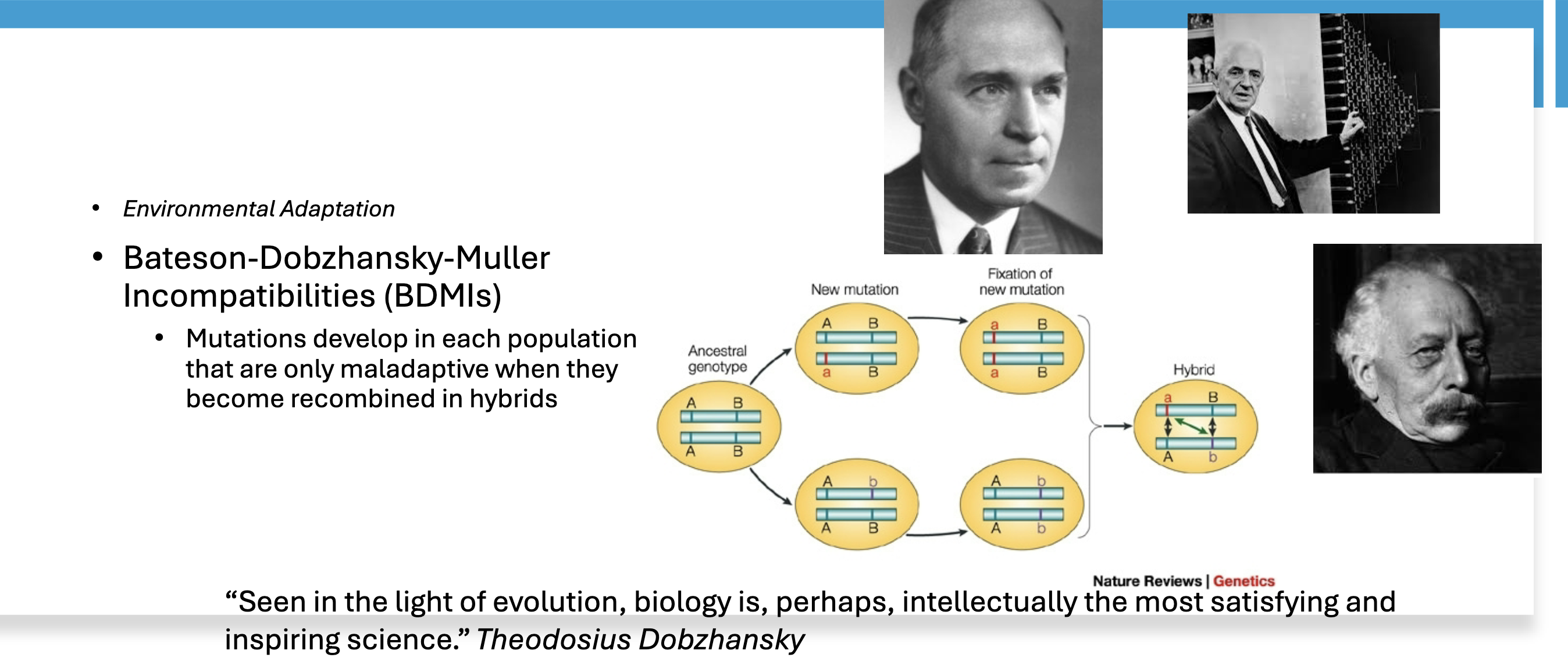
True or false: BDMIs (Bateson-Dobzhansky-Muller Incompatibilities) usually occur in hybrids rather than in parental lineages.
True
Grizzly bears (Ursus arctos) have been expanding their range northward as climate change has
forced them to cooler latitudes. In doing so, they have encountered polar bears (Ursus maritimus) and begun hybridizing. What is a possible outcome if hybrids of grizzly and polar bears continue to interbreed?
a. Reinforcement
b. Fusion
c. Stability
d. All of the above
d. All of the above
Which of the following is an example of vicariance:
A. A female aphid develops a mutation that inhibits her ability to produce offspring with males in her population. Over time, two populations of aphids evolve in the same region that are unable to interbreed.
B. A river runs through the territory of a population of squirrels. Over time, the squirrels on either side of the river become separated and evolve into two separate populations.
C. A cohort of fish larvae migrate to a newly formed reef. Over time, the fish on the new reef and the fish on the old reef evolve into two separate populations.
D. A population of copepods expands northward as glaciation retreats. Over time, several populations of copepods evolve that can interbreed with the populations close to them, but not with populations far from them.
B. A river runs through the territory of a population of squirrels. Over time, the squirrels on either side of the river become separated and evolve into two separate populations.
Which of the following are requirements for evolution by natural selection to occur? Select ALL that apply.
A. Variation
B. Differential reproduction
C. Large population size
D. Heritability
A. Variation
B. Differential reproduction
D. Heritability
Two species of spadefoot toads (Spea multiplicata and Spea bombifrons) both live in semi-arid areas of the American Southwest. When these two species come out to reproduce males of S. multiplicata will produce a few slow calls ("Brrrrrrrrrrp Brrrrrrrrrp") whereas males of S. bombifrons will produce many fast calls ("Brp Brp Brp Brp Brp"). This allows females to identify males of their own species and is an example of which type of isolation?
Pry-zygotic
The American crocodile and the Cuban crocodile can interbreed and produce viable, fertile offspring. Which type of hybrid zone does this example currently represent?
Fusion
A few million years ago, some individuals in the species Drosophila persimilis experienced a chromosomal mutation (specifically an inversion). Consequently, individuals of D. persimilis with the mutation were no longer able to produce viable offspring with D. persimilis that did not have the mutation. Today, the lineage that acquired this mutation is called Drosophila pseudoobscrua and is its own species. This is an example of which type of speciation?
Sympatric
Evolution always occurs slowly and gradually.
False

Figure 1A (previous page) shows the range of different seven subspecies, or populations, of the greenish warbler around the Asian continent. Color gradations indicate morphological clines between the populations and possible hybrid zones. The red and violet striped (“hatched”) area in central Siberia indicates the overlap zone of two subspecies that do not mate together. While the greenish warbler range likely started in central Asia (the lavender population) before spreading north and south around the Himalayas. The gap between the ends of the orange population is likely the result of recent habitat destruction in China. Describe what you expect the genetic clines of the populations to be. You may abstractify your description using an unrooted phylogenetic tree
Blue would form the center of two major branches. One branch leading to the violet and one branch leading to the green, yellow, orange then red. Lavendar may be a small branch away from blue.

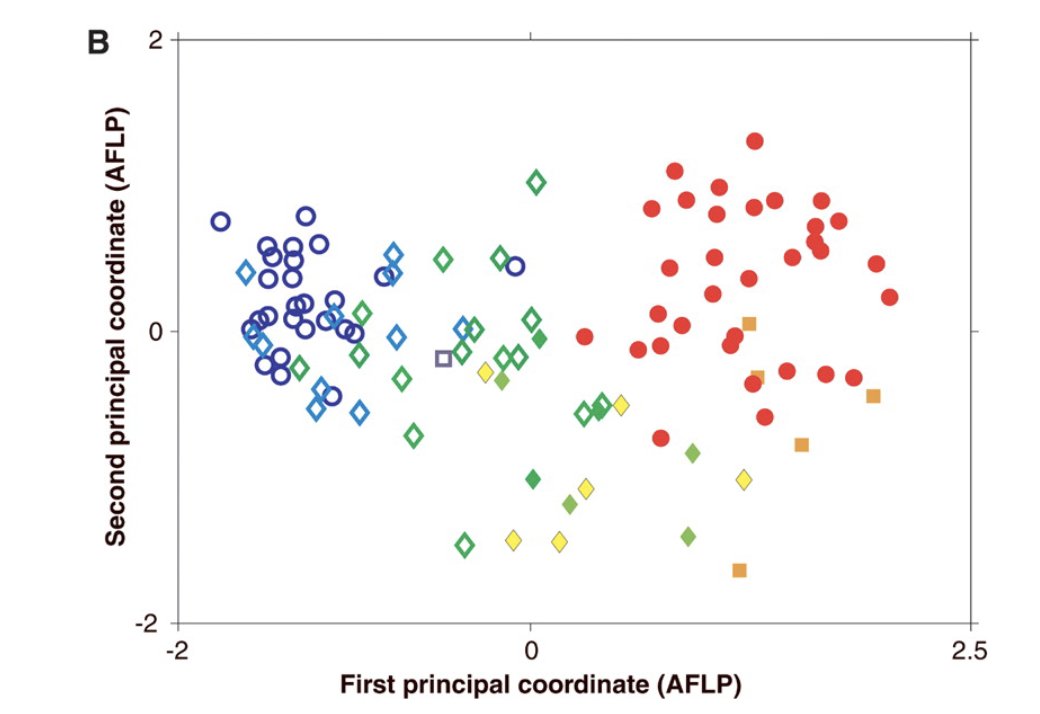
Figure 1B (previous page) is a PCA plot of the AFLP gene used by the authors to measure genetic distance between the subspecies. The symbols and colors match the sampling location indicated in 1A (ex. a red circle in 1B indicates one of the UY samples in 1A). Describe the pattern of genetic clines of the population according to the PCA plot.
The “center” is the green and yellow, with branches of populations moving away from them. The primary axis separates the orange reds (on the right) and the violet blues (on the left). The second axis mostly separates the red and orange (top from bottom) and the green and yellow, but poorly resolves the lavender, violet and blue.
Compare your prediction in Q1 and your interpretation in Q2. Do they match? What do these results combined indicate about the continuum of speciation observed for the greenish warbler? (Look at questions 14 and 15)
Overall, they match. The main divide between the subspecies of the greenish warbler are between the geographic southern branch (yellow, orange, red) and the northern branch (green, blue, lavender, violet). Perhaps most importantly, the two “ends” (violet and red) are genetically most distant even though their geographic ranges overlap. This can be explained because of the geographic distance from the original home range that each population has overcome.

The AFLP gene is from the nuclear genome. On the next page is an unrooted phylogenetic tree of the mitochondrial genomes where the colors match the geographic populations indicated in Figure 1A. Is the mitochondrial data from the supplemental figure on the next page consistent with the data from Figure 1B of the previous page? Explain.
Mostly, yes. Although the yellow and green overlaps more with the red and orange populations than might be suggested from the PCA plot in Figure 1B, the large mitochondrial genetic distance between the violet and red populations is consistent with the genetic distance of the AFLP gene.
What value does including mitochondrial data add to the nuclear data presented above? Discuss the difference in inheritance patterns and evolution patterns between nuclear and mitochondrial DNA.
Mitochondrial genomes have higher substitution rates than nuclear genomes, and they do not recombine as nuclear genomes can. Additionally, mitochondrial genomes are inherited maternally, leaving a single lineage from which a haplotype descends. This is unlike the nuclear genome which can have genetic introgression from more distant lineages. Consequently, combining nuclear and mitochondrial strengthens support for the hypothesis that populations of the greenish warbler spread around the Himalayas and have met each other again in the hatched zone in northern central Asia. In other words, if only the nuclear markers had been used, other mechanisms (such as admixture) could not be ruled out as explanations for the pattern. However, since mitochondrial genomes cannot recombine as nuclear genomes can, this explanation can be ruled out.

Below are two pairwise plots of genetic distance versus geographic distance. The symbols match those used in Figure 1 and the supplemental tree above. Note that both axes are a range of negative to positive values. What do these graphs indicate about the speciation pattern for the greenish warbler?
Both plots show the diamond/green population as being the intermediate genotype between the red (closed circle) and violet (open circle) populations. Both plots demonstrate that the populations of greenish warblers have diverged along two different evolutionary lineages, and although the red and violet population ranges overlap geographically, they are genetically the most dissimilar.
In a follow-up article1, several of the same authors found that the birdsongs also correlated with geographic and genetic distance. What mechanisms of evolution are likely at play for driving the divergence? Be as specific as possible.
The genotype differences identified in the first article are likely linked to the phenotype differences identified in the second article. In terms of the mechanisms (selection, mutation, migration and drift), it seems most likely that the growing edge of the species’ range has permitted factors like mutation and drift to generate diversity between populations of the north and south perimeters. Specifically, it seems likely that the variation occurred in birdsong. This, combined with sexual selection favoring certain birdsongs in certain regions appears to set up a case of runaway sexual selection.
Which scientific concept did Charles Darwin and Alfred Wallace independently discover?
Natural Selection
Which of the following situations will lead to natural selection:
A. The seeds of two plants land near each other and one grows larger than the other.
B. Two types of fish eat the same kind of food, and one is better able to gather food than the other.
C. Male lions compete for the right to mate with females, with only one possible winner.
D. All of the above
D. All of the above
Which description is an example of a phenotype:
A. A certain duck has a blue beak.
B. A mutation occurred to a flower.
C. Most cheetahs live solitary lives.
D. Both a and c
D. Both a and c
Which situation is most likely an example of convergent evolution:
A. Squid and humans have eyes similar in structure.
B. Worms and snakes both move without legs.
C. Some bats and birds have wings that allow them to fly.
D. All of the above
D. All of the above
Which situation would most likely lead to allopatric speciation?
Flood causes the formation of a new lake.
What is the main difference between dispersal and vicariance?
One involves the movement of the organism, and the other involves a change in the environment.
Which variable increases the likelihood of allopatric speciation taking place more quickly?
Longer distance between divided groups
What is the main difference between autopolyploid and allopolyploid?
The source of the extra chromosomes
Which reproductive combination produces hybrids?
When members of closely related species reproduce
Which condition is the basis for a species to be reproductively isolated from other members?
It does not change genetic information with other species
Which situation is not an example of a pre-zygotic barrier?
Two species of insects produce infertile offspring
Which term is used to describe the continued divergence of species based on the low fitness of hybrid offspring?
Reinforcement
Which components of speciation would be least likely to be a part of punctuated equilibrium?
Ongoing gene flow among all individuals