Prokaryotes
 Call Kai
 Learn
Learn Practice Test
 Spaced Repetition
 Match
Match Flashcards
 Knowt Play
1/36

Earn XP
Description and Tags
Gen Bio 2
Name | Mastery | Learn | Test | Matching | Spaced | Call with Kai | Chat |
|---|
No analytics yet
Send a link to your students to track their progress
37 Terms
Eukaryotes
Cells with membrane bound organelles and nuclei. Found in multicellular organisms.
Prokaryote
Includes Archea and Bacteria which house singular cell organisms and cells that lack nuclei and membrane bound organelles.
Carl Woese
The creator of the three-domain system to classify organisms in 1977.

Prokaryotic Genomes
has less DNA than eukaryotic genomes
consists of circular chromosomes
Typical genomes are rings of DNA that has no membrane and is located in the nucleoid region
Some have smaller rings called plasmids
Archaea
share traits with both eukaryotes & bacteria
found in both extreme and moderate environments
Prokaryotic Abundance & Size
estimated population of prokaryotic cells is 4-6×10³^0 cells
typically measure to be 0.5-5 picometers smaller than eukaryotic cells
inhabit diverse environments from soil, water to extreme environments
Peptidoglycan
A network of sugar polymers cross-linked by polypeptides
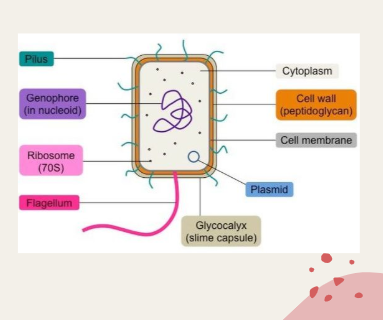
Prokaryotic cells features
cytoplasm
cell wall
cell membrane
plasmid
glycocalyx
(some have flagellum)
ribosomes
genophone
pilus
Pilus
A hair like structure made of repeating proteins called pilin. Used for adhesion, motility, and conjugation.
Genophore
The main long DNA molecule that carries the genetic info in bacteria. Located in the cytoplasm.
Plasmid
A small circular piece of double-stranded DNA found in bacteria that exists and replicated separately from the main bacterial chromosome.
Glycocalyx
present in different types of bacteria
a sticky,sugar-rich, outer layer that surrounds the cell wall of many bacteria
Prevents the cell from drying out
Ribosome
A tiny molecular machine made of protein and RNA that builds the proteins inside a bacterial cell
Free floats throughout the cytoplasm
Polysaccharide
A protein layer called a capsule the covers many prokaryotes.
Fimbriae ( Also called Pili)
Long hair like structures that allow them to stick to their substrate or other individuals in a colony.
S3x Pili are longer and allow them to exchange DNA by conjugation.
Gram Staining
A common laboratory test used to divide bacteria into two major groups based on cell wall composition, Gram-positive & Gram negative.
Gram Negative bacteria
Have less peptidoglycan and an outer membrane that can be toxic to other organisms.
more likely to be antibiotic resistant.
Gram Positive
Have more peptidoglycan and a thicker outer membrane which makes it non-toxic and non-resistant to antibiotics
Prokaryotic Motility
Most motile bacteria propel themselves by their flagella ( structurally different from eukaryotic flagella)
In heterogeneous environments many bacteria exhibit taxis ( the ability to more toward or away from stimuli)
Heterogeneous environment
A setting made of mixed, dissimilar, or diverse parts rather than uniform elements.
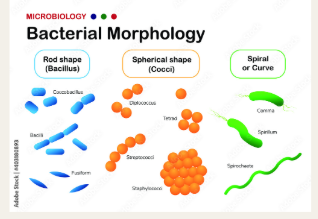
Bacterial Shapes
coccus ( Cocci/plural), Spherical
Bacillus, rod-shaped
Spirillum, spiral shaped
Bacterial Nutrition
Heterotrophic: Require organic carbon sources
Autotrophic: Synthesize organic compounds from CO2
Chemosynthetic: gain energy from oxidizing inorganic compounds
photosynthetic: Uses light energy to synthesize organic compounds
Asexual Reproduction
Divide through binary fission ( simple cell division )

Transformation
a type of horizontal gene transfer
uptakes naked DNA by other competent bacteria and maybe integrated into the genome or existent plasmid.

Transduction
a type of horizontal gene transfer
Transfer of DNA by a virus
Virus activates and rewrites DNA of bacteria to form a new bacteria cell

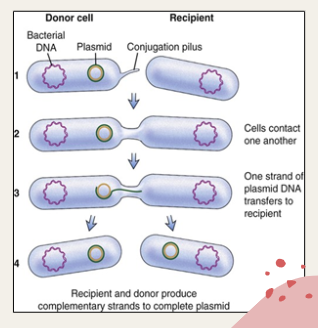
Conjugation
A type of horizontal gene transfer
Transfer of DNA through direct contact with another cell
a strand of plasmid DNA transfers to the recipient
Life Cycle of Prokaryotes
Lag: Adaptation to environment
Log: Exponential growth
Stationary Phase: Growth rate equals death rate
Death Phase: nutrient depletion and waste accumlation
Prokaryotes leads to high mutation rates and genetic diversity

Nutrient Cycling
Prokaryotes help with the decompostiion and nutrient recycling in ecosystems.

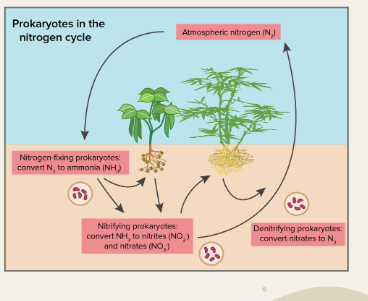
Nitrogen Fixation
Cyanobacteria convert atmospheric nitrogen into usable forms for plants.
Symbiotic Relationships
Prokaryotes have relationships with other plants and animals that benefit both of them.
Ex. Nostoc bacteria with hornworts.
Bioremediation
Prokaryotes clean up environmental pollutants.
Prokaryotic Lab Specimen: Spirillum Volutans
A large, helical bacteria commonly found in stagnant freshwater environments
known for its distinctive spiral shapes and its role in the microbial ecology of these habitats
Plays a major role in decompostiion of organic material and indicates water quality
the presence of spirillum volutans can suggest low oxygen conditions & high organic matter
measuring 5-8 picometers in diameter
a bipolar flagella which allows corkscrew motion
Gram-negative w/ cell wall structure that includes an outer membrane

Bacterial Fermentation
A metabolic process that converts sugars to acids, gases, or alcohol, in the absence of oxygen.
Importance of fermentation, preservation, food production
Ex. lactic acid bacteria and yeast
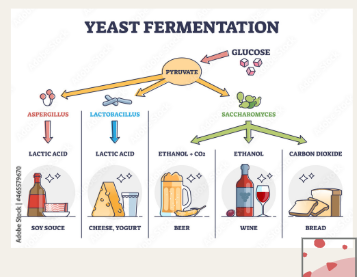
Lactic Acid Fermentation
Carried out by lactic acid bacteria Lactobacillus
converts glucose into lactic acid
examples are yogurt and sauerkraut
Alcoholic Fermentation
Carried out by yeast and some bacteria
Converts glucose into ethanol and carbon dioxide
examples are beer, wine and the rising of bread dough
Acetic Acid Fermentation
Carried out by acetic acid bacteria
converts ethanol into acetic acid
examples vinegar
Cyanobacteria
photoautotrophs using photosynthesis to generate oxygen
contain chlorophyll and can fix atmospheric nitrogen (important for plant growth
has specialized cells like heterocysts and akinetes aid which aid in survival and nitrogen fixation
