ASVAB Mechanical Comprehension part 3
 Call Kai
 Learn
Learn Practice Test
 Spaced Repetition
 Match
Match Flashcards
 Knowt Play
1/90

There's no tags or description
Looks like no tags are added yet.
Name | Mastery | Learn | Test | Matching | Spaced | Call with Kai | Chat |
|---|
No analytics yet
Send a link to your students to track their progress
91 Terms
What is a wedge?
A moving inclined plane used to split, cut, lift, or separate objects.
What does the wedge move?
Wedge moves between objects and pushes them apart.
What are examples of wedges?
Axe
Knife
Chisel
Doorstop
How does a wedge work?
Works by converting a forward pushing force into sideways forces.
What type of wedge is easier to split objects?
Thinner
Longer
As the wedge moves forward:
It pushes the material apart.
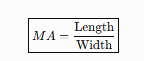
How is the mechanical advantage of a wedge calculated?
Length = distance from tip to back
Width = thickness of the wedge
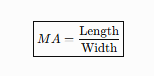
How does the shape of a wedge affect its mechanical advantage?
Longer, thinner wedge = greater mechanical advantage; Spreads the force over a longer distance, making it easier to split or cut.
What is the relationship of a long + thin wedge towards mechanical advantage?
Greater mechanical advantage
What is the relationship of a short + thick wedge towards mechanical advantage?
Lower mechanical advantage
How are an inclined plane and a wedge different?
Inclined Plane
Usually stays stationary
Moves an object up or down
Example: Ramp
Wedge
Usually moves
Pushes between objects
Splits, cuts, or separates materials
Example: Axe
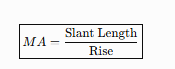
What is the formula for Inclined Plane?
What is the formula for Wedge?
What is a lever?
A simple machine that helps make work easier by rotating around a fixed point called the fulcrum.
What can a lever do?
Increase force
Increase distance
Change the direction of a force
Examples of a lever.
Crowbar
Seesaw
Wheelbarrow
Baseball bat
What are the three parts of a lever?
1. Fulcrum
2. Effort (Input Force)
3. Resistance (Load)
Memory Trick:
"Fulcrum = Pivot • Effort = Push • Resistance = Load."
What is a fulcrum in regards to a lever?
The fixed pivot point where the lever rotates.
What is effort in regards to a lever?
Input force
The force you apply to move the lever.
What is resistance in regards to a lever?
Load
The object or weight being moved.
What is a first-class lever?
Has the fulcrum between the effort and the resistance.
Memory Trick:
"First = Fulcrum First (in the middle)."
What is the arrangement for a first-class lever?
Arrangement:
Effort → Fulcrum → Resistance
or
Resistance → Fulcrum → Effort
What can a first-class lever do?
Increase force
Increase distance
Change the direction of the applied force
What is an example of a first-class lever?
Seesaw
Crowbar
Hammer pulling a nail
Scissors
Think of a seesaw:
The fulcrum is in the center.
What is a second-class lever?
Lever that has the resistance (load) between the fulcrum and the effort.
What is the arrangement of a second-class lever?
Fulcrum → Resistance → Effort
What does a second-class lever do?
Increases force
Does not increase distance
It makes lifting heavy loads easier.
What is an example of a second-class lever?
Wheelbarrow
Nutcracker
Bottle opener
Think of a wheelbarrow:
Fulcrum = Wheel
Resistance = Load
Effort = Handles
What is a third-class lever?
Lever that has the effort between the fulcrum and the resistance.
What is the arrangement of a third-class lever?
Fulcrum → Effort → Resistance
What does a third-class lever do?
Increases distance and speed
Does not increase force
It sacrifices force to produce greater movement.
What is an example of a third-class lever?
Baseball bat
Fishing rod
Tweezers
Human forearm
Think of a baseball bat:
Fulcrum = Hands
Effort = Lower hand applying force
Resistance = Ball
Which class of lever increases force?
First-Class Lever
Second-Class Lever
Which class of lever does not increase force?
Third-Class Lever
Which class of lever increases distance and speed?
First-Class Lever
Third-Class Lever
What is a pulley and tackle system?
A group of pulleys connected with ropes that helps lift heavy objects using less
What does a pulley and tackle system create?
Creates mechanical advantage by using multiple sections of rope to support the load.
Examples of a pulley and tackle system.
Cranes
Elevators
Boat rigging
Hoists
What determines the mechanical advantage of a pulley and tackle system?
The number of rope sections supporting the unfixed pulley.
When there are more ropes connected to and supporting the moving (unfixed) pulley what happens?
(PULLEY AND TACKLE SYSTEM)
The greater the mechanical advantage
Memory Trick:
"Count the ropes, find the force."
What is an unfixed pulley?
A pulley that moves with the load.
What does a unfixed pulley help with?
It helps reduce the force needed to lift an object.
The ropes attached to this pulley support the load.
How do you determine which pulley system has the greatest mechanical advantage?
Find the unfixed (movable) pulley.
Count the number of rope sections pulling on or supporting it.
The system with more supporting ropes has the greater mechanical advantage.
Why do more ropes increase mechanical advantage in a pulley system?
Each rope section supporting the unfixed pulley shares part of the load.
What do more rope sections mean in a pulley system?
Less force needed to lift the object
Greater mechanical advantage
What is the trade off of having more rope sections in a pulley system?
You must pull more rope to move the load the same distance.
What is the formula for mechanical advantage in a pulley system?

What is density?
the amount of mass contained in a specific volume of a substance; how much "stuff" is packed into a certain space.
What are examples of density?
A rock has a high density because a lot of mass is packed into a small volume.
A balloon filled with air has a low density because little mass is spread out over a large volume.
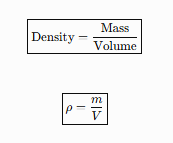
How is density calculated?
ρ = density
mmm = mass
VVV = volume
What happens to density when mass increases?
Density increases; volume stays the same.
↑Mass=↑Density
What happens to density when volume increases?
Density decreases; mass stays the same.
↑Volume=↓Density
What is pressure?
The amount of force applied over a certain area; tells us how concentrated a force is.
What are examples of pressure?
A sharp knife creates high pressure because the force is concentrated over a small area.
A snowshoe creates lower pressure because the force is spread over a larger area.
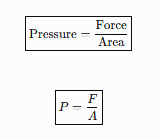
How is pressure calculated?
P = pressure
F = force
A = area
What happens to pressure when force increases?
Pressure increases; area stays the same.
↑Force=↑Pressure
Memory Trick:
"More push = more pressure."
What happens to pressure when area increases?
Pressure decreases; force stays the same.
↑Area=↓Pressure
Memory Trick:
"Spread the force, reduce the pressure."
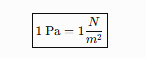
What is the SI unit of pressure?
Pascal (Pa)
What is a pascal equal to?
One Newton of force applied over one square meter.
Are density and pressure scalar or vector quantities?
Scalar quantities
What does a scalar have?
Magnitude (amount)
No direction
What are examples of scalar quantities?
Density
Pressure
Temperature
Mass
What are examples of vector quantities?
Force
Velocity
Torque
What does a vector have?
Magnitude (amount)
Direction
What is Pascal’s Principle?
When pressure is applied to an enclosed fluid, that pressure is transmitted equally and undiminished throughout the entire fluid and to the walls of the container.
SIMPLE TERMS: A push on one part of a trapped fluid creates the same pressure throughout the fluid.
What does Pascal’s Principle tell you
Memory Trick:
"Pressure placed in a fluid spreads equally."
How does Pascal’s Principle work in a hydraulic system?
Hydraulic systems use Pascal’s Principle to multiply force.
What happens when force is applied to a small piston?
Pressure is created in the fluid.
The pressure travels equally through the fluid.
The pressure pushes on a larger piston.
The larger piston produces a greater output force.
What are examples of force being applied to a small piston (Pascal’s Principle work in a hydraulic system)
Hydraulic jack
Car brakes
Hydraulic lifts
Why does Pascal’s Principle allow force multiplication?
Pressure is transmitted equally
What is the formula for Pascal’s Principle?

Regarding Pascal’s Principle, what happens when the same pressure acts on a larger area?
More force is produced.
Characteristics of a small piston regarding Pascal’s Principle?
Small area
Small input force
Characteristics of a large piston regarding Pascal’s Principle?
Large area
Larger output force
What is Bernoulli’s Principle?
When a fluid moves, energy is conserved.
A change in fluid speed causes a change in pressure.
Relationship of higher speed to pressure using Bernoulli’s Principle?
Higher speed = Lower pressure
Relationship of lower speed to pressure using Bernoulli’s Principle?
lower speed = higher pressure
What is the relationship between fluid speed and pressure in Bernoulli’s Principle?
Fluid speed and pressure are inversely related.
When speed increases:
↑Speed→↓Pressure
When speed decreases:
↓Speed→↑Pressure
What does Bernoulli’s Principle assume about fluid energy?
Do not create energy
Do not destroy energy
Transform energy between pressure, speed, and height
The total energy remains constant.
What is the main difference between Pascal’s and Bernoulli’s Principles?
Pascal’s Principle focuses on: Pressure in enclosed fluids
Bernoulli’s Principle focuses on: Moving fluids
Pascal’s Principle example.
Hydraulic jack
Bernoulli’s Principle examples.
Airplane wings
Fluid flowing through pipes
What are the three ways heat can be transferred?
Conduction
Convection
Radiation
What is conduction?
Transfer of heat through direct physical contact between objects.
Moves from hot to cold.
Examples of conduction.
The hot pot transfers heat
Your hand absorbs the heat
The heat travels through the material by direct contact.
How does conduction transfer heat?
Hot particles vibrate faster.
They collide with nearby particles.
Energy transfers from particle to particle.
The material itself does not move; only heat energy moves.
What is convection?
Transfer of heat through the movement of fluids (liquids, gases).
What happens to fluids when it heats up?
It expands.
It becomes less dense.
It rises.
Cooler fluid moves in to replace it.
This creates a convection current.
What is an example of convection?
Steam heating your hand; Hot steam particles move and transfer heat to your hand.
Boiling water
Warm air rising
Ocean currents
What is radiation?
Transfer of heat through electromagnetic waves.
Radiation does not require physical contact or a fluid.
Heat can travel through empty space.
How is radiation different from conduction and convection?
Conduction:
Direct contact
Convection:
Moving fluid
Radiation:
No contact
No fluid