Lecture Exam 1 kim jones
 Call Kai
 Learn
Learn Practice Test
 Spaced Repetition
 Match
Match Flashcards
 Knowt Play
1/212

There's no tags or description
Looks like no tags are added yet.
Name | Mastery | Learn | Test | Matching | Spaced | Call with Kai | Chat |
|---|
No analytics yet
Send a link to your students to track their progress
213 Terms
important comment of culture media
agar
primary structure of proteins
amino acid
glycoproteins with specific regions of attachment for bacteria, viruses, and other microorganisms
antibody
uses microbes already present or introduced intentionally to restore ability or clean up toxic pollutants
bioremediation
cell wall of plants and many algae
cellulose
disruption of native state of protein through application of various agents
denature
an infectious disease whose incidence has increased in the past 20years and could increase in the future
emerging infectious disease
catalyst for all chemical reactions in cells
enzyme
true nucleus, single celled
eukaryote
hereditary information of living beings gradually changes through time
evolution
manipulates the genetics of microbes, plants, and animals for the purpose of creating new products and GMOs
genetic engineering
protective outer layer, role in the attachment of cells to other cells or surfaces
glycocalyx
water loving, negative charge
hydrophillic
water fearing, uncharged
hydrophobic
component of the gram-negative cell wall
Lipopolysaccharide
A very large organic molecule composed of many smaller molecules
Macromolecule
Any organism of microscopic or submicroscopic size.
microorganism
subunits of macromolecules
monomer
microbes that cause diseases
pathogen
short chain of amino acids
peptide
component of the bacterial cell wall
peptidoglycan
chain of various lengths of monomers
polymer
long chain of amino acids that makes proteins
Polypeptide
unicellular organism lacking a nucleus
Prokaryote
DNA that has been formed artificially by combining constituents from different organisms.
Recombinant DNA
present or existing everywhere
ubiquitous
bacteria, algae, protozoa, fungi, viruses
what are the 5 major groups of microorganisms
(microbiology) single-celled or noncellular spherical or spiral or rod-shaped organisms lacking chlorophyll that reproduce by fission
bacteria
Kingdom composed of heterotrophs; many obtain energy and nutrients from dead organic matter
fungi
A tiny, nonliving particle that invades and then reproduces inside a living cell.
Virus
microscopic, one-celled animals often found in decayed materials and contaminated water
protoza
typically eukaryotic microorganisms that carry out photosynthesis
algae
3.5 billion years ago
when did the first prokaryotes appear
1.8 billion years ago
when did the first eukaryotes appear
Photosynthesis that oxidizes water to form oxygen; the form of photosynthesis characteristic of plants, protists, and cyanobacteria
oxygenic photosynthesis
the series of processes by which nitrogen and its compounds are interconverted in the environment and in living organisms, including nitrogen fixation and decomposition.
nitrogen cycle
nitrogen fixation, nitrification, assimilation, ammonification, denitrification
nitrogen cycle steps
bread production, alcohol production, treatment of wounds and lesions, cleaning up human created contamination
what are some beneficial roles of bacteria
AIDs, Hep C, Zika Virus
Emerging and Remerging Diseases
spontaneous generation (development of life from lifeless matter)
Abiogenesis
development of life from preexisting life
Biogenesis
A French chemist, this man discovered that heat could kill bacteria that otherwise spoiled liquids including milk, wine, and beer.
Louis Pasteur
Pasteurization
Louis Pasteur
first to observe "small chambers" in cork and call them cells.
Robert Hooke
made first simple microscope
Anton van Leeuwenhoek
Provided indirect evidence linking microbes to disease. Developed surgery to prevent microbes entering wounds. Aseptic technique
Joesph Lister
Discovered and described bacterial endospores
Ferdinand Cohn
along with Ignaz Semmelweis promoted importance of hand washing to prevent disease in hospital settings
Oliver Wendell Holmes
advocated hand washing to prevent transmission of puerperal fever from one OB patient to another
Ignaz Semmelweis
Developed the culture plate method to identify pathogens
Robert Koch
an enzyme produced chiefly by certain bacteria, having the property of cleaving DNA molecules at or near a specific sequence of bases.
restriction enzymes
A microbial community that usually forms as a slimy layer on a surface.
Biofilm
the complete collection of microorganisms in the human body's ecosystem and their importance
human microbiome
carbohydrates, lipids, proteins, nucleic acids
what are the 4 major types of macromolecules
primary, secondary, tertiary, quaternary
what are the 4 levels of protein folding
sequence of amino acids
primary structure
The second level of protein structure; the regular local patterns of coils or folds of a polypeptide chain.
secondary structure
The third level of protein structure; the overall, three-dimensional shape of a polypeptide due to interactions of the R groups of the amino acids making up the chain.
tertiary structure
when more than one polypeptide forms a large multiunit protein
quartenary structure
Adenine-containing RNA nucleotide with two additional phosphate groups
Structure of ATP
transfer and storage of energy
Function of ATP
use genus and species name, italicize the whole name, capitalize name of genus
proper way to write an organisms scientific name
type of RNA that combines with proteins to form ribosomes
What is rRNA?
classification and identification of bacteria and archae
What is rRNA used in
Domain, Kingdom, Phylum, Class, Order, Family, Genus, Species
Taxonomic Hierarchy
3 domains, 5 kingdoms
What is the Woese-Fox taxonomic system
archaeologists, bacteria, eukarya
What are Woese's 3 domains?
prokaryotic, live in extreme environments
archea
The domain that includes all eukaryotic organisms
eukarya
Prokaryotae, Protista, Fungi, PLantae, Animalia
what are woese-fox 5 kingdoms
unicellular, simple cell structure with no nucleus
Prokaryotae
unicellular and multicellular eukaryotic organisms; may be auto or heterotrophic and live in salt and fresh water
Protoctista
Kingdom of multicellular photosynthetic autotrophs that have cell walls containing cellulose
plantae
kingdom of multicellular eukaryotic heterotrophs whose cells do not have cell walls
animalia
a macroscopic cluster of cells appearing on a solid medium arising from the multiplication of a single cell
colony
difference between an object and its background
contrast
application of second stain with a contrasting colour to sample for microscopy
counterstain
to grow microorganisms
culture
the introduction of an inoculum into media to culture microbes
Inoculation
the increase of an object's apparent size by using lenses or mirrors
magnification
nutrients for the growth of microbes
media
an ion that binds a chemical dye and holds it down
mordant
crystal violet, Malachite, carbol fuchsin
primary stain
the capacity of the optical system to distinguish two adjacent objects or points of views from one another
resolution
a measure of the light-bending ability of a medium
reflective index
parts of a bacteria cell
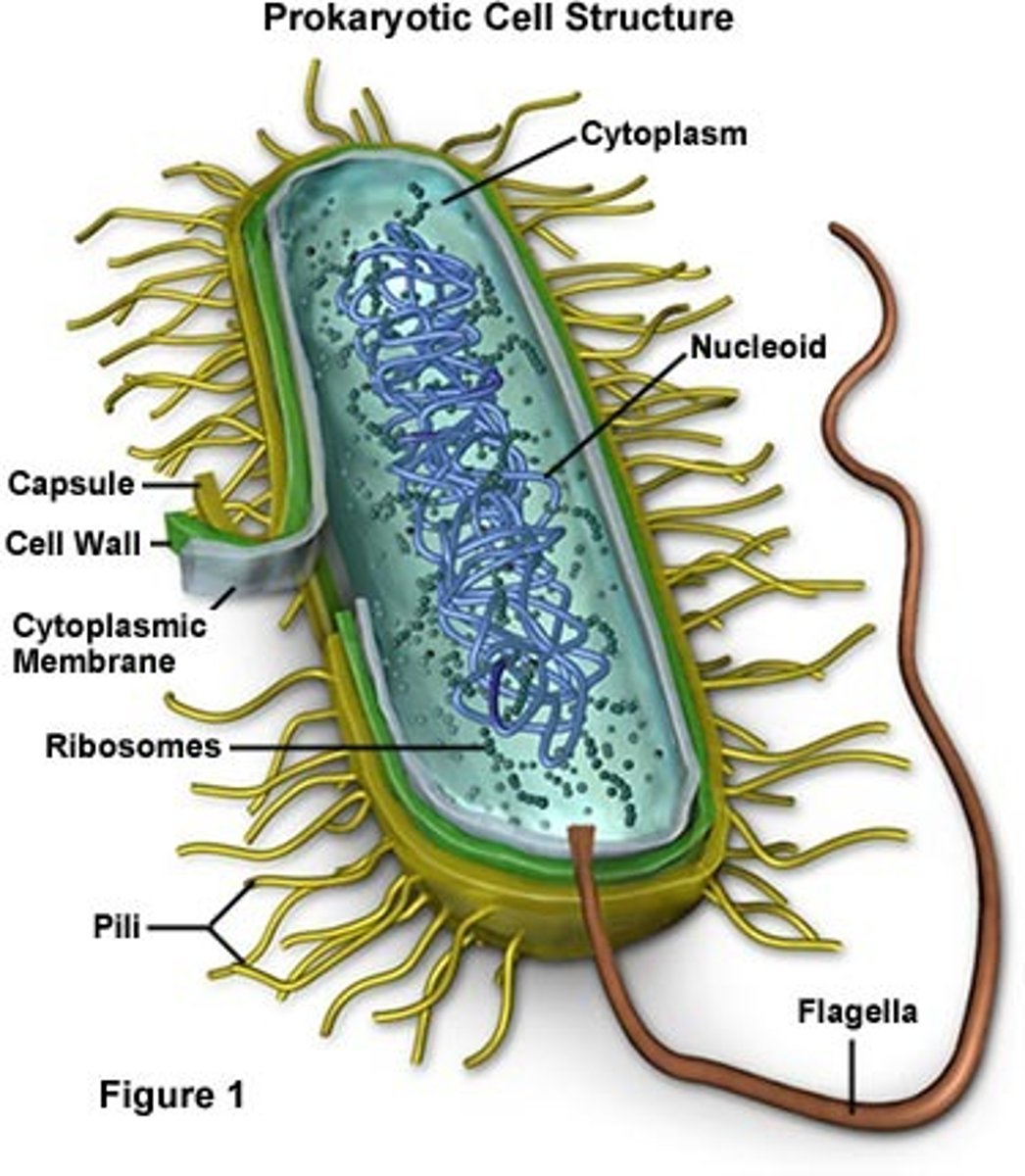
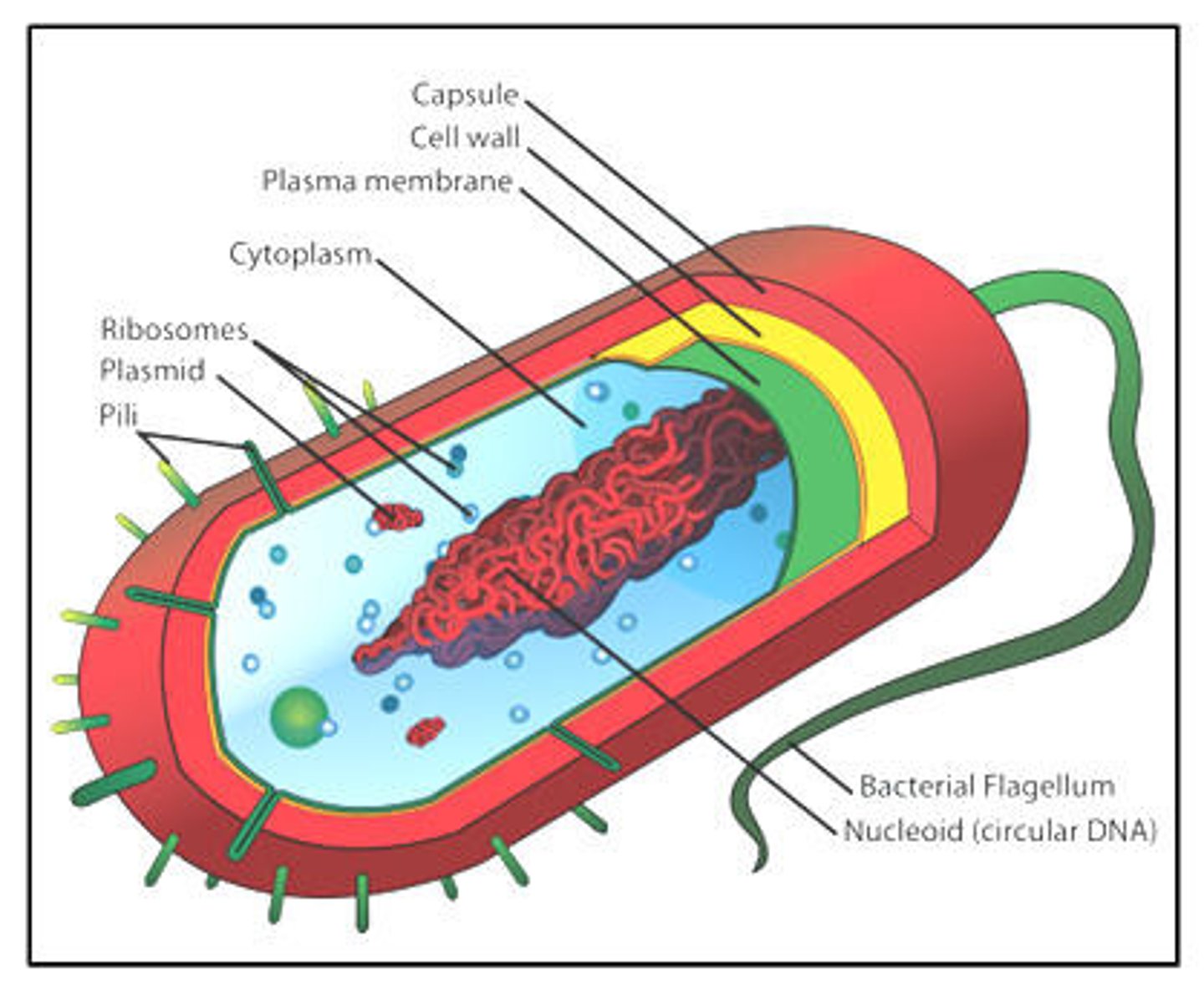
protects the cell and gives it shape
cell wall
protects the wall against some antibiotics (only present in Gram-negative cells)
outer membrane
A jellylike fluid inside the cell in which the organelles are suspended
Cytoplasm
a threadlike structure of nucleic acids and protein found in the nucleus of most living cells, carrying genetic information in the form of genes.
chromosome
contains some genes obtained through genetic recombination
plasmid
protect the cell and assist in attaching the cell to other surfaces
capsule and slime layer
A thick-walled protective spore that forms inside a bacterial cell and resists harsh conditions.
endospore
A short, thick hair-like protein structure that allows a bacterium to attach to other bacteria and surfaces.
pilus
A long, whiplike structure that helps a cell to move
flagellum
label a bacteria cell
cocci, bacilli, spirilla
what are the shapes of bacteria cells
-Pairs (diplococci, diplobacilli)
-Clusters (staphylococci)
-Chains (streptococci, streptobacilli)
-Groups of four: tetrad
Cubelike groups of eight: sarcinae
what are the arrangements of bacterial cells
round cells sometimes flattened
cocci
Rod shaped bacteria
bacilli
