CHEM 341 (Inorganic Chemistry 3) Final Exam
 Call Kai
 Learn
Learn Practice Test
 Spaced Repetition
 Match
Match Flashcards
 Knowt Play
1/20

Name | Mastery | Learn | Test | Matching | Spaced | Call with Kai | Chat |
|---|
No analytics yet
Send a link to your students to track their progress
21 Terms
CHAPTER 1
how to write a complexe?
Writing a complex involves designating a central metal atom or ion that is coordinated to surrounding ligands. The ligands can be neutral molecules or anions, and they bond to the metal through lone pairs of electrons.
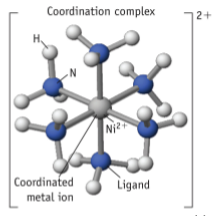
what is a lewis base?
e pair/lp donor
what is a lewis acid?
e pair/lp acceptor
what does the ligand have to be?
a lewis base or radical that gives one or more electron pairs to the metal center.
how do you name complexes?
Cation first, then anion (solid state)
Cation/neutral = name of element
"-ate” = anionic complex
inner-sphere complexe in []
outside this will be in () = anion = regular name
Ligands (L) in alphabetical order
Prefixes don’t affect alphabetical order! (bi, tris, etc)
![<ol><li><p>Cation first, then anion (solid state)</p><ol><li><p>Cation/neutral = name of element</p></li><li><p>"-ate” = anionic complex</p></li></ol></li><li><p>inner-sphere complexe in []</p><ol><li><p>outside this will be in () = anion = regular name</p></li></ol></li><li><p>Ligands (L) in alphabetical order</p><ol><li><p>Prefixes don’t affect alphabetical order! (bi, tris, etc)</p></li></ol></li></ol><p></p>](https://assets.knowt.com/user-attachments/f62e4f40-d7a6-4176-b0bc-4d7f820123a7.png)
what is and how do you find the d^n config of a metal?
how many electrons on metal d orbs after oxidation
n = M column # - oxidation state (= M charge - total L charges ± overall charges)
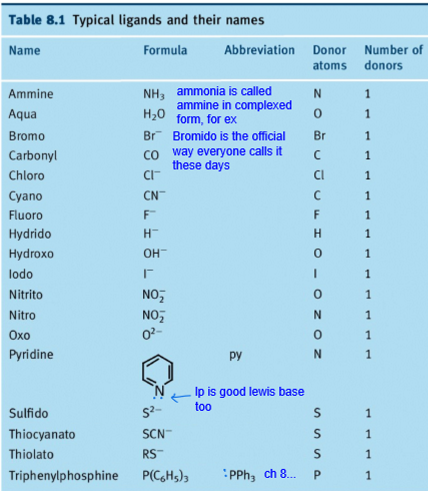
how do you name Ligands?
if neutral = its name
if anionic = “-o” suffix
if complex/polydentate/chelating (ring) = ask prof in exams
acac (2O), bipy (2N), edta (2N, 4O) ambidentate, cyclam (4N), en (2N)
when bi vs bis and such? = simple vs complex/polydentate/chelating ligands like those above
di/tri/tetra + simple ligand
bis/tris/tetrakis + (complex ligand)
what is an ambidentate ligand like edta?
can attah at 2 diff places not at the same time, like N or O
what are the 4 types of isomerisms? (not very important)
linkage = how/where it attaches
ionization = swap 2 ions inner/outer
hydrate = a water goes from inner to outer sphere
coordination = M’s swap in 2 metal complexes, rare
what does a CN = 2 mean?
d10 ions = Ag+, Cu+
linear
what does a CN = 3 mean?
d10 ions = Ag+, Cu+, Au+
planar Y or T
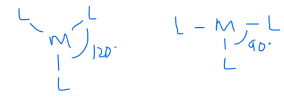
what does a CN = 4 mean?
TETRAHEDRAL
d0 or d10 ions
bulky Ls, small Ms
SQUARE-PLANAR
d8 = M(II)
CN = 4 | what is the important isomerism in square planar complexes?
MA2B2 which exist as cis or trans
OR if ligands diff then that
what does a CN = 5 mean?
TBP
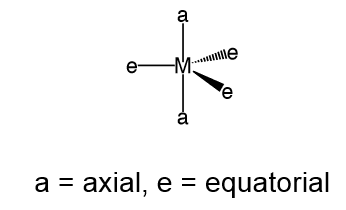
SQR PYR
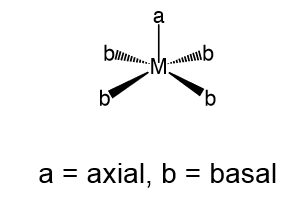
CN = 5 | can TBP and SQR PYR interconvert?
yes very bcs covalent bonds, called Berry pseudo rotation
BUT fast so no sep!
CN = 5 | can the ligand settle the structure?
yes, diff topology/3d shape even if same formula if tbp vs sqr pyr
what does a CN = 6 mean?
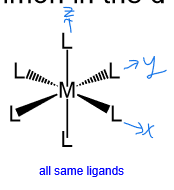
OCTAHED - most common in d !
TRIG PRISM - rare!
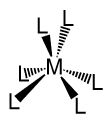
CN = 6 | can OCT and TRIG PRIS interconvert?
yes, via rotation of 1 trio of bonds
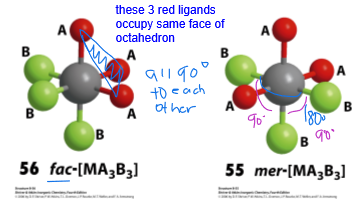
CN = 6 | what are the important isomerism in OCT complexes?
if MA4B2
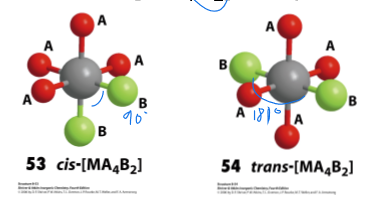
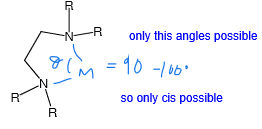
5 or 6 chelates ensure cis bcs of stereo
if MA3B3