Controlled Substances
 Call Kai
 Learn
Learn Practice Test
 Spaced Repetition
 Match
Match Flashcards
 Knowt Play
1/35

There's no tags or description
Looks like no tags are added yet.
Name | Mastery | Learn | Test | Matching | Spaced | Call with Kai | Chat |
|---|
No analytics yet
Send a link to your students to track their progress
36 Terms
Partitioning
occurs at phase boundary due to a greater affinity for one phase than the other
liquid-liquid (water and oil)
solid-liquid (ice in water)
liquid-gas (boiling water)
physical states: solid, liquid, gas
function of temp and pressure → water is classic example
based on chemical properties
charged vs neutral
polar vs non-polar (polarity: separation of charge- dipole moment)
density, pH, etc
Important for chromatography as well

Equilibrium
the state where the concentration of all reactants and products remain constant with time
rate of forward reaction is equal to the reverse reaction
equilibrium constant (K)
express the relationship between the products and reactants
[A] = concentration of chemical species A
^a = stoicheometric coefficient from the balanced equilbirum equation
![<p>the state where the concentration of all reactants and products remain constant with time</p><ul><li><p>rate of forward reaction is equal to the reverse reaction</p></li><li><p>equilibrium constant (K)</p></li><li><p>express the relationship between the products and reactants</p></li><li><p>[A] = concentration of chemical species A</p></li><li><p>^a = stoicheometric coefficient from the balanced equilbirum equation</p></li></ul><p></p>](https://assets.knowt.com/user-attachments/fa63a3f1-5e96-412b-ab27-69ce72317ab0.png)
Le Châtelier’s Principle
disturbance of equlibrium results in a counteraction to re-establish eqilibrium
K = equilibrium constant
K ~ 0.001, mostly reactants
K ~1000, mostly products
only calculated when reaction is at equilibrium
reaction moves to left or right to reach equilibrium again
Henry’s Law
related the partial pressure of a gas to the concentration in a liquid
ex) ethanol is more volatile than the matrix components from blood
Breathalyzer
partition between liquid and gas in the lungs
Acid Dissociation Constant (Ka)
quantitative measure of the strength of an acid
equilibrium constant of the dissociation of a weak acid in an aqueous solution
strong acids completely dissociate (ionize)
HCl → H+ + Cl-
HNO3 → H+ + NO3-
often reported as pKa due to the many orders of magnitude

Solubility Equilibrium Constant (Ksp)
solubility of a compound in an aq phase
salt vs. freebase form
common salts: sodium, calcium, sulfates, and chlorides
don’t forget about pH
Characterization of Solubility
hydrophilic/lipophobic = soluble in aq phase
hydrophobic/lipophilic = non-soluble in aq phase
Salt Form Base
charged species
counter ion
soluble in aq phase (water)
ex) cocaine hydrochloride (snorted/injected)

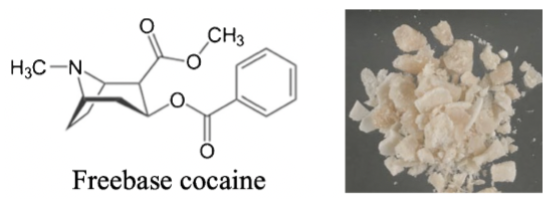
Freebase Form
uncharged species
no counter ion
non-soluble in an aq phase (water)
ex) freebase cocaine (smoked)
Lipophilicity
solubility of a drug in lipid membranes
hydrophobic = lipophilic
why does it matter?
our biological fluids are aq
our membranes are lipids
drug absorption through passive diffusion
metabolic properties → drug metabolism
ADME = Absorption, Distribution, Metabolism, and Excretion

Pharmacokinetics
movement of drugs in the body
Pharmacodynamics
effect of drugs and mechanism of action
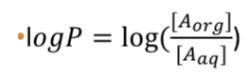
Octanol-Water Partition Coefficent (Kow)
how lipophilicity is calculated
partition coefficient of the unionized form
+ logP = lipophilic
ex) Isopentanol → logP ~ 1 (10:1 ratio of octanol:water)
- logP = hydrophilic
ex) Methanol logP ~0.7 (1:7 ratio of octanol:water)
Equal partitioning when logP = 0
find where something wants to be (octanol or water) by shaking everything up and see where the molecule wants to be (aq or organic) → good to know for extraction and sample prep
Distribution Coefficient (LogD)
represents the partition coefficient for both the neutral and ionized form of the compound at any pH
logD of 7.4 = real physiological and biological conditions
determine the pH → this one wants to stay in blood
to get rid of it → go somewhere in the body that has a higher pH
helpful to know what drug— helps determine where it wants to be in the body

Bronsted-Lowry Definitions
Acid = donates a proton (conjugate base)
Base = accepts a proton (conjugate acid)

Lewis Definitions
Acid = accepts a pair of valence electrons to form a bond
Base = donates a pair of valence electrons to form a bond

Strength of an acid
tendency to donate a proton and/or dissociate in water
ex) HCl → H+ + Cl-
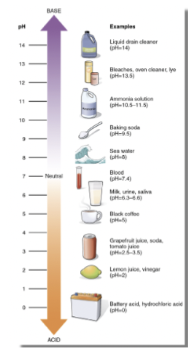
pH
measurement scale to specify the acidity or basicity of an aqueous solution
logarithmic scale = each unit is a 10-fold change in acidity or bascitiy
range from 0-14 (7 is neutral)
really a measure of the amount of free H+ and OH- ions in aq soln
Kw
self-ionization constant of water = 14
pKa
another measure of acid strength
converts large Ka values into manageable numbers
smaller pKa = stronger acid

Henderson-Hasselbalch
provides the relationship between pH and pKa
acids = pH and pKa
bases = pOH and pKb

Amphoteric
more than one ionizable center
acidic and basic character
ex) morphine
Does partitioning require both liquids to be immiscible or not?
IMMISCIBLE
What are the 5 extraction techniques?
Dry Extraction
Liquid-Liquid Extraction
Liquid-Liquid Microextraction
Solid-Phase Extraction
Solid-Phase Microextraction
Dry Extraction
most simplistic extraction
add an organic solvent to a powdered sample
extraction of drugs from common diluents like sugar and cornstarch
unfortunately, often too simple an extraction —> if several things, can’t just put this extraction in IR unless combined with chromatographic separation
ex) GC-MS of unknown white powder (how many things are there?)
Liquid-Liquid Extraction (LLE) aka Solvent Extraction
aqueous and organic solvents separated via separatory funnel (shaking forces interaction)
partitioning driven by pH dependence
solvent must be immiscible to form 2 layers
density is important → which layer do I want?
Advantages:
quick & easy for qualitative analysis
high selectivity
high eluant capacity (can do with large samples/bulk quantity)
Disadvantages:
large solvent consumption
cost of solvent
cost for disposal
safety concerns → benzene & chloroform
emulsions possible = ruin the experiment (might not be able to test the samples again)
bulky and expensive glassware

H2O density
1.000 g/mL
Liquid-Liquid Microextraction
same principles as LLC, but on a smaller scale
solvent volumes less than 5 mL
centrifuge tubes instead of a separatory funnel
must carefully remove the desired layer with a pasteur pipette
Advantages: lower solvent consumption & associated concerns
Disadvantages: difficulty removing layers (have to be extremely careful)

Solid-Phase Extraction (SPE)
better for quantitative analysis
dissolved analytes separated from the solution
affinity of solute for sorbent material relative to solution
eluted from sorbent material
different stationary phases available
positive or negative pressure used to force/pull the sample through the cartridge
let gravity do its thing OR do it faster with pressure

Solid-Phase Partitioning
solutes dissolved in a mobile phase and pass through a stationary phase
separation occurs based on interaction (adsorpton, solubility, binding, or electrostatic interactions)
K_D is used to express degree of interaction
KD = ([stationary]/[mobile])
polarity-based interactions (like-dissolves-like)
same concept as liquid chromatography
now getting to a point to separate each component individually without having crossover (more selective technique)
based on interaction desired → normal phase, reversed phase, ion exchange
Advantages:
enhanced separation compared to LLE → upwards 50x better than LLE
greater recovery → no transfer losses between glassware
reduced organic solvent waster → minimal organic solvent required
less apparatus required → no expensive and bulky separatory funnels
Disadvantages:
more complex chem involved → wide range of sorbent material and elution solvents
requires method development → more time-consuming on the front end
more steps in the extraction process → conditioning, washing, elution, etc.
cost of SPE cartridges and pressure system
![<ul><li><p>solutes dissolved in a mobile phase and pass through a stationary phase</p></li><li><p>separation occurs based on interaction (adsorpton, solubility, binding, or electrostatic interactions)</p></li><li><p>K_D is used to express degree of interaction</p><ul><li><p>KD = ([stationary]/[mobile])</p></li></ul></li><li><p>polarity-based interactions (like-dissolves-like)</p></li><li><p>same concept as liquid chromatography</p></li><li><p>now getting to a point to separate each component individually without having crossover (more selective technique)</p></li><li><p>based on interaction desired → <strong>normal phase, reversed phase, ion exchange</strong></p></li></ul><p></p><p><strong>Advantages:</strong></p><ul><li><p><strong>enhanced separation compared to LLE</strong> → upwards 50x better than LLE</p></li><li><p><strong>greater recovery</strong> → no transfer losses between glassware</p></li><li><p><strong>reduced organic solvent waster</strong> → minimal organic solvent required</p></li><li><p><strong>less apparatus required </strong>→ no expensive and bulky separatory funnels</p></li></ul><p></p><p><strong>Disadvantages:</strong></p><ul><li><p><strong>more complex chem involved</strong> → wide range of sorbent material and elution solvents</p></li><li><p><strong>requires method development</strong> → more time-consuming on the front end</p></li><li><p><strong>more steps in the extraction process</strong> → conditioning, washing, elution, etc.</p></li><li><p><strong>cost of SPE cartridges and pressure system</strong></p></li></ul><p></p>](https://assets.knowt.com/user-attachments/cdc69a72-ce7b-43a6-9cd6-a656829c307b.png)
Normal Phase
polar bonded phase / nonpolar solvent
retains polar compounds → if separating polar things, do this
elute with polar solvent
Reversed Phase
non-polar bonded phase / polar solvent
retains non-polar compounds
elute with non-polar solvent
Ion Exchange
anion (positively charged) → retains negatively charged compounds
cation (negatively charged) → retain positively charged compounds
SPE Process
Conditioning the sorbent material → wets the surface
Load the sample solution → allows for interaction with the sorbent material
Wash the sorbent material → removes remaining impurities
Elute analytes from sorbent material → removes analytes from the sorbent material and into the final analyte solution
**same holds true for polarity or ionic types
elute in increasing strength (weakest to strongest)

SPE Concerns
binding capacity and surface area determine the volume of soln
based on saturation of binding sites
once all binding sites are filled, no more analytes can be retained
leads to loss of analytes
sample can be concentrated with minimum solvent or through dry down and reconstitution (adding expenses)
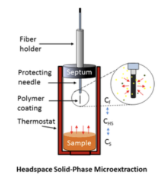
Solid-Phase Microextraction (SPME)
fiber coated with the extracting phase → PDMS with an additive is common
liquid or gas sample (solvent free method)
targets volatile & semi-volatile compounds
sample heated and allowed to reach equilibrium between the headspace and solution
small fiber acts as the substrate for the sorbent
active material bonded to a thin silica needle
liquid polymer or solid sorbent
similar materials to SPE
extraction and preconcentration
equilibrium is important for quantification
common for ILR analysis with SPME-GC-MS
Advantages:
target for volatile and semi-volatile compounds
preconcentration step
automation
Disadvantages:
lower effectiveness due to reduced surface area of the SPME fiber
requires method optimization for fiber selection and equilibration period
only limited commercially available SPME chemistries