Harder flashcards to remember
 Call Kai
 Learn
Learn Practice Test
 Spaced Repetition
 Match
Match Flashcards
 Knowt Play
1/78

There's no tags or description
Looks like no tags are added yet.
Name | Mastery | Learn | Test | Matching | Spaced | Call with Kai | Chat |
|---|
No analytics yet
Send a link to your students to track their progress
79 Terms
What is the hippocampus's role in memory?
It is crucial for long-term memory storage.
What is the role of the prefrontal cortex in memory?
It is associated with short-term memory processing.
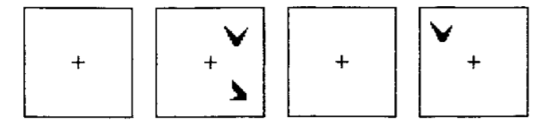
Outline Smith and Jonides’ (1997) task
2 stimuli presented, followed by probe
Decide if probe in (i) same location (spatial), or (ii) same form (visual) as one of the presented stimuli
Stimuli identical in both tasks
But different brain activity (PET)
Right hemisphere = spatial task
Left hemisphere = visual task
-> Suggests there are two separate systems processing visual and spatial inputs
What is the suffix effect?
Recalling the final items of a spoken list is impaired by appending a nominally irrelevant speech sound (the "suffix") at the end
What is articulatory suppression?
A technique in cognitive psychology used to disrupt verbal memory by preventing a person from silently rehearsing information
What are the 3 types of prospective memory?
Time-based
Event-based
Implementation intentions
What are the stages of prospective memory?
Iguanas Race Cars In Indiana
Intention formation - intention linked to a specific cue
Retention interval - environmental monitoring of task-relevant cues
Cue detection and intention retrieval
Intention recall - retrieve intention from retrospective memory
Intention execution - fairly automatic and undemanding
What is priming?
Facilitated processing of repeated stimuli
What brain regions are primarily involved in non-declarative memory?
Basal ganglia and neocortex.
What brain structures are affected for individuals with anterograde amnesia?
Damage to hippocampus: poor episodic memory
Damage to para-hippocampal cortex: poor semantic memory
Damage to both regions: poor episodic/semantic memory
What are 3 different types of semantic memory?
Superordinate, e.g. items of furniture
Basic-level, e.g. chair
Subordinate, e.g. rocking chair
What brain regions are primarily involved in declarative memory?
Medial temporal lobe and diencephalon.
What are implementation intentions? (prospective memory)
Action plans that specify where, when, and how a goal will be achieved.
What is the DRM paradigm?
A method to study false memories where participants recall words semantically associated with a list but not included.
You make connections between list words and the associated word, leading to memory error
What is the consolidation in relation to anterograde amnesia?
Physiological process in the hippocampus leads to formation of long-lasting memories
Consolidated memories stored elsewhere, protecting then from effects of hippocampal damage
Name and explain 3 common issues within face recognition
- Unconscious transference: misidentify a familiar (but innocent) face as being person responsible
• Other-race effect: recognition for same-race faces generally more accurate than other-race face
• Own-age bias: more accurate when culprit is similar age to witness
What is associative agnosia?
Able to group (combine) features
Cannot associate features with stored knowledge of object identity
Damage to temporal and occipital lobes in both left and right hemisphere
What are monocular (pictorial) cues?
Cues such as interposition, linear perspective, and texture gradients that help perceive depth.
What are the 2 motion cues associated with depth perception?
Motion parallax: nearby objects move more rapidly than far away objects
Optic flow: images get larger as we approach them
What is prosopagnosia (face blindness)?
Poor face recognition but good object recognition
Face and object recognition involve different brain areas
Fusiform gyrus
What is the recognition-by-components (RBC) theory? What are the 2 processes at play?
The theory suggests that we recognise objects by breaking them down into a small set of basic 3D shapes called geons (geometric ions) and then identifying how those geons are arranged relative to one another.
Object recognition is a joint effort between 2 processes:
One responsible for features and components
Another for overall shape and global patterns
What are oculomotor cues?
Convergence: eyes turn inwards when we focus on close objects
Accommodation: shape of lenses in the eye changes shape depending on an objects distance
What is good continuation in Gestalt principles?
We prefer to organise objects where contours continue smoothly.
What are binocular cues in depth perception?
Each eye has a different view of the world(stereopsis), leading to binocular disparity.
Difference = binocular disparity
What is agnosia?
A failure to recognise objects, often caused by brain damage.
→ can be apperceptive or associative
What is apperceptive agnosia?
Ability to perceive features, e.g. colour
Unable to group features to name object
Damage to posterior regions of the right hemisphere
What are illusory conjunctions?
Illusory conjunctions occur when a person incorrectly combines features from different objects into a single object during perception.
Example
If you briefly see:
a red X
a green O
You might later report seeing:
a green X
a red O
What is the difference between the exogenous and endogenous attention networks? (Posner,1980)
EXOGENOUS
Bottom-up - driven by environmental factors
Stimulus-driven
Automatically shift attention
Peripheral cues
ENDOGENOUS
Top-down
Happens within our brain
Goal-directed
Controlled by expectations
Central cues
What are the two types of neglect?
Object-centred (allocentric): lack of awareness of one side of objects.
Subject-centred (egocentric): lack of awareness of an entire side of the visual field.
What is the Cocktail Party Problem? (Cherry, 1953)
It refers to the challenge of focusing on one conversation while ignoring others, often using physical differences to aid in selection.
Using physical differences (e.g. gender, location)
Extract little information from unattended stimulus
Exogenous (stimulus-driven), as hear salient information in unattended stimulus
What is inattentional bias?
Inattentional bias is the failure to notice an unexpected, fully visible item when attention is diverted to other aspects of a display.
What are the two major theoretical approaches to reading aloud?
The dual-route model and the connectionist triangle model
What is the difference between surface, phonological and deep dyslexia?
Surface: lexical route impaired
Phonological: letter-to-sound conversion impaired
Deep: phonological and semantic impairment
What is the interactive activation model of visual word processing? What are the 3 levels of recognition?
Recognition units at 3 levels:
Feature level
Letter level
Word level
Involves parallel processing
Bottom-up and top-down processes interact
What is categorical perception?
The perception of phonemes as the same despite physical differences
What is semantic priming?
A phenomenon where a target word is recognised faster if preceded by a semantically related word.
What is phonological priming?
Words processed faster when prime (sound-based cue) is phonologically identical
What does the connectionist triangle model suggest? (Plaut et al, 1996)
Based on highly interactive system between orthography (spelling), phonology (sound) and semantics (meaning)
Direct route between spelling and sound
Indirect route via word meaning
What is the word superiority effect?
A target letter is more readily detected in a letter string when it forms a word rather than a non-word.
What does the dual-route model propose? (Coltheart et al, 2001)
It proposes two routes between printed word and speech: grapheme-phoneme conversion and lexicon/semantic knowledge.
Activation at one level cascades onto the next
What is the phonemic restoration effect?
Listeners are unaware that a phoneme has been removed and replaced by a non-speech sound.
What are angloscentricites?
When the relationship between orthography and phonology is inconsistent
Outline 3 research methods for studying reading
Naming task: say printed word out loud as rapidly as possible
Lexical decision task: decide rapidly whether string of letters forms a word
Prime words task: does a word presented before a target word affect processing of the target?
What is egocentric heuristic?
Interpretations based on our own knowledge, rather than that shared with speaker
What is pragmatics in language comprehension?
The study of intended meaning, including figurative language such as metaphor, irony and idiom
What is the Constraint-based model?
A one-stage, parallel processing model that uses all sources of information to parse sentences.
constrains the number of possible interpretations
competing syntactic analyses of a sentence activated at the same time
structure receiving most support from constraints is highly activated
frequency and probability based on past experiences is important
→ our brains understand sentences by immediately analysing all possible meanings at once
What are the 2 stages of the prediction model?
Latent semantic analysis: represents the meanings of words based on relations with other words
Construction-integration: use information from first stage to construct interpretation
What are the two stages of forming a causal inference?
Bonding: automatic activation of words from preceding sentence
Resolution: ensures interpretation is consistent with contextual information
What is the unrestricted race model and its 3 assumptions?
Combines aspects of the Garden Path and Constraint-Based models.
• Following 3 assumptions:
All sources of information used to identify syntactic structure of a sentence
All other structures are ignored, unless favoured structure disconfirmed by subsequent information
If chosen structure discarded, reanalysis undertaken before another structure chosen
What does parsing refer to in language comprehension?
Analysing the syntactic/grammatical structure of sentences
What does the cognitive neuroscience N400 effect indicate?
→ measuring neurons on the outside of the skull
→ a negative peak 400 ms after word onset
Reflects a mismatch between predicted and actual meaning, reflecting fast access to word meaning and world knowledge.
What is the Garden Path Model?
• A two-stage, serial processing model that assumes one syntactical structure is considered initially without semantics.
• Simplest syntactical structure is chosen using minimal attachment and late closure.
What are the two differing accounts for understanding metaphor?
Standard pragmatic model and prediction model
What is the standard pragmatic model?
Compute the literal meaning first.
Check whether the literal meaning makes sense in context.
If it doesn't, search for a non-literal meaning
What does the WEAVER++ model describe?
It describes word-form encoding by activation verification, with processing occurring in a serial fashion.
There are 3 levels: highest, second and lowest
Speech production proceeds from meaning (lexical selection/lemma) to sound (morphemes/phonemes
→ each processing stage occurs in seriation
What is a spoonerism?
A speech error where the initial letters of two words are switched, e.g., 'shake a tower' instead of 'take a shower'.
What is Jargon aphasia?
Speech grammatically correct but have difficulties accessing correct words
Substitute one word for another
Produce neologisms
Problems at phonological level
What is a word exchange error?
A type of speech error where words are swapped, indicating that speech planning extends over the entire clause.
e.g. ‘my room seems empty without my chair’ vs ‘my chair seems empty without my room’
What does under specification refer to in speech?
The use of simplified expressions like '…or something' or '…and things like that'.
What four factors are included to make common ground achievable in speech?
Syntactic priming
Gesture
Prosodic cues
Discourse markers
What is the spreading-activation theory of speech production?
A theory suggesting that processing occurs in parallel at different levels (semantic, lexical, phonological).
Categorical rules: impose constraints on items/categories that are acceptable at each level
Insertion rules: select items to be spoken, most highly activated nodes selected
→ processing occurs in parallel at different levels
What are the three main levels in the WEAVER++ model?
Lexical concepts
Lemmas (abstract words)
Word forms (morphemes/phonemes).
Provide four example errors of spelling
Substitutions: different phoneme e.g colore → conore (colour)
Transpositions: flip letters e.g. denaro → derano (money)
Omissions: remove letter e.g. nostro → nosro (ours)
Addition: add letter e.g. fritto → frritto (fried)
What are the two major theories of speech production?
Spreading-activation theory (Dell, 1986)
WEAVER ++ model (Levelt et al, 1999)
What are discourse markers in speech?
Words/phrases that aren’t directly relevant to the speaker’s message, e.g. um…
What is morpheme exchange in speech errors?
When inflections or suffixes are attached to the wrong words, e.g., 'he trunked two packs'.
What is aphasia?
Impaired ability to name everyday objects
Name 6 speech errors
Wild Snakes Slide Silently Most Nights
Word exchange
Spoonerism
Sound exchange
Semantic substitution
Morpheme exchange
Number agreement
Outline the process of speech production according to the WEAVER ++ model
Calm Leaders Manage Problems Patiently Always
Conceptual preparation
Lexical selection
Morphological encoding
Phonological encoding
Phonetic encoding
Articulation
What is preformulation in speech production?
The production of phrases used before, such as 'a piece of cake' or 'under the weather'.
What is syntactic priming?
When a speaker copies words or phrases heard previously, influenced by the other person speaking.
→ tends to happen implicitly
What are the three main types of similarity in analogical problem solving?
Superficial: obvious features/context
Structural: underlying relationships/principles
Procedural: similar solving steps
What is analogical problem solving?
Solving problems by drawing comparisons between current and previous problems, highlighting similarities.
What does IGOR stand for when defining problem solving?
Initial state - clear description of how everything is set up at the beginning of the problem
Goal state - what the problem should look like at the end
Operators - the actions to be taken to get to the goal
(Operator) restrictions - what you are not allowed to do
What is the representational change theory?
Prior knowledge and perception shape how we initially understand the problem.
We then search for a solution based on that understanding.
If no solution is found, we reach an impasse (get stuck).
We then rethink or restructure the problem and try a new search for a solution.
Insight occurs when the new representation leads to the answer.
What is myside bias?
The tendency to evaluate statements based on personal beliefs rather than on merit.
What is syllogistic reasoning?
Syllogistic reasoning is a type of deductive reasoning where you draw a conclusion from two premises (statements), typically involving categories or groups
Example
Major premise:
All dogs are animals.
Minor premise:
Max is a dog.
Conclusion:
Therefore, Max is an animal
What is meant by modus tollens? Provide an example
A valid logical rule stating that if "If P, then Q" is true and Q is false, then P must also be false.
Premises:
If the weather is nice, David takes a walk.
David does not take a walk.
Conclusion:
Therefore, the weather is not nice.
What is meant by modus ponens? Provide an example
Modus ponens is a valid logical rule stating that if "If P, then Q" is true and P is true, then Q must also be true.
Premises:
If the weather is nice, David takes a walk.
The weather is nice.
Conclusion:
Therefore, David takes a walk.