✅️✅️2 - General Concepts of Bones & Joints
 Call Kai
 Learn
Learn Practice Test
 Spaced Repetition
 Match
Match Flashcards
 Knowt Play
1/158

There's no tags or description
Looks like no tags are added yet.
Name | Mastery | Learn | Test | Matching | Spaced | Call with Kai | Chat |
|---|
No analytics yet
Send a link to your students to track their progress
159 Terms
true
True or false?
A bone is an organ
organ
-Store minerals and fat, blood cell formation.
-Is an actively metabolizing tissue that change in in shape, size, and position by mechanical or biochemical demands
skeleton
Group of bones that serves for support, protection, providing levers for muscular action and movement
osteology
The science of bones
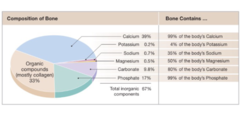
67%
_____% of the bones structure consists of minerals
33%
_____% of the bones structures consist of organic material
minerals
Nitric acid removes the [minerals/organic compounds] from the bone, making them soft while maintaining their shape
![<p>Nitric acid removes the [minerals/organic compounds] from the bone, making them soft while maintaining their shape</p>](https://assets.knowt.com/user-attachments/71b88f38-85b4-4729-be58-643ab2c59edd.png)
organic compounds
The shape of a bone is from the [minerals/organic compounds]
Reviewed
Review
axial skeleton
Classification of bones
What is #1?

heterotopic skeleton
Classification of bones
What is #2?

appendicular skeleton
Classification of bones
What is #3?
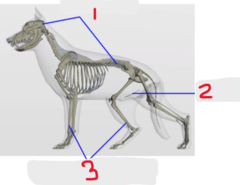
321
How many bones does a canine have?
Reviewed
Review

long
Bone shape?
-typical of the limbs
-three centers of ossification: one for the shaft (diaphysis), and one for each extremity (epiphysis)
-have a medullary cavity

short
Bone shape?
-have no dimension that greatly exceeds the others
-no medullary cavity

flat
Bone shape?
-expanded in two directions
-no medullary cavity

pneumatic bones
-Not a shape classification, but a characteristic of some flat bones of the skull in domestic mammals
-Excavated to contain air-filled spaces
-In mammals, these are confined to the skull and contain the paranasal sinuses

birds
In _____, some of the long bones have air pockets that communicate extensively with the respiratory system

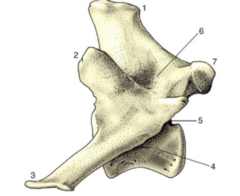
irregular
This is an example of a _____ bones
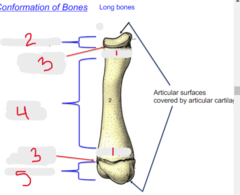
physis
The growth plate of a long bone is known as the _____
diaphysis
The body/shaft of a long bone is known as the _____
metaphysis
What is #1?
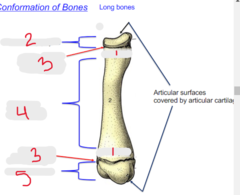
proximal epiphysis
What is #2?

physis
What is #3?

diaphysis
What is #4?

distal epiphysis
What is #5?
spongy bone
What is #1?
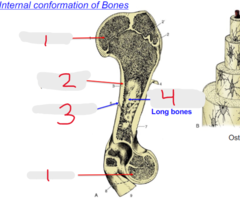
compact bone
What is #2?

nutrient foramen
What is #3?
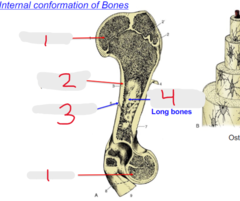
medullary cavity
What is #4?

cortex
Compact bone is also referred to as the _____
marrow cavity
The medullary cavity is also referred to as the _____
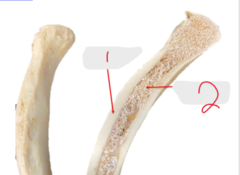
spongy bone
What is #1?

compact bone
What is #2?

compact bone
What is #1?

spongy bone
What is #2?
medullary cavity
What is the blue arrow pointing to?

bone marrow
Medullary cavity and the interstitial spaces of the spongy bone are occupied by _____
bone marrow
What is #1?

endosteum
What is #2?
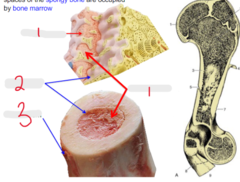
periosteum
What is #3?

hyaline articular cartilage
Articular surfaces are clothed in _____, which is calcified in its deepest layer, which is firmly attached to the underlying cortex

fibrous
Hyaline articular cartilage becomes _____ toward the periphery, where it blends with the periosteum and joint capsule
hyaline articular cartilage
What is the blue arrow pointing to?
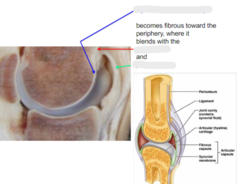
periosteum
What is the red arrow pointing to?
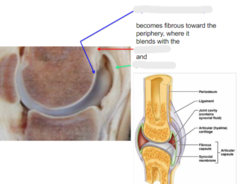
joint capsule
What is the green arrow pointing to?
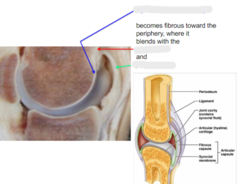
yellow
With [yellow/red] bone marrow, the hemopoietic potential is "inactive"
![<p>With [yellow/red] bone marrow, the hemopoietic potential is "inactive"</p>](https://assets.knowt.com/user-attachments/12ba5a0e-00b8-49c9-b895-954505be1b31.jpg)
red
The [yellow/red] bone marrow is richly vascularized, gelatinous tissue, with hemopoietic properties
![<p>The [yellow/red] bone marrow is richly vascularized, gelatinous tissue, with hemopoietic properties</p>](https://assets.knowt.com/user-attachments/7ca31b05-b9f3-49b1-bd77-741f86b912cc.jpg)
lines
Bone elevations
What is the blue arrow pointing to?

crests
Bone elevations
What is the TOP blue arrow pointing to?

tubercles
Bone elevations
What is the BOTTOM blue arrow pointing to?
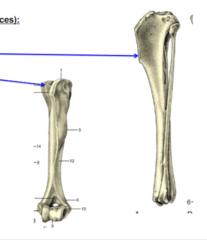
tuberosities
Bone elevations
What is the 1st (top) blue arrow pointing to?
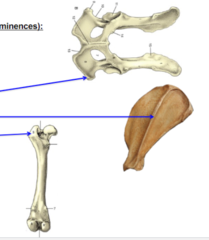
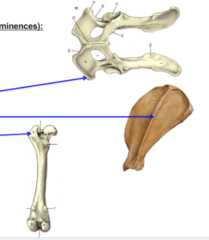
spines
Bone elevations
What is the 2nd (middle) blue arrow pointing to?

trocanters
Bone elevations
What is the 3rd (bottom) blue arrow pointing to?
fossa
Bone depressions
What is the TOP blue arrow pointing to?
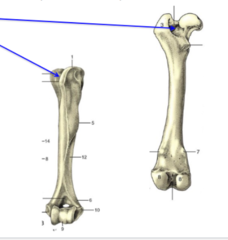
grooves
Bone depressions
What is the BOTTOM blue arrow pointing to?

endochondral ossification
-Initial formation of a cartilage model that is subsequently resorbed while serving as a matrix for bone development
-Areas within this model that initially start to mineralize are called "centers for ossification" - primary and secondary
-Cartilaginous plate (physis) remains btwn and separates adjacent centers until bone is mature
-Contiguous cartilage production, with subsequent resorption and ossification, at these plates is what allows a developing bone to elongate
primary
The [primary/secondary] centers of ossification form before birth and are located in the diaphysis
(TOP image)
![<p>The [primary/secondary] centers of ossification form before birth and are located in the diaphysis</p><p>(TOP image)</p>](https://assets.knowt.com/user-attachments/5cb56852-3a0e-4974-90ca-3c9e0949cce9.png)
secondary
The [primary/secondary] centers of ossification form after birth and are located in epiphysis and large eminences
(BOTTOM image)
![<p>The [primary/secondary] centers of ossification form after birth and are located in epiphysis and large eminences</p><p>(BOTTOM image)</p>](https://assets.knowt.com/user-attachments/f19a3ff0-200d-4b4d-92b5-46e490d1acb3.png)
intramembranous ossification
-Bone forms directly within a sheet of connective tissue
-No cartilage model is involved
-Characteristic of many flat bones
-Also occurs under the periosteum as bones grow in diameter, so most bones actually develop from a mixture of endochondral and intramembranous ossification
nutrient foramina
-May resemble an oblique fracture on radiographs
-Often where signs of panosteitis are first detectable
-Position is fairly consistent for each bone

nutrient artery
Bone blood supply
Penetrates toward the middle of the diaphysis
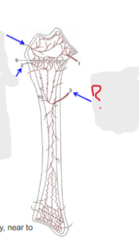
epiphysial arteries
Bone blood supply
What is #1?

metaphysial arteries
Bone blood supply
What is #2?

5-10%
Bones have a generous blood supply - near to _____-_____% of the cardiac output
sesamoid bones
-"Seed-like" bones
-Example: Patella
anthrology
The science concerned with the study of anatomy, function, dysfunction and treatment of joints or articulations
simple joints
bone + bone = ?
composite joints
bone + more than 1 bone = ?
fibrous joints
Categories of joints
United by dense connective tissues and are immobile
cartilaginous joints
Categories of joints
United by cartilage and are semi-mobile
synovial joints
Categories of joints
A fluid filled cavity intervenes between bones and allows mobility
fibrous joints
Sutures, gomphosis, and syndesmoses are associated with what category of joints?
cartilaginous joints
Synchondroses and symphysis are associated with what category of joints?
synovial
Plane, hinge, pivot, condylar, ellipsoidal, saddle, and ball-and-socket/spheroidal joints are all types of _____ joints
fibrous joint
-United by dense connective tissues
-Immobile
cartilaginous joint
-United by cartilage
-Semi-mobile
synovial joints
-A fluid-filled cavity intervenes between the bones
-Mobile
fibrous
Sutures are _____ joints
sutures
Fibrous joints in the skull that connect the skull's bones together
fibrous
Gomphosis are _____ joints
gomphosis
Specialized fibrous joint that anchors a tooth to its alveoli in the maxilla, incisor or mandible bones

fibrous
Syndesmosis are _____ joints
syndesmosis
A fibrous that holds two or more bones/ cartilages with ligaments or a strong membrane
syndesmosis
The interosseous membrane is a _____ joint

cartilaginous
Synchondrosis is a _____ joint
synchondrosis
Cartilaginous joint where the bones/cartilages are joined by hyaline cartilage
synchondrosis
Epiphysial cartilage (growth cartilage) is a _____ joint
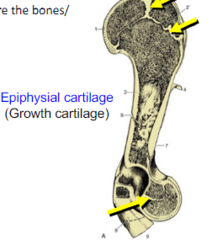
cartilaginous
Symphysis is a _____ joint
symphysis
Fibrocartilaginous joint between two bones

synovial joint
-Keep bones or cartilage together with a fibrous joint capsule that is continuous with the periosteum of the joined bones.
-This joint unites long bones and permits free mobility.
osteosarcoma
Bone tumor
osteomyelitis
Infection of bone (from cat bite, for example)
osteotomy
Cutting of a bone
cells
The _____ of a bone modify its shape
can
Bones [can/can not] be modified
33%
What is the total organic compounds found in bone?
67%
What is the total inorganic compounds found in bone?
collagen
What is the main component of organic compounds found in bones?