(8VC) Female Reproductive Endocrinology
 Call Kai
 Learn
Learn Practice Test
 Spaced Repetition
 Match
Match Flashcards
 Knowt Play
1/35

There's no tags or description
Looks like no tags are added yet.
Name | Mastery | Learn | Test | Matching | Spaced | Call with Kai | Chat |
|---|
No analytics yet
Send a link to your students to track their progress
36 Terms
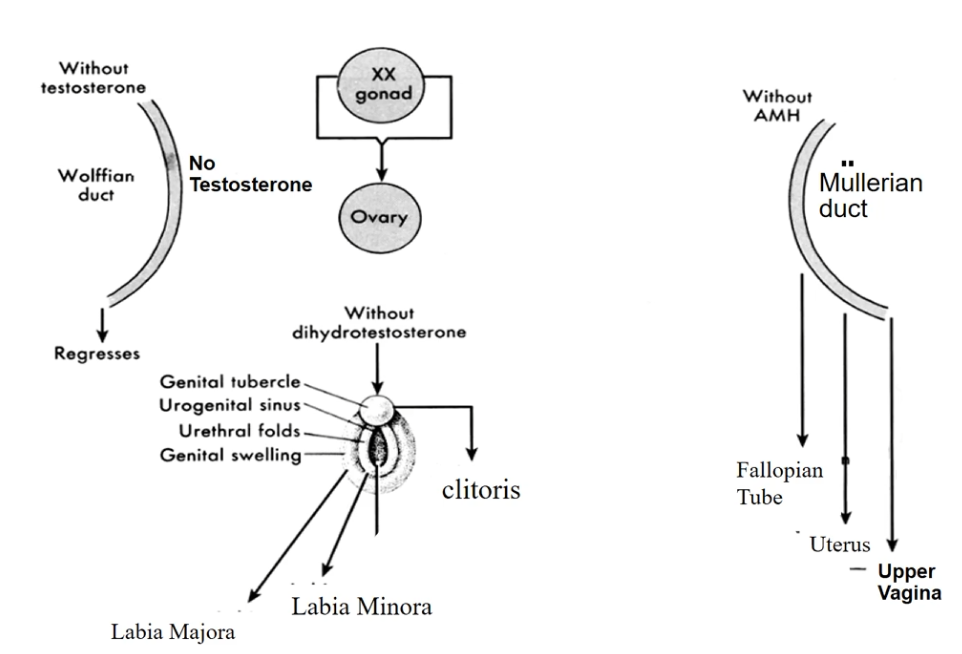
Without testosterone, what happens to the wolffian duct?
it regresses
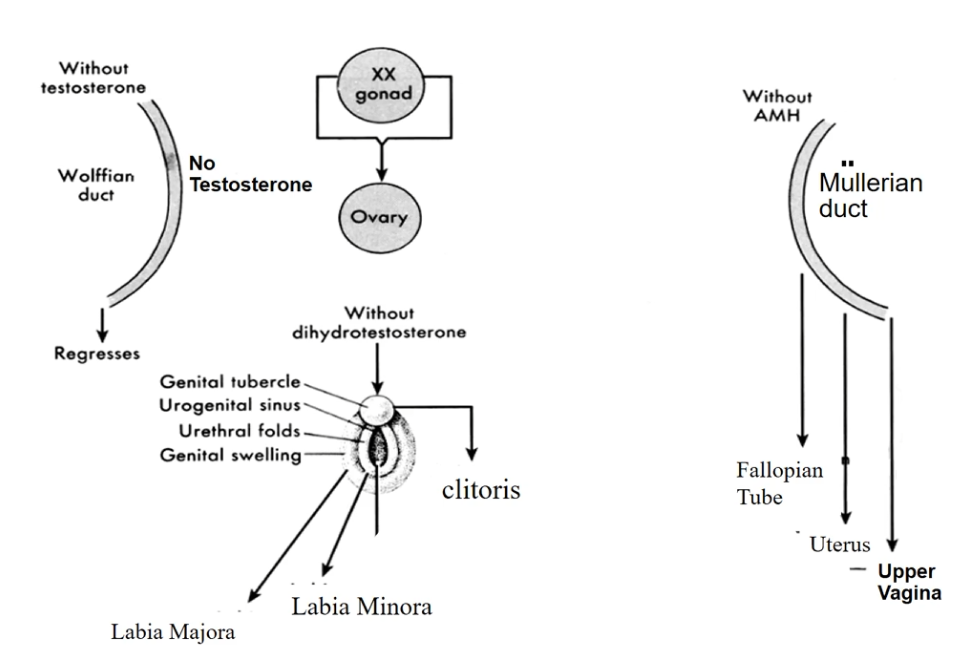
Without AMH, what happens to the mullerian duct?
it develops into fallopian tube uterus and upper vagina
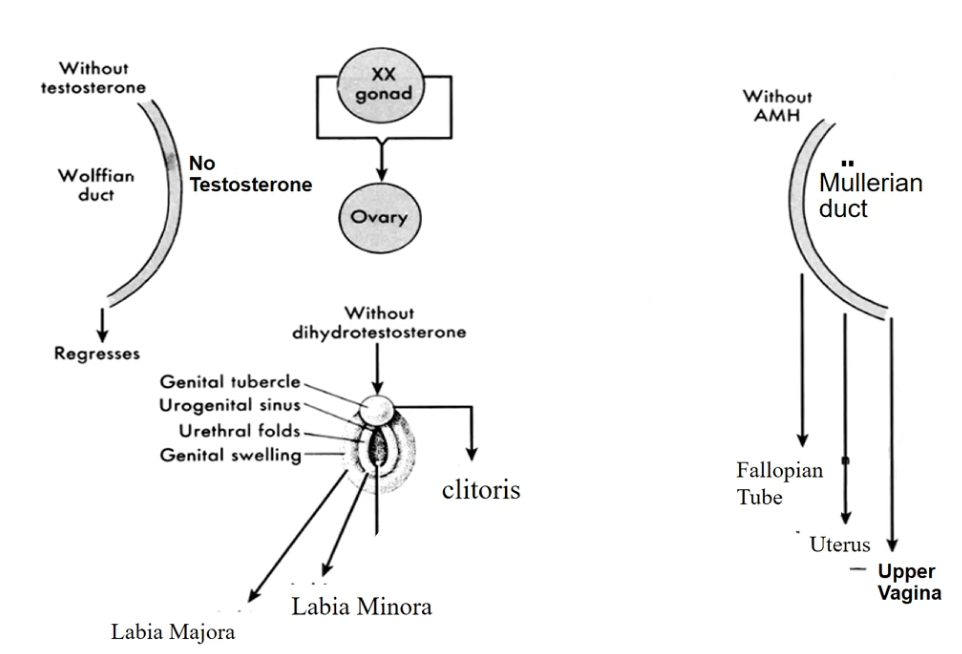
The lack of —- which converts — into —- leads to development of outer sex organs such as the clitoris, labia majora, and labia minora
5-alpha-reductase which converts testosterone to dihydrotestosterone
Ovaries sit in the —- in close proximity to the opening of the —-
peritoneal cavity; fallopian tube
How do oocytes move during monthly ovulatory events
oocyte is moved from the ovary into fallopian tubes via beating of the fimbriae
Fertilization occurs in the —- due to what
occurs in the fallopian tube due to hormonal influences of the myometrium
—- is high prior to ovulation which causes —-. What is this important for?
estrogen is high which causes contraction of the myometrium. This is important for both transport of the oocyte and transport of sperm up the uterus
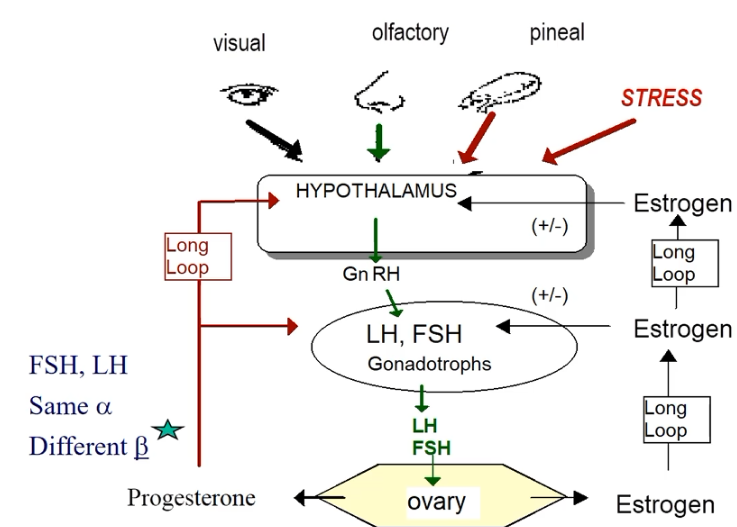
Show the hypothalamic pituitary gonadal axis
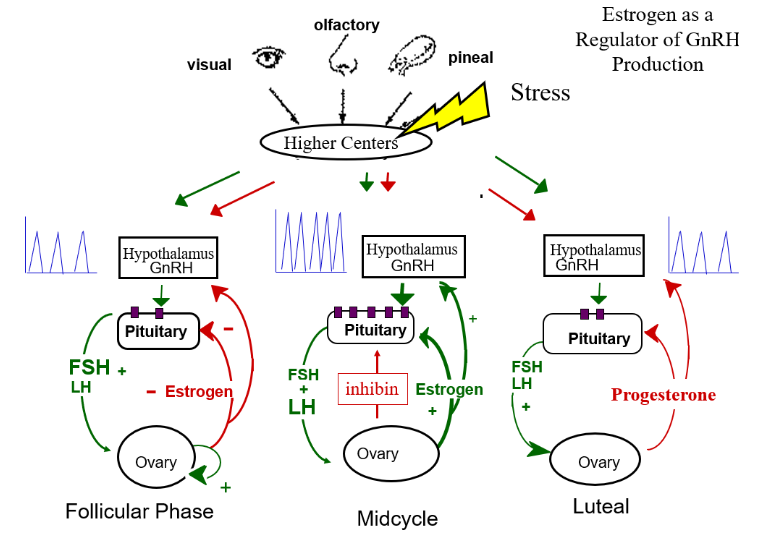
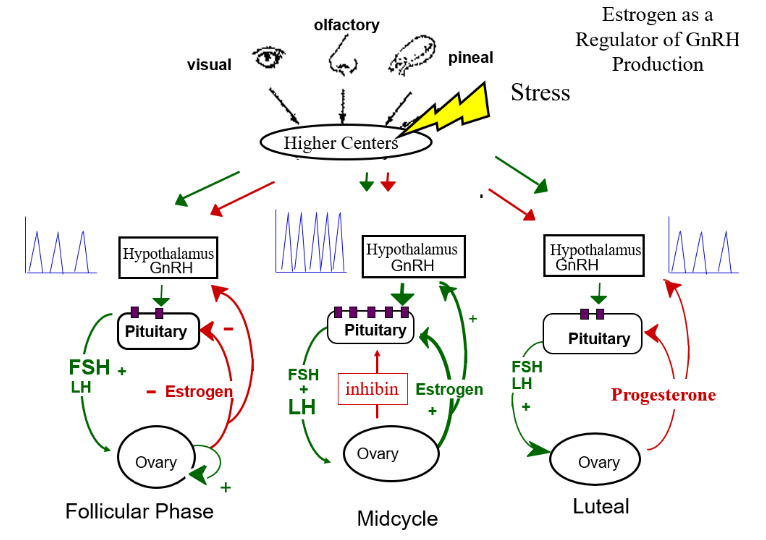
GnRH release from hypothalamus results is LH and FSH release from anterior pituitary (same as in males). LH and FSH causes release of estrogen and progesterone from ovarian follicles. Estrogen can have both a negative and positive feedback effect on the release of GnRH or LH and FSH. Estrogen has a positive feedback effect during a critical time in the ovarian cycle which drives the LH surge. Once ovulation has occurred, the remnants of the ovarian follicle will produce progesterone instead of estrogen. Progesterone has a negative feedback effect on both GnRH and LH+FSH.
t/f Cortisol (caused by stress) can positively regulate GnRH release from the hypothalamus
false; it negatively regulates it
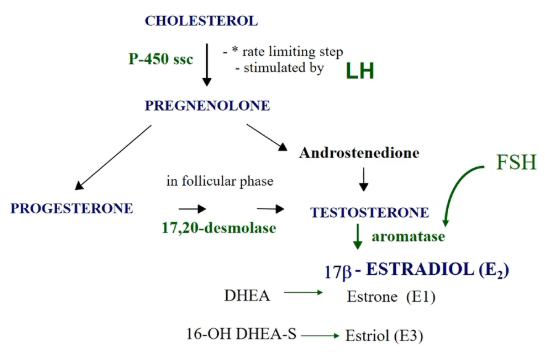
Review how estrogen is produced from its precursor (note the rate limiting step and what hormones are involved)
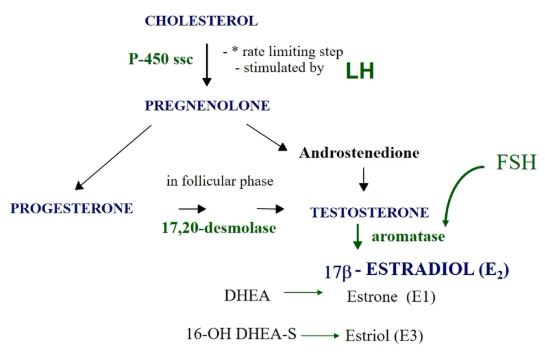
When we refer to “estrogen” we are most often referring to what form of estrogen?
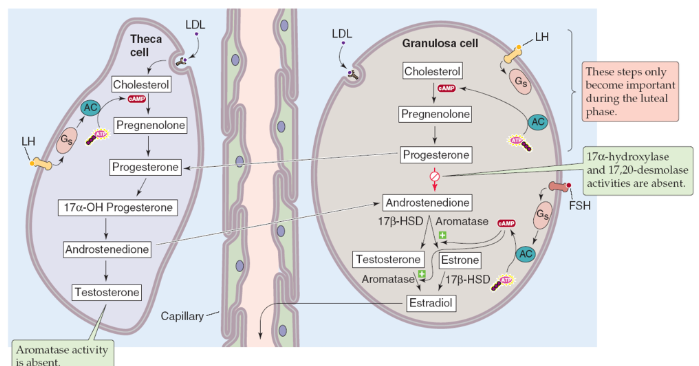
estradiol(E2) which is the form made by conversion of testosterone via aromatase
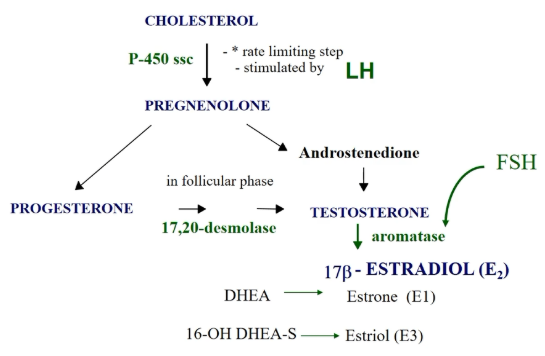
Estrone (E1)
aka the estrogen of menopause. Made by the conversion of DHEA by aromatase. DHEA is an adrenal androgen which is produced during menopause.
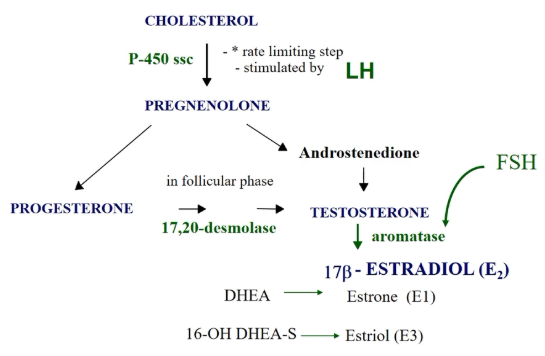
Estriol (E3)
aka the estrogen of pregnancy. made by conversion of 16-OH DHEA-S which is produced by the fetus
Show the life cycle of an ovarian follicle
There are two distinct phases of ovarian follicle development: gonadotropin-independent growth and gonadotropin-dependent growth. These phases also are known as pre-antral growth (stage 1) and antral growth (stage 2), respectively. The gonadotropins are follicle-stimulating hormone (FSH) and luteinizing hormone (LH). After puberty, once a month a small cohort of primordial follicles begin maturing. Only one will become a mature or graffian follicle.
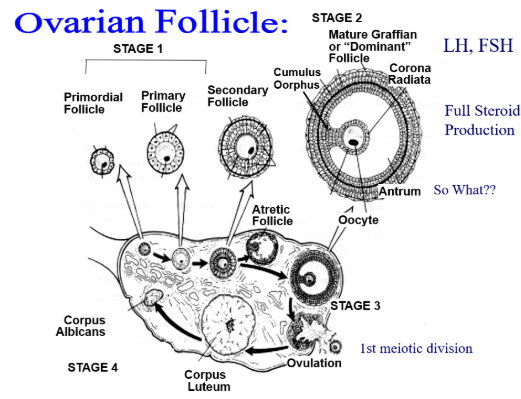
Each ovarian follicle contains a —- before ovulation.
primary oocyte
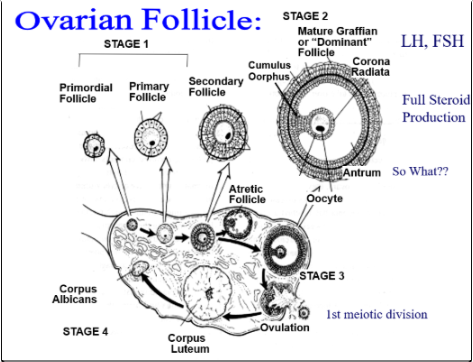
The pool of primordial follicles present in the female ovary reaches its maximum number around — and then decreases in a — fashion throughout life until complete depletion occurs during —-
20 weeks of gestational age; logarithmic; menopause
t/f oocytes are protected by an ovarian blood barrier much like the testes blood barrier
false; the oocytes are protected by being arrested as primary oocyte and thus not being haploid until ovulation
During fetal development there are approximately —- oocytes that enter meiosis
7 million
Primordial follicle
develop in the fetus and primary oocyte within is arrested at prophase 1 of meiosis 1. Represent the ovarian reserve of follicles.
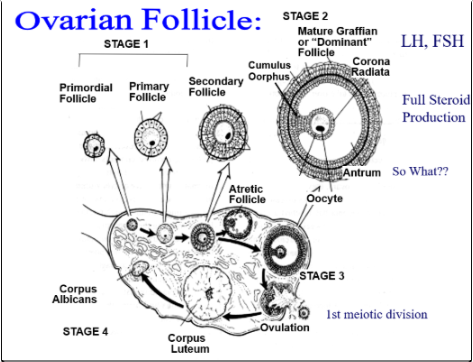
Primary follicle
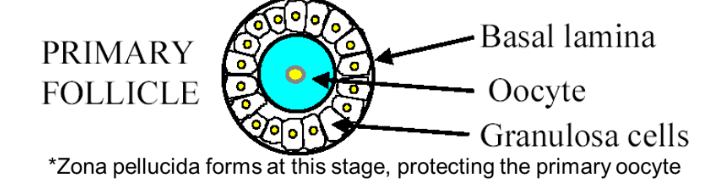
when primordial follicles transition into primary follicles, the oocyte enlarges and granulosa cells proliferate which then start expressing FSH receptors. A primary follicle is defined by the presence of one or more cuboidal granulosa cells that are arranged in a single layer surrounding the oocyte. Zona pellucida forms at the primary follicle stage
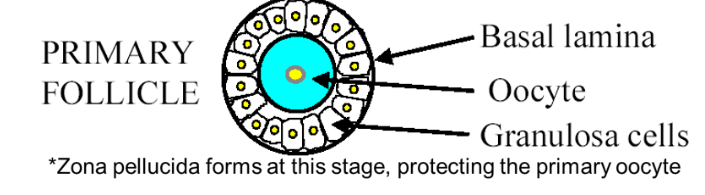
Granulosa cells
develop around follicle cells during the transition from primordial to primary follicle. Responsible for nourishing the cell to support oocyte maturation.
Secondary follicle
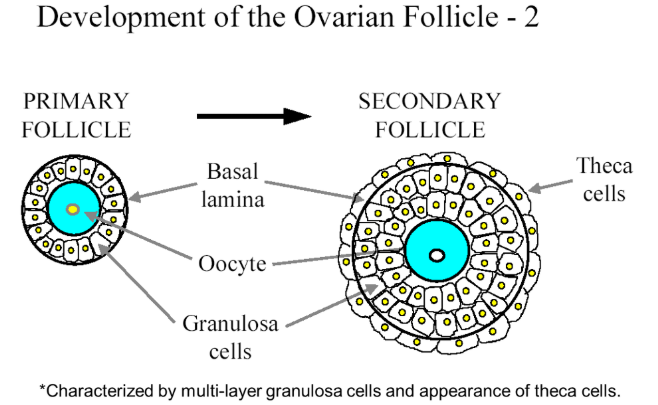
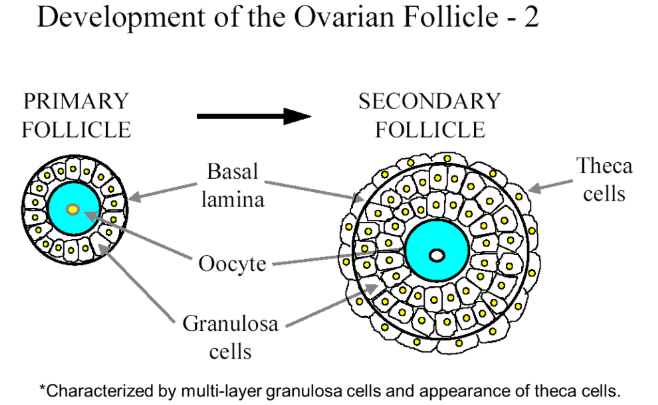
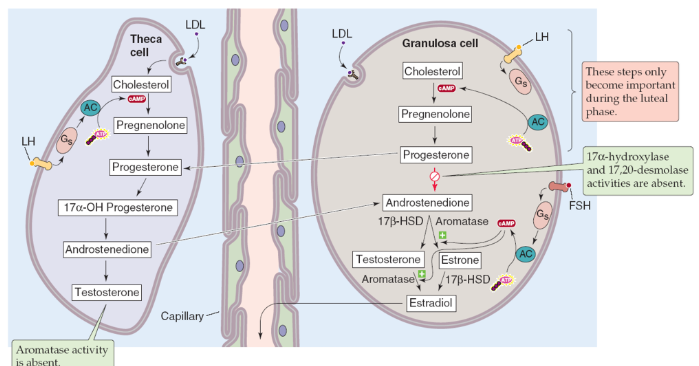
has multiple layers of granulosa cells. Theca cells on the outermost layer act like leydig cells and respond to LH to produce testosterone
Theca cells
found in secondary and graffian follicles. Produce testosterone in response to LH
Graffian follicle
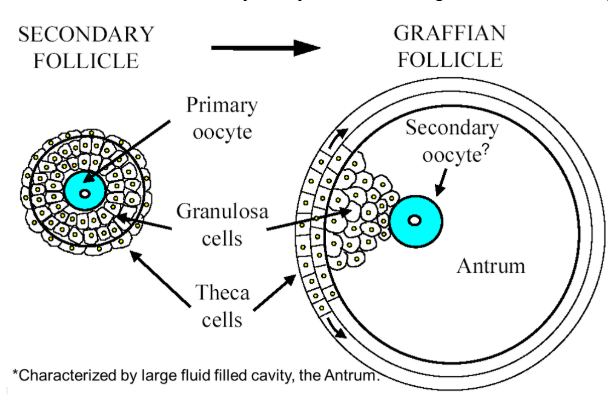
as the secondary follicle grows, it eventually gains a large fluid filled cavity called the antrum. This cavity is filled with follicular fluid which is a plasma exudate conditions by secretory products from the oocyte and granulosa cells. Primary oocyte will become a secondary oocyte when the graffian follicle ruptures (during ovulation)
What does FSH do in the ovarian cycle?
stimulates primordial follicular cells to transform into granulosa cells and activates theca cells to cause them to express aromatase which converts testosterone into estrogen
What does LH do in the ovarian cycle?
stimulates formation of theca cells in the secondary follicle stage and stimulates those cells to produce testosterone (precursor to estrogen). Surge in LH is what causes ovulation as well.
Describe what happens during ovulation to graffian follicles?
preovulatory graffian follicles have lots of LH receptors and a surge in LH triggers resumption of meiosis in the primary oocyte of the follicle. Increased estradiol inhibits GnRH release from the hypothalamus by negative feedback, which leads to a decrease in serum FSH. The decrease in FSH is also a result of rising inhibin levels. A dominant follicle (usually one) is selected at approximately day 7 of the cycle. The dominant follicle out-competes the rest of the cohort for a limited FSH supply. Estradiol production increasingly comes from the dominant follicle. The rest of the cohort will undergo atresia throughout the remainder of the follicular phase.
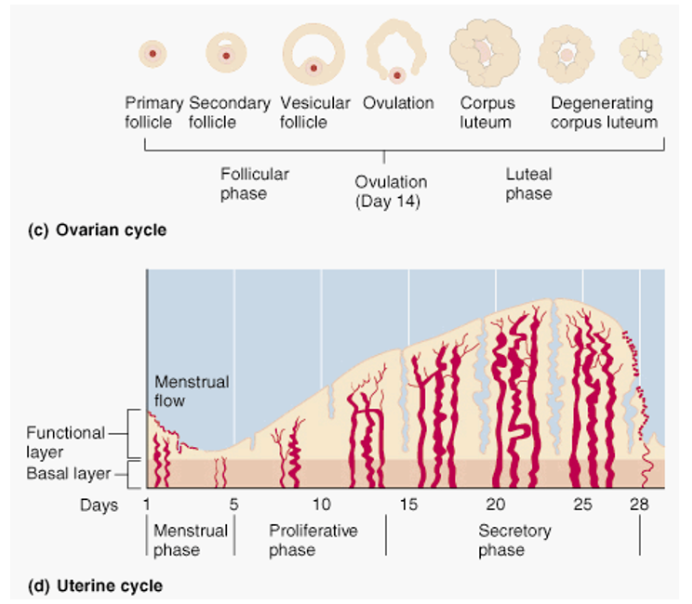
Endometrium
inner lining of uterus. Estrogen leads to growth while Progesterone enhances/sustains growth and increases vasculature
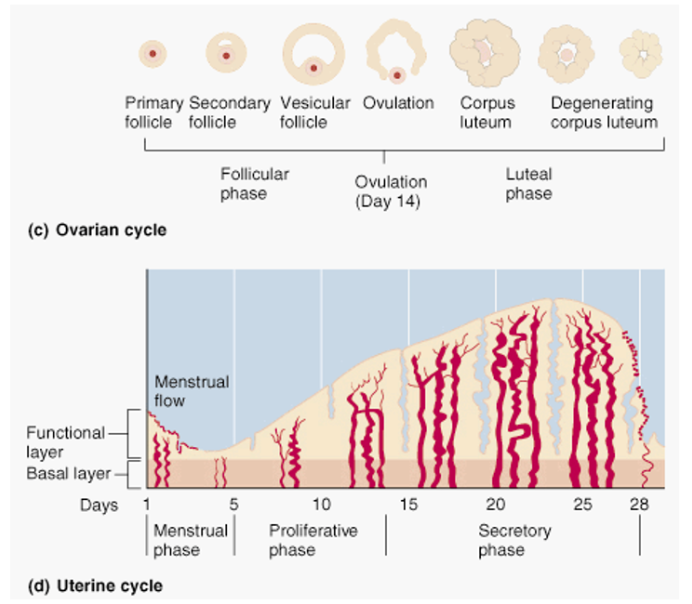
Myometrium
thick outer layer of uterus. Estrogen causes contraction while progesterone causes relaxation
Show an overview of the ovarian cycle and endometrial cycle
during follicular phase estrogen causes growth in endometrium and FSH causes development of follicular cells. LH surge causes ovulation and release of the secondary oocyte from a graffian follicle. The remains of this follicle form a corpus luteum which produces progesterone instead of estrogen. Progesterone enhances growth and blood supply in the luteal phase as well inhibiting contractions/movement of myometrium. Endometrial growth is timed to ovulation and transport of the oocyte toward fertilization. Prepares for implantation.
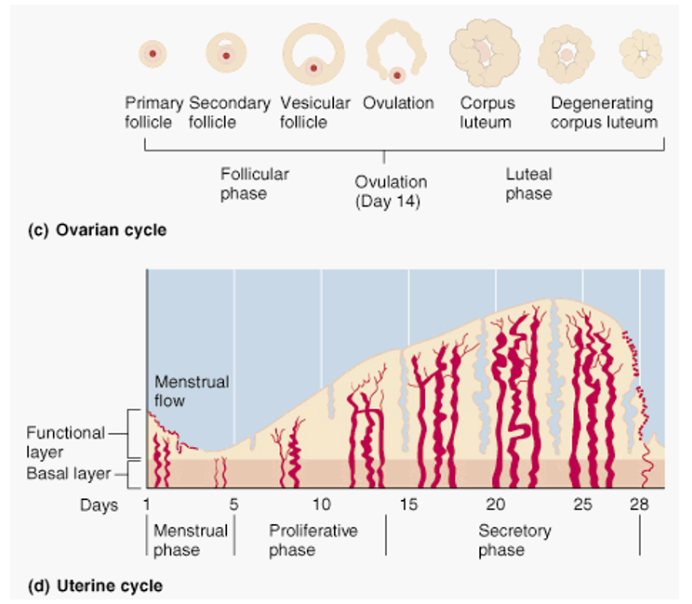
Describe what happens in the luteal phase of the ovarian cycle?
progesterone is secreted by the corpus luteum after ovulation. This stimulates secretory and vascular activity of the endometrium, preparing for implantation of an embryo. When the corpus luteum regresses, progesterone levels fall. New vasculature in the endometrium regresses and the tissue sloughs off (causing the bleeding associated with the menstrual cycle)
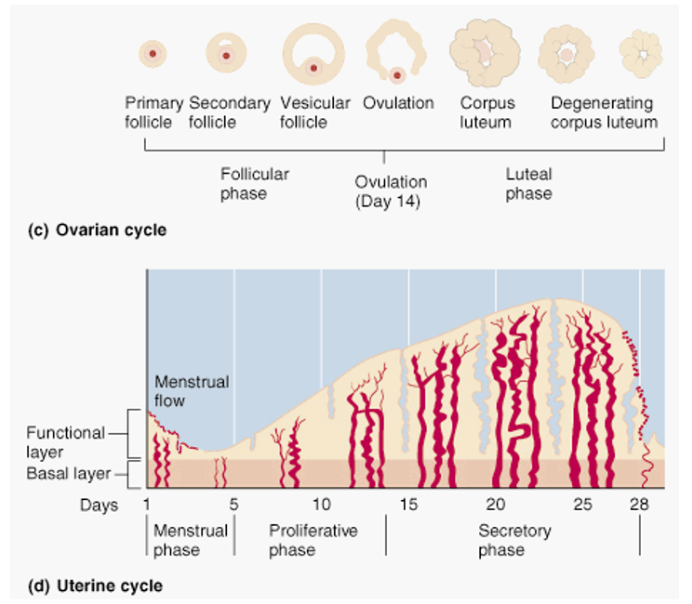
Show the difference in feedback of FSH, LH and estrogen between the follicular phase, midcycle/ovulation and luteal phase of the ovarian cycle
estrogen acts as a negative inhibitor during the follicular phase when levels are still low but as a positive feedback in the midcycle leading to an LH surge and thus ovulation. Progesterone (secreted by the corpus luteum) negatively inhibits GnRH and FSH+LH. This negative feedback prevents another ovulatory event from occurring before fertilization may occur
How does the birth control pill work?
Synthetic estrogen and progestin (a form of progesterone) in the pills travel through the bloodstream to the hypothalamus and the pituitary gland. The estrogen suppresses production of FSH in the pituitary gland so follicle maturation doesn't occur
Show the type of cell LH affects and how it does so
LH affects both Theca and granulosa cells. In theca cells it triggers testosterone production. In granulosa cells, it triggers progesterone production (LH receptor is expressed in preparation of the luteal phase)
Show the type of cell FSH affects and how it does so
It causes granulosa cells to produce estrogen by upregulating aromatase activity.
Menopause
complete atresia (form of programmed cell death) of all remaining follicles. Granulosa cells no longer make estradiol or inhibin and gonadotropins rise to castrate levels (no estrogen to cause negative feedback). Theca/stroma cells still make androgens but they are no longer converted to estrogen.