Bonding- detailed notes
 Call Kai
 Learn
Learn Practice Test
 Spaced Repetition
 Match
Match Flashcards
 Knowt Play
1/20

Earn XP
Description and Tags
Name | Mastery | Learn | Test | Matching | Spaced | Call with Kai |
|---|
No analytics yet
Send a link to your students to track their progress
21 Terms
Ionic bond
is the electrostatic force of attraction between the oppositely charged ions formed by electron transfer
occurs between a metal and a non-metal & electrons are transferred form the metal to the non-metal so both the atoms have full outer shells
when electrons are transferred, it created charged particles called ions- oppositely charged ions attract through the electrostatic forces to form giant ionic lattice.
The charge of an ion is related to the strength of the ionic bond that forms so ions with a greater charge will have a great attraction to other ions so there is strong forces of attraction so stronger the ionic bonding so, ionic bond is stronger and the melting point is higher when the ions are smaller or have higher chargers e.g. MgO has a higher melting point that NaCl as the ions involved (Mg 2+ (1s2 2s2 2p6 3s2—> Mg 2+→1s2 2s2 2p6) & O2- (1s2 2s2 2p4—> 1s2 2s2 2p6) are smaller and have higher charges than those in NaCl, Na+, Cl-)
Since larger ions will have a greater ionic radius so they have a weaker attraction to the oppositely charged ion because the attractive forces have to act over a greater distance.
Covalent bond
A covalent bond is the strong electrostatic attraction between a shared pair of electrons and the nuclei of the bonded atoms
forms between 2 non-metals & electrons are shared between the 2 outer shells in order to achieve a full outer shell (multiple electron pairs can be shared to produce multiple covalent bonds)
shared paired of electrons are represented by dot and cross diagrams
the length of a covalent bond is strongly linked to its strength- shorter bonds tend to be stronger as the atoms are held closer together so the forces of attraction are greater, requiring more energy to overcome the forces.
double and triple bonds are shorter than single covalent bond so they have much stronger forces
Dative covalent bonding
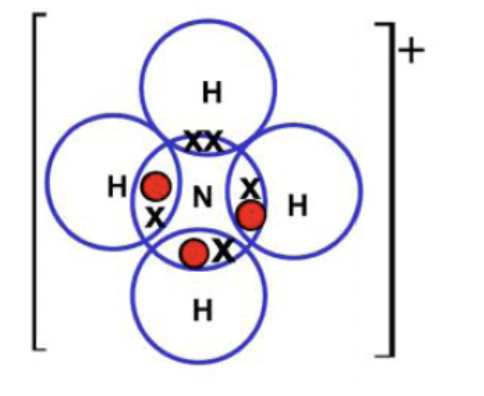
Dative covalent bond forms when the shared pair of electrons in the covalent bond are supplied from a single atom
it is indicated using an arrow from the lone electron pair e.g. Ammonia (NH3) has a lone electron pair that can form a dative bond with a hydrogen ion (H+) to produce an ammonium ion (NH4+)
once a dative bond is formed its treated as a standard covalent bond as it reacts in the same way and has the exact same properties regarding strength and length
its also called co-ordinate bonding
Metallic bonding
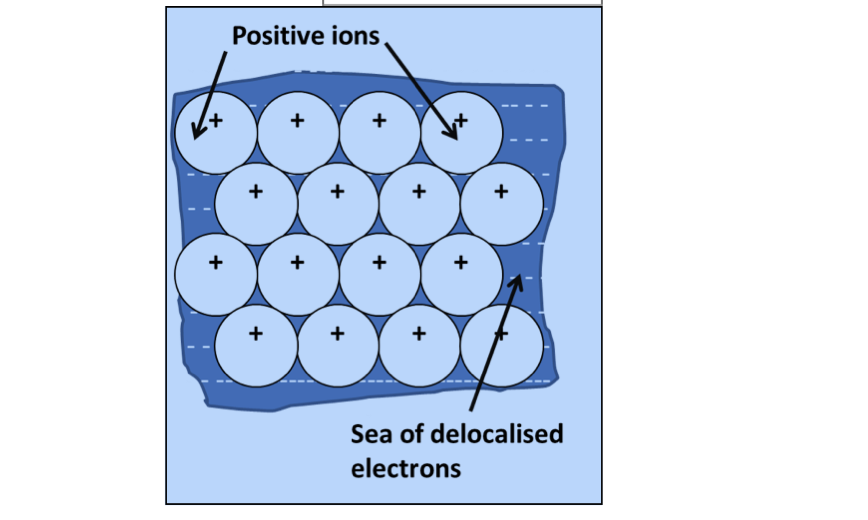
A metallic bond is the electrostatic force of attraction between the positive metal ions and the delocalised electrons
Metallic bonding consists of a lattice of positively charged ions surrounded by a ‘sea of delocalised electrons’ producing a very strong electrostatic force of attraction between these oppositely charged particles.
3 factors affecting the strength of a metallic bond are:
Number of protons/strength of nuclear attraction - the more protons the stronger the bond as more electrons are released in to the ‘sea’
Number of delocalised electrons per atom (the outer shell electrons are delocalised ) - the more delocalised electrons the stronger the bond
Size of ion- the smaller the ion the stronger the bond
e.g. Mg has a stronger metallic bonding than Na so it has a higher melting point, The metallic bonding gets stronger because in Mg there are more electrons in the outer shell that are released to the sea of electrons. The Mg ion is also smaller and has one more proton. There is therefore a stronger electrostatic attraction between the positive metal ions and the delocalised electrons and higher energy is needed to break bonds.
Physical properties
physical properties of a substance include its boiling point, melting point, solubility and conductivity
they are different depending on the type of bonding and the crystal structure of the compound
crystal structure
4 main types of crystal structure- ionic, metallic, simple molecular and macromolecular
Ionic (e.g. sodium chloride)
substances with an ionic crystal structure have a high melting and boiling points- as the electrostatic forces holding the ionic lattice together are strong and require a lot of energy to overcome
however when molten or in solution, ionic substances can conduct electricity as the ions are separate and are no longer in a lattice- so the ions are free to move and can carry a flow of charge (electric current)
ionic substances are brittle materials when the layers of alternating charges are distorted, like charges repel breaking apart the lattice into fragments
Metallic (e.g. Aluminium)
substances with a metallic structures are good conductors- the ‘sea’ of delocalised electrons is able to move and carry a flow of charge
metals are also malleable as the layers of positive ions are able to slide over one another- the delocalised electrons prevent fragmentation as they can move around the lattice
the electrostatic forces of attraction between the + ions and delocalised electrons are very strong and require a lot of energy to overcome
this means metallic substances have high melting points and are nearly always solid at room temperature
mercury is the only liquid metal at room temperature
Simple Molecular (e.g. Iodine)
substances with a simple molecular structure consists of covalently bonded molecules held together with weak van Der Waals forces these are types of intermolecular force that act between the molecules holding them in a structure
simple molecular substances have low melting and boiling points as not much energy Is needed to overcome the forces since the van Der Waals force are very weak
water has a simple molecular structure but has an unusually high boiling point for the size o molecule due to the presence of hydrogen bonding
simple molecular substances are very poor conductors as their structure doesn't contain any charged particles
Macromolecular (e.g. diamond)
substances that has a macromolecular structure are covalently bonded into a giant lattice structure
each atom has multiple covalent bonds which are very strong, giving the substances a very high melting point
the strength of the covalent lattice makes macromolecular substances rigid.
Diamond is a macromolecular structure made up of carbon atoms each bonded to four further carbon atoms- this makes diamond one of the hardest, strongest material known
Graphite is another molecular structure made up of carbon atoms, however in graphite each carbon atom is bonded to 3 others in flat sheets.The electrons are not used in bonding are released as free electrons which moves between layers, meaning it can conduct electricity.
shapes of molecules
the shape of a molecule is determined by the number of electron pairs around the central atom
each electron pair naturally repels each other so that the largest bond angle possible exists between the covalent bonds
Lone Pair Repulsion
any lone pairs present around the central atom provides additional repulsive forces which changes the bond angle
for every lone pair present, the bond angle between covalent bond is reduced by 2.5 degrees
Molecule shapes
The shape of a molecule can be determined by considering the type and quantity of electron pairs:
Find the number of electron pairs
Determine how many of the pairs are bonding pairs and how many are lone pairs
Bonding pairs indicate the basic shape and lone pairs indicate any additional repulsion

Linear molecule
2 electron pairs
Has 2 bonding pairs & 0 non-bonding pairs
the diagram of the molecule is drawn in a straight line
bond angle is 180 degrees
Trigonal Planner
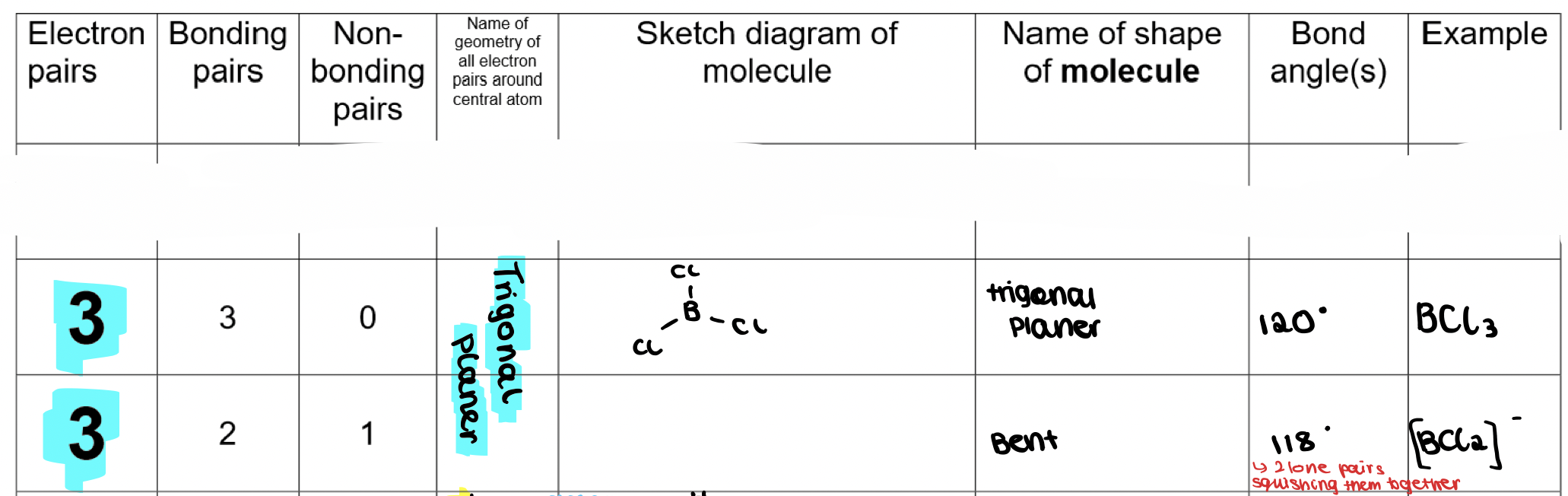
Has 3 electron pairs
3 bonding pairs & 0 non-bonding pairs
name of shape of molecule is trigonal planner
bond angle is 120 degrees
Has 3 electron pairs
2 bonding pairs & 1 non-bonding pairs
name of shape of molecule is bent
bond angle is 118 degrees (since there’s 2 lone pairs squishing them togther)
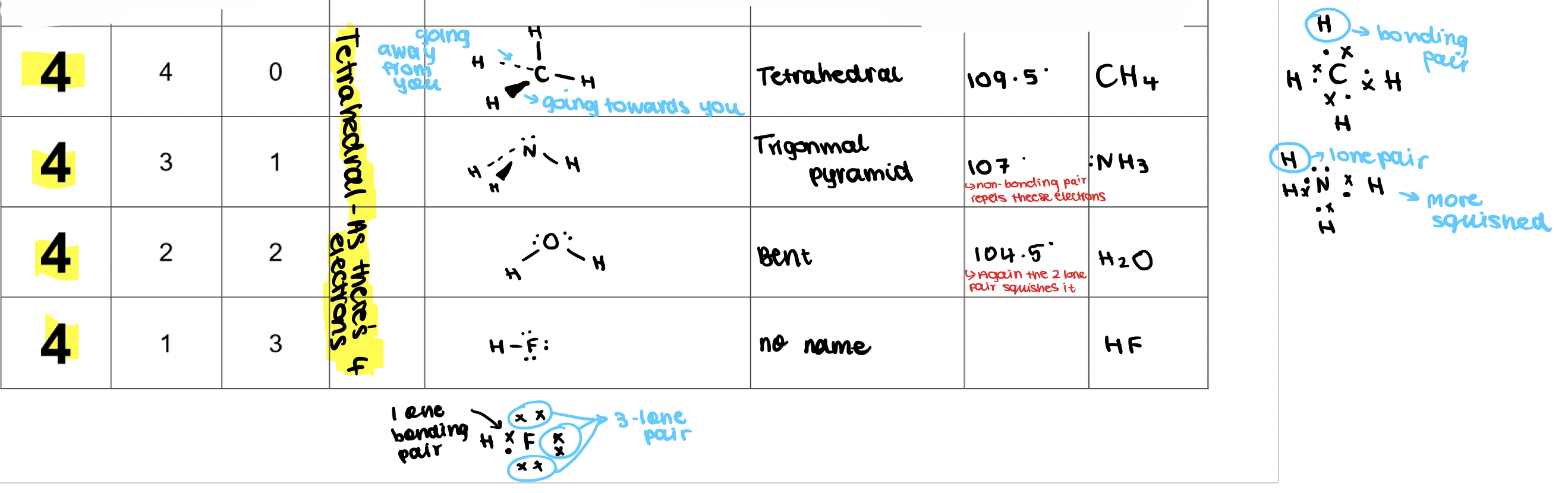
Tetrahedral
Has 4 electron pairs
4 bonding pairs & 0 non-bonding pairs
name of shape of molecule is tetrahedral
bond angle is 109.5 degrees
Has 4 electron pairs
3 bonding pairs & 1 non-bonding pairs
name of shape of molecule is Trigonal pyramid
bond angle is 107 degrees
Has 4 electron pairs
2 bonding pairs & 2 non-bonding pairs
name of shape of molecule is bent
bond angle is 104.5 degrees
Has 4 electron pairs
1 bonding pairs & 3 non-bonding pairs
no name for shape of molecule
bond angle is none degrees
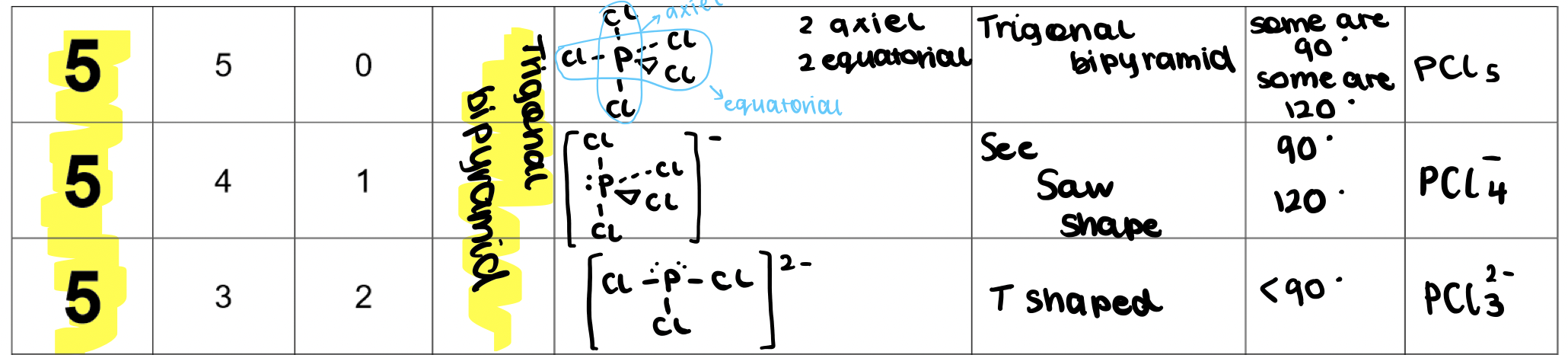
Trigonal bipyramid
Has 5 electron pairs
5 bonding pairs & 0 non-bonding pairs
name of shape of molecule is trigonal bipyramid
bond angle = some are 90 degrees and some are 120 degrees
Has 5 electron pairs
4 bonding pairs & 1 non-bonding pairs
name of shape of molecule is see saw shape
bond angle = some are 90 degrees and some are 120 degrees
Has 5 electron pairs
3 bonding pairs & 2 non-bonding pairs
name of shape of molecule is T- shaped
bond angle <90 degrees
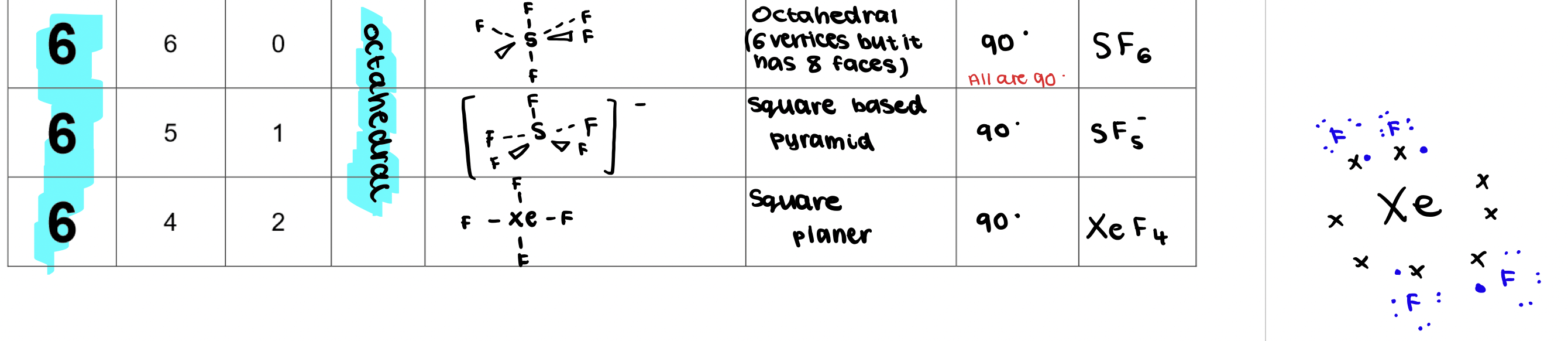
Octahedral
Has 6 electron pairs
6 bonding pairs & 0 non-bonding pairs
name of shape of molecule is octahedral
bond angle is 90 degrees
Has 6 electron pairs
5 bonding pairs & 1 non-bonding pairs
name of shape of molecule is square based pyramid
bond angle is 90 degrees
Has 6 electron pairs
4 bonding pairs & 2 non-bonding pairs
name of shape of molecule is square planner
bond angle is 90 degrees
Bond polarity
the negative charge around a covalent bond is not evenly spread around the orbital of the bonded atoms
Electronegativity
Every atom has electronegativity, which is defined as:
The power of an atom to attract negative charge towards itself within a covalent bond
This ‘power’ is different for every atom depending on its size and nuclear charge
electronegativity increases along a period as atomic radius decreases and decreases down a group as shielding increases
Permanent Dipole
If the 2 atoms that are bonded have different electronegativities, a polar bond forms
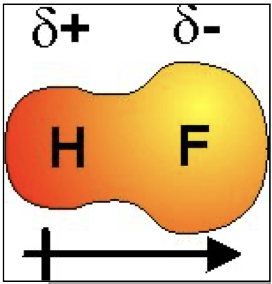
The more electronegative atom draws more of the negative charge towards itself and away from other atom, producing δ- region and a δ+ region- this is a permanent dipole
Hydrogen fluoride is a polar molecule as fluorine is a lot more electronegative than hydrogen so electrons are drawn to the right
Polar molecules with a permanent dipole can align to form a lattice of molecules similar to an ionic lattice
Induces Dipole
An induced dipole can form when the electron orbitals around a molecule are influenced by another charged particles
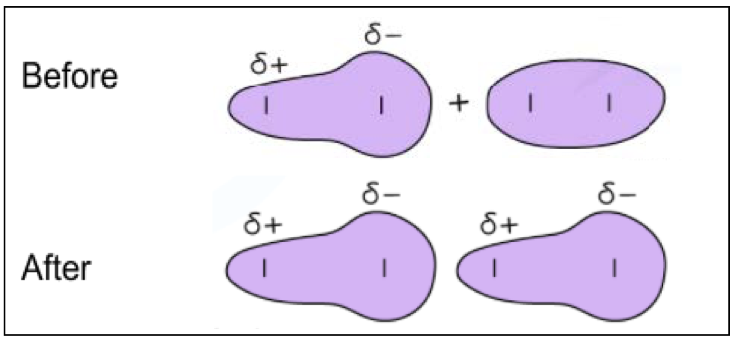
Van der Waals Forces -intermoleuclar forces)
This is the weakest type of intermolecular force- acts as an induced dipole between molecules- they do not occur in ionic substances
occur between all simple covalent molecules and the separate atoms in noble gases
the strength of van Der Waals forces varies depending on the Mr of the molecules and its shape
The larger the Mr of the molecule, the stronger the intermolecular forces
Straight chain molecules experience stronger van Der Waals forces than branched chain molecules as they can line up and pack closer together
this reduces the distance over which the force acts, therefore they are stronger
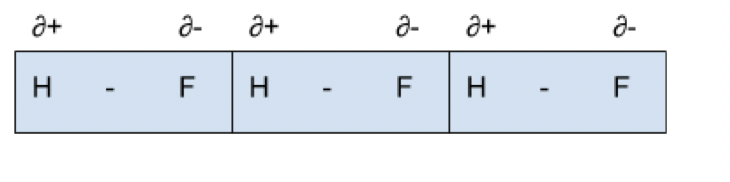
Permanent Dipole- intermolecular force
this type of intermoleuclar force acts between molecules with a polar bond
the δ- and δ+ regions attract each other and hold the molecules together in a lattice like structure
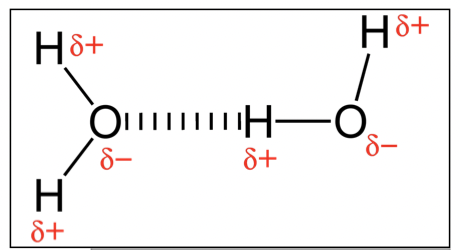
Hydrogen Bonding
This is the strongest type of intermolecular force
hydrogen bonds only form between hydrogen and the 3 most electronegative atoms: nitrogen, oxygen and fluorine
the lone pair on these toms forms a bond with a hydrogen atom from another molecule, shown with a dotted line
molecules held together with hydrogen bonds have a much higher melting and boiling points compared to similar sized molecules without hydrogen bonding
this shows how the type of intermolecular forces acting between the molecules heavily influences the physical properties of a substance