Lecture 13: Brain Development
 Studied by 1 person
 Call Kai
 Learn
Learn Practice Test
 Spaced Repetition
 Match
Match Flashcards
 Knowt Play
1/35

There's no tags or description
Looks like no tags are added yet.
Name | Mastery | Learn | Test | Matching | Spaced |
|---|
No study sessions yet.
36 Terms
macro neuroanatomy (also learning goals)
Recognize basic neuroanatomy, and patterns of anatomical and functional brain development
Explain the difference between “forward inference” and “reverse inference”
Explain how both behavioral and neural data inform the puzzle of face processing in infancy
Explain how both behavioral and neural data inform the puzzle of infant memory, and infantile amnesia
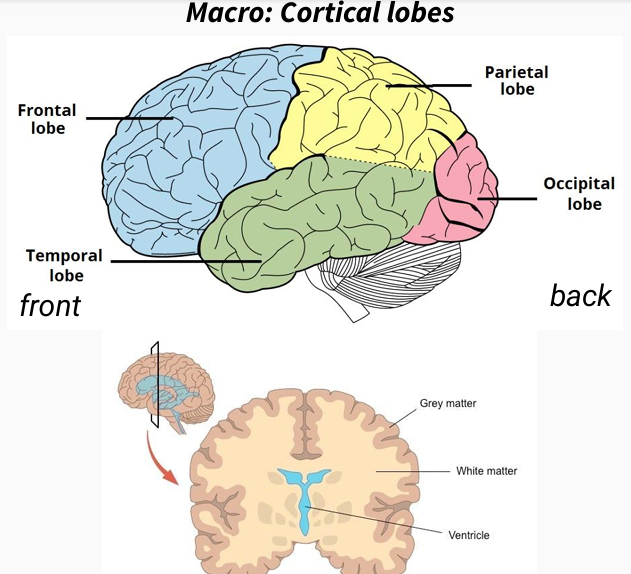
micro neuroanatomy

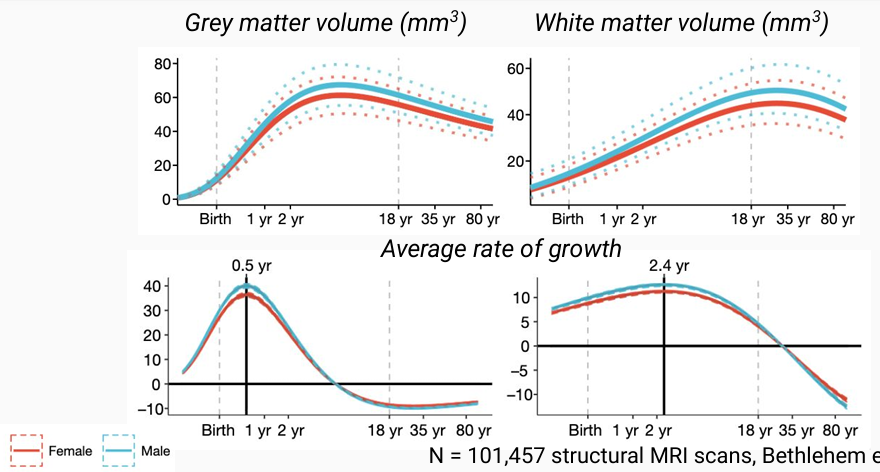
Anatomical development
Grey matter grows most ~1 yr, white ~2yr
maxima see image
maximum white matter around our age, 18! according to prof, but clearly its greater than that according to the graph lol, but close enough ig
idk not important
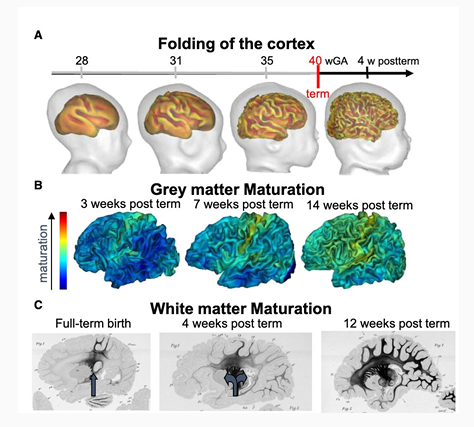
more anatomical development
many changes in gray and white matter volume continuing into childhood and even young adulthood
specifics not important

random image
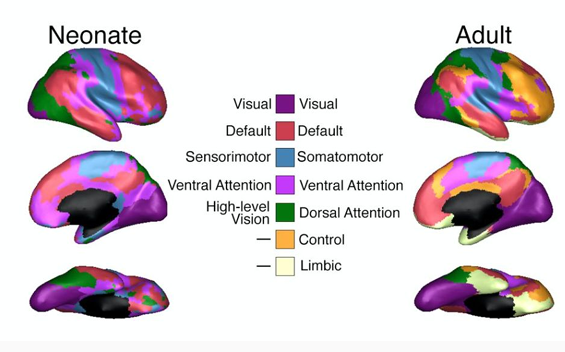
organization of brain networks
adult brains organized into functional networks - regions of brain whose activity rises and falls together (even at rest)
much of this functional structure is present from birth
measured while infants were asleep
but this is not measuring neural responses in awake people
want to see how brains support cognition and behavior of ppl who are awake and doing things
How can we think about (1) the anatomical immaturity of the infant brain, and yet (2) the early emergence of cognitive functions?
Presence of change does not imply starting from 0
nonzero starting point
wow revolutionary
what does brain data add to learning about the developing mind????
hard to learn about mind by measuring brain
all cognitive functions have neural origins (so finding capacity through behavior implies neural mechanisms that support it)
um she’s saying idk… everything is brain, so duh you don’t learn anything? so by itself it’s not satisfying
u have to think about why this specific brain area (shocker)
brain responses don’t always support behavior
causation correlation
forward vs reverse inference
forward:
manipulating stimulus or task, then measuring the brain
Q: What is neural basis for [mental function]?
A: Brain areas, X, Y, and Z
Reverse:
measuring brain and making inference about underlying mental function
Q: What [mental process] involved in [task]?
A: Cognitive processes X, Y, and Z
Forward inference: which brain regions respond more to personal v impersonal moral scenarios?
“Impersonal scenarios evoke calculated thinking, more so than personal scenarios”
“Personal scenarios evoke emotional reasoning, more so than impersonal scenarios”
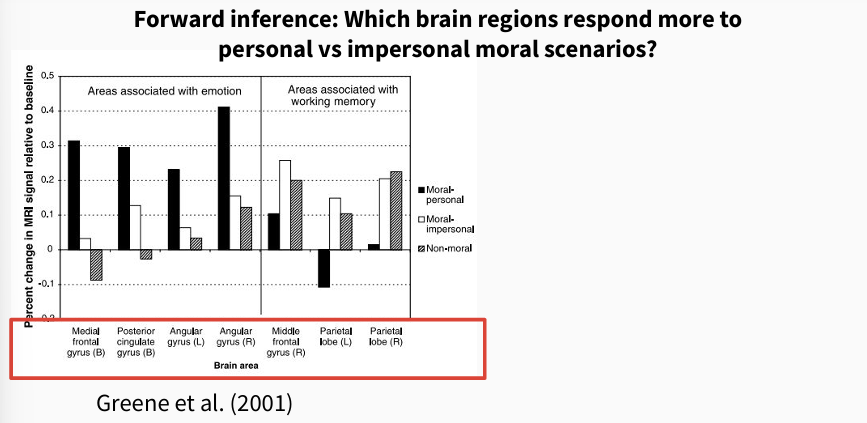
reverese: given neural activation, what cognitive processes are likely involved in processing moral vs impersonal moral scenarios?
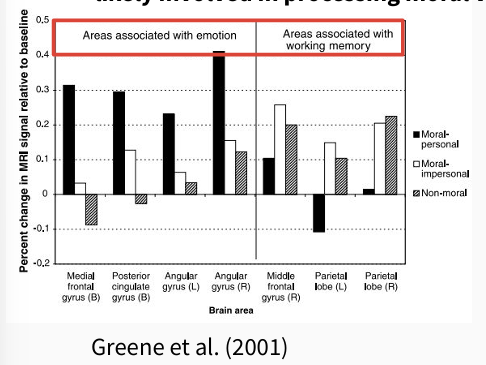
controversial??!
Using brain to learn about mind requires making reverse inferences.
controversial because the same region can be active during many different mental processes
what do brain data add to learning about developing mind? (again)
um ig can tell us about “Common mechanisms” vs “Distinct mechanisms”
- in adults v infants, is same mental process/behavior supported by same or distinct neural mechanism
face processing
what is neural basis for face perception early in life
adult face processing
Multiple face-selective regions, including the fusiform face area (FFA), superior temporal sulcus (STS), and medial prefrontal cortex (MPFC)
‘face selective’: responds more to faces than other stuff
like houses, objects, bodies, scenes
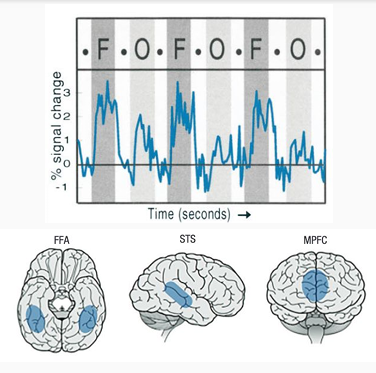
FFA in adults
In adults, FFA does not merely respond to faces, but is causally involved in face perception
N=1 case study in patient with electrodes implanted over FFA
electrode stimulate FFA, japanese guy sees face on random stuff like box/soccer ball
looks at doctor, and his face like changes
eyes nose change. dude becomes anime character
hair stays same
FFA STS MPFC
these brain areas hypothesized to have increasingly abstract functions as we move from back to front of brain
FFA: processing faces
STS: processing social interactions
MPFC: processing self relevance and social value
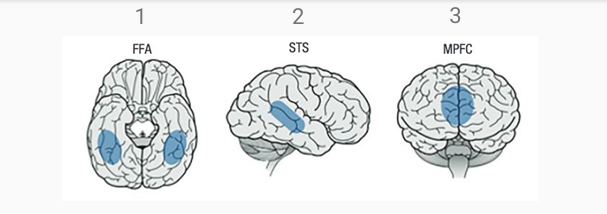
Serial hypothesis
face processing proceeds from concrete to absract over development, with brain areas developing face-selective response in a particular order
first infants learn to identify face (FFA)
Next, learn to sense other ppl’s interactions (STS)
Finally, connect what they see to themselves and attribute social value (MPFC)
case study 1: face processing
n=47 infants (2-10 months)
dynamic videos of different visual categories, plus a baseline (reference point)
basically see if response was more positive compared to baseline
selective responses: greater response to category X than any other

case study 1 continued
infant FFA responds to faces as early as we can measure
Ditto for areas in adults have more abstract functions like STS (social perception) and MFPC (social value)
Forward inference: infant FFA, STS, and MPFC, show a face-selective response, as early as we can measure
Reverse inference: Infants appreciate that faces are potentially valuable social partners, as early as they can perceive faces
the previous reverse inference is controversial
but there is supporting data: (past lectures)

face processing more support
In infants: STS and MPFC don’t merely respond to faces, but are also sensitive to social interaction and self relevance
in 4 mo: more response to mutual vs averged gaze in STS and MPFC
in 6 mo: greater response to MPFC to hearing own name vs familiar name
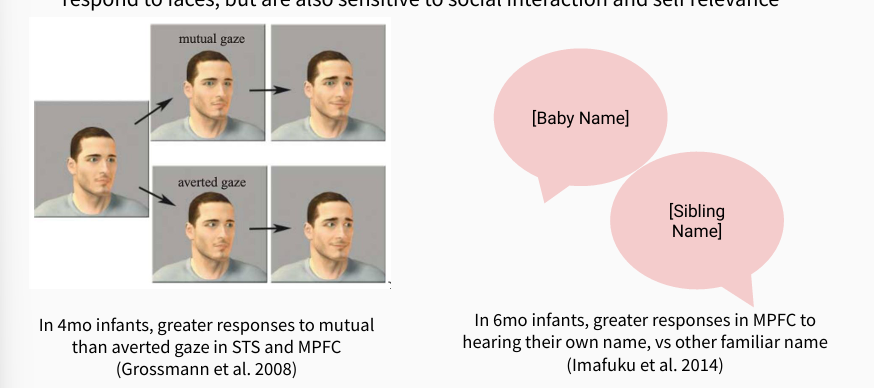
serial hypothesis conclusion?
No support for this proposal
instead face-selective responses emerge in parallel in these regions (forward inference).
Plausibly, perceiving faces, social partners, and making social evaluations emerge in parallel (reverse inference + behavioral evidence).
memory demo
shows a bunch of squares and one of em changes color.
i guess its harder if theres more total squares
short term memory
information that is briefly stored so that it can be actively processed
limited to just a handful of items
capacity limit of about 3 items
temporal scale: ~seconds
can measure this with a change detection array (the squares thing)
excellent performance when 1-3 items to track, lower 4+
demo 2
series of images of like houses and stuff
asking u what changed
everything changed but there were too many things to track and it happened “slowly” (ig one or couple changes at a time)
demo 3 science lab
stuff disappearing and moving
can’t keep track of everything all at once
long term memory
Stored information that constitutes our general knowledge base
higher capcity
temporal scale: minutes to lifetimes
e.g. what ur mom looks like, that JHU is in baltimore (declarative); how to cook ur fave recipe (procedural), something that happened in 8th grade (episodic)
evidence for shrotish-term memory in infancy

longish term memory
3mo infants learned that kicking makes mobile move
after a few days delay:
infants kicked when set up with same mobile as before
but not a different mobile
also “every single aspect of language development"
u need memory to learn language lol
infantile amnesia
infants clearly can remember things
but! how come older children or adults can’t recall memories from early childhood, up to age 3-4
hypothesis: developmental change in neural mechanisms for memory formation explains infant amnesia
if true: neural mechanisms for memory should differ between adults + infants
In adult humans and other animals: hippocampus is critical role, which matures into adolescence
perhaps in infants, memory operates via diff mechanisms, that do not involve hippocampus
methods to test adults memory
show particpants pictures in lab, and test them later to see what they remember
Finding: in adults, greater responses in hippocampus to items that will be remembered than those that will be forgotten
adapted method for infants
4-24 mo infants scanned using fMRI, in similar task of sequences of images
evidence of whether infants remembered:
preferential looking for the familiar item, after a delay
infants also showed greater responses in hippocampus for items that will subsequently be remembered vs forgotten, just like adults
common mechanisms
infantile amnesia hypothesis
no evidence that infants can’t remember stuff
both infants and adults use hippocampus
no support for distinct mechanisms
remaining hypo: Issues storing or retrieving memories from early childhood?
closing/summary
Brains develop. Yet, many of the brain systems present in adults are wired up at birth and functional soon after.
Itʼs hard to learn about the mind by measuring the brain (reverse inference). But itʼs possible! For example, neural data has provided evidence for common mechanisms of face perception and memory in infants and adults
Developmental cognitive neuroscience works best with a multidisciplinary toolkit, including both behavioral and neural studies