2.1 - Atoms, Isotopes, Ions, and Molecules: The Building Block
 Call Kai
 Learn
Learn Practice Test
 Spaced Repetition
 Match
Match Flashcards
 Knowt Play
1/44

There's no tags or description
Looks like no tags are added yet.
Name | Mastery | Learn | Test | Matching | Spaced | Call with Kai | Chat |
|---|
No analytics yet
Send a link to your students to track their progress
45 Terms
anion
negative ion that is formed by an atom gaining one or more electrons, designated by the elemental name being altered to end in “-ide.”
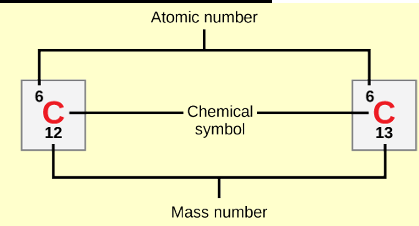
atomic mass
the total amount of neutrons and protons in an element or its isotope.
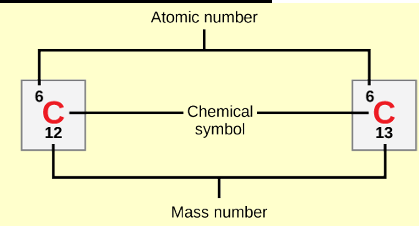
atomic number
total number of protons in an atom.
balanced chemical equation
statement of a chemical reaction with the number of each type of atom equalized for both the products and reactants.
cation
positive ion that is formed by an atom losing one or more electrons.
chemical bond
interaction between two or more of the same or different atoms that results in the formation of molecules.
chemical reaction
process leading to the rearrangement of atoms in molecules: involves the breaking and forming of chemical bonds.
chemical reactivity
the ability to combine and to chemically bond with each other: how readily a substance undergoes chemical reactions.
compound
substance composed of molecules consisting of atoms of at least two different elements: formed through chemical bonds.
covalent bond
type of strong bond formed between two of the same or different elements: forms when electrons are shared between atoms, and be single, double, or triple bonds.
electrolyte
ion necessary for nerve impulse conduction, muscle contractions and water balance.
electron
negatively charged subatomic particle that resides outside of the nucleus in the electron orbital; lacks functional mass and has a negative charge of -1 unit.
electron configuration
arrangement of electrons in an atom’s electron shell (for example: 1s22s22p6): defines the chemical properties and reactivity of the atom.
electron orbital
how electrons are spatially distributed surrounding the nucleus: the area where an electron is most likely to be found.
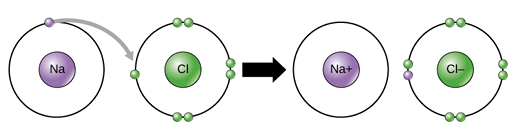
electron transfer
movement of electrons from one element to another: important in creation of ionic bonds.
electronegativity
ability of some element to attract electrons (often of hydrogen atoms), acquiring partial negative charges in molecules and creating partial positive charges on the hydrogen atoms.
element
one of 118 unique substances that cannot be broken down into smaller substances: each element has unique properties and a specified number of protons.
equilibrium
steady state of relative reactant and product concentration in reversible chemical reactions in a closed system.
hydrogen bond
weak bond between slightly positively charged hydrogen atoms to slightly negatively charged atoms in other molecules.
inert gas (noble gas)
element with filled outer electron shell that is unreactive with other atoms: complete valence shell.
ion
atom or chemical group that does not contain equal numbers of protons and electrons: positive charge when an electron is given away, negative charge when an electron is gained.
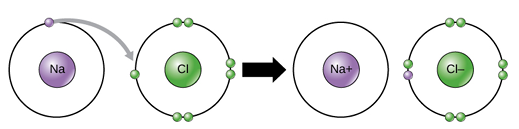
ionic bond
chemical bond that forms between ions with opposite charges (cations and anions). ex: postively charged sodium ions and negatively charged chloride ions bond together to make crystals of sodium chloride with a zero net charge.
irreversible chemical reaction
chemical reaction where reactants proceed uni-directionally to form products: cannot be easily reversed to regenerate the original reactants.
isotope
one or more forms of an element that have different numbers of neutrons. isotopes of an element have the same number of protons but varying atomic masses.
law of mass action
chemical law stating that the rate of a reaction is proportional to the concentration of the reacting substances.
mass number
total number of protons and neutrons in an atom.
matter
anything that has mass and occupies space.
molecule
two or more atoms chemically bonded together.
neutron
uncharged particle that resides in the nucleus of an atom: has a mass of one amu.
nonpolar covalent bond
type of covalent bond that forms between atoms when electrons are shared equally between them or bonds that form between two atoms of the same element: in this bond, there is no charge separation, leading to an even distribution of electrical charge.
nucleus
core of an atom: contains protons and neutrons: responsible for the atom's mass and positive charge.
octet rule
rule that atoms are most stable when they hold eight electrons in their outmost shells.
orbital
region surrounding the nucleus: contains electrons.
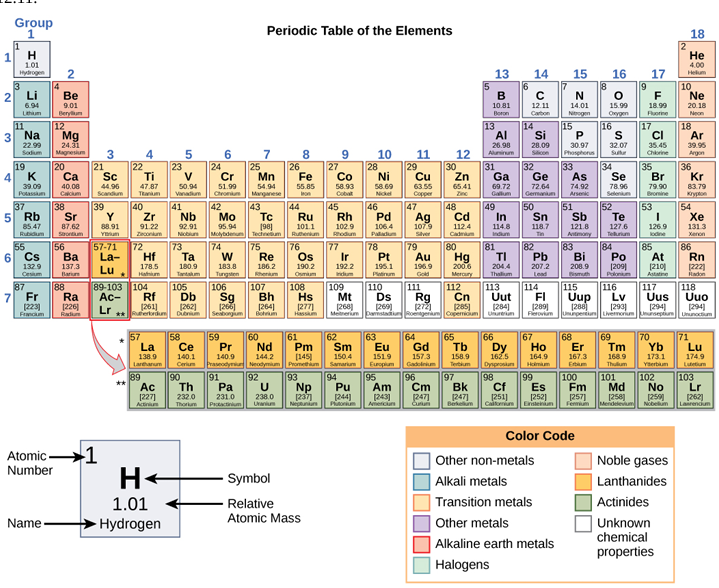
periodic table
organizational chart of elements indicating the atomic number (protons) and atomic mass (weight) of each element: the columns represent the potential shared state of elements’ outer electron shells.
polar covalent bond
type of covalent bond that forms as a result of unequal sharing of electrons, resulting in the creation of slightly positive and slightly negative charged regions of the molecule.
product
molecule found on the right side of a chemical equation: the result of a chemical reaction, formed when reactants undergo a transformation.
radioisotope
isotope that emits radiation composed of subatomic particles to form more stable elements.
reactant
molecule found on the left side of a chemical equation: substances that undergo a chemical reaction to form products.
reversible chemical reaction
chemical reaction that functions bi-directionally, where products may turn into reactants if their concentration is great enough.
valence shell
outermost shell of an atom: contains electrons that participate in chemical bonding and reactions.
van der Waals interaction
very weak interaction between molecules due to temporary charges attracting atoms that are very close together.