Skeletal System Review Flashcards
 Call Kai
 Learn
Learn Practice Test
 Spaced Repetition
 Match
Match Flashcards
 Knowt Play
 Podcast
1/58

Earn XP
Description and Tags
Comprehensive vocabulary flashcards covering skeletal system structure, bone anatomy, histology, bone repair, markings, divisions, curvature abnormalities, joints, and fracture types.
Name | Mastery | Learn | Test | Matching | Spaced | Call with Kai | Chat |
|---|
No analytics yet
Send a link to your students to track their progress
59 Terms
Skeletal System
The body's support structure consisting of 206 bones, cartilage, ligaments, and tendons that supports soft tissues, holds organs in place, and enables movement.
Axial Skeleton
The longitudinal division of the skeletal system comprising 80 bones, including the skull, ossicles, hyoid bone, vertebral column, sternum, and ribs.
Appendicular Skeleton
The division of the skeletal system comprising 126 bones, including the upper and lower limbs and the pectoral and pelvic girdles.
Diaphysis
The shaft of a long bone, composed primarily of compact bone tissue.
Epiphysis
The end section of a long bone, composed mostly of spongy bone tissue.
Epiphyseal Plate
A layer of hyaline cartilage located between the epiphysis and diaphysis of a growing long bone, where the bone increases in length; also known as the growth plate.
Epiphyseal Line
The osseous structure that replaces the epiphyseal plate once bone growth in length stops.
Periosteum
A dense connective tissue membrane covering most of the outer surface of a bone, consisting of two layers and housing blood vessels and nerves.
Endosteum
A thin connective tissue membrane lining the internal surface of the medullary cavity in a long bone.
Medullary Cavity
The internal central cavity of a long bone shaft that houses red marrow in juveniles and yellow marrow in adults.
Yellow Marrow
Adipose tissue stored inside the medullary cavity of adult long bones.
Red Marrow
Tissue located within bones containing blood-forming cells.
Osteogenesis Imperfecta (OI)
A genetic or heritable disorder in which bones fracture easily with minimal or no obvious cause; also known as brittle bone disease.
Osteoblasts
Bone-forming cells that secrete the organic matrix and osteoid and regulate bone mineralization.
Osteocytes
Mature, entrapped osteoblasts that represent the most abundant cell type in bone tissue.
Osteoclasts
Large, bone-eating cells responsible for matrix resorption, existing bone removal, repair, and remodeling.
Compact Bone
Dense lamellar bone tissue, also called cortical bone, located on the outer region of bones.
Spongy Bone
Porous lamellar bone tissue, also called cancellous bone, located on the inner region of bones.
Intramembranous Ossification
Direct bone formation that takes place within connective tissue membranes.
Endochondral Ossification
Indirect bone formation that takes place inside a cartilaginous precursor model.
Foramen
A hole through a bone that allows structures such as nerves or blood vessels to pass through.
Canal (or Meatus)
A hole in a bone that is elongated into a tunnel-like passage.
Fossa
A depression located on the surface of a bone.
Condyle
The smooth, rounded end of a bone where it articulates with another bone to form a joint.
Epicondyle
A rounded protuberance located at the end of a bone near a condyle, serving as an attachment point for ligaments, tendons, and muscles.
Suture
A fibrous, immovable joint uniting the bones of the skull.
Maxilla
The upper jaw bone that articulates by sutures to the temporal bone and holds the superior set of teeth.
Mandible
The facial bone forming the lower jaw, which holds the inferior set of teeth.
Atlas (C1)
The first cervical vertebra, which lacks a body and articulates with the occipital bone to allow the 'yes' movement of the head.
Axis (C2)
The second cervical vertebra, which allows significant head rotation ('no' motion) around its dens process.
Kyphosis
An abnormal posterior curvature of the spine primarily affecting the upper thoracic region, causing a hunchback condition.
Lordosis
An abnormal anterior curvature of the spine primarily affecting the lumbar region, causing a swayback condition.
Scoliosis
An abnormal lateral curvature of the spine, most commonly occurring in the thoracic region.
Sacral Hiatus
An opening at the inferior end of the sacrum where the spinous process of the fifth sacral vertebra fails to form, serving as a site for caudal anesthetic injections.
True Ribs
Rib pairs 1 through 7 that attach directly to the sternum via costal cartilages.
False Ribs
Rib pairs 8 through 12 that do not attach directly to the sternum.
Floating Ribs
Rib pairs 11 and 12, which are false ribs that have no anterior attachment to the sternum.
Sternal Angle
The palpable junction between the manubrium and body of the sternum (Angle of Louis) that marks the level of the second rib.
Pectoral Girdle
The shoulder girdle consisting of four bones—two scapulae and two clavicles—that attach the upper limbs to the body.
Clavicle
The collarbone; an S-shaped bone that articulates with the scapula at the acromion process and provides the only bony attachment of the upper limb to the axial skeleton.
Scapula
The shoulder blade; a flat triangular bone with three large fossae for muscle attachment.
Trapezoid
The smallest carpal bone located in the distal row of the wrist.
Capitate
The largest carpal bone located in the wrist.
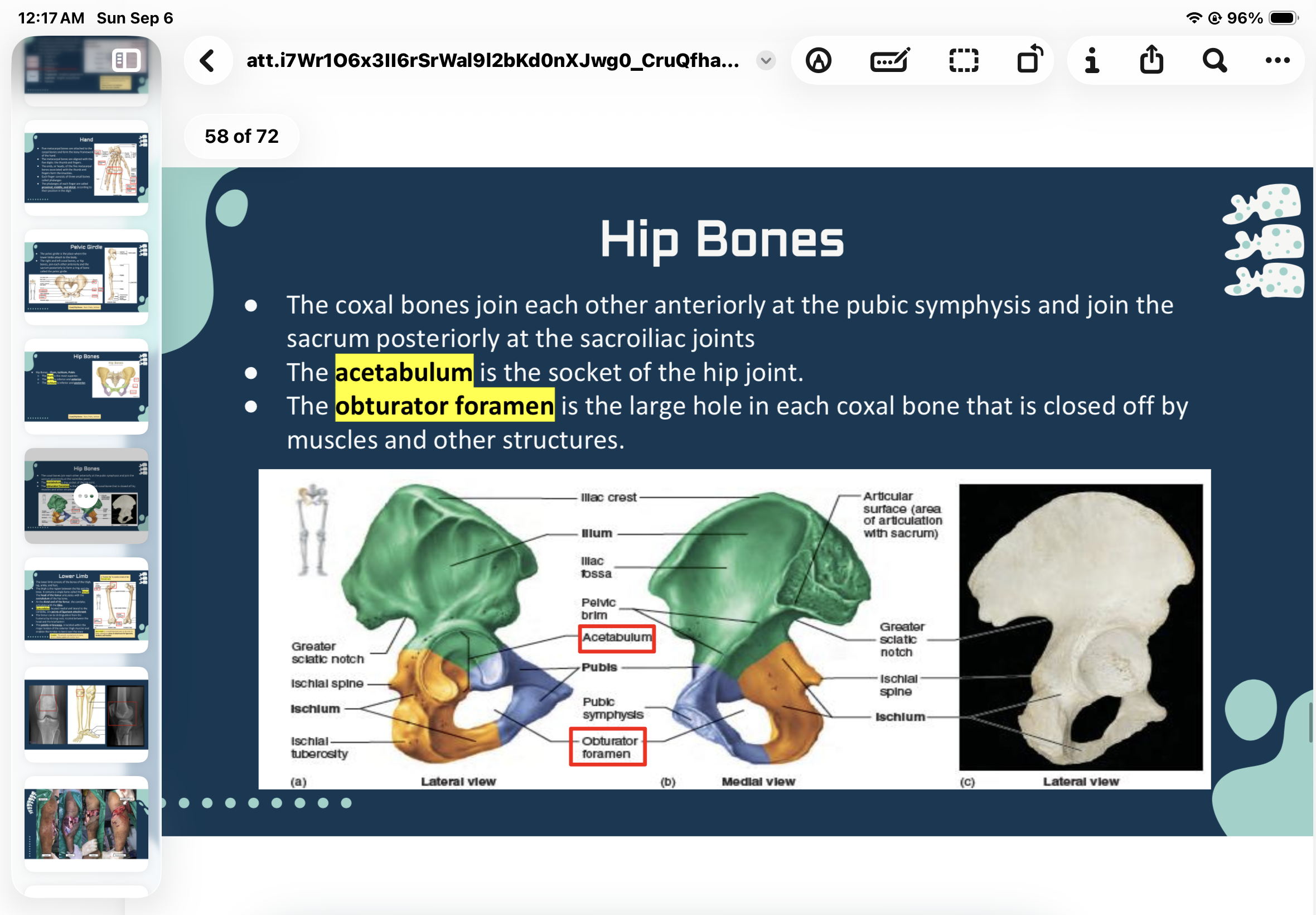
Pelvic Girdle
The ring of bone formed anteriorly by the joining of the right and left coxal bones and posteriorly by the sacrum, where the lower limbs attach.
Acetabulum
The cup-shaped socket on the lateral side of the coxal bone that articulates with the head of the femur to form the hip joint.
Obturator Foramen
The large hole in each coxal bone that is closed off by muscles and other connective structures.
Patella
The kneecap; a bone located within the tendon of the anterior thigh muscles that allows the tendon to bend smoothly over the knee joint.
Tibia
The larger, medial, major weight-bearing bone of the lower leg.
Fibula
The slender bone situated on the lateral side of the lower leg.
Synarthrosis
A functional classification for a joint that is completely non-movable.
Amphiarthrosis
A functional classification for a joint that is slightly movable.
Diarthrosis
A functional classification for a joint that is freely movable.
Synovial Joint
A structural class of freely movable joints containing a fluid-filled cavity surrounding the ends of articulating bones.
Open Fracture
A bone fracture in which the broken bone protrudes through the skin; also called a compound fracture.
Closed Fracture
A bone fracture in which the overlying skin is not perforated; also called a simple fracture.
Greenstick Fracture
An incomplete fracture that occurs on the convex side of the curve of a bending bone.
Comminuted Fracture
A bone fracture in which the bone breaks into more than two fragments.

Synovial joints