Photo Chapter 1
 Call Kai
 Learn
Learn Practice Test
 Spaced Repetition
 Match
Match Flashcards
 Knowt Play
1/46

There's no tags or description
Looks like no tags are added yet.
Name | Mastery | Learn | Test | Matching | Spaced | Call with Kai | Chat |
|---|
No analytics yet
Send a link to your students to track their progress
47 Terms
What do “photo” and “graph” mean?
light, drawn/written
Who used the term “Light writing”
Hercules Florence and Johann H. von Maedler
What is the definition of Photograph (n)
A picture made using a camera, in which an image is focused onto film or other light sensitive material and then made visible and permanent by chemical treatment, or stored digitally
Where cameras discovered before photography?
Yes! Artists used them
what is the pre-cursor to the modern camera
the camera obscura
what is like “an early camera obscura”?
a pinhole camera (much like it + material that captures the image")
who has the OG camera obscura
Santa Monica
Who has a camera obscura (besides Santa Monica)
Griffith Park Observatory
Who has a mobile camera obscura
San Francisco
What Chinese philosopher described the camera obscura as a “collecting place” in 5th century BC
Mo-Ti
what philosopher understood the optical principle of the camera obscura in 384-322 BC and described it in his Problemata
Aristotle
Who is the father of modern optics who showed light is reflected from an object into the eye (965-1040 CE)
Abu Alihasan Ibn Al-Haitham (ALHAZEN)
who gave two clear descriptions of the camera obscura in his notebooks (1490 CE)
Leonardo Da Vinci
Who recommended the camera obscura to artists in his book Magiae Naturalis (1558)
Giovanni Battista Della Porta
Who first used the term camera obscura or ‘dark room’ in 1604
Johannes Kepler
Who discovered the light sensitive properties of silver nitrate (1725)
Johann Heinrich Schulze
whos experiments were coated with silver nitrate which created silhouettes but could not “fix” the images (1802)
Thomas Wedgwood
1st photograph (with permanent) fixed image. Heliograph (1826)
Niepce
who created mirror like images. daguerrotype (1839)
Daguerre
who experimented with paper (the calotype, 1840)
Talbot

Artist, Title, Date
Theodore Gericault, The Raft of the Medusa, 1819
Who is an early pioneer in photography?
Joseph Nicephore Niepce
What is the first photograph? who made it and when?
View from LeGras, Niepce, 1826
What is Heliography? Who made it? When?
A type of early photographic engraving made using a sensitized silver plate and an asphalt or bitumen varnish, Niepce, 1822

Slide ID? “mirror of nature”
John Constable, The Hay Wain (Landscape: Noon), 1821
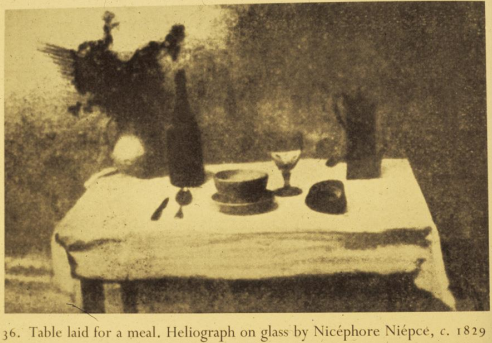
Slide ID?
Niepce, heliograph, 1829
Who found a practical process for photography and sold to the French Government c. 1838-39
Louis Jacques Mande Daguerre
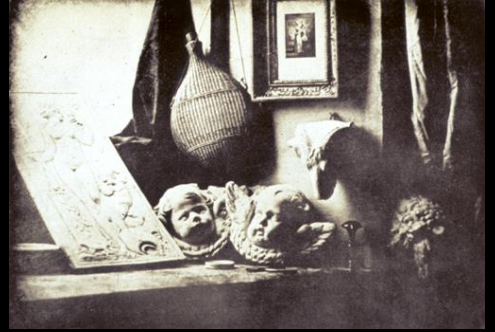
Slide ID?
Daguerre, Still Life, 1837
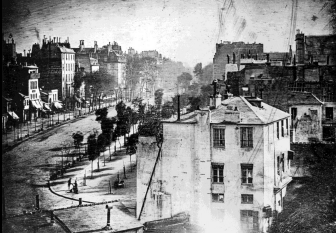
Slide ID?
Daguerre, Le Boulevard, 1839 Daguerrotype

Slide ID?
Meeting of the Academics of Sciences, August 19, 1839
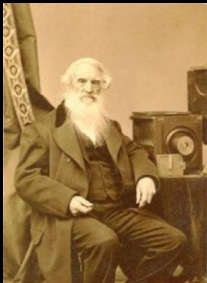
Who is the inventor of the telegraph and first to communicate the discovery to America?
Samuel F. B. Morse

Slide ID?
Robert Cornelius, Self-Portrait, 1839, Earliest extant American photographic portrait, from the Library of Congress
who made the world’s first (extant) photograph? what year?
Niecpe: View from LeGras, 1826
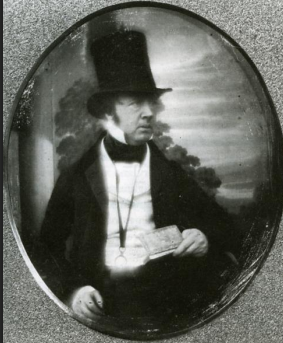
Who photographed this picture of William Henry Fox-Talbot? Slide ID?
Antoine Claudet, 1844, daguerreotype
Who is William Henry Fox-Talbot
1841 patent “calotype”, developed and perfected an effective photogravure process
Calotype (discovered by W.H. Fox Talbot in 1840, patented in 1841)
an early negative/positive photographic process (paper = negative, sunlight = positive)
What did the Calotype have a lack of
clarity
what does the term Negative mean
a master image from which other prints are produced. Negatives have been produced on glass and chemical coated plastic

what is this
The Pencil of Nature by Fox-Talbot: the first book of photographic images
calotypes 1844-1846
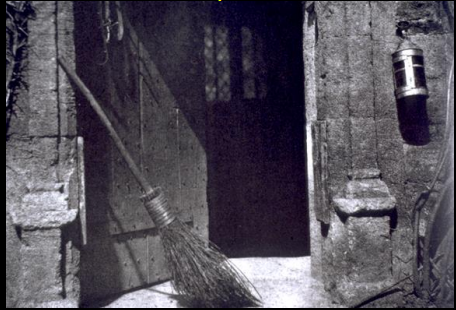
what is The Open Door (1843) by Fox-Talbot compared to?
Dutch Genre Painting “artistic treatment of the mundane”

What is the Greek word “calotype” come from and what does it mean
kalos, beautiful

what are photos without a camera
photograms
what are the pros and cons of daguerrotypes?
pro: very high-quality images, con: long exposure time/process and did not allow for multiple prints of an image
what issue from daguerreotypes did calotypes solve
solved the issue of not making multiple prints by enabling photographers to make multiple prints from a single negative
what were the shortcomings of calotypes
Talbot strictly licensed the process (which dampened the commercial potential), calotypes were subject to fading
what rendered the calotype and daguerreotype obsolete
the albumen print and the wet collodion glass negative process
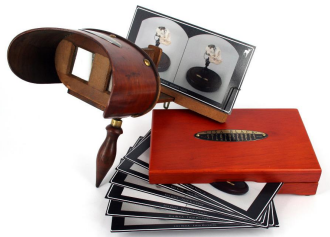
what is this? what was it the beginning of?
Stereoscope, the beginning of 3-D entertainment