Coasts Flashcards
 Call Kai
 Learn
Learn Practice Test
 Spaced Repetition
 Match
Match Flashcards
 Knowt Play
1/38

There's no tags or description
Looks like no tags are added yet.
Name | Mastery | Learn | Test | Matching | Spaced | Call with Kai | Chat |
|---|
No analytics yet
Send a link to your students to track their progress
39 Terms
How do waves form?
Waves are created by wind blowing over the surface of the sea. As the wind blows over the sea, friction is created - producing a swell in the water.
things that affect the size of a wave
The strength of the wind
The length of time the wind blows for
The fetch: the distance that the wave travels for
Destructive waves characteristics
Swash: weak |
Backwash: strong |
Energy: high energy |
Process: erosion |
Height: high wave height |
Frequency: high frequency |
Often occurs during storms
Constructive waves characteristics
Swash: strong |
Backwash: weak |
Energy: low energy |
Process: deposition (build the beach) |
Height: low wave height |
Frequency: low frequency |
Erosion
the breaking down the land by moving agents such as wind or the sea
Weathering
the breakdown of rocks where they are
Mass Movement
the movement of large amounts of material down the cliff
Transport
the movement of material
Deposition
dropping of material
Hydraulic Action |
The force of the water hitting against the cliffs.
The force of the water forces air into weaknesses in the rocks breaking them apart
Abrasion |
The sandpaper effect. The material in the water scrapes against the cliffs |
Attrition |
Rocks within the water knock against each other and become smaller and more rounded |
Solution
Minerals in the rocks are dissolved by slightly acidic seawater |
Types of Weathering
Physical | Caused by changes in temperature An example is freeze-thaw weathering |
Biological | Caused by plants and animals. e.g tree roots growing through the rocks and breaking them apart and the burrowing of animals through softer rocks |
Chemical | Dissolving of minerals in the rocks over time by slightly acidic rainwater |
Why do waves break?
Waves start out at sea. |
As waves approaches the shore, friction slows the base. |
This causes the orbit to become elliptical. |
Until the top of the wave breaks over. |
Mass Movement
A large movement of soil and rock debris that moves down slopes in response to the pull of gravity in a vertical direction.
Rain saturates the permeable rock above the impermeable rock making it heavy. |
Waves or a river will erode the base of the slope making it unstable. |
Eventually the weight of the permeable rock above the impermeable rock weakens and collapses. |
The debris at the base of the cliff is then removed and transported by waves or river. |
Types of Mass Movement
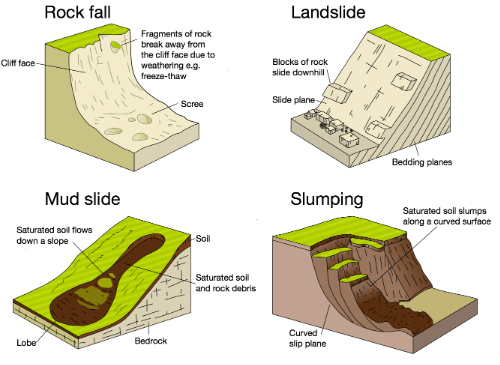
Transportation
A natural process by which eroded material is carried/transported.
Types of transportation
Solution | Minerals dissolve in water and are carried along. |
Suspension | Sediment is carried along in the flow of the water. |
Saltation | Pebbles that bounce along the sea/river bed. |
Traction | Boulders that roll along a river/sea bed by the force of the flowing water. |
Longshore Drift
Waves approach the beach at an angle in the direction of the prevailing wind.
The swash carried the material up the beach at a right angle.
The backwash carried the material straight back down under gravity
This moves material along the beach.
Deposition
Material is deposited when the waves lose energy either by constructive waves or when waves enter a bay
Headlands and bays
They are formed along discordant coastlines where there are band of hard and soft rock at right angles to the coasts
The waves attack the coast and erode through erosion such as abrasion and hydraulic action
The softer rocks are less resistant. They are eroded more quickly to create a bay
The hard rocks are more resistant and are eroded more slowly to create headlands
Wave refraction lowers the energy of waves as they enter the bay so a beach often forms here due to deposition (constructive waves)
An example is Swanage Bay (clay and sand) and Durlston Head (limestone) in Dorset
Caves, arches, stacks and stumps
These are formed on the hard rocks of headlands
Waves attack weak points in the headlands such as a crack.
They are eroded through processes such as hydraulic action and abrasion. Most erosion would take place when there are destructive waves which have more energy such as during a storm
The crack is eroded and it becomes a cave
The back of the cave is eroded over time until it becomes very thin
Eventually the back of the cave is eroded all the way through which creates an arch
The top of the arch is weakened by weathering such as mechanical or chemical.
This means the top of the arch collapses to leave a stack
The base of the stack is eroded and the top if weakened through weathering until it eventually collapses to leave a stump.
An example of a stack is Old Harry in Dorset, and Old Harry’s Wife is a stump.
How are cliffs formed?
Cliffs are shaped through erosion and weathering
Soft rocks form gently sloping cliffs
Hard rocks form high, steep cliffs.
Wave-cut platforms
The waves erode the base of a cliff through erosion such as hydraulic action and abrasion
This create a wave-cut notch in the base of the cliff
The top of the cliff is also weakened through weathering such as mechanical and chemical
Eventually the overhanging cliff will collapse under the force of gravity
The material will be transported away by the destructive waves or eroded
The waves will then erode the base of the cliffs again and the processes repeats
The base of the cliffs is left behind as a wave-cut platform which is exposed at low tide.
This will become smoother over time as it is eroded
An example of a wave-cut platform is in Kimmeridge in Dorset.
Spits
A spit is an extended stretch of sand or shingle jutting out into the sea from the land.
Material is transported along the coastline in the direction of the prevailing wind through the process of longshore drift
When the waves reach an area where the coastline changes direction (a river estuary), the energy of the waves will fall
This causes deposition. The largest material is dropped first and then the smaller material.
Over time, longshore drift continues to transport material and deposits it to create a finger of sediment that is attached to the headland at one end.
The material does not reach the other headland as the deposition is prevented by the river flowing out to the sea
The spit provides shelter to the area behind it, leading to stagnant water and the formation of a salt marsh.
The river transports and deposits further material in this area
Sometimes the end of the spit curves round to create a hook if the secondary wind blows in a different direction for a short period of time.
Bars
These are formed in a similar way to spits
Longshore drift transports material along the coastline in the direction of the prevailing wind
When the waves reach a change in direction of a coastline (a bay) the material is deposited as the waves lose energy
The material is deposited across the entire bay so it is attached at both ends to the land
Sand Dunes
These form on a wide beach where there is a plentiful supply of sand
Wind blows the sand inland where an obstacle such as a dead bird or litter will trap the sand and cause it to start to build up forming a ridge
The ridge itself can then be a barrier causing a further build up of sand
This creates an embryo dune that migrates inland
Marram grass grows on the dune (can survive in salty beach conditions). The roots hold the sand in place and the grass traps more sand being blown in from the beach. This makes the dune bigger. This creates a foredune
Over time, the death and decay of marram grass adds nutrients to the sand turning it into a soil creating what is called a yellow dune
The dunes can now support a wider range of vegetation such as heather and bracken.
The oldest dunes are found at the furthest point from the beach, have a much more fertile soil and can sometimes support entire woodlands or even golf courses. These are called grey dunes.
Beaches
Beaches are formed in areas where the waves lose energy and deposit the material that they have transported and broken down from somewhere else
This is often in a bay where the water becomes shallow and wave refraction causes the waves to deposit their material.
Sandy beaches are formed in very low energy environments (usually a bay) as the waves deposit even the smallest material that they are carrying
Sandy beaches tend to be wide and flat with the chance of sand dunes forming at the back
Pebble beaches have higher energy as the waves have enough energy to carry the smallest material away but not the larger pebbles.
Pebble beaches are narrow and steep
At the back of a pebble beach, there is often a storm beach where the largest pebbles are thrown during a storm. The smallest material is closest to the sea as this gets broken down by the waves through attrition
Hard Engineering Defences
Groynes | Wood barriers prevent longshore drift, so the beach can build up. |
|
Sea Walls | Concrete walls break up the energy of the wave . Often curved to reflect waves away |
|
Gabions | Cages of rocks/boulders absorb the waves energy, protecting the cliff behind. |
|
Rock armour | Large rocks are placed at the base of cliffs and absorb the waves energy |
|
Soft Engineering Devices
Beach Nourishment | Beaches built up with sand, so waves have to travel further before eroding cliffs. |
|
Dune Regeneration | Creating sand dunes and stabilising this with marram grass |
|
Managed Retreat | Low value areas of the coast are left to flood & erode. |
|
Hard Engineering
Large man-made structures that prevent natural processes from taking place
Soft Engineering
Natural management that works with natural processes
Lyme Regis
a small town on the South coast of the UK and makes up part of the stretch of coastline called the Jurassic Coast. It is located in South West Dorset.
It is surrounded by beautiful coastlines, which are World Heritage Sites famous for fossils.
Opportunities at Lyme Regis
Tourism is Dorset’s biggest industry: recreational fishing, fossil hunting, boat trips, water sports like windsurfing, sailing and kayaking, beach trips, boat trips, village shops, fudge shops, and museums.
The local economy depends on tourism as a major source of income and jobs.
The Dorset coast generates £800 million per year most of that comes from overnight stays, buying food and drink and entertainment and shopping.
More fossils are released from the cliffs when there is a landslide so there is some benefit to tourism when the landslides. 500 to 1000 people arrived within hours of a landslip trying to find rare fossils locked in the hillside.
Hazards of Lyme Regis
Rapid rates of coastal erosion and landslides
Lyme Regis is built on a layer of limestone, which is very solid. On top of that layer are slippery muds, clays and sands, which slide over the limestone layer to form the landslides. These are all types of sedimentary rocks.
The sea erodes the cliffs at the bottom of the land, causing it to become unstable and slip even further.
The beach was being eroded away.
The cliffs to the east of the town were prone to landslides especially after rain because the muds and clays were saturated with water. This area was popular with fossil hunters.
Management of Lyme Regis
More than £35 million has been spent since 1994 to prevent coastal erosion
It was done to protect homes, roads and infrastructure from coastal erosion
extended rock armour at The Cobb
used nailing to stabilise the cliffs
sea walls
Advantages of Management of Lyme Regis
Long-term protection against destructive coastal erosion and landslips
the new beaches have increased visitor numbers and seafront businesses are thriving
the harbour is now better protected, benefitting boat owners & fishermen
Disadvantages of Management of Lyme Regis
increased visitor numbers = conflicts with local people who think traffic congestion and litter have increased
some people think the new defences have spoilt the natural coastal landscapes
sea wall may interfere with coastal processes and affect neighbouring stretches of coastline, causing problems elsewhere
expensive for such a small community
stabilising cliffs will prevent landslips that may reveal important fossils.