Unit 2. Urine Volume, Composition, & Types of Specimen
 Call Kai
 Learn
Learn Practice Test
 Spaced Repetition
 Match
Match Flashcards
 Knowt Play
1/91

There's no tags or description
Looks like no tags are added yet.
Name | Mastery | Learn | Test | Matching | Spaced | Call with Kai | Chat |
|---|
No analytics yet
Send a link to your students to track their progress
92 Terms
Urine
is a complex, yellowish fluid that is considered as an ultrafiltrate of plasma from which glucose, amino acids, water and other substances essential to body metabolism have been reabsorbed.
1200-1500 ml
The average daily urine output is about
Dietary intake
Physical activity
Body metabolism
Endocrine functions
Factors that could affect urine concentration
Urea
Creatinine
Uric Acid
Organic Components of Urine
Chloride
Sodium
Potassium
Phosphate
Ammonium
Calcium
Inorganic Components of Urine
Urea
URINE COMPOSITION:
a metabolic waste product produced in the liver from the breakdown of protein and amino acids
accountsfor nearly half of the total dissolved solids in urine
Creatinine
URINE COMPOSITION:
Product of metabolism of creatine by muscles
Uric Acid
URINE COMPOSITION:
Product of breakdown of nucleic acid in food and cells
CHLORIDE
URINE COMPOSITION:
Primary inorganic component. Found in combination with sodium (table salt) and many other inorganic substances
SODIUM
URINE COMPOSITION:
Primarily from salt, varies by intake
POTASSIUM
URINE COMPOSITION:
Combined with chloride and other salts
PHOSPHATE
URINE COMPOSITION:
Combines with sodium to buffer the blood
AMMONIUM
URINE COMPOSITION:
Regulates blood and tissue fluid acidity
CALCIUM
URINE COMPOSITION:
Combines with chloride, sulfate, and phosphate
Creatinine, urea, sodium and chloride content are higher in urine than in other body fluids.
Urea nitrogen = 600mg/100mL
Creatinine = 50mg/100mL
How do you determine whether a specimen is urine??
Proteins & glucose
______ and ______ are not present in a normal urine spx.
URINE VOLUME
Determines by the body’s state of hydration
depends on the amount of water that the kidneys excrete
affected by
fluid intake
fluid loss from nonrenal sources
variations in ADH secretion
need to excrete increases amounts of dissolved solids (glucose, salts)
1200-100 mL
Normal daily urine output:
600-2000 ml
Normal range for urine
Polyuria
It is because of persistent production of more than 2000-3000ml of urine in 24 hours.
associated with diabetes mellitus and diabetes insipidus.
Oliguria
It is related to an abnormal decrease in urine output.
It is observed in dehydration, renal insufficiency, poorly compensated heart disease, calculi formation, kidney tumors.
From excessive water loss from vomiting, diarrhea, perspiration, severe burns
hypersthenuria (1.030)
Oliguria is always accompanied by _______________
Anuria
It pertains to the total suppression of urine production or complete cessation or blockage or urine flow.
It can be seen in severe acute nephritis, mercury poisoning, obstructive uropathy and kidney failure.
From any serious damage to the kidneys or from a decrease in the flow of blood to the kidneys
Nocturia
It is related to the excretion of more than 500 ml urine at night.
apparent in individuals with chronic progressive renal failure.
isosthenuria
Nocturia is always accompanied by___________ or low urine specific gravity which indicates loss of concentrating ability of the tubules.
Infants: <1 ml/kg/hr
Children: <0.5 ml/kg/hr
Adults: <400 ml/day
Oliguria urine output levels
Children: >2.5-3 ml/kg/day
Adults: >2.5L/day
Polyuria urine output levels
Hypersthenuria
Indicates a concentrated urine.
>1.010 specific gravity
Isosthenuria
Indicates a urine that is neither concentrated nor diluted.
≈ 1.010 specific gravity
hyposthenuria
Indicates a dilute urine.
< 1.010 specific gravity
Diuresis
It is transitory increase in urine volume due to intake of diuretics (alcohol, caffeine, polydipsia)
Diabetes mellitus
Caused by defects in insulin production or function, leading to high body glucose levels. The kidneys cannot reabsorb excess glucose, resulting in high urine output with high specific gravity due to increased glucose content.
Diabetes insipidus
Results from decreased ADH production or function, leading to inadequate water reabsorption from plasma filtrate. The urine is truly dilute with low specific gravity.
RANDOM URINE SAMPLE (OCCASIONAL URINE SAMPLE)
TYPES OF URINE SPECIMEN:
It is a specimen that is collected anytime of the day and is commonly used as a routine screening test for disease diagnosis.
Spx received most commonly
Is affected by the most recent food, most recent activity, and most recent medication and supplement.
Prone to erroneous results
FIRST MORNING URINE SAMPLE
TYPES OF URINE SPECIMEN:
It is the first urine that is voided in the day after a person has assumed a supine position.
A concentrated specimen (acidic), ensuring detection of chemicals and formed elements that may not be present in a dilute random specimen
Delivered to the laboratory within 2 hrs after collection or kept refrigerated.
routine screening
pregnancy testing
detection of orthostatic proteinura
TYPES OF URINE SPECIMEN:
First Morning Urine specimen is used for (3)
ovary cancer
Positive pregnancy test w/out intercourse in female could mean
testicular cancer
Positive pregnancy test w/out intercourse in male could mean
FASTING/SECOND MORNING URINE SAMPLE
TYPES OF URINE SPECIMEN:
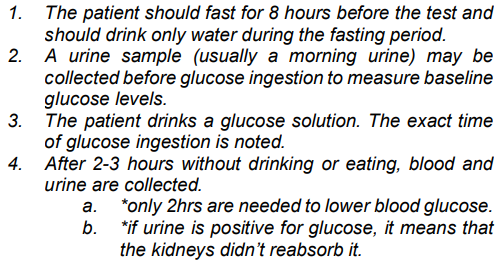
It is intended for diabetic screening or monitoring.
2-HOUR POST PRANDIAL
TYPES OF URINE SPECIMEN:
Monitoring Insulin Therapy
Give glucose load
Wait for 2hrs
Check for glucose in the urine (glucose should decrease/negative.
If it is positive, it means that the insulin therapy is not working
GLUCOSE TOLERANCE SPECIMEN
TYPES OF URINE SPECIMEN:
Collected along with OGTT Samples
Tested for Glucose and Ketones
The number of specimens varied with the length of the test. GTTs included fasting, half-hour, 1-hour, 2- hour, and 3-hour specimens and possibly 4-hour, 5- hour, and 6-hour specimens.
renal threshold
TYPES OF URINE SPECIMEN:
GLUCOSE TOLERANCE SPECIMEN results are correlated with the _______________ for glucose.
GLUCOSE TOLERANCE SPECIMEN
TYPES OF URINE SPECIMEN:
EARLY AFTERNOON SPECIMEN
TYPES OF URINE SPECIMEN:
It is intended for urobilinogen determination (alkaline tide)
Usually collected at 2-4pm.
12-HOUR MORNING SPECIMEN
TYPES OF URINE SPECIMEN:
ADDIS COUNT
37% - 47% Formalin is used
24-HOUR SPECIMEN
TYPES OF URINE SPECIMEN:
For the detection of analytes that are affected by diurnal variations and daily activities e.g. solutes such as catecholamines, 17-hydroxysteroids, and electrolytes in which the lowest concentration is in the early morning and the highest concentration occurs in the afternoon.
Patient must begin and end the collection period with an empty bladder.
T
T or F
In 24-hour specimen collection, if the concentration of a particular substance remains constant, the specimen may be collected over a shorter period.
24-HOUR SPECIMEN
TYPES OF URINE SPECIMEN:
Used for measuring the Glomerular Filtration Rate (GFR) and for hormonal studies.
TYPES OF URINE SPECIMEN:
It is a sample wherein about 30-45 ml. of urine is collected within 4 minutes.
32.5 - 37.7°C.
TYPES OF URINE SPECIMEN:
Drug specimen's temperature is also measured, and it should be within __________
Chain of Custody
a documented process that tracks the collection, transfer, handling, and storage of evidence or samples to ensure their integrity and prevent tampering throughout the testing or legal process.
East Avenue Medical Center (EAMC)
NRL for Confirmatory Drug Test (URINE)
MIDSTREAM CLEAN-CATCH
TYPES OF URINE SPECIMEN:
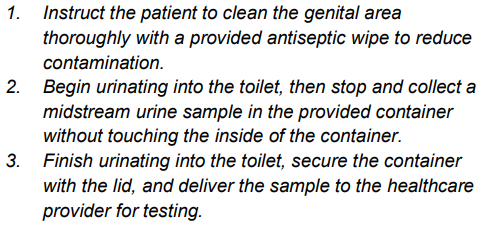
It is the least traumatic routine screening for urinalysis and bacterial culture. It is usually the method of choice for obtaining non-contaminated specimens
MIDSTREAM CLEAN-CATCH
TYPES OF URINE SPECIMEN:
THREE-GLASS URINE COLLECTION
TYPES OF URINE SPECIMEN:
It is used for prostatic infection determination.
In collecting this sample, all portions, beginning, middle, and final portion of the void, are collected in three separate containers.
third container.
TYPES OF URINE SPECIMEN:
In 3-glass urine collection, the prostate is massaged prior to collection in the ___________
bacterial culture (100,000 colony of bacteria is seen)
confirmatory test for UTI
CT scan, MRI, etc.
confirmatory test for Prostatitis
CATHETERIZED SPECIMEN
TYPES OF URINE SPECIMEN:
It is used if the patient is having difficulty voiding. It can also be used in a female patient to avoid vaginal contamination, especially during menstruation.
SUPRAPUBIC ASPIRATION
TYPES OF URINE SPECIMEN:
It is a process of collecting bladder urine for bacterial culture and cytology.
Sometimes, it is used in place of catheterization for obtaining a single urine sample.
Completely free of extraneous contamination, particularly in infants or children.
bags with adhesive
URINE CONTAINER:
for the collection of pediatric specimens
50 ml
URINE CONTAINER:
The recommended capacity of the container is ____
Individually packaged sterile containers with secure closures
URINE CONTAINER:
should be used for microbiological studies of urine
Sterile containers
URINE CONTAINER:
___________ are also suggested if more than 2 hours elapse between specimen collection and analysis.
False
Labels must be attached to the container, not to the lid, and should not become detached if the container is refrigerated or frozen.
T or F
Labels must be attached to the lid, and not to the container to avoid contamination.
1. Specimens in containers that are unlabeled or improperly labeled
2. Labels and requisition forms that do not match
3. Specimens contaminated with feces or toilet paper
4. Containers with contaminated exteriors
5. Specimens of insufficient quantity
6. Specimens that have been transported improperly
7. Specimens that have not been preserved correctly during a time delay
8. Specimens for urine culture collected in a nonsterile container
9. Inappropriate collection for the type of testing needed (for example, midstream clean-catch specimen for bacterial culture)
Grounds for Specimen rejection
Oxidation or reduction of metabolites
CAUSES OF THE CHANGES IN UNPRESRVED URINE
Color: Modified/Darkened
Bacterial growth and precipitation of amorphous material
CAUSES OF THE CHANGES IN UNPRESRVED URINE
Clarity: decreased
Bacterial multiplication causing breakdown of urea to ammonia
CAUSES OF THE CHANGES IN UNPRESRVED URINE
Odor: Increased ammonia smell
Breakdown of urea to ammonia by urease-producing bacteria/loss of CO2
CAUSES OF THE CHANGES IN UNPRESERVED URINE
pH: increased
Glycolysis and bacterial use
CAUSES OF THE CHANGES IN UNPRESERVED URINE
Glucose: dereased
Volatilization and bacterial metabolism
CAUSES OF THE CHANGES IN UNPRESERVED URINE
Ketones: Decreased
Exposure to light/photo oxidation to biliverdin
CAUSES OF THE CHANGES IN UNPRESERVED URINE
Bilirubin: Decreased
Oxidation to urobilin
CAUSES OF THE CHANGES IN UNPRESERVED URINE
Urobilinogen: Decreased
Multiplication of nitrate-reducing bacteria
CAUSES OF THE CHANGES IN UNPRESERVED URINE
Nitrite: Increased
Disintegration/lyse in dilute alkaline urine
CAUSES OF THE CHANGES IN UNPRESERVED URINE
Red and white blood cells and casts: Decreased
Multiplication
CAUSES OF THE CHANGES IN UNPRESERVED URINE
Bacteria: Increased
Loss of motility, death
CAUSES OF THE CHANGES IN UNPRESERVED URINE
Trichomonas: Decreased
refrigeration (2-8°C)
SPECIMEN PRESERVATION:
The method of preservation used most routinely is
which decreases bacterial growth and metabolism
refrigerated
24 hrs
room temperature
SPECIMEN PRESERVATION:
If the urine is to be cultured, it should be __________ during transit and kept refrigerated until cultured, up to_______
The specimen must return to ____________ before chemical testing by reagent strips.
amorphous urate and phosphate crystals
SPECIMEN PRESERVATION:
Refrigeration also can cause precipitation of ___________________
URINE PRESERVATIVES
URINE PRESERVATIVES
Refrigeration
URINE PRESERVATIVES

Acids (boric acid, HCL, acetic acid, tartaric acid)
URINE PRESERVATIVES

Formalin (formaldehyde)
URINE PRESERVATIVES

Sodium fluoride
URINE PRESERVATIVES

Commercial preservative tablets
URINE PRESERVATIVES

Urine Collection Kits4 (Becton, Dickinson, Rutherford, NJ)
URINE PRESERVATIVES
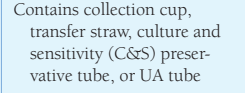
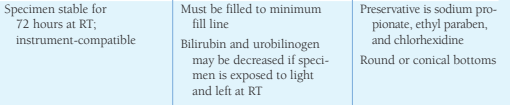
Light gray and gray C&S tube
URINE PRESERVATIVES

Yellow UA Plus tube

Cherry red/yellow Preservative Plus tube
URINE PRESERVATIVES