Dynamics of Disease Transmission
 Call Kai
 Learn
Learn Practice Test
 Spaced Repetition
 Match
Match Flashcards
 Knowt Play
1/27

There's no tags or description
Looks like no tags are added yet.
Name | Mastery | Learn | Test | Matching | Spaced | Call with Kai | Chat |
|---|
No analytics yet
Send a link to your students to track their progress
28 Terms
What is the epidemiological triad and what does it connect?
model used to explain how disease occurs through the interaction of three factors: agent (pathogen), host, and environment
What is host susceptibility to an agent (pathogen) determined by?
biological characteristics - genetics, nutrition, immune response (ex. immunocompromised)
demographics - age, gender, race, reproductive status
socioeconomic factors - crowding, povertu
behavior - ex. multiple sexual partners, cannibalism, needle sharing
Why are vector-borne diseases more complicated to combat?
have to manage vector AND pathogen
more impacted by environmental conditions
vectors can spread efficiently between many hosts
What disease transmission dynamics affect concern over widespread transmission?
agent factors - type of infectious agent (bacteria, protozoan, etc.)
pathogenecity and severtiy of disease
environmental factors, including cultural
vector factors - mode of transmission, aggressive vs nonaggressive feeding behavior, longevity, infection rate, seasonality of vector activitry

Describe the four stages that determine the risk of pathogen spillover from animals to humans
presence in animal population - impacted by reservoir host distribution/density, prevalence and intensity of infection
transmission to human - impacted by shedding rate, harvest rate, pathogen survival, biting rate of vector on host, vector survival
human exposure to pathogen - impacted by human behavior, preparation of meat, biting rate of vector on human
host susceptibility- innate immune responses and compatability, structural barriers
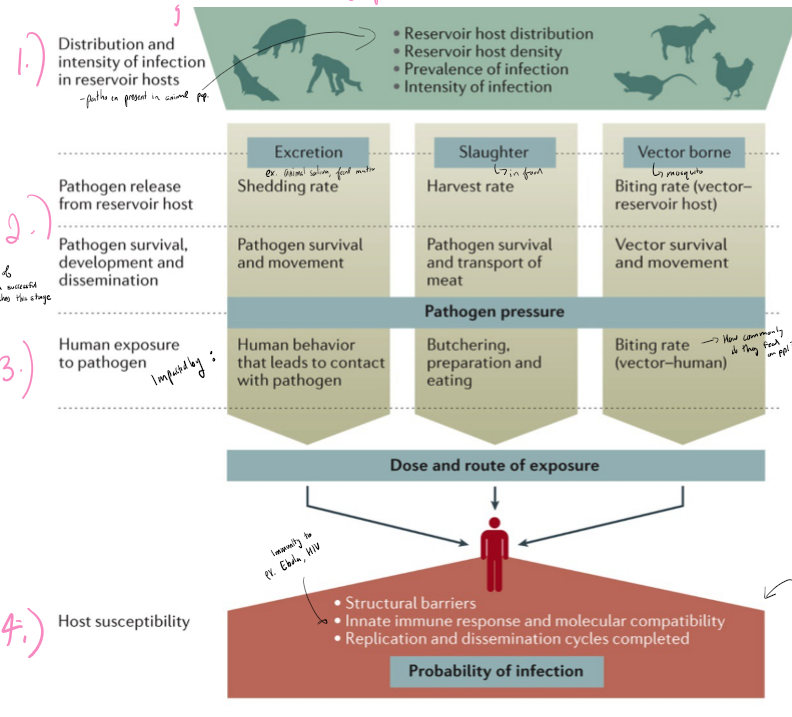
What are barriers to successful disease spillover?
reservoir host distribution
reservoir host density
pathogen prevalence
infection intensity
pathogen release from reservoir host
pathogen survival and spread
human exposure
strucutral barriers
innate immune response and molecular compatability (HUGE BARRIER)
replication cycle
if any barrier is impenetrable, spillover CAN NOT occur
What are the most and least limiting barriers for pathogens to successfully transition from animal to human infection?
most - pathogen release
least - reservoir density and distribution
What are the modes of transmission categories of pathogens?
direct
indirect
What are the direct modes of pathogen transmission?
physical contact with infected person
droplet - short distance spread through sneezing, coughing, etc. LARGER
vertical - transplancental (mother to fetus)
What are the indirect modes of pathogen transmission?
airborne - pathogen in air as aerosol SMALLER
vehicle-borne - inanimate objects (fomites) - ex. medical devices, water, soil, food, blood - may have to be ingested first
vector-borne - either via relationship with pathogen or mechanical (fly lands on horse poop, picks up pathogen, lands on cupcake)
What are common pathogen portals of entry into the body?
skin
respiratory tract
GI tract
genitourinary tract
transplacental (mother to fetus)
What are common pathogen portals of exit from the body?
skin
blood
secretions
urine
feces
How do pathogens taht enter through the respiratory tract exit the body?
secretions
How do modes of transmission impact the chain of disease infection?
link portal of entry and exit
determine how easily a disease can spread
determines which control measures can break chain of infection
Airborne transmission is associated with what portal of entry and exit?
entry - respiratory tract
exit - respiratory secretions
ex. flu
GI tract portal of entry is associated with what form of transmission and portal of exit?
transmission - food (indirect)
exit - feces
Mosquito-borne transmission is associated with what portal of entry and exit?
entry - skin (via mosquito bite; indirect)
exit - skin (via mosquito bite; indirect)
What are the major components of the chain of infection?
infectious agent
reservoir
portal of exit
mode of transmission
portal of entry
susceptible host
What is biological and mechanical vector transmission
biological - pathogen develops/replicated within a vector
mechanical - vector physically carries pathogen without pathogen developing (ex. bacteria on fly foot)
What is vertical transmission?
transmission from mother to offspring
What is zoonotic disease transmission?
transmission of a pathogen from animals to humans
What happens if one spillover barrier is impenetrable?
spillover can not occur
How does reservoir host density affect spillover risk?
greater reservoir density can increase opportunities for pathogen maintanance, mutation, transmission, and human exposure
How does pathogen shedding affect spillover risk?
greater shedding increases the amount of pathogen released into the environment and opportunities for transmission
What type of transmission involves contaminated food or water?
indirect; vehicle-borne
What type of transmission involves a contaminated object?
indirect; vehicle-borne
A pathogen leaves an infected host in feces, contaminates food, and enters another person through the GI tract. Identify the chain.
portal of exit - feces
transmission - indirect; vehicle-borne via food
entry - GI tract