9-16 Language Networks
 Call Kai
 Learn
Learn Practice Test
 Spaced Repetition
 Match
Match Flashcards
 Knowt Play
1/34

There's no tags or description
Looks like no tags are added yet.
Name | Mastery | Learn | Test | Matching | Spaced | Call with Kai | Chat |
|---|
No analytics yet
Send a link to your students to track their progress
35 Terms
cortical regions
what are processing hubs and need to talk to each other?
subcortical regions
what relay sensory information to the cortex?
decomposes that sensory info (spoken & written language)
after subcortical regions send sensory information to cortex, what does the cortex do?
white matter tracts
how to cortical regions talk to each other?
neurological model
Carl Wernicke created what in 1874 but drew it in the right hemisphere and was revamped by Norman Geschwind
Wernicke-Geshwind obsolete language processing model
To hear, speech is sent through auditory pathway to Heschl’s gyrus, then to Wernicke’s area where word meaning is extracted
To speak, word meanings are sent from Wernicke’s area to Broca’s area. The model proposed Broca held representations of words. That information is sent to the motor cortex, then to the facial motor neurons in the brainstem to move facial muscles
To read, written text is sent from occipital lobe to the angular gyrus, then to Wernicke’s area (for silent reading) and then to Broca’s (for reading aloud
speech understanding and speech production
Although outdated, the Wernicke-Geshwind model was an important early milestone because it introduced the idea that language relies on a connecting nerve pathway between _______, paving the way for today's view of complex brain networks.
white matter
what are bundles of myelinated axons that connects cortical and subcortical regions (structural wiring of the brain)
gray matter
what are neuron cell bodies?
the cables that connect cortical processing hubs
white matter tracts
diffusion tensor imaging
what can you measure white matter pathways with? (measures directionality of water diffusion along axons)
Arcuate fasciculus
Superior longitudinal fasciculus
Uncinate fasciculus
Inferior fronto-occipital fasciculus; inferior longitudinal fasciculus
Frontal aslant tract
Corpus callosum
major white matter tracts in language (6)

Arcuate fasciculus
White matter tract that…
-Classic tract is identified in the Wernicke-Geschwind model
-Connects posterior temporal (Wernicke’s) and frontal (Broca’s) language regions
-Central to the dorsal stream*
-Exact functional contribution is still actively debated

superior longitudinal fasciculus
white matter tract that…
-Broader dorsal pathway connecting frontal, parietal, and temporal regions
-Overlaps functionally with arcuate fasciculus
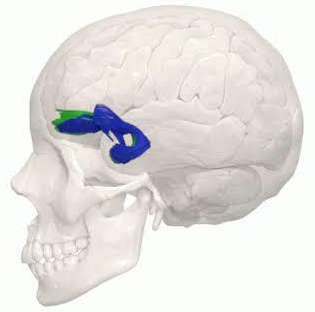
Uncinate fasciculus
white matter tract that…
-Connects anterior temporal lobe to the frontal lobe
-Part of the ventral semantic pathway

Inferior fronto-occipital fasciculus and inferior longitudinal fasciculus
white matter tract that…
-Long ventral tracts linking occipital and temporal regions to the frontal lobe
-IFOF: Implicated in semantic processing and reading
-ILF: processes visual signals, helps with object and face recognition
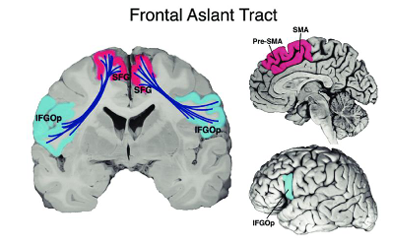
frontal aslant tract
white matter tract that…
-More recently characterized
-Connects supplementary motor area(SMA)/pre SMA to Broca’s area
-Implicated in speech initiation and fluency (Stuttering research)

corpus callosum
white matter tract that…
-is a major interhemispheric tract
-Bilateral coordination of language processing
dual stream model of language
current prevailing model of speech processing
ventral, dorsal
two streams in dual stream model of language
how the dual stream works
the auditory cortex performs spectrotemporal analysis by breaking down raw sound into basic features like pitch, rhythm, and frequency, which the phonological network then organizes into recognizable speech units like syllables and phonemes. Once these speech sounds are identified, the signal splits into two distinct processing pathways to handle either understanding their meaning or coordinating the motor actions needed to repeat them.
phonological network
Linked system of brain regions along the superior temporal sulcus that process speech sounds, turning them from sounds into meaningful units (Also turn thoughts into spoken word). its activated by language tasks that require access to phonological information (speech perception and production)

ventral stream
stream that turns sound to meaning. (comprehension) responsible for speech comprehension by mapping raw acoustic speech sounds into concepts and vocabulary stored in the brain. there are two key anatomical networks
lexical interface
anatomical network in ventral stream that acts as a dictionary link between word sounds (phonology) and their meanings (semantics) (words and definitions). the brain regions include posterior middle temporal gyrus (pMTG) and posterior inferior temporal sulcus (pITS)
combinatorial network
anatomical network in ventral stream where makes individual words into larger semantic phrases and syntactic structures (grammar and sentences). the brain regions include anterior middle temporal gyrus (aMTG) and anterior inferior temporal sulcus (aITS)
uncinate fasciculus, inferior fronto-occipital fasciculus, inferior longitudinal fasciculus
white matter tracts that physically support the ventral stream for speech processing (critical for semantic processing and comprehension)
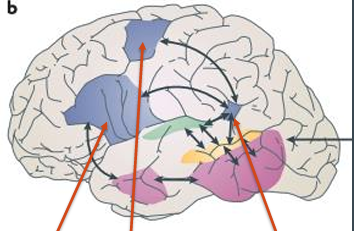
dorsal stream
stream that turns sound to articulation (production) it connects the sensory auditory system directly with the motor system, allowing the brain to convert heard speech sounds into motor plans for speech production. the pathway relies on network made up of posterior inferior frontal gyrus, and premotor cortex

insula
hidden region of the cortex that lies deep within the lateral fissure (sylvian fissure)
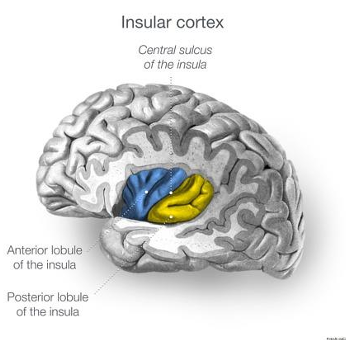
anterior insula
which part of the insula is involved in the dorsal stream pathway?

arcuate fasciculus, superior longitudinal fasciculus
white matter tracts that support the dorsal stream (critical for speech production and repetition)
ventral
if someone has difficulties with speech perception, which stream is likely impacted?
dorsal
Damage to the supramarginal gyrus or the arcuate fasciculus in the ____ stream causes conduction aphasia, where a person can speak smoothly and understand language, but cannot repeat back words or phrases exactly as heard.
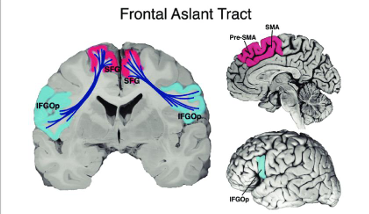
frontal aslant tract damage
damage linked to initiation deficits, studied in relation to stuttering
cortical region
damage to white matter often produces more selective, dissociable deficits than damage to a single ______ alone
white matter
what helps conceptualize language processing as a network, and not just isolated to a “center”