Cell Biology Exam 1
 Studied by 0 people
 Call with Kai
 Learn
Learn Practice Test
 Spaced Repetition
 Match
Match Flashcards
 Knowt Play
1/56

There's no tags or description
Looks like no tags are added yet.
Name | Mastery | Learn | Test | Matching | Spaced | Call with Kai |
|---|
No study sessions yet.
57 Terms
True or False? During the cell cycle, most cell growth occurs during interphase.
true
True or False? Eukaryotic cells have both nuclear and non-nuclear DNA.
true
True or False? Endocytosis is commonly used to add new membrane at cellular wound sites.
false
True or False? Truncating mutations (i.e., mutations that cause an early stop codon) are more likely to lead to a gain of function than a loss of function.
false
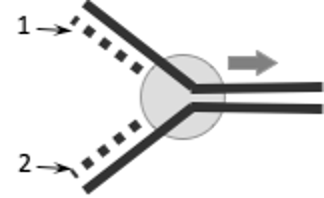
A DNA replication fork is shown below. The strand labeled ‘1’ is called the … strand.
lagging. It’s 3’ end is on the left, and the 5’ end is at the fork. So it polymerizes (5’ to 3’) in a direction opposite to the fork.
Using genetic engineering, a student has fused an ER signal sequence to a toxic protein whose cytosolic expression leads to cell lysis but is harmless when in the ER. This student has also fused a mitochondrial signal sequence to another protein that is required in the cytosol for cell viability but is inactive when in mitochondria. Whereas wild-type cells die upon the expression of these fusion proteins, she has been able to identify viable mutants, which have a loss-of-function mutation in a gene encoding a protein involved in transmembrane transport. The products of these genes are probably ...
B. involved in the transport of proteins into mitochondria, but not in the transport of proteins into the ER.
The mutation would need to stop mitochondrial import for the cell to live. Import of the protein into the ER should remain intact because cytosolic expression of this protein causes cell lysis but it is harmless in the ER.
Fundamental unit of life. Small, membrane-enclosed units filled with a concentrated aqueous solution of chemicals and endowed with the extraordinary ability to create copies of themselves by growing and then dividing in two.
Cell
America's first cell biologist. He said “the key to every biological problem must finally be sought in the cell; for every living organism is, or at some time has been, a cell.”
E.B. Wilson
Deoxyribonucleic acid. Has sugar-phosphate backbone & hydrogen-bonded base pairs = nucleotide.
AT (double bonded) and CG (triple bonded).
DNA
Single strand of DNA or RNA whose nucleotide sequence acts as a guide for the synthesis of a complementary strand.
Template
This requires transcription of DNA to RNA and translation of RNA to protein.
Gene Expression
Uses ribose. Uses C, G, and A, but replaces T with U (uracil). Single-stranded. Can exert functions itself (like ribosomal RNA, tRNA, microRNA) or serve as messengers (mRNA) that code for protein production.
RNA
The major macromolecular constituent of cells. A linear polymer of amino acids linked together by peptide bonds in a specific sequence.
Protein
Copying of one strand of DNA into a complementary RNA sequence by the enzyme RNA polymerase.
Transcription
Process by which the sequence of nucleotides in an mRNA molecule directs the incorporation of amino acids into protein. Occurs on a ribosome.
Translation
The segment of DNA sequence corresponding to a single protein, a set of protein variants, or a single catalytic, regulatory, or structural RNA
gene
The membrane that surrounds a living cell.
plasma membrane
The passing on of characteristics from one generation to the next.
heredity
A molecule that can be bonded to other identical molecules to form a polymer.
monomer
A large molecule made of monomers
polymer
a sugar molecule (monosaccharide) with at least one phosphate group attached
sugar phosphate
the fundamental building block of nucleic acids like DNA and RNA, composed of three parts: a phosphate group, a five-carbon sugar (ribose or deoxyribose), and a nitrogenous base (Adenine, Guanine, Cytosine, Thymine, or Uracil)
nucleotide
the linkage of monomers into a polymer
polymerization
sugar in RNA
ribose
sugar in DNA
deoxyribose
One way RNA differs from DNA. RNA is primarily single-stranded. The term is…
strandedness
Nucleotide bases
Cytosine, guanine, thymine, uracil, adenine
nucleotide triplets that specify amino acids
codon
free-energy carriers
adenosine triphosphate (ATP)
Cellular membranes are composed of ______ molecules – they have one part that is hydrophilic (water-soluble), and another that is hydrophobic
amphiphilic
water soluble
hydrophilic
water insoluble
hydrophobic
An organic compound made entirely of hydrogen (H) and carbon (C) atoms
hydrocarbon
____have a membrane-enclosed nucleus that houses DNA. Single-celled or multicellular. Larger genomes (in humans: ~25000 genes). Also have more non-coding DNA.
Eukaryotes
__have no distinct nucleus (bacteria & archaea). Predominantly single-celled. Simple genomes (1000-6000 genes). Smallest is M. genitalium (~500 genes). Little internal compartmentalization.
prokaryotes
A single, organized layer of amphiphilic (water-loving head, water-fearing tail) phospholipid molecules that spontaneously forms at an interface, like air and water, with hydrophilic heads in the water and hydrophobic tails pointing out, acting as a simplified model for studying cell membrane components and interactions
phospholipid monolayer
the fundamental structure of cell membranes, consisting of two layers of phospholipid molecules arranged with their water-loving (hydrophilic) heads facing outward and water-fearing (hydrophobic) tails facing inward, creating a semipermeable barrier that controls substance movement in and out of the cell
phospholipid bilayer
Help get things in and out. They are embedded in the phospholipid bilayer.
transporters
What are the three domains of life?
bacteria, archaea, eukaryotes
Heritable change in the nucleotide sequence of a chromosome.
mutation
a genetic event where a segment of DNA, containing one or more genes, gets copied, creating extra identical or similar gene copies within a genome
gene duplication
The acquisition by an organism of genetic information by transfer, for example via the agency of a virus, from an organism that is not its parent and is typically a member of a different species.
horizontal gene transfer
Genes that are related by descent. There are two types. Disrupting homologous genes in different species often causes similar phenotypes (observable traits)
Homologs / homologous genes
genes in two separate species that derived from the same ancestral gene
orthologs
Related genes in the same genome that resulted from gene duplication
paralogs
the membrane-bound organelle in eukaryotic cells that acts as the cell's control center, housing the cell's genetic material (DNA) organized into chromosomes, and directing crucial activities like growth, metabolism, and reproduction
nucleus
degradation center
lysosome
energy hub ; Membrane-bounded organelle, about the size of a bacterium, that carries out oxidative phosphorylation and produces most of the ATP in eukaryotic cells.
mitochondria
sorting organelle ; Extensive, net-like membrane-bounded compartment in the cytoplasm of eukaryotic cells, where lipids are synthesized and membrane-bound proteins and secretory proteins are made.
ER
cytoskeleton components ; dynamic protein fibers made of actin monomers, forming a crucial part of the eukaryotic cytoskeleton that dictates cell shape, enables movement (like crawling or muscle contraction), and facilitates intracellular transport and division, working with motor proteins like myosin to create force and movement.
actin
Mechanism in which a cell engulfs and internalizes an external particle
phagocytosis
organelles which perform photosynthesis may have originated by a similar mechanism
chloroplast
examples of prokaryotes?
E. coli
examples of eukaryotes?
yeasts like S.cerevisiae and S.pombe
examples of plants?
Arabidopsis
examples of invertebrates?
c.elegans and Drosophila
essential cell division cycle regulator ; acting as master regulators by phosphorylating other proteins to drive transitions between cell cycle phases
CDK (Cyclin-Dependent Kinase)