Lab 1: Animal Architecture, Taxonomy, and Protozoa
 Call Kai
 Learn
Learn Practice Test
 Spaced Repetition
 Match
Match Flashcards
 Knowt Play
1/37

Earn XP
Description and Tags
Vocabulary practice flashcards covering body planes, anatomical regions, body symmetry, taxonomic hierarchy, and major unicellular eukaryote (protozoan) groups.
Name | Mastery | Learn | Test | Matching | Spaced | Call with Kai | Chat |
|---|
No analytics yet
Send a link to your students to track their progress
38 Terms
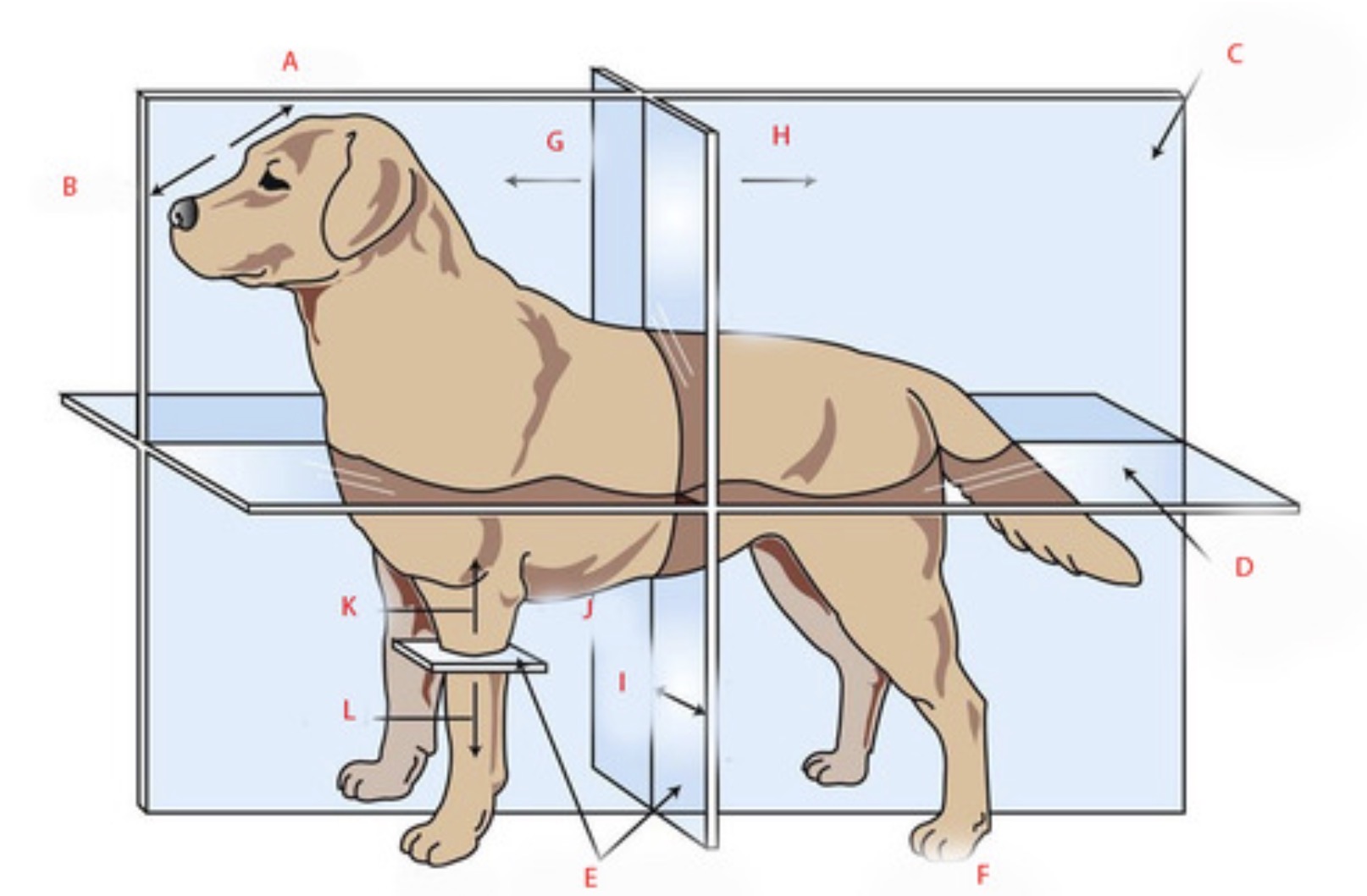
What is a frontal plane and which one is a frontal plane?
An imaginary body plane that divides an organism into dorsal and ventral parts;D


Transverse plane
An imaginary body plane that divides an organism into anterior and posterior parts; I


Sagittal plane and what letter represents this plane in the image
An imaginary body plane that divides an organism into left and right parts;C


Midsagittal plane
The specific sagittal plane (also called median plane) that divides a bilaterally symmetrical animal into two equal but mirrored halves.

Medial
An anatomical region or direction that is closer to the midline of the body.

Lateral
An anatomical region or direction that is further away from the midline of the body.

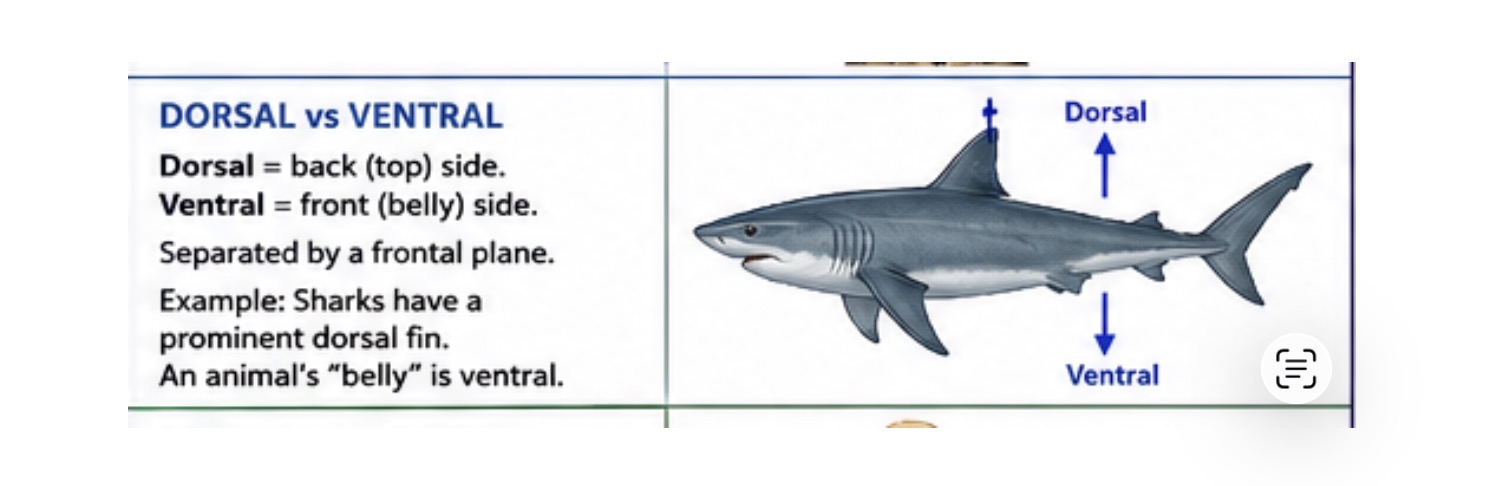
Dorsal
An anatomical region referring to the back of the body.

Ventral
An anatomical region referring to the front or belly side of the body.
Proximal
An anatomical term describing a location along a limb or digit closer to where it attaches to the body.

Distal
An anatomical term describing a location along a limb or digit further away from where it attaches to the body.

Anterior (Cranial)
An anatomical region referring to the head end of an animal.

Posterior (Caudal)
An anatomical region referring to the tail end of an animal.

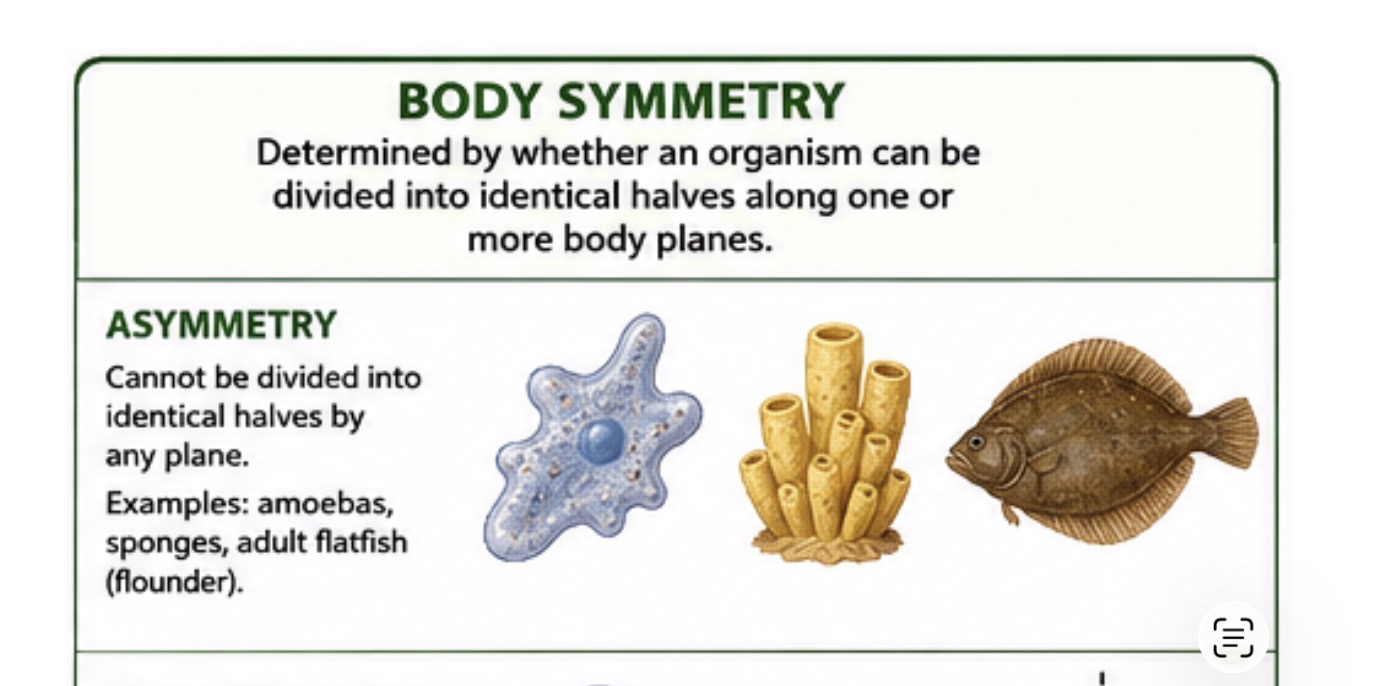
Asymmetry
A type of body symmetry where an organism cannot be divided into identical halves by any plane, as seen in amebas, sponges, and adult flatfish.
Radial symmetry
A type of body symmetry where an organism can be divided into identical halves by multiple planes, as seen in jellyfish, sea anemones, and adult sea stars.

Bilateral symmetry
A type of body symmetry where an organism can be divided into identical halves at the midline only by a midsagittal or median plane.

Taxonomy
The area of biological sciences devoted to the identification, naming, and classification of living things according to common characteristics.
Binomial nomenclature
A system of naming organisms in which each organism is indicated by two words: the capitalized genus name and lowercase species name, both written in italics or underlined.
Taxon
A taxonomic category or group, such as a phylum, order, family, genus, or species (plural: taxa).

Domain
Any of three primary divisions of living systems (eukaryotes, bacteria, and archaea) that rank above a kingdom in taxonomic systems.

Kingdom
The highest taxonomic classification into which organisms are grouped based on fundamental similarities and common ancestry.

Phylum
One of the major divisions of the kingdoms of living things; the second-largest standard unit of biological classification.

Class
The biological classification beneath a phylum and above an order.

Order
A taxonomic category of organisms ranking above a family and below a class.

Family
A taxonomic category of organisms ranking above a genus and below an order; in animals, family names end in -idae.

Genus
A taxonomic category ranking below a family and above a species, generally consisting of a group of species exhibiting similar characteristics.

Species
A subdivision of biological classification composed of related organisms that share common characteristics and can interbreed.


Phylum Euglenozoa
A taxonomic group of flagellated unicellular eukaryotes that move via tail-like flagella.


What is this?
Euglena: A genus of unicellular flagellated eukaryotes in Phylum Euglenozoa that are autotrophic and use chloroplasts to perform photosynthesis.


what is this?
Trypanosoma: A genus of flagellated unicellular eukaryotes in Phylum Euglenozoa responsible for causing human diseases such as Chagas disease and African sleeping sickness.


Phylum Apicomplexa
A taxonomic group of spore-forming endoparasitic unicellular eukaryotes.


what is this?
Plasmodium: A genus of endoparasitic unicellular eukaryotes in Phylum Apicomplexa that causes malaria.

Phylum Ciliophora
A taxonomic group of unicellular eukaryotes characterized by the presence of hair-like cilia surrounding their outer membrane.
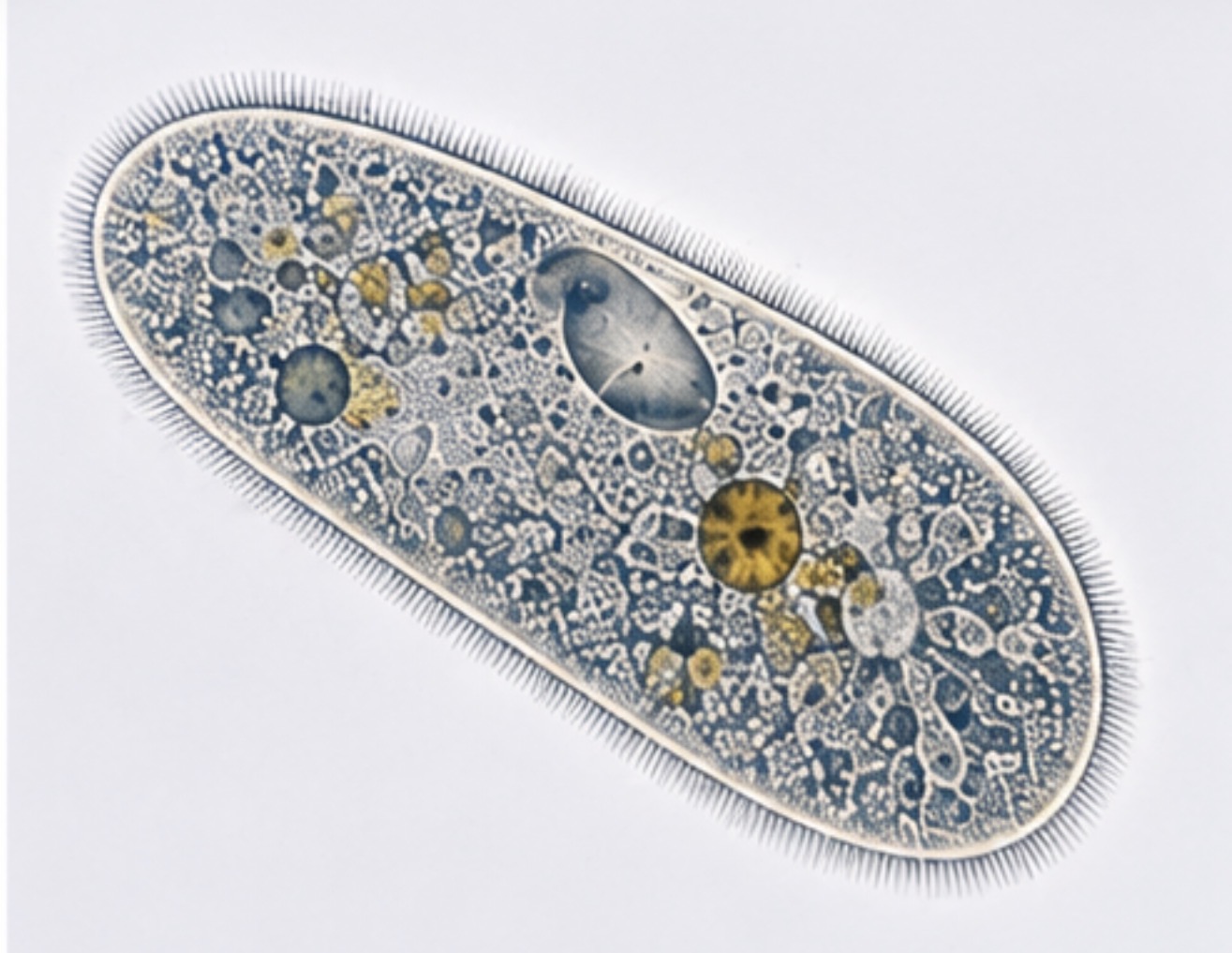
What is this?
Paramecium: A genus of unicellular eukaryotes in Phylum Ciliophora that use cilia for locomotion and to sweep food into their oral groove.

Oral groove
A structure resembling a long dent on one side of a Paramecium into which cilia sweep food.

Phylum Amoebozoa
A taxonomic group of unicellular eukaryotes characterized by a dynamic asymmetrical shape and movement via pseudopodia.

What is this?
Amoeba: A genus of unicellular eukaryotes in Phylum Amoebozoa that move and engulf food using pseudopodia.

Pseudopod
A membrane projection (plural: pseudopodia) extended outward by amebas to pull themselves forward and surround food particles.

Phagocytosis
The process by which amebas surround and engulf food particles using their pseudopodia.