Receptors
 Studied by 0 people
 Call with Kai
 Learn
Learn Practice Test
 Spaced Repetition
 Match
Match Flashcards
 Knowt Play
1/98

There's no tags or description
Looks like no tags are added yet.
Name | Mastery | Learn | Test | Matching | Spaced | Call with Kai |
|---|
No study sessions yet.
99 Terms
Definition of Pharmacology
The science of drugs and how they act in a biological system
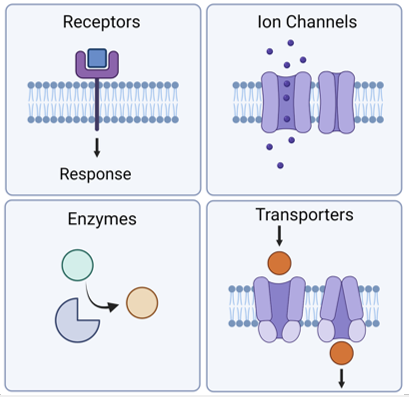
What are the four main protein drug targets?
Receptors
Ion channels
Enzymes
Transporters

What are ion channels?
Membrane proteins that open in response to a cue and allow specific ions to move down their concentration gradient.
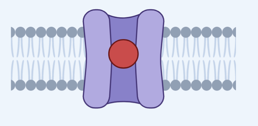
Ion Channel Blockers
Blocks the ion channel
Prevents ion movement
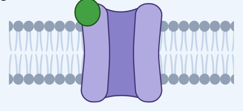
Ion Channel Modulators
Increases/decreases chance of the ion channel opening
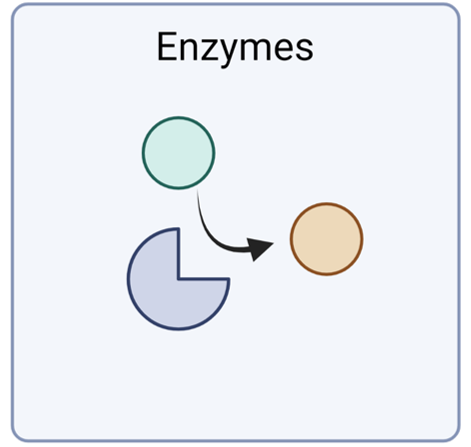
What are enzymes?
Biological catalysts that mediate biochemical reactions.
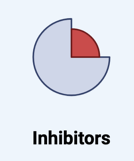
Enzyme inhibitors
Prevents activity
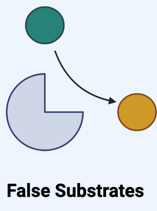
False substrates
Abnormal metabolite produced
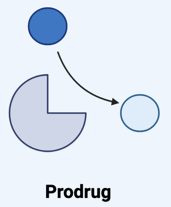
Prodrug
Activation of drug molecule
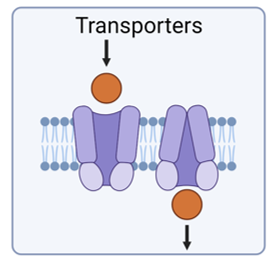
What are transporters?
Proteins that carry substances across membranes
Transporters can move substances against a gradient (active transport).
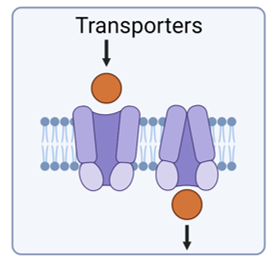
How are transporters different from ion channels?
Transporters are not pores, they are not open to both sides of the membrane at once. They bind to the solute and undergo a conformational change to move it across
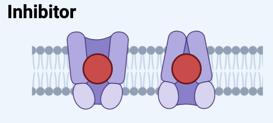
Transporter inhibitor
Transporter inhibitors block transport
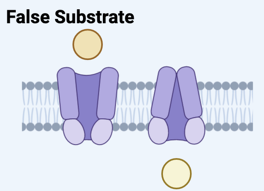
Transporter false substrate
False substrates leads to an abnormal compound accumulating
What is a receptor?
A protein (usually on the cell surface) that responds to exogenous cue and relay signal into a cell to produce a response.
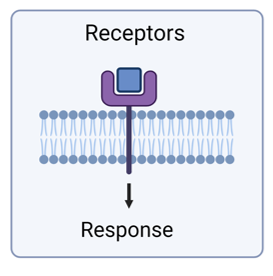
What do receptors allow for?
Receptors allows fine tuning of physiological function
Definition of Ligand
Something that binds to a receptor
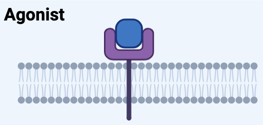
Definition of Agonist
Something that binds and induces a response
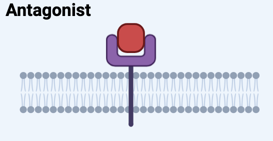
Definition of Antagonist
Something that binds and produces no response
What is a second messenger?
An intracellular signalling molecule that relays the signal from receptor to effector.
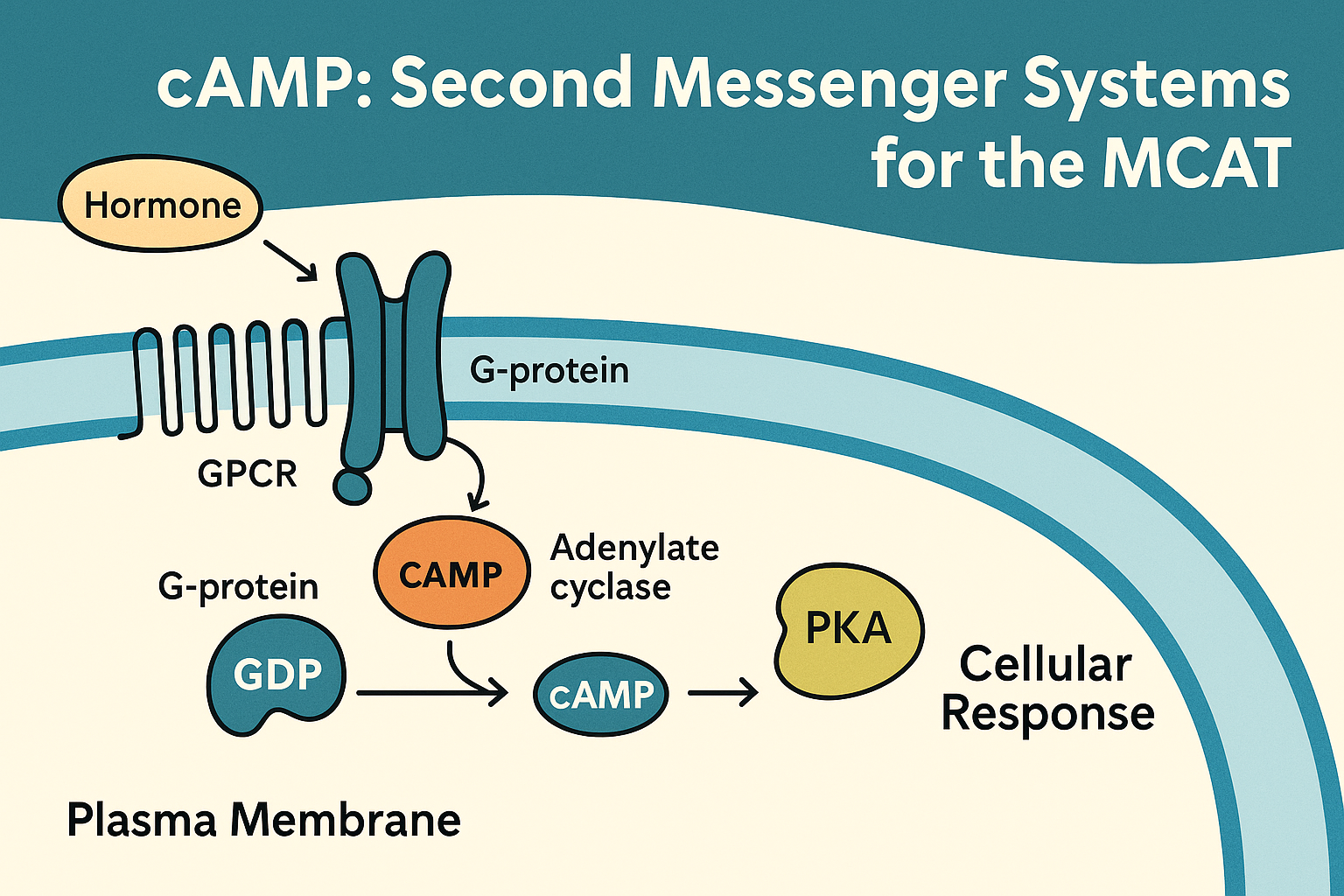
What is signal transduction?
A sequence of events/secondary messengers that leads to a biological response.
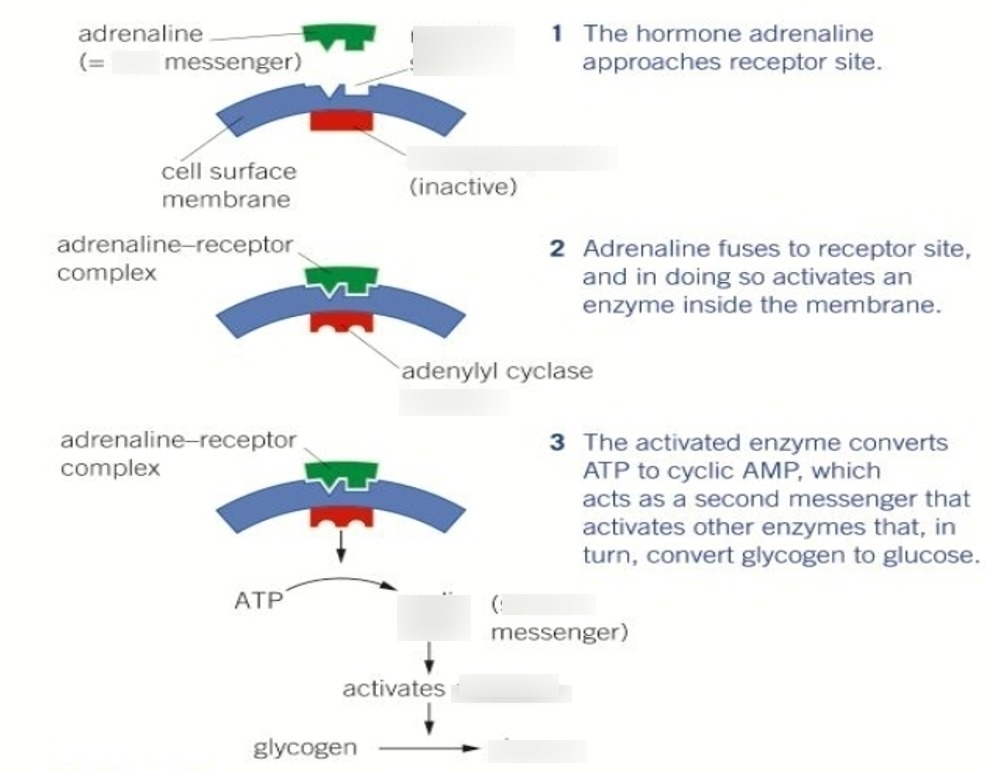
What happens when a ligand binds to a receptor?
A ligand binds to receptor
This binding causes conformational change of receptor protein
Conformational change results in cellular effect, for example:
- Opening of channel
- Activation of linked enzyme
- Recruitment of effector protein
- Intracellular transport
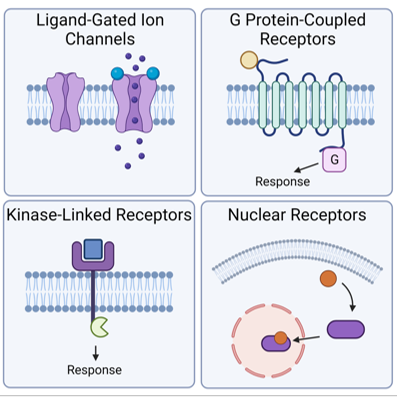
What are the 4 main families of receptors?
Ligand gated ion channels
G protein-coupled receptors (GPCRs)
Kinase-linked receptors
Nuclear receptors
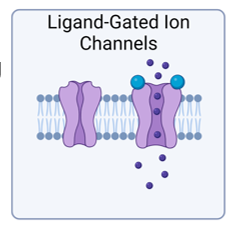
What are Ligand-Gated Ion Channels?
Receptors that open an ion channel directly when a ligand binds.
What’s the difference between ligand gated ion channels and ion channels in general?
The channel opens only when a ligand binds. Ion channels are always open.
What is a kinase?
An enzyme that uses ATP to phosphorylate targets, acting as an on/off switch.
Are kinases second messengers?
Yes
How are kinase-linked receptors activated?
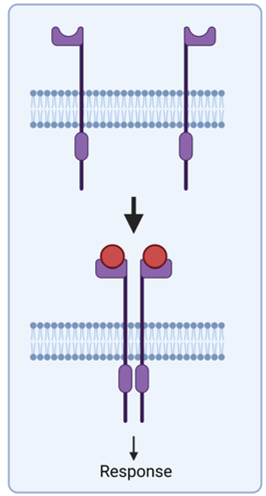
There’s a receptor in 2 halves in the membrane (monomer)
Ligand-receptor engagement brings the 2 receptor proteins (the 2 halves) together in the membrane (dimer)
This activates the kinase-linked receptor
The activation initiates a downstream cascade and biological response
What does EGFR stand for?
Epidermal growth factor receptor
Why is EGFR important clinically?
EGFR are a type of kinase-linked receptor
Some types of lung cancer express more EGFR proteins, leading to more growth
These cancers are therefore susceptible to drugs that target EGFR
What defines a GPCR?
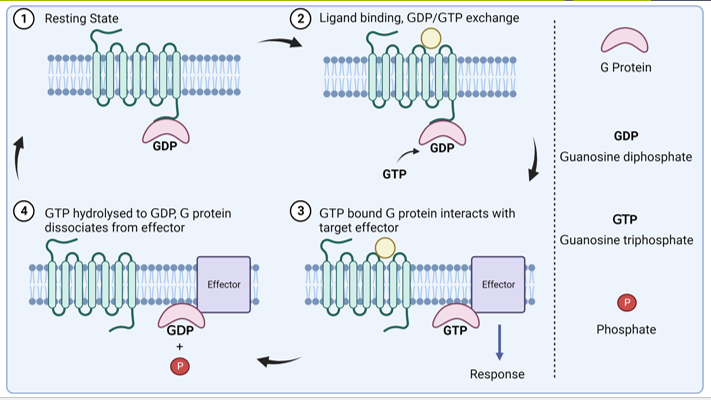
A receptor with 7 transmembrane domains and is coupled to G protein
Ligand binding activates G protein which interacts with effector
Different GPCRs coupled to different G proteins. These elicit different effects
How are GPCRs activated?
Ligand binding activates the G-protein, which interacts with the effector
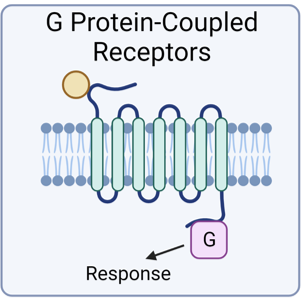
Are different GPCRs coupled to different G proteins?
Yes, and different G proteins have different effects
What are nuclear receptors?
Intracellular receptors that regulate gene expression.
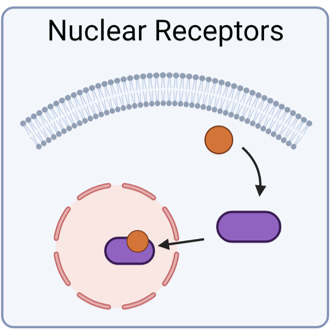
How are nuclear receptors activated?
The ligand enters the cell and binds to the receptor in the cytoplasm.
This forms a ligand-receptor complex
The ligand-receptor complex then moves into the nucleus and acts on gene expression
What does “signal – action – response” mean?
Ligand binding → receptor activation → intracellular signalling → biological effect.
Match receptor type to activation mechanism.
Ligand-gated ion channel
GPCR
Kinase-linked receptor
Nuclear receptor
/
→ G-protein activation
→ gene expression
→ phosphorylation cascade
→ channel opening
Ligand-gated ion channel → channel opening
GPCR → G-protein activation
Kinase-linked receptor → phosphorylation cascade
Nuclear receptor → gene expression
How do we measure response to agonists?
Concentration response curve
How can we compare different agonists?
Emax (Maximal response of agonist - efficacy)
EC50 (Concentration that elicits 50% response - potency)
Name all the different types of agonism:
Full agonist
Partial agonist
Inverse agonist
Biased agonism
How do we measure receptor affinity?
Saturation binding curve to determine Kd
Competition binding curve to compare affinities
What is a ligand?
Something that binds (natural ligand, drug, etc)
What is an agonist?
A ligand that binds to and activates a receptor. Agonists drives the response
Example of agonist
Acetylcholine is the agonist for both nicotinic ligand gated ion channels and muscarinic G protein coupled receptors
What determines a response?
Affinity + Efficacy = Response
Affinity = How well a drug binds to a receptor
Efficacy = How well a drug activates a receptor
How do we measure response in receptors?
Using the concentration response curve
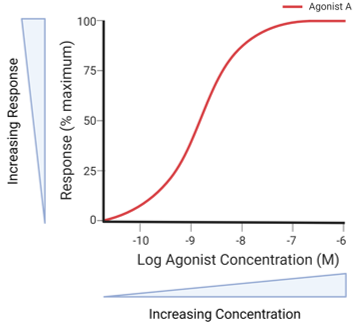
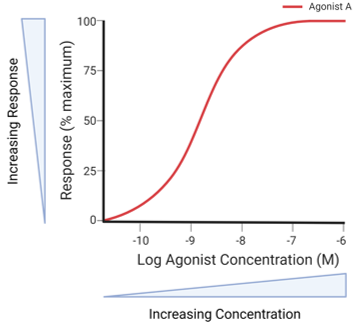
Concentration response curve
Biological system is exposed to increasing concentrations of agonist/drug
Chosen response is recorded, i.e. smooth muscle contraction, cell growth
The recorded response is then plotted against concentration on a log scale
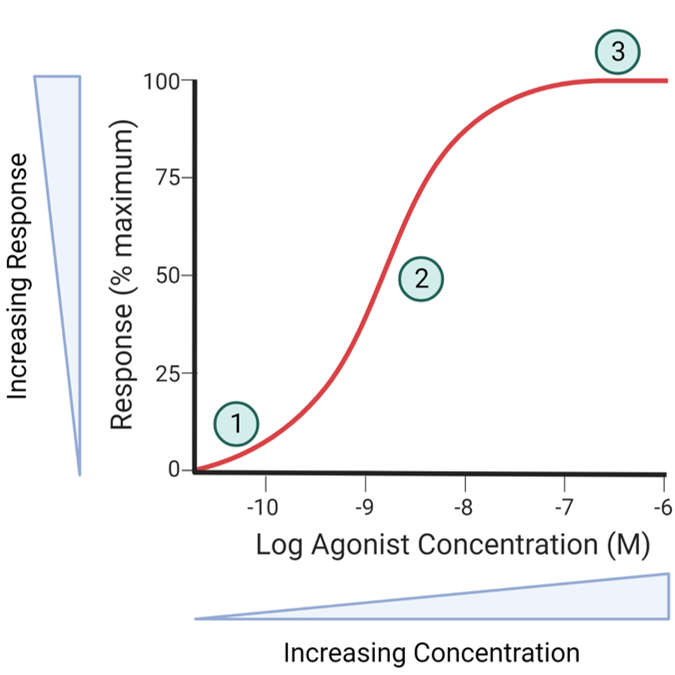
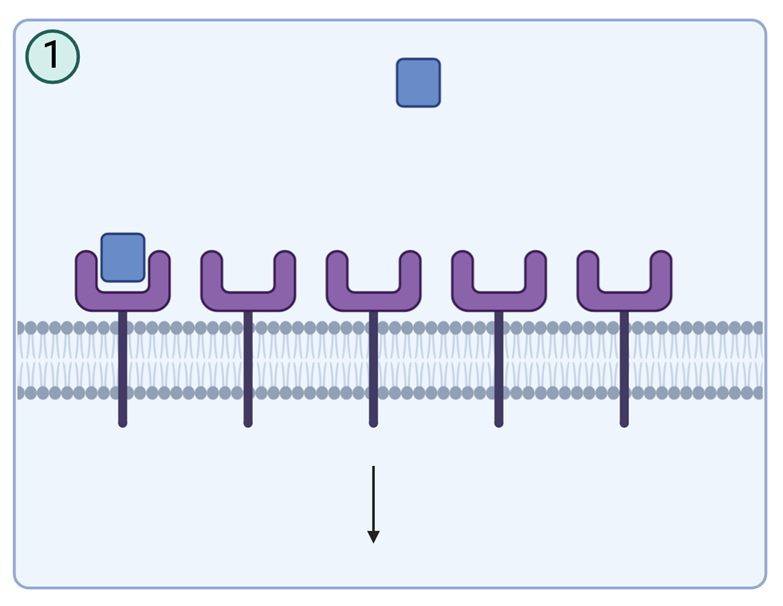
What’s happening at 1?
There is initial low concentrations that evoke limited response. There is low receptor occupancy and poor response
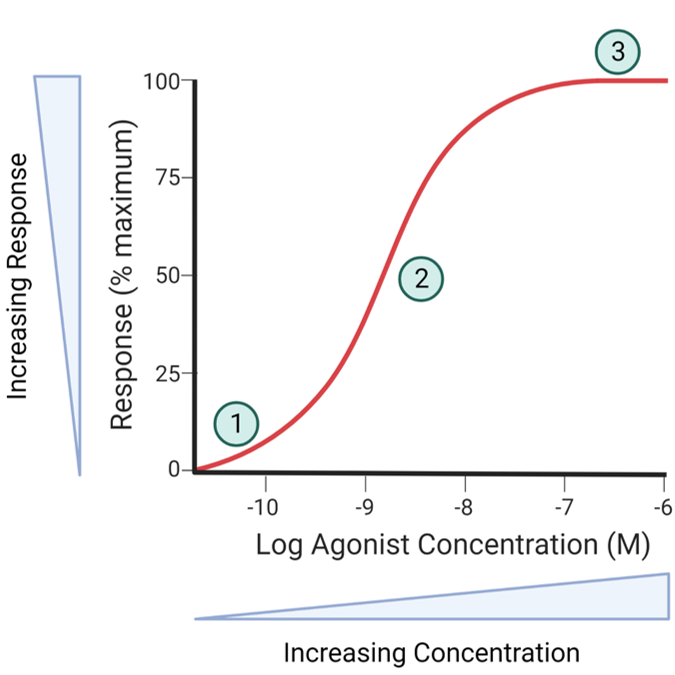
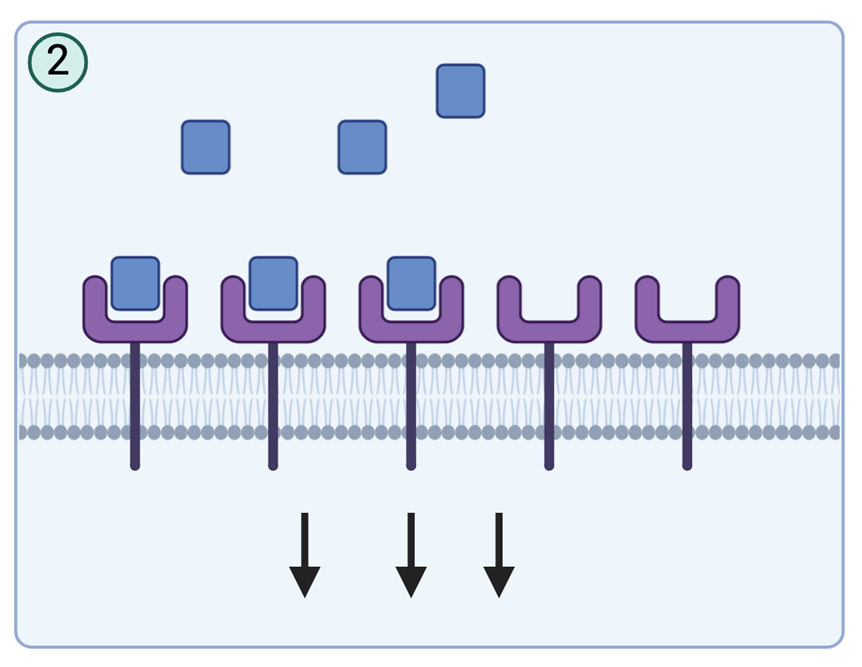
What happens at 2?
Eventually increasing concentrations evokes increasing response in linear fashion
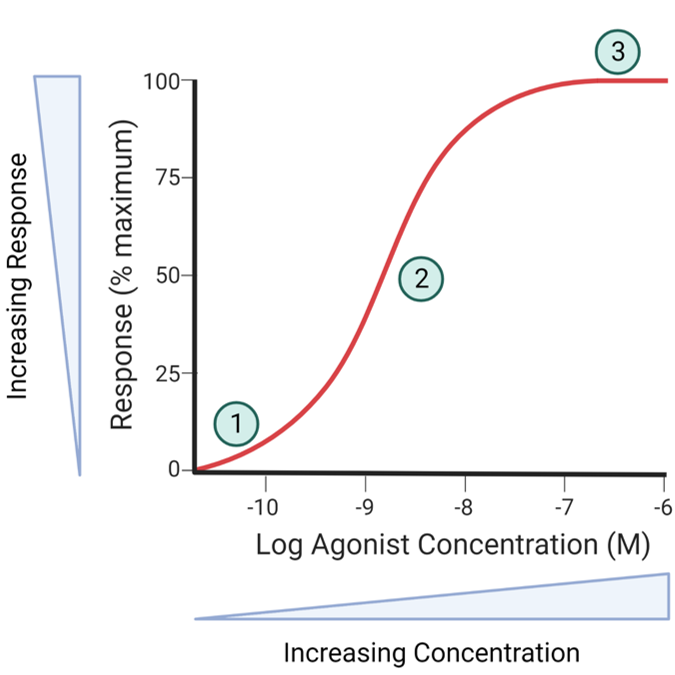
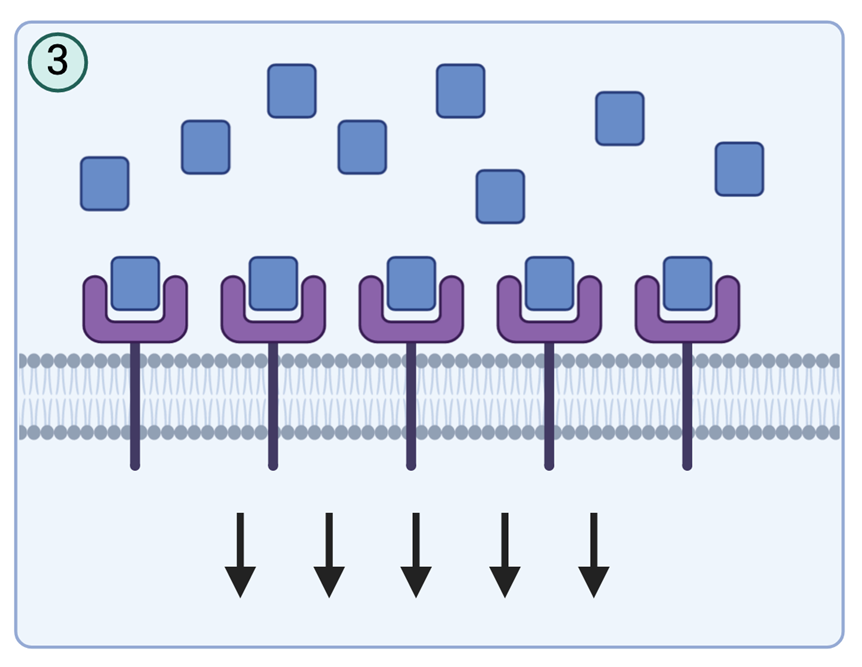
What happens at 3?
Finally, response is maxed out (full receptor occupancy, maximum biological response)
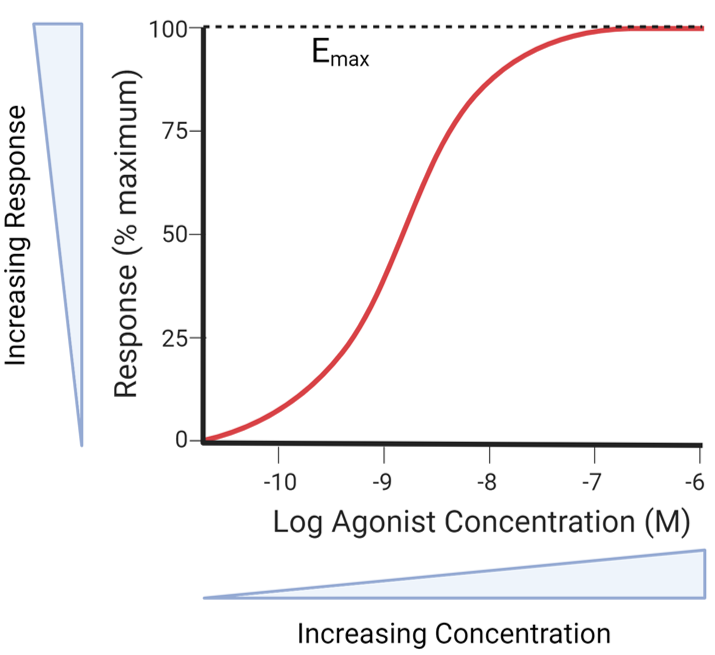
Emax in the Concentration Response Curve
Emax is the maximum effect produced by an agonist.
It is how effective the agonist is at producing a response.
The maximum effect produced by agonist is not necessarily the maximum response of the biological system.
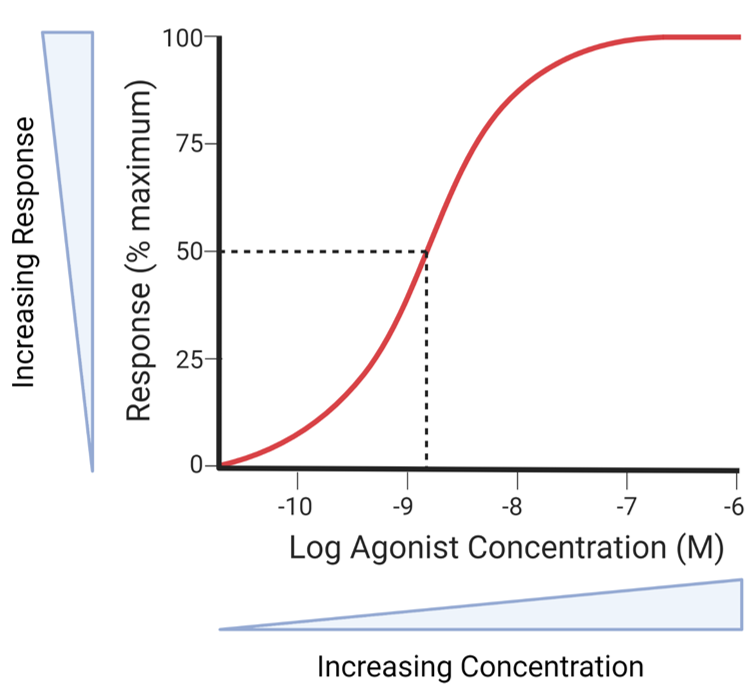
EC50 in concentration response curve
EC50 is the concentration of agonist required to elicit 50% of maximal response (Emax)
Useful measure to compare between different agonists in the same system
Potency of a drug
Potency of a drug refers to how much drug is needed to produce an effect
A more potent drug requires a lower or higher concentration to produce the same response?
Lower
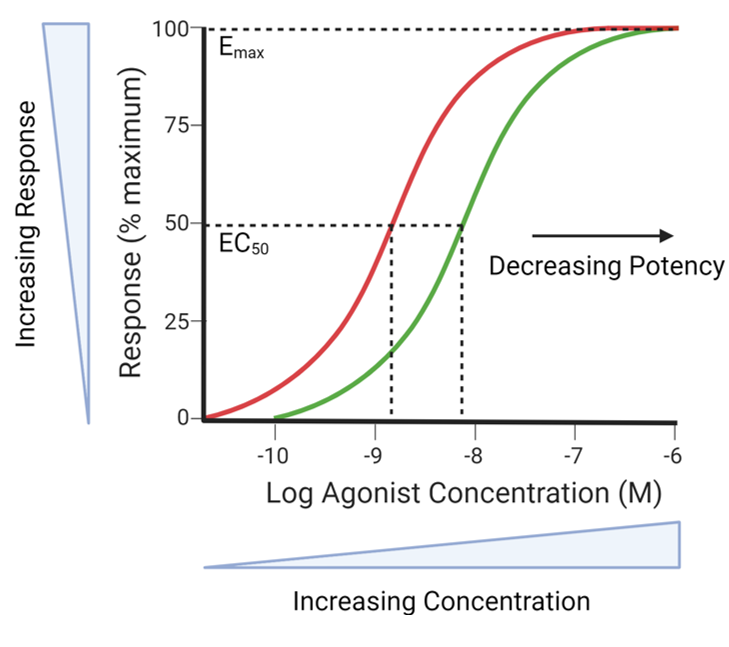
Agonist A is the red line. Agonist B is the green line.
Which agonist is more or less potent?
Agonist A and B have the same Emax
They have different EC50 values
EC50 Agonist A = 2 nM
EC50 Agonist B = 8 nM
Higher concentrations of agonist B are required to produce the same response as agonist A
Agonist B is therefore less potent than agonist A
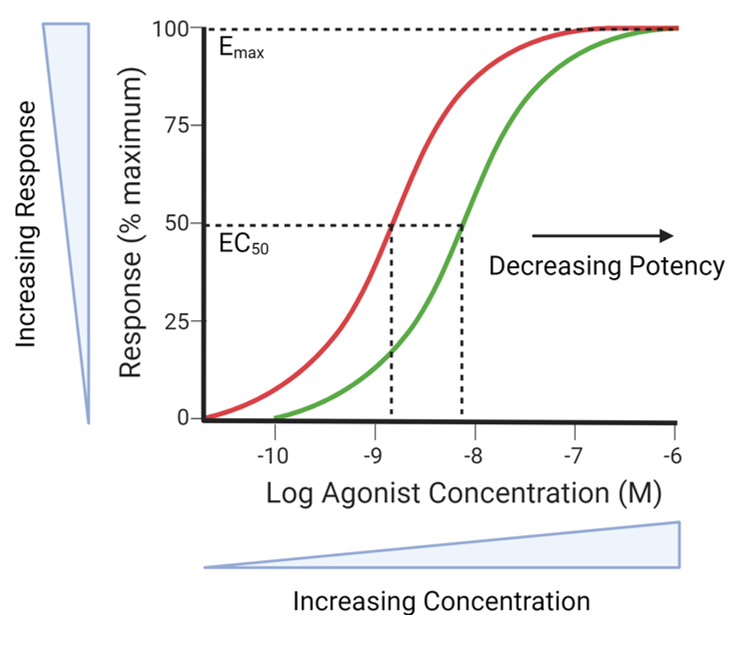
Same Emax means….
both agonists have the same efficacy
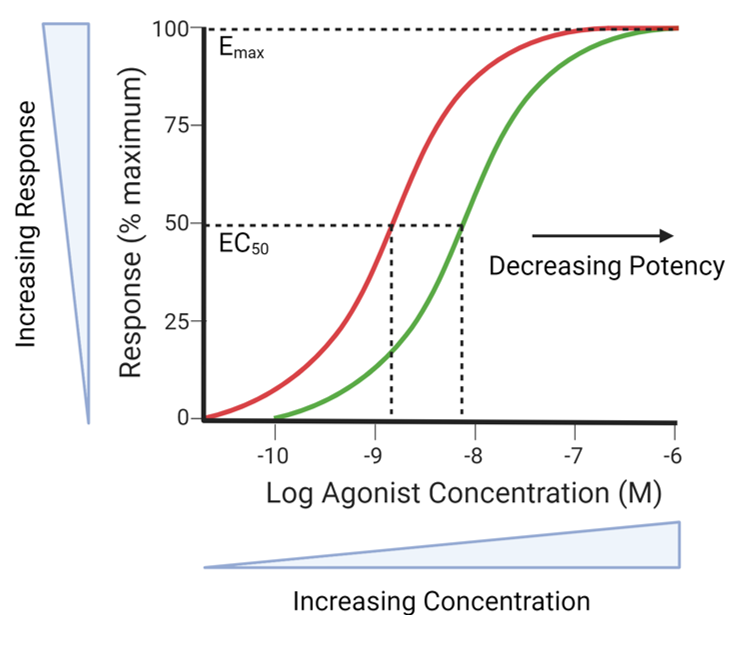
Different EC50 values means…
the agonists have different potencies
What are partial agonists?
Some agonist receptor interactions do not produce a full response in a biological system.
Either they have limited receptor occupancy (poor affinity)
Or they can’t produce a full response (poor efficacy)
They are referred to as a partial agonist
What are full agonists?
Agonists that produce a full response are full agonists
Partial Agonists Graph
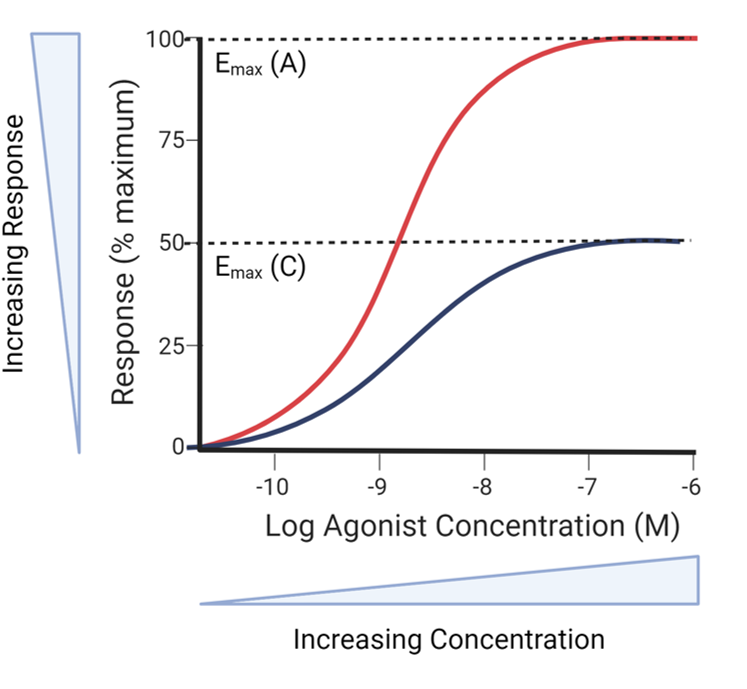

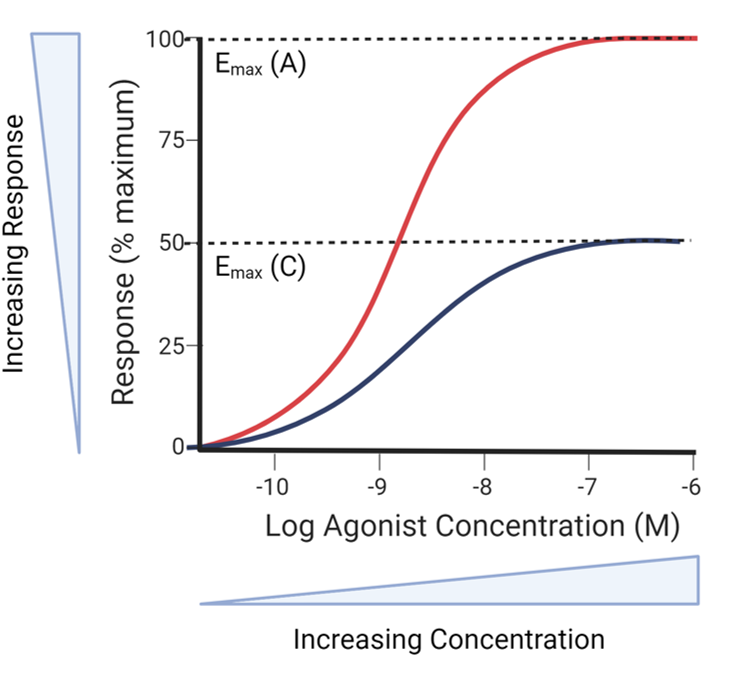
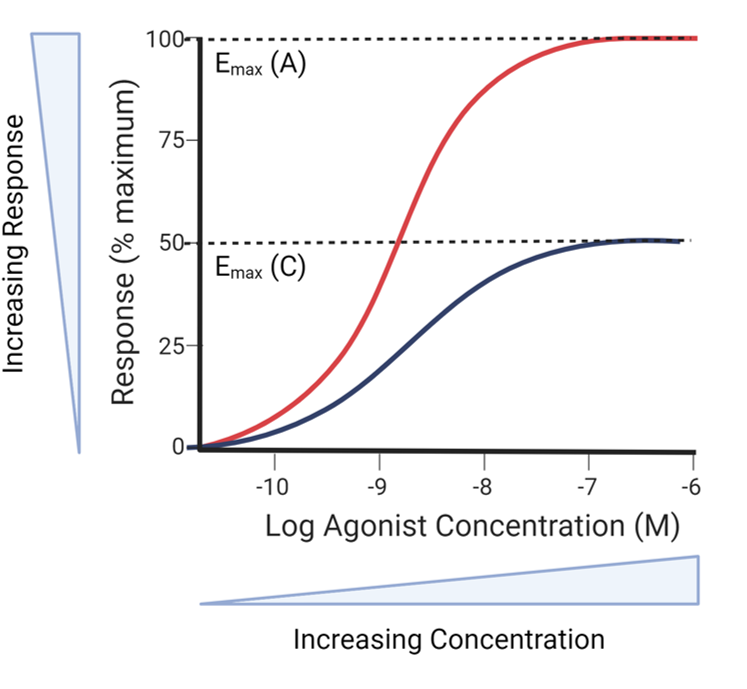
Agonist A is the red line
Agonist C is the blue line
Agonist C has a maximal response (Emax) below that of Agonist A. There is reduced efficacy.
Agonist C is a partial agonist. Agonist A is a full agonist.
How are EC50 calculated for partial agonists?
EC50 calculated at 50% Emax
Agonist A Emax is 100%
EC50 taken at 50%Agonist C Emax is 50%
EC50 taken at 25%
What are inverse agonists?
Some biological systems and receptors have a basal level of activity without any agonist present
Termed ‘constitutive activity’
e.g. Heart muscle contraction
This activity can be reduced by certain drugs
These are called Inverse Agonists
Inverse Agonists Graph
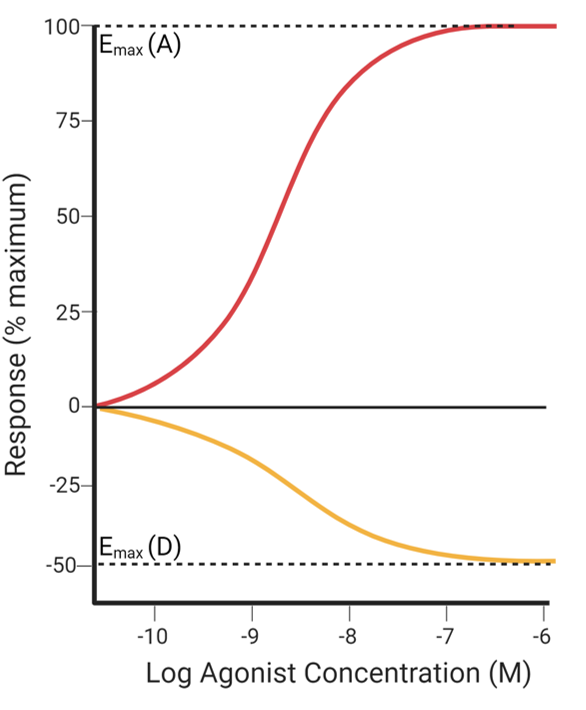
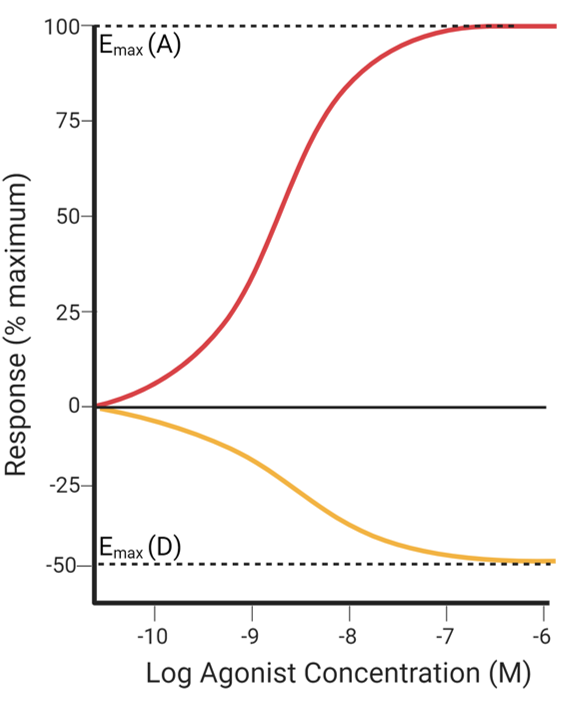
Red line is Agonist A
Yellow line is Agonist D
Agonist D reduces biological response below basal levels. Agonist D is an inverse agonist.
Agonist A Emax = 100%
Agonist D Emax = -50%
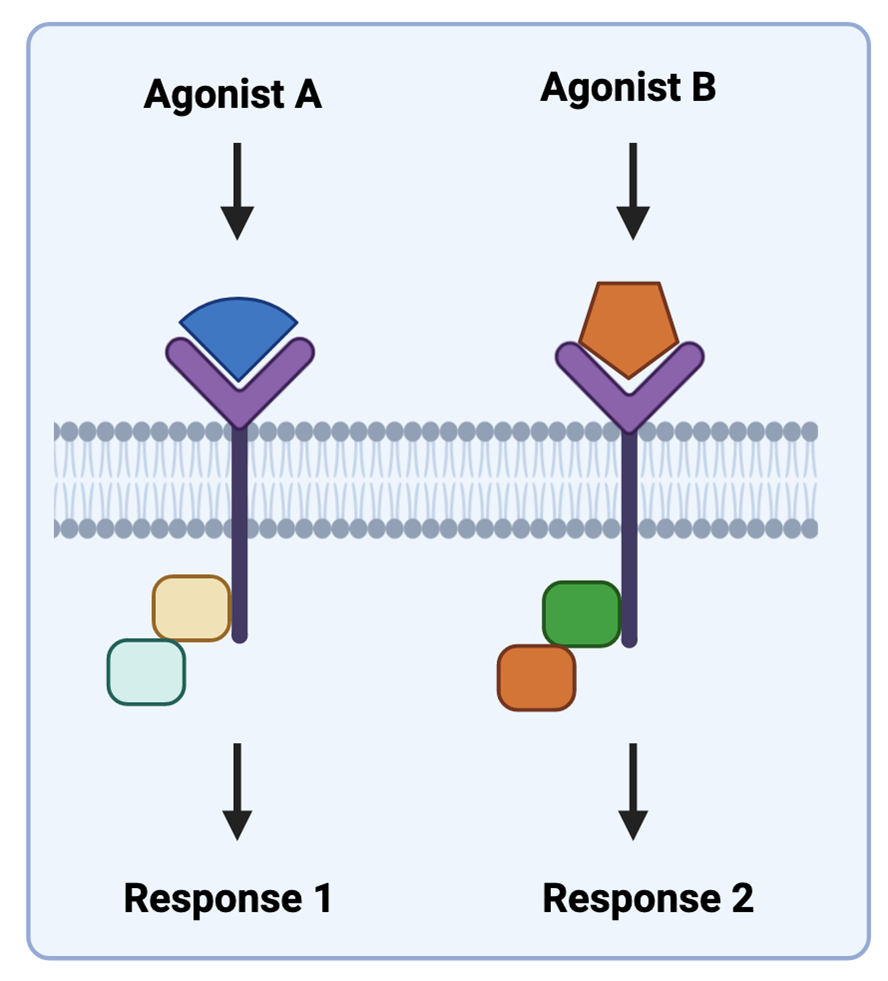
What is biased agonism?
Different agonists can produce different effects through the same receptor
The agonists promote different activation states of receptor. This leads to different second messengers, which then leads to a different response
Termed Biased Agonism
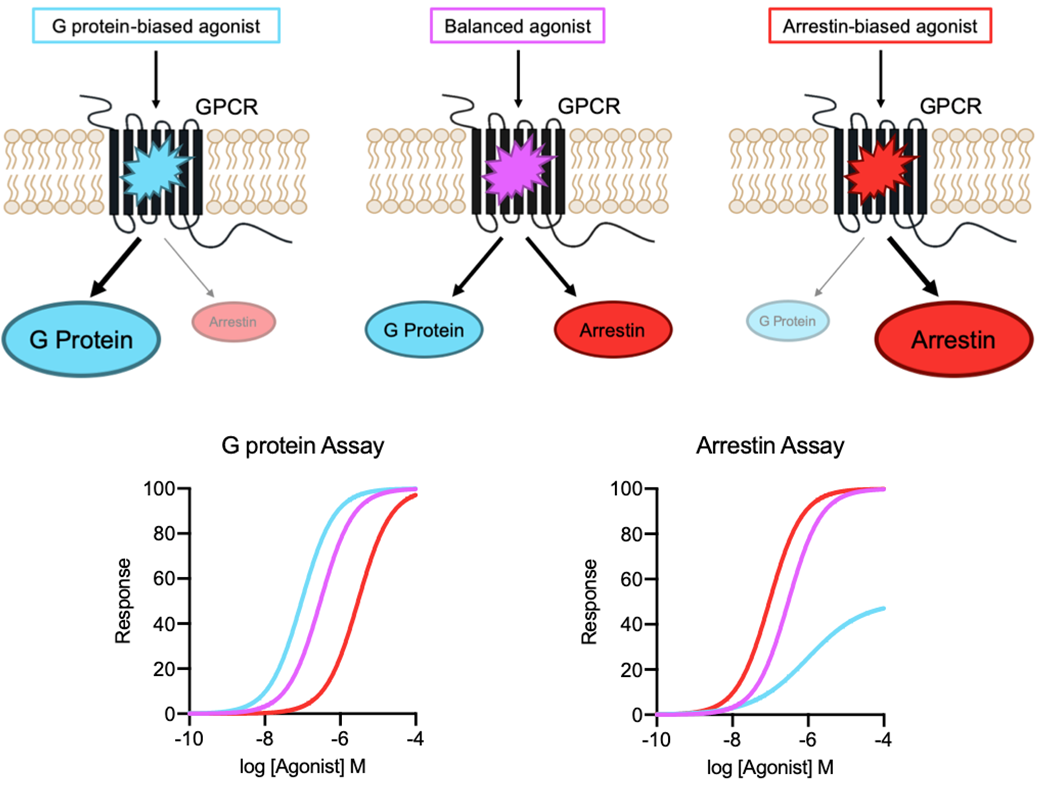
Biased agonism in GPCR
A single receptor (like a GPCR) can activate multiple signalling pathways, and different drugs can “prefer” or bias toward one pathway over another.
GPCRs can signal through G proteins and β-arrestins
Different agonists will variably activate each signalling pathway, exhibiting bias
This can be distinguished by using multiple readouts
How to measure affinity?
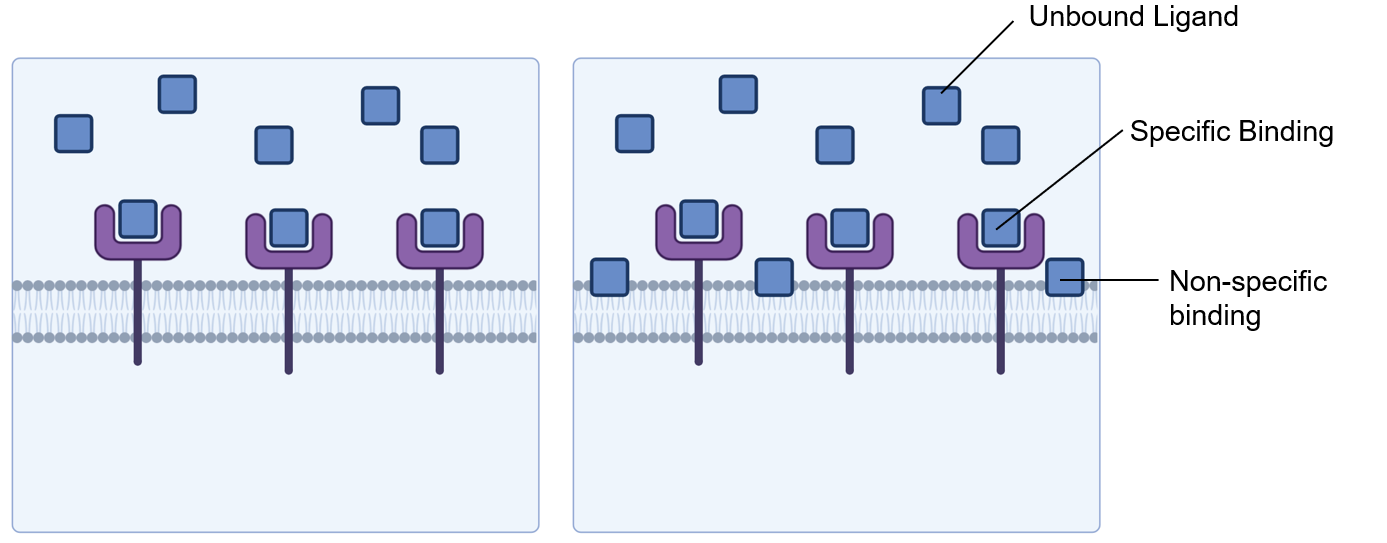
By observing the types of binding (specific and non specific binding)
Types of binding
Ligands preferentially bind to their receptor (Specific Binding).
At higher concentrations, ligands exhibit non specific binding
Measuring affinity using a saturation binding curve
Using a labelled ligand (e.g., fluorescent, radiolabelled) we can measure how much ligand binds to a biological membrane (Total binding)

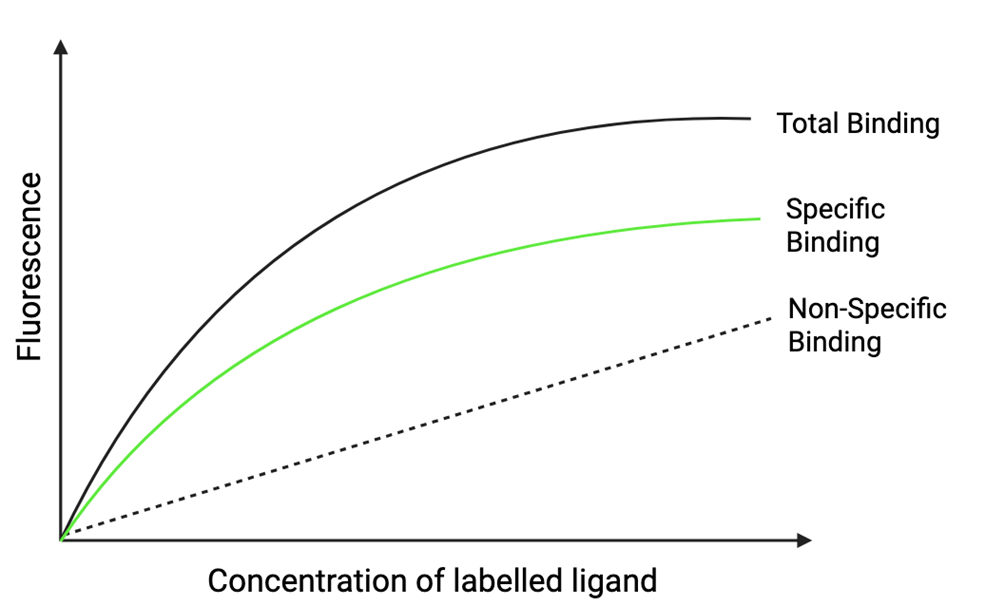
Dissociation Constant (Kd)
To determine specific binding, subtract non specific from total
Then calculate a dissociation constant (Kd) for the ligand
Smaller Kd = higher affinity
Competition binding curve
Can use same principles to assess affinity of test drugs for a receptor
Biological membrane is saturated with high amount of a labelled ligand
Adding in a drug compound targeted at that receptor displaces labelled ligand, reducing fluorescence
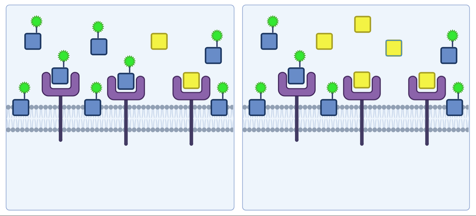
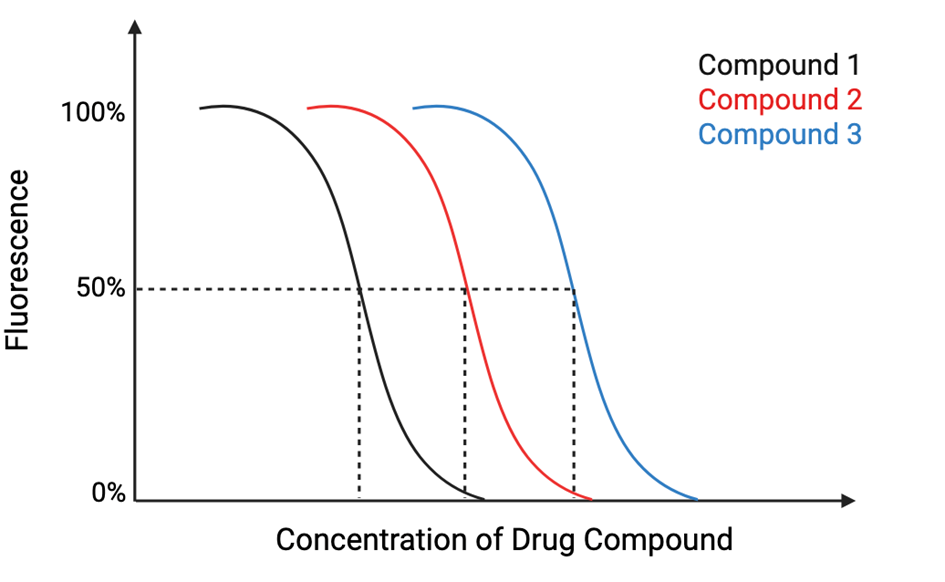
Measuring drug affinity - Competition binding curve
Increasing concentration of drug displaces increasing amounts of labelled ligand
Inverse concentration-response curve
IC50 – concentration required to lower response by 50%
Compounds with higher affinity will displace more labelled ligand at lower concentrations
What does antagonist mean?
A ligand that binds to but does not activate a receptor
What are competitive antagonists?
They compete with the agonist for the same receptor binding site
Can competitive antagonists be reversible or irreversible?
Yes both
Reversible competitive antagonist
Increasing agonist concentration can outcompete antagonist
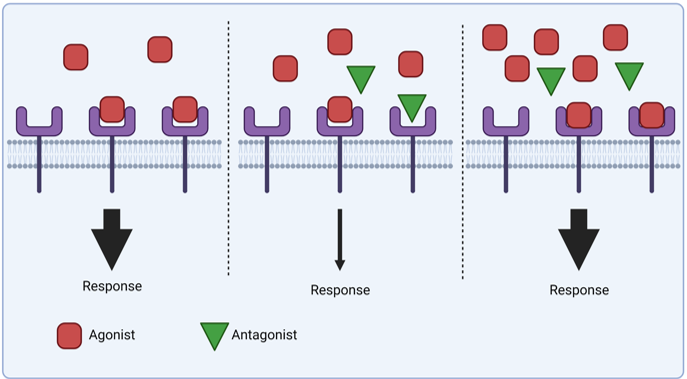
Irreversible competitive antagonist
Antagonist permanently binds to receptor, no amount of agonist will dislodge
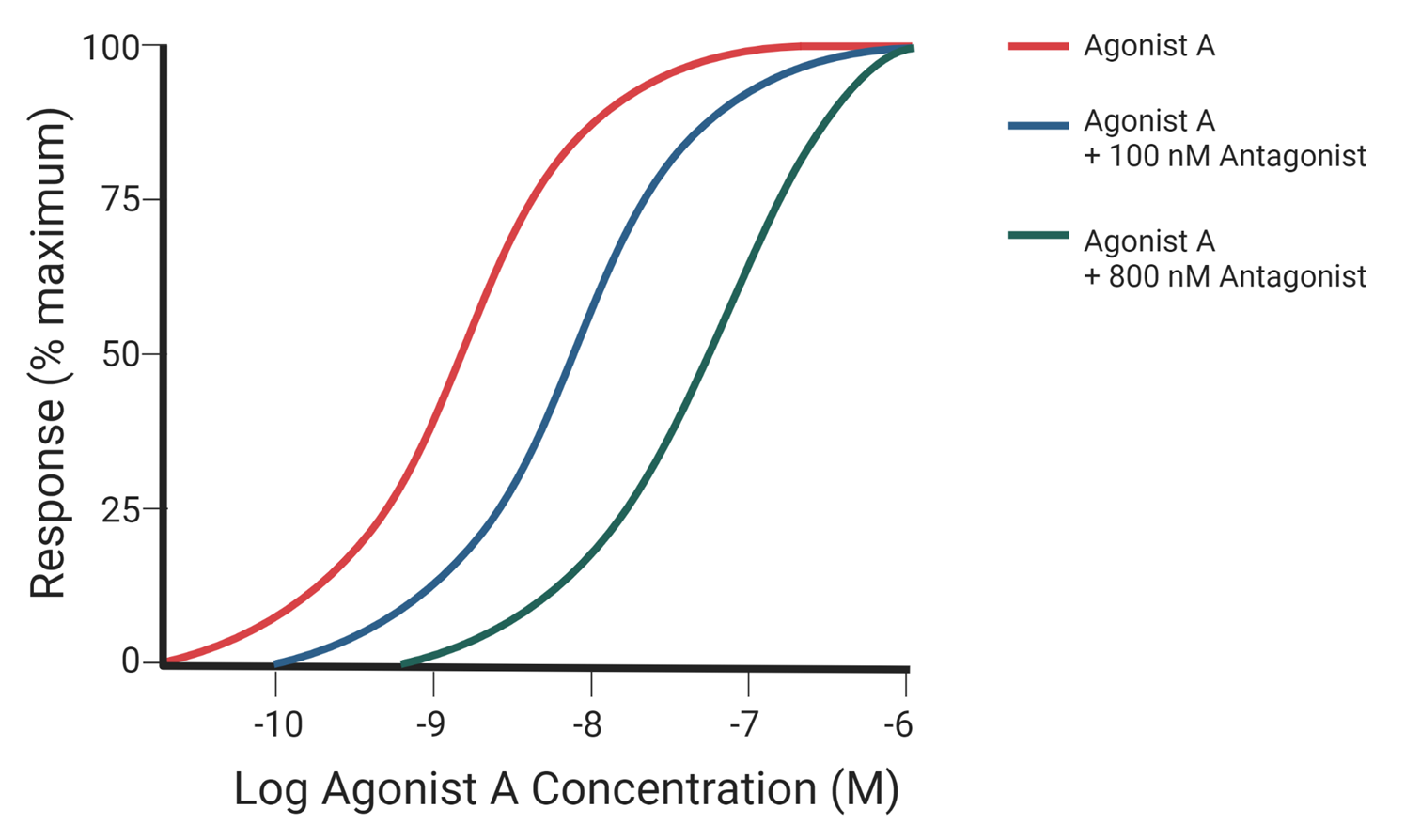
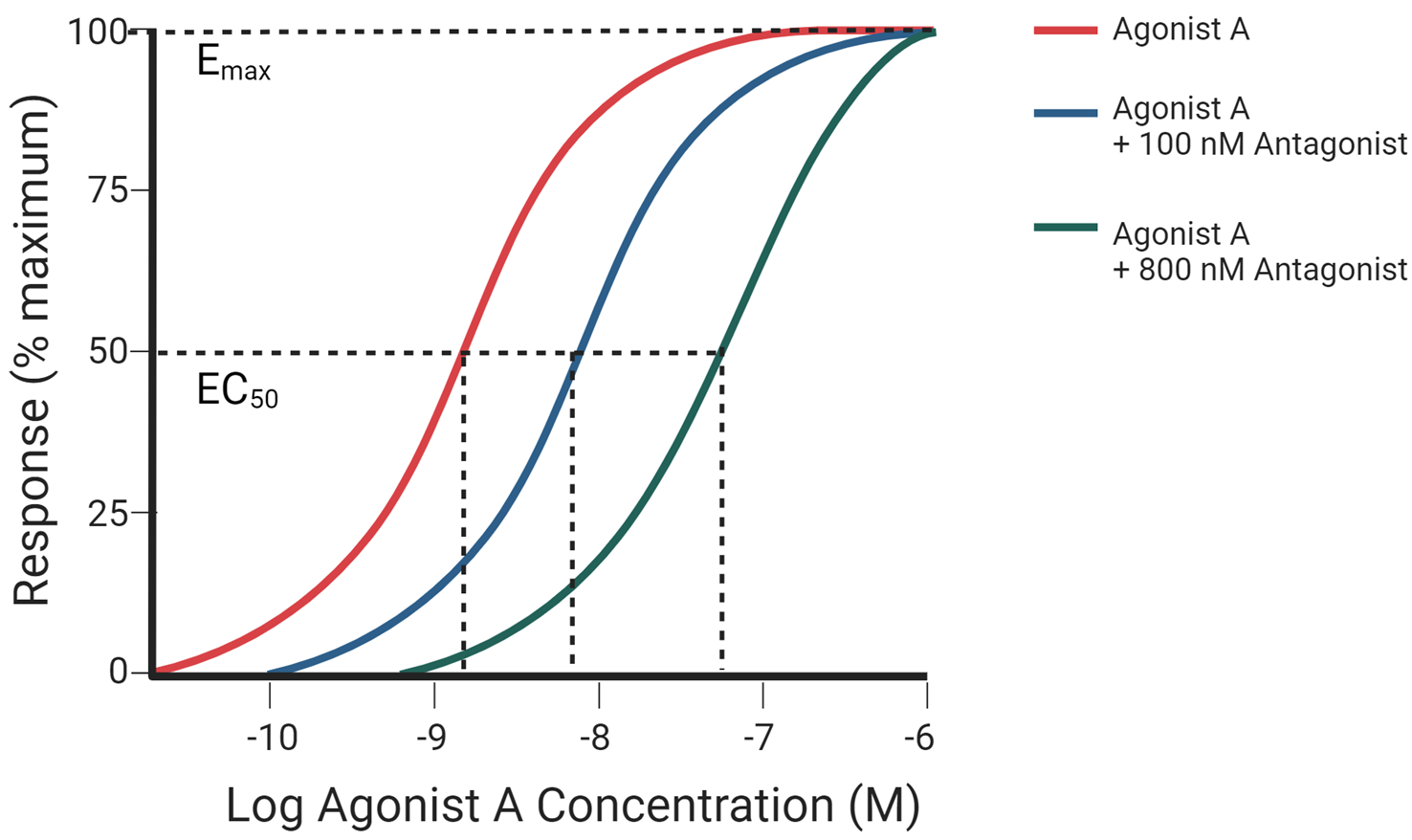
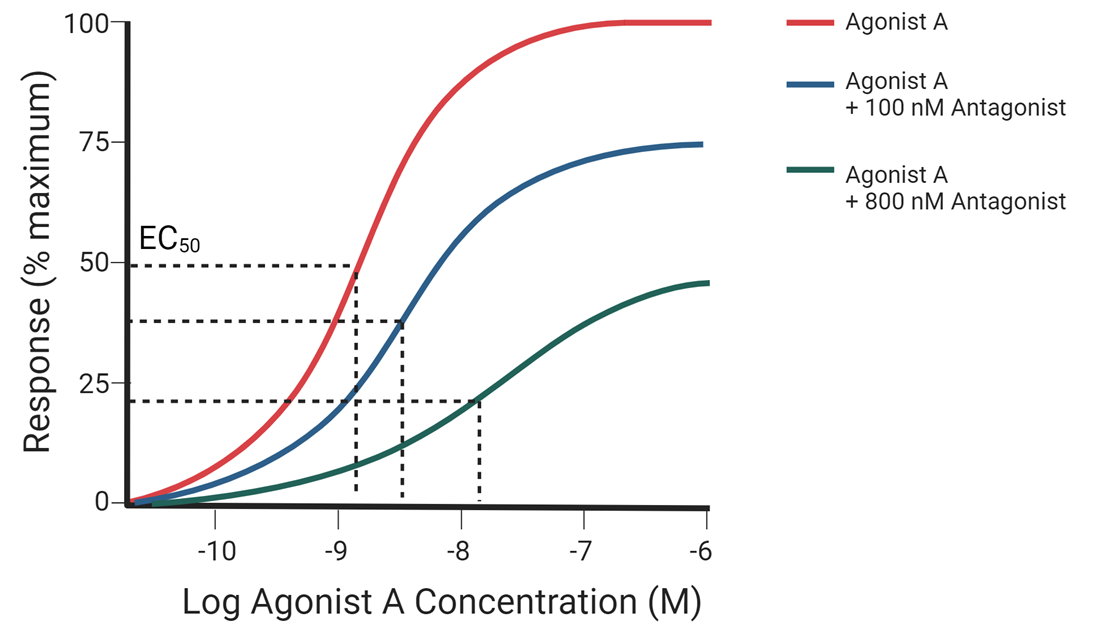
In presence of antagonist, a higher concentration of Agonist A is required to evoke same response
Characteristic shift in agonist concentration-response curve
When you increase the concentration of the antagonist, what happens to the Emax and EC50?
The Emax of agonist A stays the same
The EC50 of agonist A gets larger (this means a higher concentration of agonist needed to produce 50% of the maximum effect)
Competitive antagonist - Irreversible Diagram
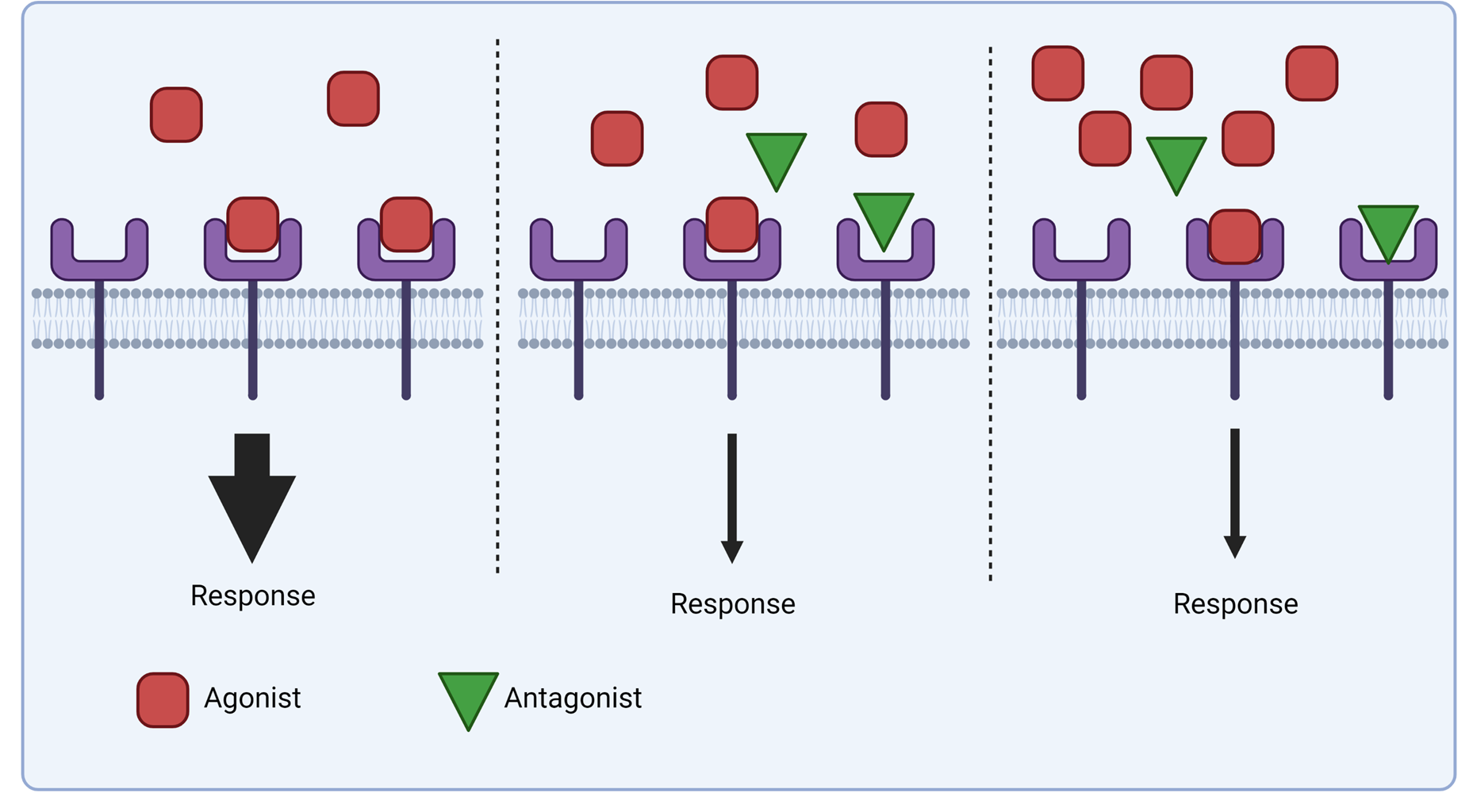
Irreversible Competitive Antagonists
In the presence of antagonist, higher concentration of agonist A cannot supplant antagonist
Reduced response
Characteristic suppression of agonist concentration-response curve
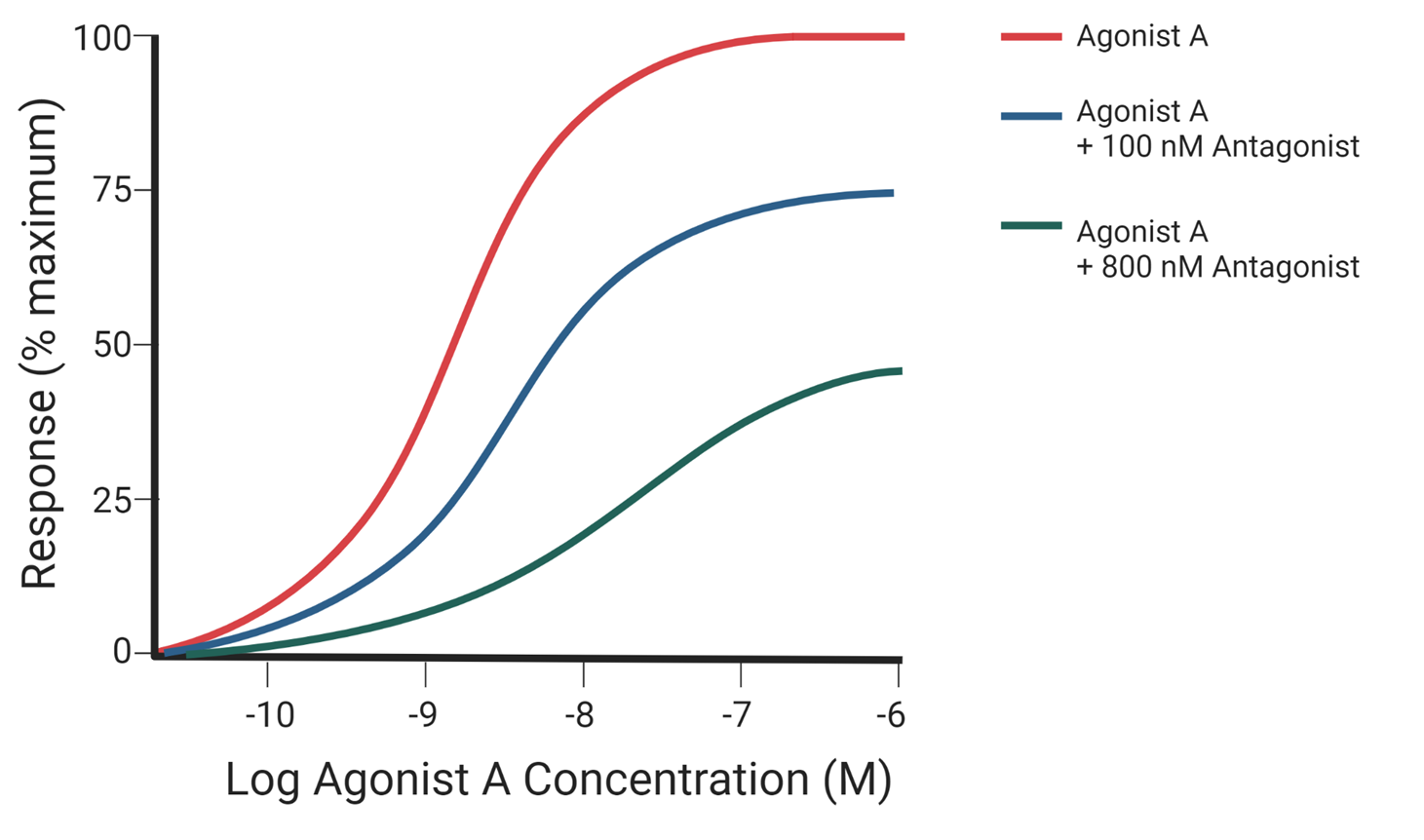
What happens to the Emax when the irreversible competitive antagonist concentrations are increased?
With increasing concentrations of antagonist:
Emax of agonist A reduces
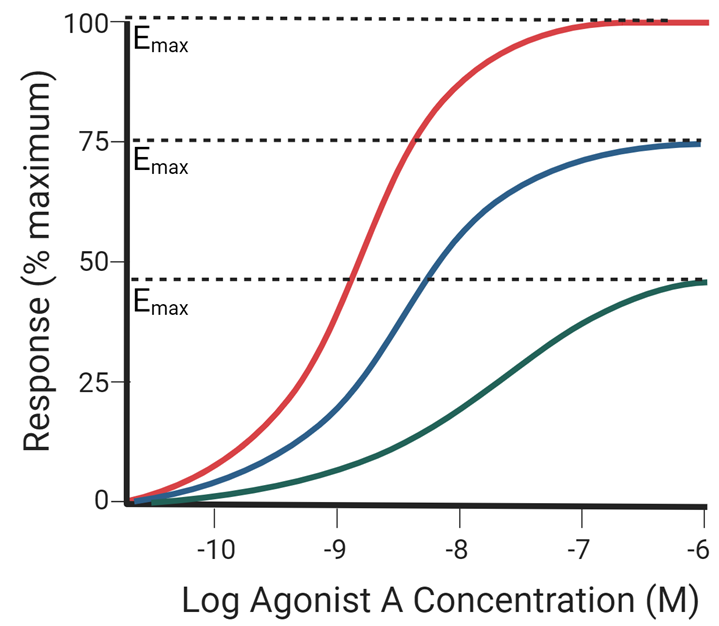
What happens to the EC50 when the irreversible competitive antagonists are increased?
With increasing concentrations of antagonist:
EC50 of agonist A increases
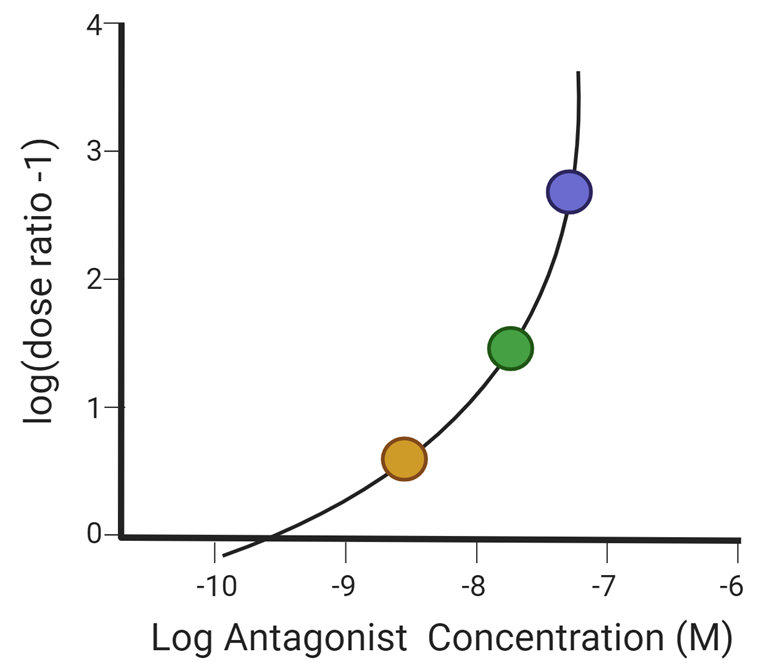
What is the Schild Plot?
It is a way to determine the nature and potency of antagonist
The Y-axis = log (concentration of antagonist)
The X-axis = log (dose ratio - 1)
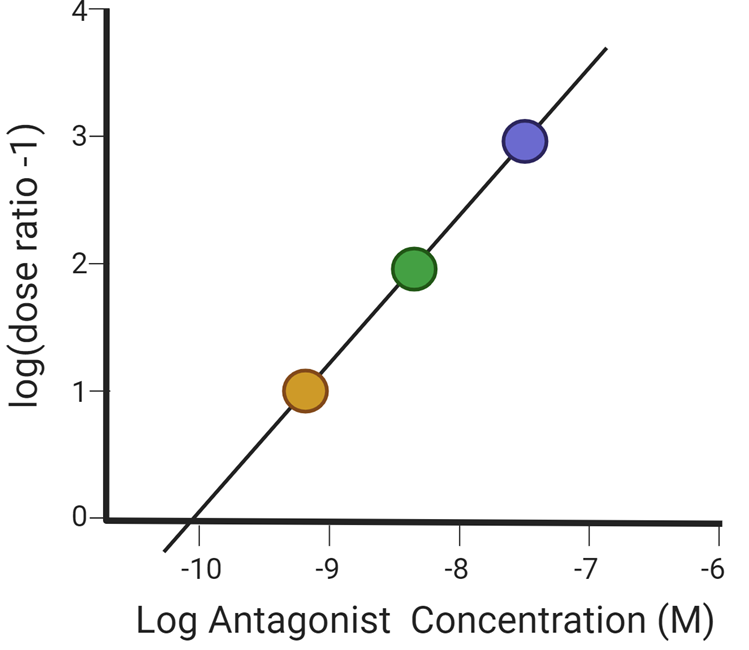
Dose ratios in antagonism calculation

What is the pA2 value in Schild plot?
The pA2 value is determined from where line intersects X axis
It is the negative log value of concentration
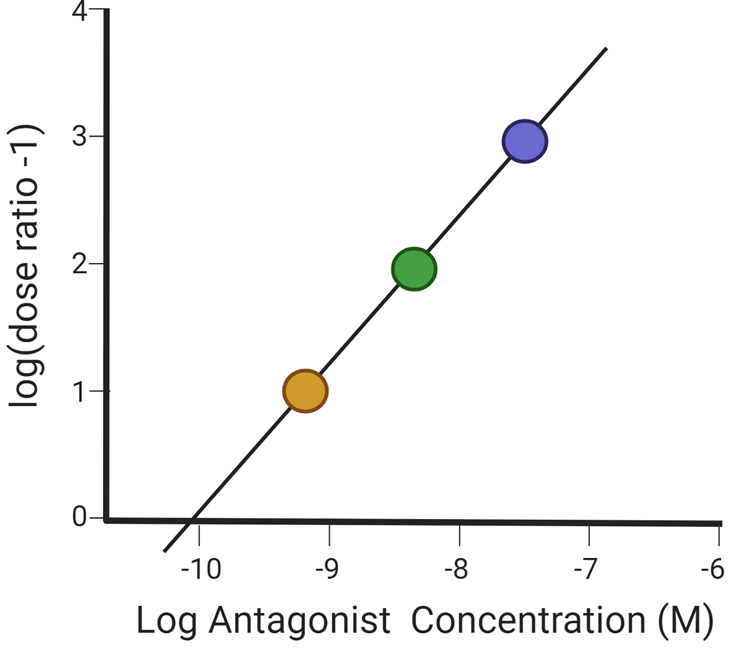
What is the pA2 equation?

What does the pA2 equation measure?
What does a higher number mean?
Why is the pA2 equation useful?
It measures the antagonist potency.
A higher number indicates a more potent antagonist
It is a useful tool to compare agonist/antagonist pairs
If 2 antagonist produce the same pA2 value, what does it suggest?
It suggests they act through the same receptor
Shape of Schild plot indicates the nature of antagonism. What is the shape of a Schild plot in competitive antagonism?
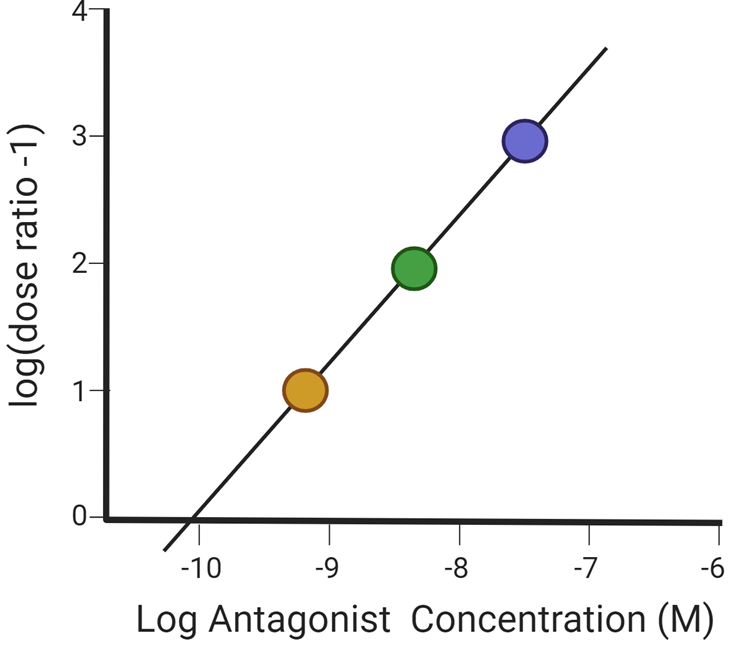
Shape of Schild plot indicates the nature of antagonism. What is the shape of a Schild plot in non-competitive antagonism?
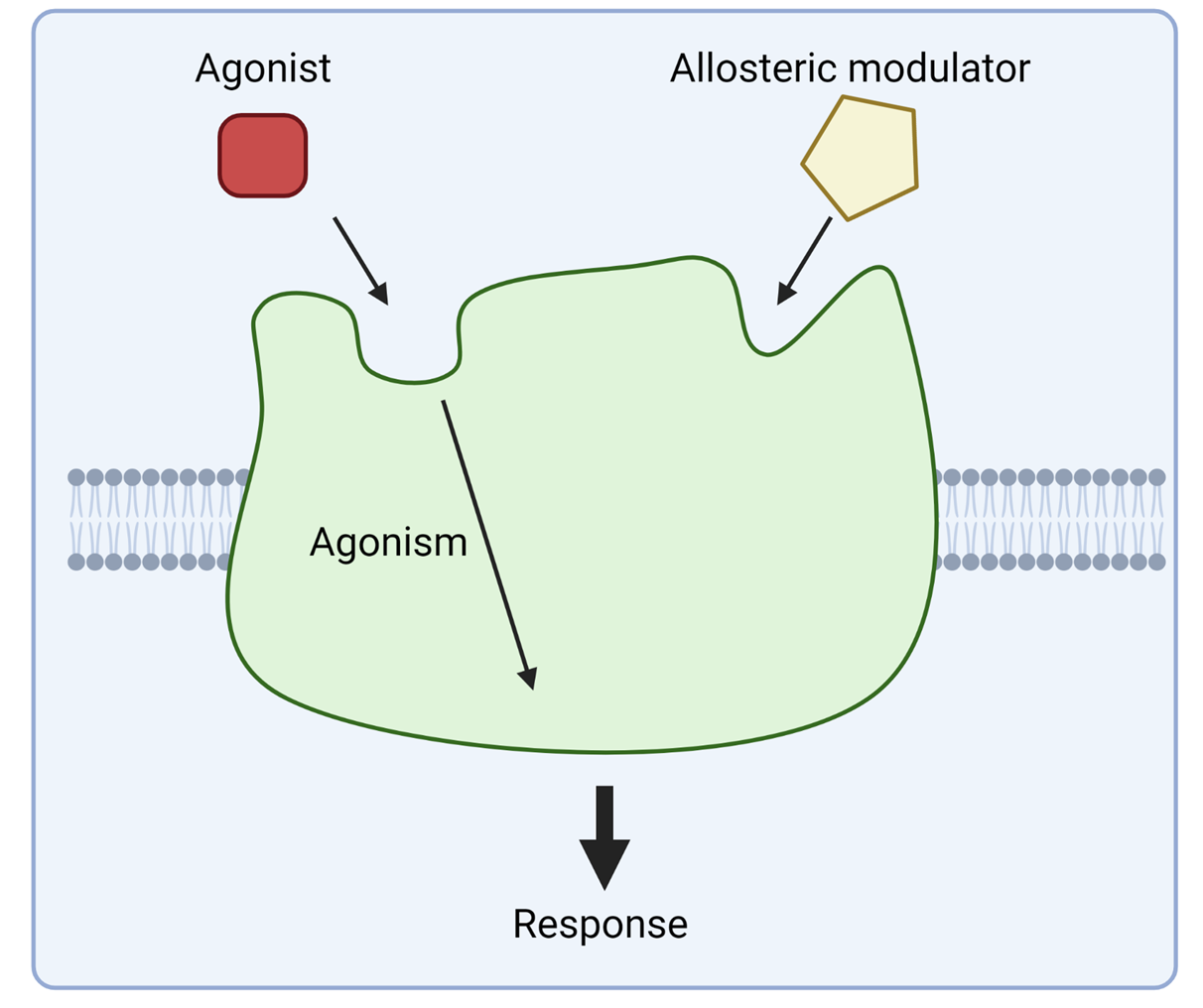
Agonists and competitive antagonists bind at the same site on the receptor. What is that receptor called?
Orthosteric site
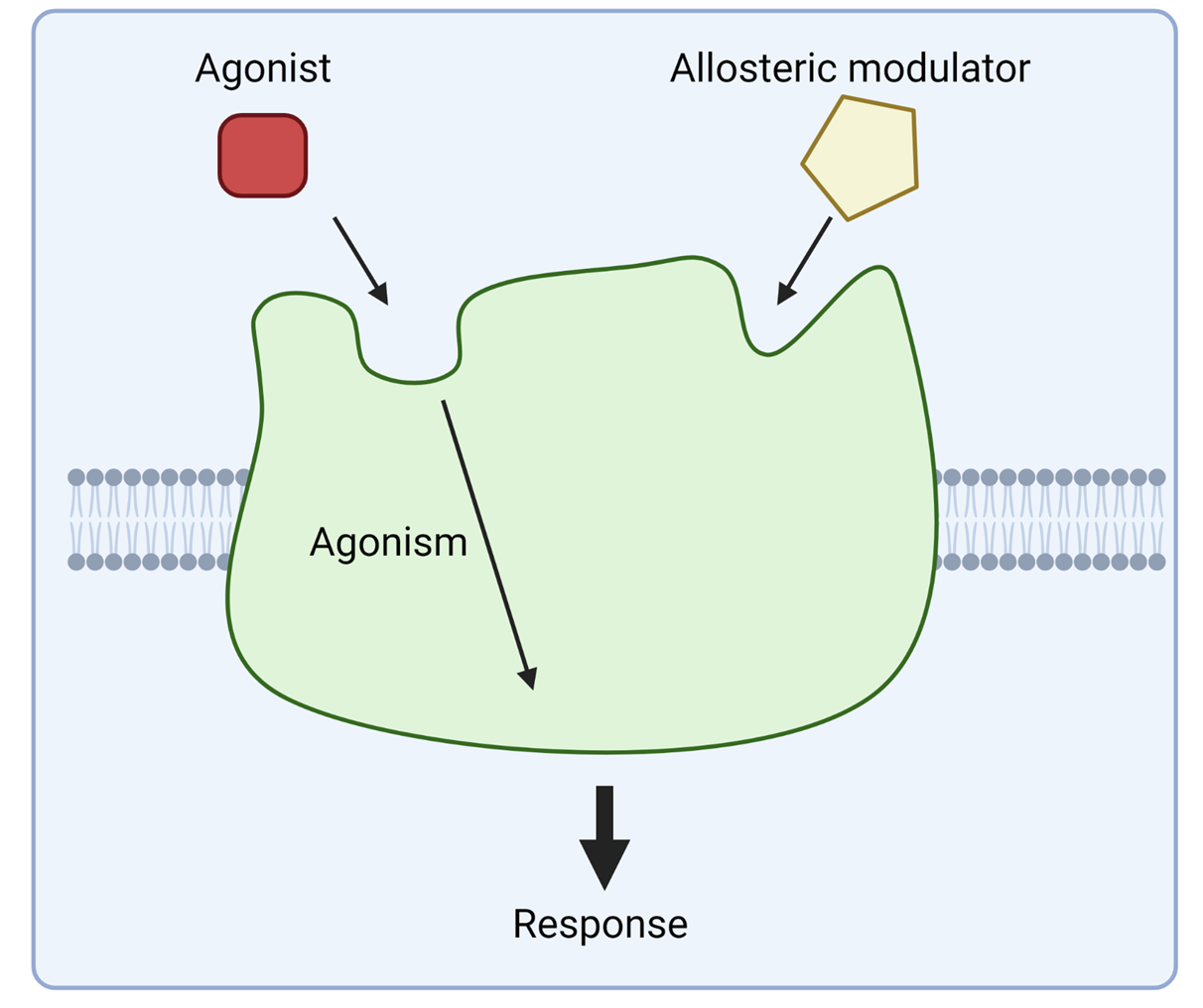
Other drugs/molecules can bind to other sites on receptors, and modify the effects of the agonist. What is the same of the other site?
Allosteric site
What is affinity modulation?
Affects how the agonist binds to orthosteric site
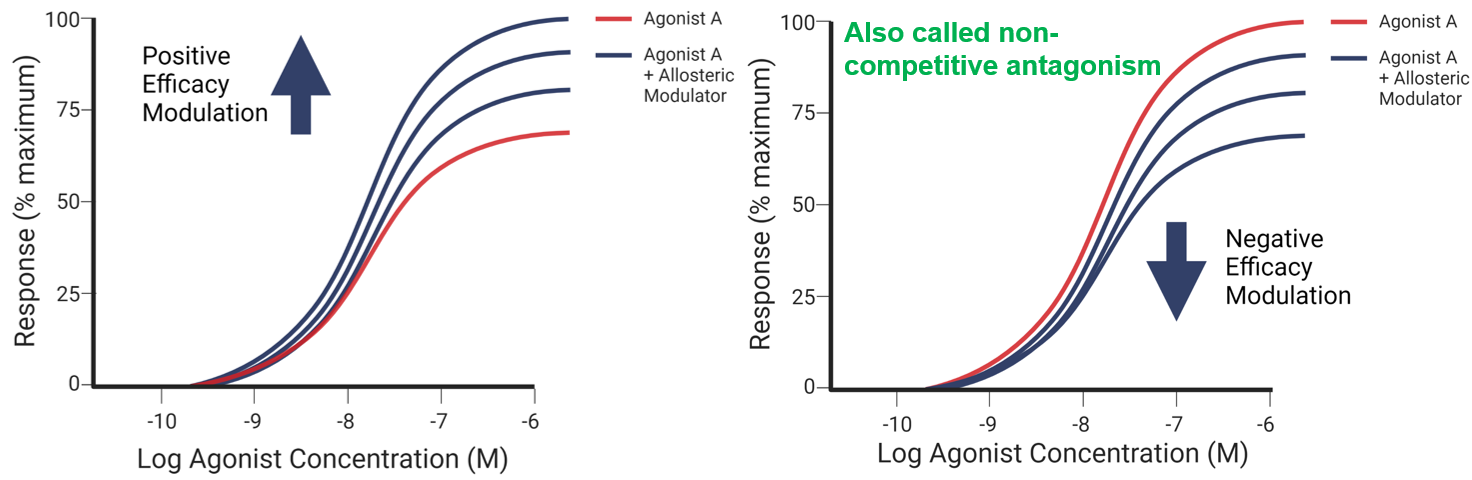
What is efficacy modulation?
Affects how the agonist activates the receptor
What is allosteric agonism?
An allosteric agonist is a ligand that binds to an allosteric site and directly activates the receptor
This means it can produce a response on its own, without the natural ligand.
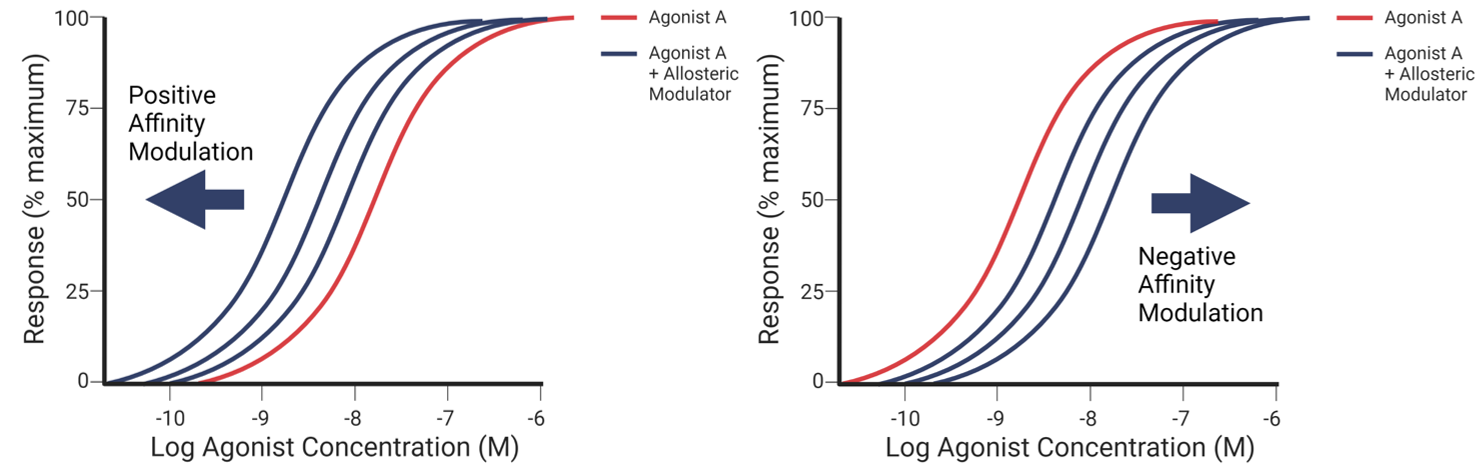
What do affinity allosteric modulators do?
They alter how well the agonist binds to the receptor.
Therefore more or less of the agonist is required for the same response
It shifts the concentration response curve left or right
What do efficacy allosteric modulators do?
They alter how well the agonist activates the receptor
The full response of the agonist is raised or suppressed
It shifts the concentration response curve up or down
How would you quantify antagonism?
Schild plot
pA2 = log(DR-1) - log[antagonist]