Population & Culture
 Call Kai
 Learn
Learn Practice Test
 Spaced Repetition
 Match
Match Flashcards
 Knowt Play
1/8

There's no tags or description
Looks like no tags are added yet.
Name | Mastery | Learn | Test | Matching | Spaced | Call with Kai | Chat |
|---|
No analytics yet
Send a link to your students to track their progress
9 Terms
Population Measures
•Rate of Natural Increase
•Annual growth rate for country or region
•Birth rate (minus) death rate (per 1,000 ppl)
•Does not reflect migration gains & losses
•Total Fertility Rate
•Prediction of # of children women will bear
•Age of marriage; frequency of childbearing
•TFR of 2.1 required to maintain population. Why?
Rate of Natural Increase
•Annual growth rate for country or region
•Birth rate (minus) death rate (per 1,000 ppl)
•Does not reflect migration gains & losses
Total Fertility Rate
•Prediction of # of children women will bear
•Age of marriage; frequency of childbearing
•TFR of 2.1 required to maintain population. Why?
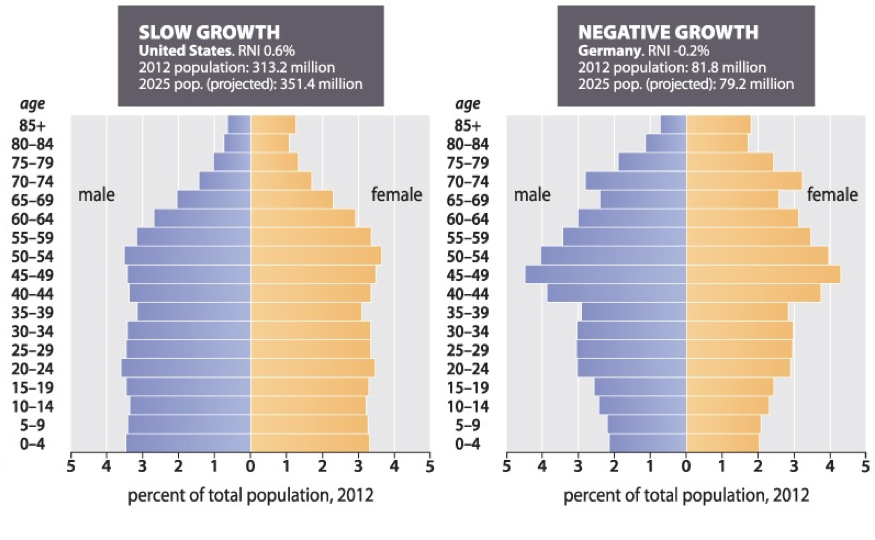
Population Pyramids
•Larger number of youth? Population growth
•Larger number of elderly? Population loss
•Population Pyramid
Graph of Age and Gender of Population
Divided by age groups
Pyramid Shape: Growing Population, more youth
Top-Heavy Shape: Shrinking Population
•Demographic Transition Model
Five-Stage Model of Population Change
Based on birth and death rates, not migration
•Five Stages
1: High Death Rate; High Birth Rate Pop. Low
2: Falling Death Rate; High Birth Rate Pop. ↑ ↑
3: Low Death Rate; Falling Birth Rate Pop. ↑
4: Low Death Rate; Low Birth Rate Pop. Stable
5: Very Low Birth & Death Rates Pop. ↓
push forces
push people out of place
•Culture
Learned behavior held in common by a group of people
•Universalizing Religions
Attempts to appeal to all people, regardless of location, culture, or ethnic background
Christianity, Islam, Buddhism
•Ethnic Religions
Typically associated with a specific ethnic group or culture
Judaism, Hinduism