passive transport lab
 Note
Note Call Kai
 Learn
Learn Practice Test
 Spaced Repetition
 Match
Match Flashcards
 Knowt Play
1/30

There's no tags or description
Looks like no tags are added yet.
Name | Mastery | Learn | Test | Matching | Spaced | Call with Kai | Chat |
|---|
No analytics yet
Send a link to your students to track their progress
31 Terms
Refers to the number of grams of solute per 100 mL of solution.
Percent solution
A solution containing 1 mole of solute in 1 liter of water.
Molar solution
A one molar solution contains 1 mole of solute and is equivalent to its molecular weight in grams per liter.
1 M solution
The diffusion of water through a selectively permeable membrane due to an unequal distribution of solutes.
Osmosis
A measure of concentration based on the number of particles per liter of solution.
Osmolarity
A solute that cannot cross a membrane.
Nonpenetrating solute
A solution that has the same concentration of nonpenetrating solutes as the intracellular fluid.
Isotonic solution
A solution that has a lower concentration of nonpenetrating solutes than the intracellular fluid.
Hypotonic solution
A solution that has a higher concentration of nonpenetrating solutes than the intracellular fluid.
Hypertonic solution
The effect of an extracellular solution on the volume of a cell, determined by the relative concentration of nonpenetrating solutes.
Tonicity
The rate depends on the solubility of the molecule in lipids.
Diffusion rate of nonpolar molecules
The rate depends on the size of the molecule, proportional to its molecular weight.
Diffusion rate of polar molecules
When RBCs shrink their membrane shrivels up and they look lumpy is called
crenation
if you put RBC into a hypotonic solution they will
swell
0.9% NaCl and 5.0% glucose
some percent solutions that are isotonic to ICF are
the higher the osmolarity, the greater the osmotic pressure of the solution
nonpenetrating solutes
Do not dissociate in water, and only contributes one particle per molecule
glucose
Does dissociate in water
NaCl and CaCl
As water enters the cell, the cell swells, and hemoglobin begins to leak out is called
hemolysis
the faster the solutes enter, the more quickly
hemolysis occurs
1 particle/mole X 1 mole/liter= 1 OsM
OsM of 1 M glucose
2 particles/mole X 1 mole/ liter=2 OsM
OsM of 1 M NaCl
OsM of 1 M CaCl2
3 particles/mole X 1 mole/liter= 3 OsM
solutions can have the same… but different …
molarity and osmolarities
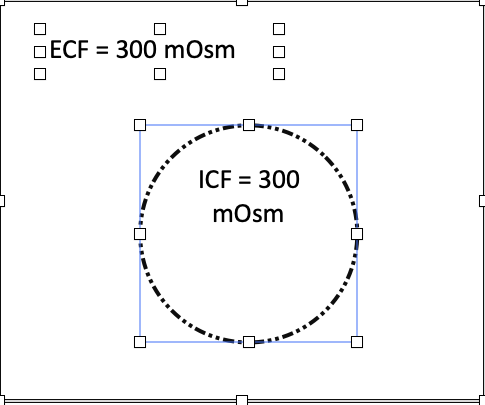
No, they have the same osmolarity, no net movement of water, no the cell volume will remain the same volume change?
Will osmosis occur? in which direction? will the cell volume change?
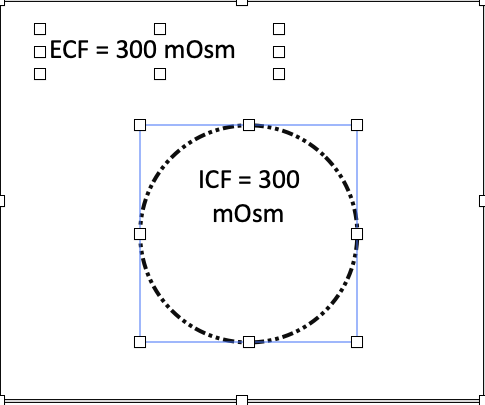
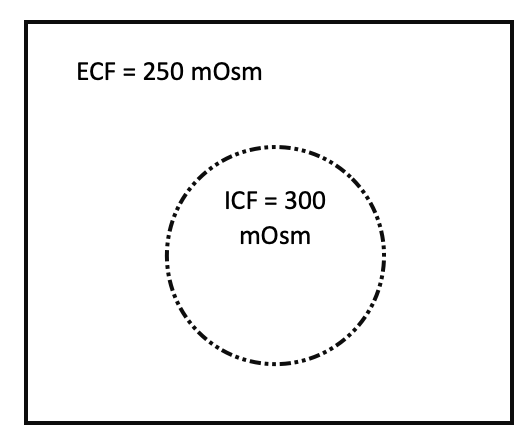
yes because there is a difference in osmolarity between the ECF and ICF, Water will move into the cell because ICF has a higher solute concentration compared to the ECF, The cell volume will increase as water enters the cell to balance
will osmosis occur? in which direction? will the cell volume increase or decrease?
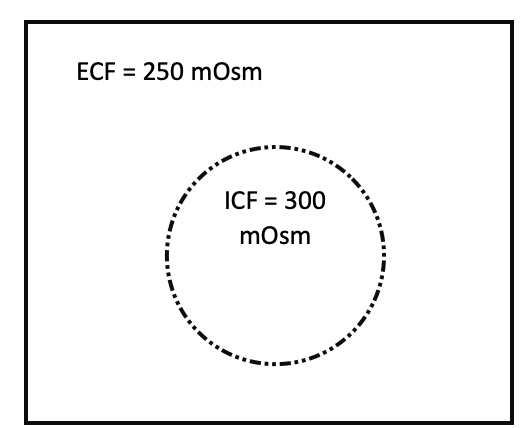
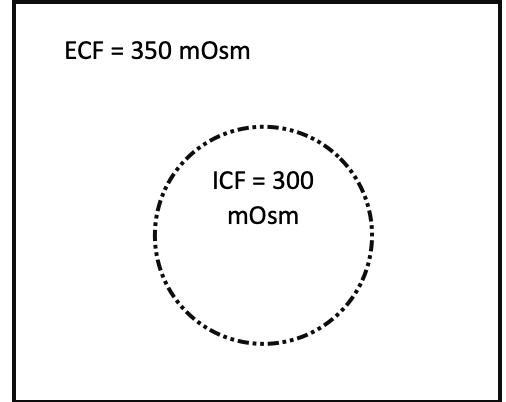
Will osmosis occur? In which direction? Will the cell volume increase or decrease?
Yes, because there is a difference in osmolarity between ECF and ICF, Water will move out of the cell because the ECF has a higher solute concentration compared to the ICF, the cell volume will decrease as water leaves the cell.
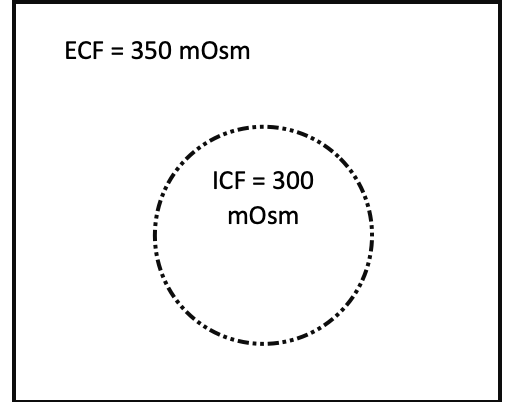
What is an ECF
Extracellular fluid
What is a ICF
intracellular fluid
A suspension of … RBCs is cloudly, and you cannot see through it red
intact
A suspension of … RBCs is red but transparent and you can see through it
hemolyzed