Skeletal Muscle Relaxtants
 Call Kai
 Learn
Learn Practice Test
 Spaced Repetition
 Match
Match Flashcards
 Knowt Play
1/23

There's no tags or description
Looks like no tags are added yet.
Name | Mastery | Learn | Test | Matching | Spaced | Call with Kai | Chat |
|---|
No analytics yet
Send a link to your students to track their progress
24 Terms
List the classes and the clinical uses of skeletal muscle relaxants
CLASSES & CLINICAL USES
NMJ blockers → procedural paralysis
Spasmolytics → acute painful spasm
Antispasticity drugs → chronic UMN spasticity
Rocuronium / succinylcholine / vecuronium → paralysis
Cyclobenzaprine / methocarbamol / carisoprodol → CNS spasm relief
Baclofen / tizanidine → chronic spasticity
Differentiate between the mechanism of Nondepolarizers and depolarizers
Nondepolarizers (competitive antagonists)
Occupy Nm → ACh can’t bind → no end- plate depolarization → flaccid paralysis
Succinylcholine (depolarizer)
Nm agonist → opens channel → stays depolarized (“can’t reset”) → paralysis
Describe the absorption of Quaternary amines
Permanently charged nitrogen atom (R₄N⁺)
Poor absorption from GI tract
Poor membrane penetration
Do not cross theBBB
Describe the ORDER OF BLOCKADE & RECOVERY of muscle relaxtants
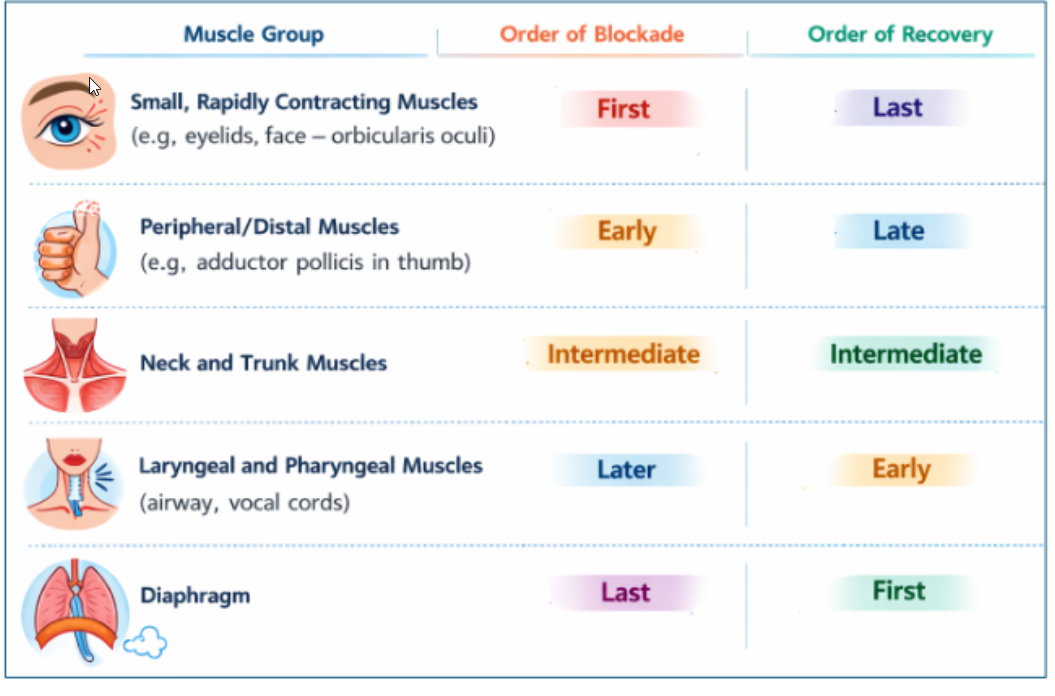
Describe the TRAIN-OF-FOUR
What is it?
TOF of NOrmal?
Nondepolarizers
succinylcholine?
TRAIN-OF-FOUR
What is it?
TOF = 4 nerve stimuli → 4 twitches
Normal (no drug)
All 4 twitches same height (no fade)
Nondepolarizers
Fade (T4 < T1) with repetitive stimulation
Succinylcholine
Phase I: no fade (uniformly decreased twitches)
Phase II (prolonged): fade can appear
(behaves “like nondepolarizer”)
NOTE: Fade = competitive block (or Phase II SCh)
Describe Succinylcholine (SCh)
What type is it?
onset
Duration
MOA
Adverse Effects
Succinylcholine (SCh)
What type is it?
Depolarizing NM blocker
Onset
Very fast → ideal for rapid sequence intubation
Duration
Short (rapid hydrolysis by plasma pseudocholinesterase)
MOA
Nm agonist → channel opens → sustained depolarization → paralysis
ADVERSE EFFECTS
Hyperkalemia risk
Avoid burns, crush/trauma, denervation/spinal cord injury, neuromuscular disease/immobility (↑ extrajunctional AChRs)
Malignant hyperthermia trigger
w/ volatile anesthetics
Bradycardia (esp. pediatrics or repeat dosing)
↑ IOP / ↑ intragastric pressure + myalgias (post- op muscle pain)
Prolonged paralysis
Atypical pseudocholinesterase or inhibitors → slow breakdown → slow recovery
NOTE: Brief fasciculations → flaccid paralysis
Describe NONDEPOLARIZERS
MOA
Two Classes/Drugs in the class
Potency vs onset
Elimination
MOA:
Nm antagonists → blocks Ach from binding -> flaccid paralysis
Two Classes/Drugs in the class
Aminosteroids
Ro-curonium,
ve-curonium,
pan-curonium
Benzylisoquinoliniums
Cis-atra-curium,
atra-curium,
miva-curium
Potency vs onset
Less potent → faster onset
Elimination
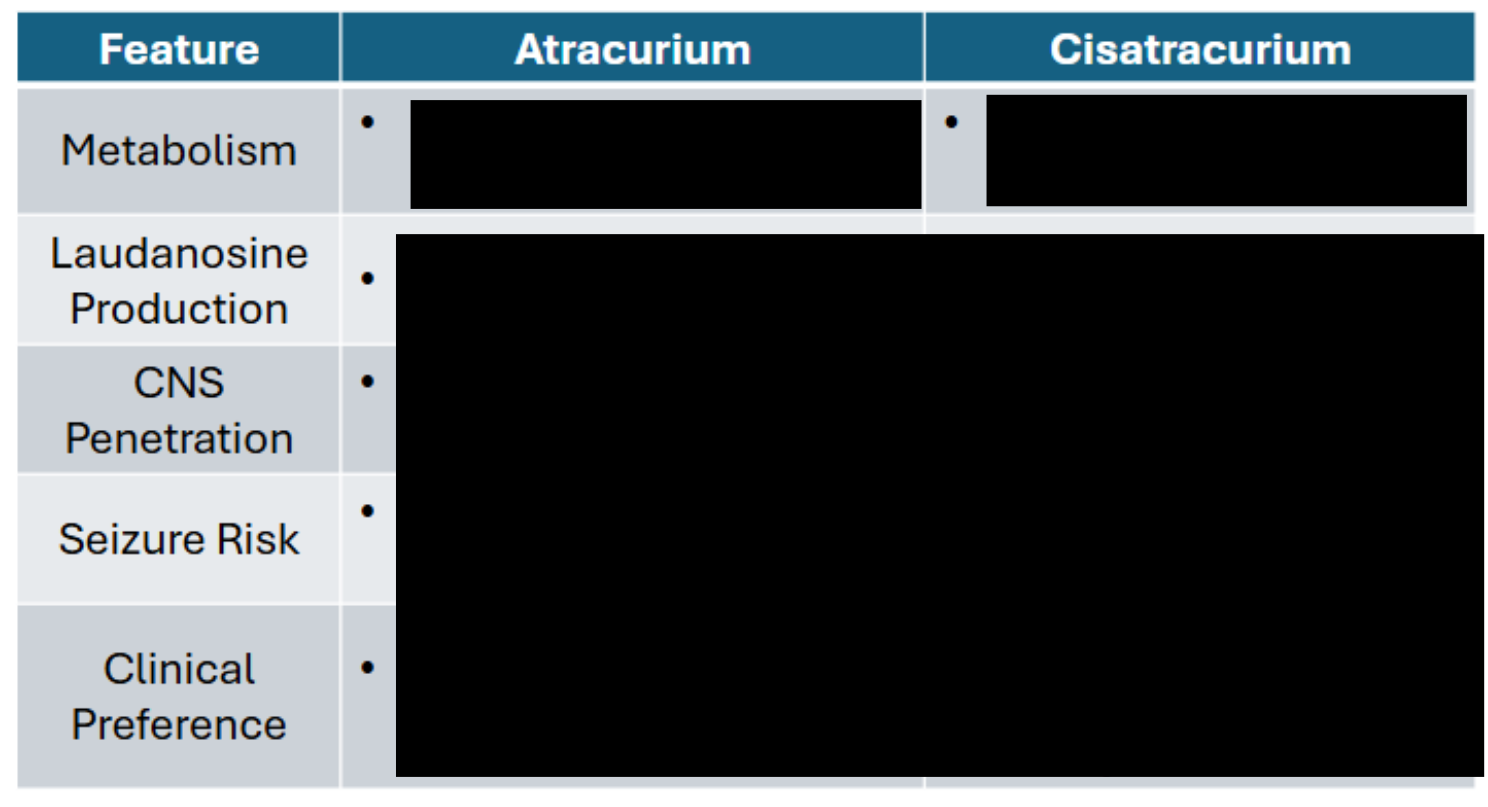
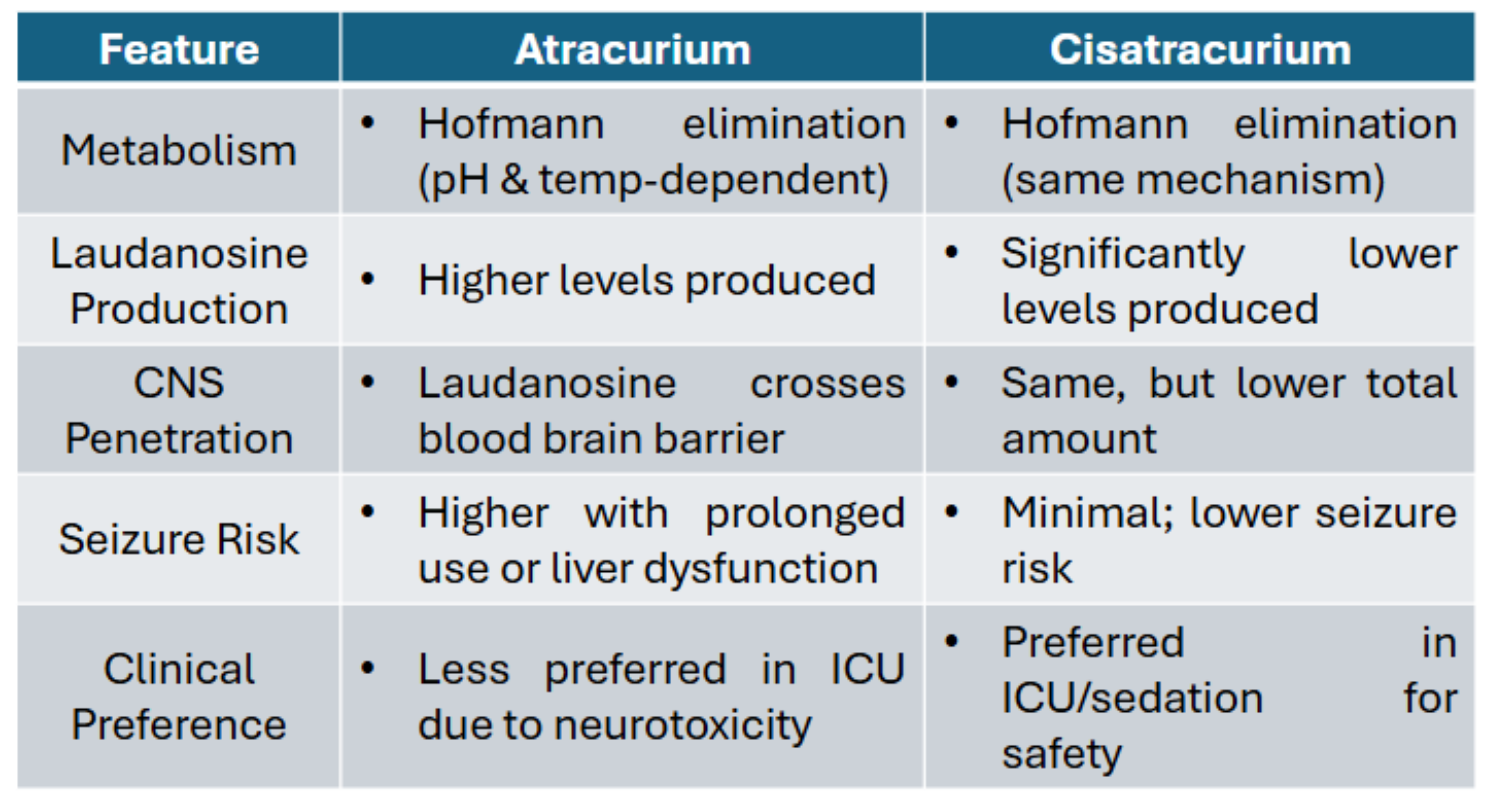
Cisatracurium/atracurium
Hofmann elimination ± ester hydrolysis → organ-independent (useful in liver/kidney dysfunction)
Describe MIVACURIUM
What is it?
Clinical Use
Meta.
Adverse Effects
What is it?
Short-acting nondepolarizing blocker
Clinical Use:
For Brief paralysis / intubation
Metabolism
Rapid plasma cholinesterase metabolism
Adverse Effects:
Prolonged in pseudocholinesterase deficiency
Histamine release →
flushing, hypotension, bronchospasm
Describe PSEUDOCHOLINESTERASE DEFICIENCY
What is it?
Side Effects
Management
Diagnosis
PSEUDOCHOLINESTERASE DEFICIENCY
What is it?
Inherited/Acquired Low/abnormal plasma cholinesterase
Side Effects
Succinylcholine + mivacurium affected
Markedly prolonged paralysis/apnea
Management:
ventilatory support until recovery
Diagnosis:
Prolonged Blockade
Dibucaine # test
Describe AChE INHIBITORS
MOA
Drug Family/Members
Synergy?
AChE INHIBITORS
MOA:
↑ ACh to outcompete nondepolarizer at Nm
Drug Family/Members:
Quaternary ammonium
Neostigmine
(intermediate acting)
Pyridostigmine
(long acting, MG maintenance)
Tertiary amine
Physostigmine
(crosses CNS, not for NMJ reversal)
Synergy?
Pair w/ antimuscarinic -> prevents bradycardia + secretions
Glycopyrrolate (or atropine)
Describe SUGAMMADEX
What is it?
MOA
Synergy?
Adverse Effects?
SUGAMMADEX
What is it?
Selective relaxant binding agent
(“molecular trap”)
MOA:
Encapsulates rocuronium + vecuronium → pulls drug out of circulation → rapid reversal (even deep block)
Synergy?
No antimuscarinic needed
(not an AChE inhibitor)
Adverse Effects?
can bind steroidal molecules & may lower exposure to estrogen/progestin contraceptives
List and describe the potential Muscle Relaxants Interactions
Potentiation (↑ paralysis)
Volatiles, aminoglycosides, Mg²⁺, lithium → lower dose + monitor TOF
Myasthenia gravis
Fewer functional Nm receptors → very sensitive to nondepolarizers
(small doses, prolonged effect)
Burns/denervation
Avoid succinylcholine → massive K⁺ efflux → hyperK arrest risk
(after ~24–48 h, for weeks–month
Describe MALIGNANT HYPERTERMIA
Causes
Earliest red flag
Symptoms
Treatment
MALIGNANT HYPERTERMIA
Causes:
Volatile anesthetics + succinylcholine
Earliest red flag
Rapid ↑ETCO₂ despite adequate ventilation
Symptoms:
Classic clinical signs
Muscle rigidity,
tachycardia,
Acidosis
Later/complications
Hyperthermia (late),
rhabdomyolysis → hyperK,
arrhythmias
TREATMENT
Stop triggers -> switch to 100% O₂ / hyperventilate
Antidote: Dantrolene
RyR1 inhibitor → ↓ Ca²⁺ release → ↓ rigidity + heat
Active cooling (ice packs/cold fluids) + treat acidosis + hyperK (arrhythmia risk)
Differentiate between SPASM vs. SPASTICITY
Spasm
Acute, painful muscle tightening
Often follows peripheral muscle injury
Spasticity
Chronic ↑ tone + hyperreflexia
Classically from upper motor neuron (UMN) lesions
MS, SCI, CP, stroke
Describe SPASMOLYTICS drugs
What are they?
Clinical Usage
Adverse Effects
Members
SPASMOLYTICS
What are they?
Outpatient “muscle relaxants”
Acute spasm meds (not NMJ blockers)
Clinical Usage
For Acute low back/neck spasm after strain
Short-term adjunct to NSAIDs/acetaminophen + early mobility
Adverse Effects:
Sedation/dizziness
Caution with driving, alcohol, CNS depressants
Members
Cyclobenzaprine → anticholinergic
Methocarbamol / metaxalone
sedation
Carisoprodol
misuse/dependence risk
Chlorzoxazone
hepatotoxicity
Describe CYCLOBENZAPRINE
Clinical Usage
MOA
Adverse Efffects
Synergy?
CYCLOBENZAPRINE
Clinical Usage:
Central muscle relaxant for acute spasm (short course)
MOA:
Acts centrally in brainstem to reduce tonic somatic motor activity
(likely via 5-HT/NE modulation)
Adverse Effects
Sedation + anticholinergic
(dry mouth, urinary retention, blurred vision, constipation)
confusion/falls
Synergy?
Avoid w/ MAOIs
(risk of serious toxicity/serotonergic effects)
Why muscle relaxants -> Sedation/Fall?
Deadly Synergies w/ Muscle Relax.?
Safety rule?
Why muscle relaxants -> Sedation/Fall
Many “muscle relaxants” = CNS depressants
Drowsiness,
slowed reaction time,
impaired driving
Deadly Synergies w/ Muscle Relax.
Alcohol, benzodiazepines, opioids → excess sedation/resp depression.
Safety rule:
start at night, short course, & avoid other sedatives when possible
Describe ANTISPASTICITY DRUGS
Clinical Usage
Members/MOA
Key limitations
ANTISPASTICITY DRUGS
Clinical Usage:
Chronic UMN spasticity
Members/MOA:
Baclofen → GABAB agonist
Tizanidine → α2 agonist
Diazepam → enhances GABAA
Dantrolene → direct skeletal muscle action
Botulinum toxin → blocks ACh release
Key Limitations:
sedation,
weakness,
dizziness,
falls
NOTE:
Baclofen or tizanidine often first
Add/consider dantrolene or selected benzodiazepines
Use botulinum toxin for focal spasticity
Describe TIZANIDINE
MOA
Adverse Effects
How to stop?
TIZANIDINE
MOA
Central α2-agonist → ↓ excitatory outflow to motor neurons → ↓ spasticity/spasm
Adverse Effects:
Sedation + dizziness
↓ BP / bradycardia
(additive with other CNS depressants/antihypertensives)
Rare hepatotoxicity
Check LFTs
How to stop?
Taper it
abrupt stop = rebound HTN/tachycardia (esp high dose/long use)
Describe BACLOFEN
MOA
Adverse Effects
Abrupt Withdrawl?
BACLOFEN
MOA
Spinal GABA(B) agonist ->
↓ excitatory transmitter release
Relieves muscle spasticity
Adverse Effects:
sedation, weakness, dizziness
Abrupt Withdrawal?
Dangerous
Withdrawal risk ↑ with intrathecal use
Describe BENZODIAZEPINES
MOA
Adverse Effects
BENZODIAZEPINES
MOA:
enhances GABAA -> inhibitory CNS signaling
Reduce spasticity
Adverse Effects
Sedation
Dependence
Respiratory depression risk
w/ other depressants
Describe DANTROLENE
What is it?
MOA?
clinical Usage
Adverse Effects
DANTROLENE
What is it?
Peripheral muscle relaxant
MOA:
Blocks RyR1 in skeletal muscle -> ↓ SR Ca²⁺ release
Clinical Usage:
malignant hyperthermia (MH)
selected spasticity
Adverse effects
Weakness
hepatotoxicity
Describe BOTULINUM TOXIN
What is it
MOa
Uses
Adverse Effects
BOTULINUM TOXIN
What is it?
presynaptic blocker
MOA:
Blocks ACh release at NMJ via SNARE cleavage → focal weakness
Uses:
focal spasticity
dystonia
Adverse effects
local weakness,
rare spread effects