CCE: Abnormal Psych
 Call Kai
 Learn
Learn Practice Test
 Spaced Repetition
 Match
Match Flashcards
 Knowt Play
1/203

There's no tags or description
Looks like no tags are added yet.
Name | Mastery | Learn | Test | Matching | Spaced | Call with Kai | Chat |
|---|
No analytics yet
Send a link to your students to track their progress
204 Terms
What are the diagnostic criteria for an Intellectual Disability?
- deficits in reasoning, problem-solving, & other areas of intellectual functioning; confirmed by clinical assmt/intelligence testing (at least 2 SDs lower than mean) IQ of 70 or less
- deficits in adaptive functioning that result in failure to meet community standards of personal independence & social responsibility
- onset: during the developmental period
Gender differences in onset of OCD?
Earlier for boys so OCD is more common in boys than girls but is equally common in adults
What are the severity levels of Intellectual Disability?
Mild, moderate, severe, & profound
based on adaptive functioning in conceptual (e.g., reading, writing, math), social (e.g., interpersonal), & practical domains (e.g., hygeine, money management)
What are the diagnostic criteria for a Specific Learning Disorder?
1) (duration) persistent difficulty w/academic skills for at least 6 months
2) academic skills -substantially below those expected for individual's age & interfere w/academic/occupational performance or ADLs
(i.e., academics below developmentally appropriate level & func. impairments)
3) learning diffs began during school-age yrs and are not better accounted for by another mental disorder/other factor
(aka, this is really broad and doesn't require any of the more specific bx symptoms like ADHD does)
What's the comorbidity & prognosis of a Specific Learning Disorder?
ADHD = most frequent co-diagnosis
co-occuring probs = delays in development of language & motor skills, attention & memory deficits, high rates school dropout & unemployment, & increased risk antisocial bx
prognosis = better outcomes w/early intervention; most children continue to have diffs in adolescence & adulthood
What are the diagnositc criteria for Autism Spectrum Disorder?
A) persistent difficulties social interaction & communication
-- babies avoid eye contact, don't smile, & resist physical contact
-- older children: trouble interpreting meaning of gestures/facial expressions & indifferent to others' feelings
-- maybe also speech abnormalities like pronoun reversal or echolalia (repeating what others say)
B) restricted, repetitive patterns of behavior, interests, and activities
-- might engage in repetitive actions, be obsessed w/object or activity, and insist on sameness
-- often focused on narrow aspects of object (vs. object in whole)
C) presence of sx during early developmental period
D) significant func impairment
Etiology of Autism Spectrum Disorder?
- has genetic contribution
- 🧠 linked to abnormalities in cerebellum, amygdala, & hippocampus
- associated w/abnormal levels norepinephrine, serotonin, & dopamine
Prognosis of Autism Spectrum Disorder?
- small number adults able to live & work independently
- better prognosis associated w/verbal communication skills by 5 or 6 yrs old, IQ of 70+, & absence of comorbid disorders
- better outcomes w/early diagnosis & provision of evidence-based interventions based on applied behavioral analysis
--> early intensive behavioral interventions (EIBI) use reinforcement, stimulus control, & operant conditioning
What are the diagnostic criteria of Childhood-Onset Fluency Disorder?
- disturbance in normal fluency and time patterning of speech that's inappropriate for indiv's age
- disturbance causes anxiety abt speaking or limits communication, social participation, or academic/occupational performance
What's the treatment for Childhood-Onset Fluency Disorder?
often, includes habit reversal training (includes awareness training, competing response training, & social support)
Diagnostic criteria of Tourette's Disorder?
multiple motor tics and 1+ vocal tics for at least 1 year & onset before 18
avg onset of tics is between age 5 to 7 years old
Differential diagnosis considerations w/Tourette's?
- Persistent Motor // Vocal Tic Disorder = involves 1+ MOTOR OR VOCAL tics for more than one year and onset before age 18 --> (i.e., if they don't have enough # tics for Tourette's)
- Provisional Tic Disorder = same as Tourette's, but just hasn't hit the 1-year mark yet
Common comorbidity in Tourette's Disorder?
children/adolescents = OCD & ADHD most common
adults = MDD, Bipolar, Substance Use Disorder
Treatment of Tourette's?
often includes haloperidol or other antipsychotic
- behavior therapy - to help manage sx
Diagnostic criteria in ADHD?
A) symptoms of inattention/hyperactivity for at least 6 months
--> inattention = forgetfulness, distractibility, difficulty organization, difficulty completing tasks
--> hyperactivity-impulsivity = trouble remaining seated, excessive talking, frequently interrupting others
B) onset sx's before 12
C) impaired functioning in at least 2 settings
Tell me about ADHD in adulthood
- at least 60% children w/ADHD continue to have sx's as adults
--> many of the same associated symptoms, but core symptoms change
--> gross motor activity decreases in adulthood
--> inattention becomes predominant symptom & interferes w/work/other aspects daily living
What's the prevalence of ADHD? Gender diffs?
rate = 5% in children; 2.5% in adults
MORE common in males w/gender ratio of 2:1 (children) and 1.6:1 (adults)
15% of children meet full ADHD criteria as adults
Etiology of ADHD?
- genetic & environmental
- neurobiological factors = NT abnormalities & lower-than-normal activity in prefrontal cortex & basal ganglia and smaller-than-normal cerebellum
Treatment of ADHD?
medication + behavioral interventions
--> CNS stimulant (e.g., methylphenidate)
--> psychosocial interventions = social skills training, self-management techniques, parent/teacher administered bx management
meds vs. behavior treatment? inconsistent results
Differential diagnoses to consider w/ADHD?
Oppositional Defiant Disorder = pattern of anhgry/irritable mood, argumentative/defiant behavior, or vindictiveness
Intermittent Explosive Disorder = recurrent behavior outbursts due to failure to control agressive impulses
What are the diagnostic criteria for schizophrenia?
1) at least 2 active sx's, for at least 1 month = at least 1 must be delusions, hallucinations, disorganized speech
2) 6+ months - continuous signs for at least 6 months
in 6-month period:
- AT LEAST 1 month active-phase symptoms
- can include prodromal/residual symptoms, e.g. negative symptoms, delusions
3) most of the time, functioning below the level it was at prior to symptoms
core symptoms of all schizophrenia spectrum disorders?
Hallucinations
negative symptoms (e.g., diminished emotional expression, avolition)
grossly disorganized or abnormal motor behavior
delusions
disorganized thinking.
Onset of schizophrenia?
usually between late teens to early 30s; PEAK:
Males = early/mid-20s
Females = late-20s
prognosis of schizophrenia?
not great...
complete remission pretty much off the table
cognitive sx usually persist even when others dormant
protective factors:
- good premorbid adjustment
- acute/late onset sx
- being a woman
- specific precipitating event
- brief duration of active sx
- insight
- family history mood d/o
- no family history schizophrenia
etiology of schizophrenia?
the more genetically similar you are, the more f*cked you might be... concordance rates ⬆️ as genetic similaritiy ⬆️
concordance rate:
- identical twins = 48%
- fraternal = 17%
dopamine hypothesis; enlarged ventricles & hyperfrontality (⬇️ activity frontal lobes)
treatment course for schizophrenia?
anti-psychotic
+
psychosocial intervention (soc skills training, psychoeducation, CBT)
also, family interventions are important, bc fam's hostility, criticism, & overinvolvement ⬆️ relapse
schizophreniform disorder
Psychotic disorder involving the symptoms of schizophrenia but lasting ** 1 - 6 MONTHS **
....< 1 month = brief psychotic disorder
.... > 6 months = schizophrenia
brief psychotic disorder
Psychotic disturbance involving delusions, hallucinations, & disorganized speech or behavior; often occurs in reaction to a stressor.
** lasting 1 day - 1 month **
(once it passes 1 month mark, it's now schizophreniform)
schizoaffective disorder
psychotic disorder featuring symptoms of both schizophrenia & major mood disorder (e.g. bipolar, MDD, etc.);
This is someone...
1) meeting criteria for major mood episode (MME) AND schizophrenia symptoms
2) delusions/hallucinations > 2 weeks in ABSENCE of MME (psychotic symptoms standing independently)
3) mood symptoms are present for the MAJORITY of illness duration
how do you differentiate schizoaffective disorder from schizophrenia? what about from bipolar w/catatonic or psychotic features?
from Schizophrenia = mood symptoms present during MOST of active-phase symptoms; social dysfunction also usually less pronounced
from Bipolar w/catatonic or psychotic features = delusions or hallucinations for 2+ weeks in absence of a major mood episode (depressive or manic) during lifetime duration of the illness
--> I.e. psychotic symptoms (delusions, hallucinations) have to emerge/persist independently
how would you parse schizophrenia vs. bipolar disorder w/psychotic or catatonic features?
temporal relationship btw mood disturbance & the psychosis...
- if delusions/hallucinations are ONLY occurring during the depressive/manic episode, not schizophrenia
delusional disorder
1+ delusions, for at least one month
types:
- erotomaniac = believes someone's in love w/them
- grandiose = believes they're great but unrecognized talent/insight or has made an important discovery
- jealous = believes their spouse/lover is unfaithful
- persecutory = believes they're being conspired against, cheated, spied on, poisoned, etc. (i.e., the classics when you think of someone's paranoia with schizophrenia)
- somatic = believes they have an abnormal bodily function/sensation
- mixed
- unspecified
bipolar I disorder
bipolar 1 = only need manic episode!
(vs. bipolar II, which req's manic and depressive episode)
gotta meet the criteria for a full manic episode (3+ of those characteristic sx's, at least 1 week, func impairment, etc.)
manic episode
distinct period of persistent, abnormally elevated expansive or irritable mood, & persistently increased energy & goal-directed activity
1+ week, present most of day/nearly all days
MUST INCLUDE at least 3 characteristic sx's (e.g., inflated self-esteem/grandiosity, ⬇️need for sleep, excessive talkativeveness, flight of ideas)
functional impairment, requires hospitalization (avoid harm to self/others), or include psychotic features
CAN include 1+ episode hypomania, depression, but doesn't REQUIRE these
manic episode vs. hypomanic episode?
same as manic except for duration & functional impairment
1) manic = 1+ week; hypomanic = 4+ days
2) no marked impairment functioning
bipolar II disorder
at least 1 hypomanic episode + 1 depressive episode
(1 + 1 = bipolar 2)
their (hypo)mania
criteria for a depressive episode?
includes
1) 5+ depressive sx =
- 1+ MUST be: depressed mood OR loss of interest/pleasure in all/nearly all activities
cyclothymic disorder
1) numerous periods of hypomanic & depressive symptoms, never meeting full criteria as "episodes"
- (basically subthreshold bipolar II)
2) duration:
- 2+ yrs adults, 1+ yr children/adolescents
3) impaired functioning
**sx present at least 50% of the time, no more than 2 months break
treatment for bipolar disorder
usually 💊pharmacotherapy
- lithium 60-90% effective for "classic" (mania+depression) bipolar; helps prevent mood swings
trends w/lithium treatment for bipolar disorder?
great option (60-90% effective) for "classic" (mania+depression) bipolar
- compliance a struggle (side effects suck)
- helps w/mood swings
- better outcomes when combined w/psychosocial intervention
treatment options for ppl that don't respond to lithium, or who have rapid cycling or dysphoric mania (prominent anxiety or depressive sx)?
anti-seizure drug like carbamazepine or divalproex sodium
treatment options for ppl w/acute mania?
olanzapine, risperidone, or other antipsychotic
can you prescribe an antidepressant & mood stabilizer?
yes, but only carefully... bc could trigger manic episode
- ⚠️TCAs greater risk than SSRIs
common comorbid conditions w/bipolar?
anxiety and substance abuse; also, risk of suicie 15x ⬆️ for ppl w/bipolar
course of bipolar?
avg age of first episode 18 yrs
90% ppl that've had 1 episode have additional
etiology of bipolar?
of the psych d/o's, genetic factors most consistently linked to Bipolar Disorders
concordance rates:
- .67-1.0 in monozygotic twins
- .2 for dizygotic twins
- if 1st degree relative got it, you're at greater risk for bipolar & depression
Depressive Disorders
disruptive mood dysregulation disorder
MDD
PDD
premenstrual dysphoric disorder
disruptive mood dysregulation disorder
A) temper outbursts - severe recurrent temper outbursts manifested verbally (e.g., verbal rages) and/or behaviorally (e.g., physical agression) grossly out of proportion in intensity/duration to the situation
B) enduring angry baseline - chronic, persistently irritable/angry mood btw the outbursts (most days)
C) duration & pervasiveness - at least 1 yr & at least 2/3 settings (home, work, peers)
D) frequency - at least 3x / week
E) timeline - can't diagnose <6 yrs or 18<; but does have to show symptoms before 10 yrs
major depressive disorder (MDD)
2+ WEEKS of depressed mood most/all days; symptoms:
- depressed mood (or irritable in kids)
- loss of interest/pleasure many/all activities
- weight loss/gain
- appetite changes
- insomnia or hypersomnia
- fatigue / loss of energy
- psychomotor agitation/retardation
- feelings of worthlessness/excessive guilt
- cognitive changes (⬇️ability think/concentrate)
- recurrent thoughts death, suicide
clinically significant distress/impairment
(i.e. mood, energy & cog changes)
when would you add the peripartum onset as specifier to MDD or Bipolar I/II diagnosis?
when symptom onset is during pregnancy or < 4 wks postpartum
not to be confused w/"baby blues", which is transitory mod sx, affects 80% women
when would you apply the seasonal pattern specifier to a MDD or Bipolar I/II diagnosis?
when there's a temporal relationship btw onset of mood episode & a particular time of the year
seasonal affective disorder (SAD)
when mood episode(s) are seasonal; often includes hypersomnia, ⬆️appetite/weight gain, craving for carbs; usually during winter (in northern hemisphere)
treatment? 💡
depression & some common trends by age?
children = depression accompanied by separation anxiety, irritability, oppositional behavior
adolescence = aggression, antisocial bx; can lead to misdiagnosis of conduct disorder
older adults = can be hard to distinguish from neurocognitivt d/o
etiology of depression?
genetic component
- identical twins higher risk than fraternal; risk either way if parent has depression
biology:
- maybe catelcholamime hypothesis (⬇️norepinephrine) or indolamine hypothesis (⬇️serotonin)...
...but probably lack of several NTs (norepinephrine, serotonin, and dopamine) more likely
treatment for depression
therapy
+
meds:
- TCAs for "classic" (vegetative) depression
- SSRIs first-line of tx for moderate to severe depression
- MAOIs for ppl that didn't respond to TCAs or SSRIs or for atypical depression sx (e.g., anxiety, hypersomnia, hyperphagia, IP sensitivity)`
Seligman's learned helplessness model
depression caused by repeated exposure to uncontrollable negative life events; leads to global negative attributions that are stable, and thus, can't be changed (hence the helplessness)
e.g., "this failure is my fault, always will be, and will happen with everything I do"
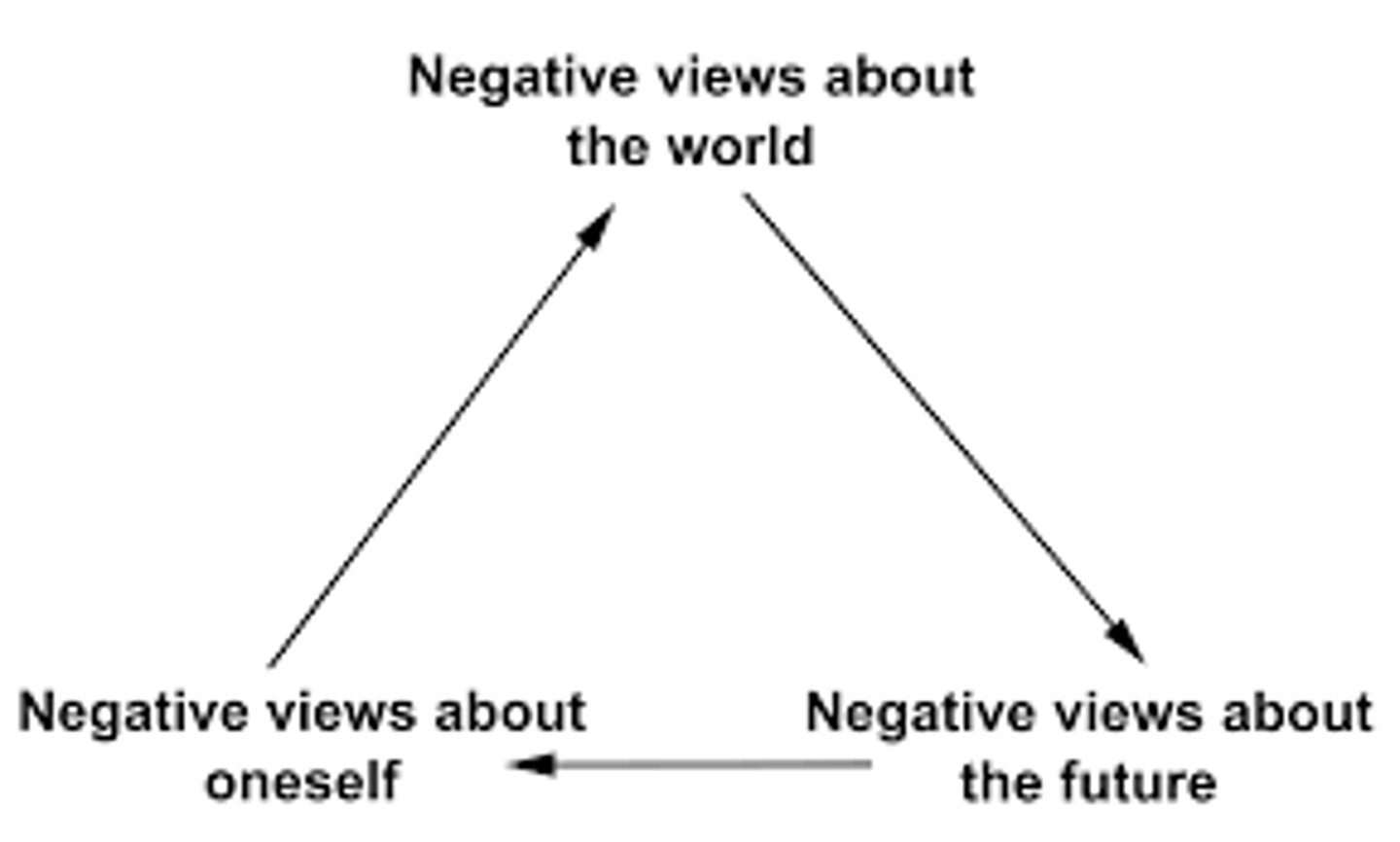
Beck's cognitive theory
depression caused by depressive cognitive triad
negative beliefs about self, world, & future
Lewinsohn's behavioral theory of depression
based on operant conditioning; says depression caused by lack of response-contingent reinforcement
says this leads to pessimism, low self-esteem, or reduced activity lvl
treatment for major depressive disorder?
💊 + therapy
therapy = CBT, interpersonal therapy (identifying & resolving IP diffs)
persistent depressive disorder
like MDD, but duration is:
- 2+ yrs in adults
- 1+ yrs in children/adolescents
how do you distinguish MDD from schizophrenia or other psychotic disorder when person's symptoms include delusions, hallucinations, and/or catatonic features?
look at the timing -- if psychotic symptoms are ONLY during depressive episodes, then you're probably lookin at depression/MDD (..or schizoaffective)
MDD vs. Uncomplicated Bereavement
in Uncomplicated Bereavement, sadness experienced as normal, predominant feeling is emptiness/loss, & comes in waves; also, tends to decrease over days to weeks
premenstrual dysphoric disorder
for most menstrual cycles, 5+ depressive sx's:
1) 1/5 must be affective labiliy, irritability, self-depracating thoughts, etc. AND
2) 1 must be one of the sx of depression (depressed mood, weight/appetite change, sleep change, etc.) or physical symptom (breast swelling, joint/muscle pain)
timeline:
- onset in week before menses w/improvement w/in few days after onset of menses
- absent/minimal symptoms in between menses
What % of ppl who commit suicide had mood disorder at the time?
60%
suicide risk factors
age, gender, race/ethnicity, marital status, suicidal thoughts & behaviors (STB), early warning signs, life stress, psychiatric disorders, personality correlates
age, gender, & race/ethnicity as risk factors for suicide
age: ⬆️ rates 45-54
gender: 4x as many men complete suicide (vs women), but women attempt 2x-3x more
race/ethnicity: across most age groups, ⬆️ for Whites;
- except for AI/AN aged 15-34; 2.5x ⬆️ than nat avg
what % of ppl that commit suicide have previously attempted?
60-80%
most common disorders present in ppl that complete suicide
MDD & Bipolar; ppl w/mood disorder 15-20% more likely to commit suicide
factor more predictive of suicide than degree of deprssive symptoms
hopelessness
separation anxiety
developmentally inappropriate/excessive fear or anxiety related to separtion from home or attachment figures
- at least 3 of the characteristic sx's:
duration = 4+ wks in children/adolescents; 6+ months adults
precipitating factors for separation anxiety disorder?
life stressor - like death of relative/pet, divorce of parents
separation anxiety disorder is often manifested as _______, which involves intense anxiety about going to school and is usually accompanied by ___________. This usually occurs at three ages: _____, _____, and ____ .
(a) school refusal;
(b) stomachache, headache, nausea, & other physical sx's
(c) 5-7, 10-11, 14-16.
social anxiety disorder
intense fear or anxiety about 1+ social situations in which person could be exposed to scrutiny/judgment by others; person fears they'll be negatively evaluated;
treatment? ERP
agoraphobia
fear/anxiety about 2/5 situations:
- using public transportation
- being in open spaces
- being in enclosed spaces
- standing in line/part of crowd
- outside the house alone
they're fearing situations where escape difficult or help not available
treatment of choice for agoraphobia?
in vivo exposure with response prevention
(think graduated exposure ladder/hierarchy)
specific phobia
intense fear or anxiety about specific object or situation
- avoids or endures w/intense distress
- disproportional to actual danger
- > 6 months
panic disorder
recurrent unexpected panic attacks & persistent concern about additional panic attacks or panic-attack-adjascent themes
generalized anxiety disorder (GAD)
excessive anxiety/worry about multiple events/activities for at least 6 months
- usually the anxiety's always there, it just changes form as they age
how do you distinguish between GAD & non-pathological anxiety?
GAD = out of control; out of proportion to actual threat posed, & more likely to be accompanied by physical sx's (fatigue, muscle tension, nausea, etc.)
treatment of choice for GAD?
CBT alone or w/medication
(💊: SSRIs first choice); if SSRI doesn't work, then benzo or buspirone (an anxiolytic)
obsessive-compulsive disorder (OCD)
recurrent obsessions and/or compulsions that are time consuming or cause significant distress/impairment to functioning
- obsessions = recurrent thoughts, images, or impulses experienced as disturbing or unwanted & that person attempts to ignore or suppress
- compulsions = repetitive behaviors or mental acts to neutralize or counteract an obsession
treatment for OCD?
therapy = ERP
meds = clomipramine (a TCA) or an SSRI
body dysmorphic disorder
preoccupation w/defect or flaw in appearance that appears minor or unobservable to others; person has performed behaviors/mental acts bc of the defect/flaw
Trauma and stress related disorders
reactive attachment disorder
disinhibited social engagement disorder
post-traumatic stress disorder
acute stress disorder
adjustment disorders
post-traumatic stress disorder (PTSD)
1) stressor -must follow exposure to actual or threatened death, serious injury, or sex violence
2) symptoms - categories = intrusion, avoidance, negative changes in cognition & mood, changes in arousal & reactivity
3) 1+ month & significant distress or impairment in functioning
The symptoms of PTSD are grouped in the DSM-5 in terms of which of the following clusters?
Intrusion
avoidance
cognition and mood
arousal and reactivity
adjustment disorder
when symptoms began w/in 3 months of the stressor;
...but after 6 months, can't be adjustment disorder anymore...gotta be something else
acute stress disorder
PTSD symptoms, but duration:
3 days < duration < 1 month
If you encounter a child that's experienced severe social neglect, what are the disorders you're on the look out for?
The pathology in this case could go in two directions:
- (internalizing) reactive attachment disorder
- (externalizing) disinhibited social engagement disorder
reactive attachment disorder
(A) consistent pattern of inhibited, emotionally withdrawn behavior toward adult caregivers, manifested by child NOT SEEKING or RESPONDING to comfort when distressed.
(B) persistent social/emotional disturbance characterized by 2+:
- minimal social/emotional repsonsiveness to others
- limited positive affect
- episodes of unexplained irritability, sadness, or fearfulness evident even during nonthreatening interactions
(C) EVIDENCE of insufficient care/neglect to an extreme
(D) care in Crit C responsible for Crit A (e.g., symptoms began following lack of care)
(E) 🚫 autism spectrum disorder
(F) EVIDENT BEFORE 5 y.o.
** child at least 9 months old **
disinhibited social engagement disorder
(externalizing version of reactive attachment disorder..)
(A) pattern of behavior where child shows 2+:
- reduced/no reticence in approaching & interacting with strangers
- overly familiar verbal/physical behaivors (that aren't consistent w/cultural practices)
- low/no checking back in with adult after venturing away, often in unfamiliar settings
- willingness to go off w/unfamiliar adult with minimal/no hesitation
(B) Crit A behaviors not limited to impulsivity (e..g, ADHD) but do include sociallly disinhibited behavior
(C) evidence of extremely insufficient care/neglect
(D) social neglect reponsible for the behavior
(E) aged > 9 months
- to a degree that's violating cultural norms; (we're not talking cute little extraverted kid)
- this is a kid that approaches anyone and can wander off without even checking back in (untethered)
- also the product of extreme neglect or changes in primary caregivers
oppositional defiant disorder (ODD)
A) recurrent pattern of angry/irritable mood, argumentative/defiant behavior, or vindictiveness as evidence by 4+ symptoms:
- often loses temper
- argues w/authority figures
- refuses to comply w/requests from authority figures or w/rules
- blames others for mistakes
B) symptoms exhibited during interactions with/at least 1 person that's NOT SIBLING
C) 6+ months & clinically significant distress (for self or environment)
* for child < 5 yrs -- behavior should occur most days, at least 6 months
** for child > 5 -- 1x/week, at least 6 months
ODD more common in families where?
inconsistenty in caregiving & harsh/inconsistent/neglectful caregiving
conduct disorder most commonly co-occurs with _____.
ADHD
intermittent explosive disorder
1) recurrent outbursts associated w/inability to control aggressive impulses, as manifested by:
(a) verbal/physical aggression on average 2x/week, for 3+ months
(b) 3 behavioral outbursts that caused damage or destruction of property and/or physical assault that injured ppl/animals during 12 month period
2) severity not proportional to provocation or precipitating stressor; outbursts NOT premeditated or goal-oriented (i.e., lack of impulse control)
** AT LEAST 6 yrs old**
conduct disorder
1) persistent pattern of bx that violates basic rights of others and/or age-appropriate social norms; evidenced by 3+ symptoms from categories:
(a) aggression to ppl & animals
(b) destruction of property
(c) deceitfulness or theft
(d) serious violation of rules
2) during 12 month period; at least 1 symptom in past 6 months;
** no one over 18; once they're 18+, it's antisocial PD **
oppositional defiant disorder (ODD) vs. conduct disorder
Both related to conduct, but behaviors in ODD usually less severe than conduct disorder & don't include aggression toward ppl/animals, destruction of property, or pattern of theft/deceit. ODD includes elements of emotion dysregulation not present in conduct disorder.
** CONDUCT DISORDER <-- MORE SEVERE than ODD **
treatment for conduct disorder
parent management training (PMT); multisystemic therapy (type of familiy therapy); sometimes warrants residential/inpatient treatment
pyromania
purposeful fire-setting on more than one occasion; and usually tension/arousal before setting the fire
kleptomania
failure to resist impulse to steal objects that aren't needed
like pyromania, there's tension/arousal before committing the act