Forensics: Chapters 7-8
 Call Kai
 Learn
Learn Practice Test
 Spaced Repetition
 Match
Match Flashcards
 Knowt Play
1/35

Earn XP
Description and Tags
Name | Mastery | Learn | Test | Matching | Spaced | Call with Kai | Chat |
|---|
No analytics yet
Send a link to your students to track their progress
36 Terms
Three types of fingerprints
Visible - made after the ridges have been in contact with colored material (EX: blood, grease etc.)
Plastic - ridge impressions left on soft material (EX: putty, wax, soap, dust etc.)
Invisible (latent) - transfer of body oils to the surface of an object
How do fingerprints form
form from contact of friction ridges on hands, feet, or lips w/ an object when we are still in the womb (totally unique)
Do gloves prevent fingerprint markings
No, they can be left through or in surgical gloves. (NOTE: leather & cloth so distinctive that they can be traced)
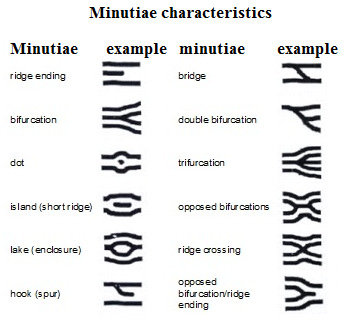
Minutiae
Ridge ending, bifurcation, dot, island (short ridge), lake, hook, bridge, double bifurcation, ridge crossing
How to lift a print
Dust a fine powder w/ a fine brush then apply tape to lift and apply it to a card for permanent storage
How to lift a print from a porous surface
Use ninhydrin on the surface; will react w/ amino acids in the print (heat up to speed up)
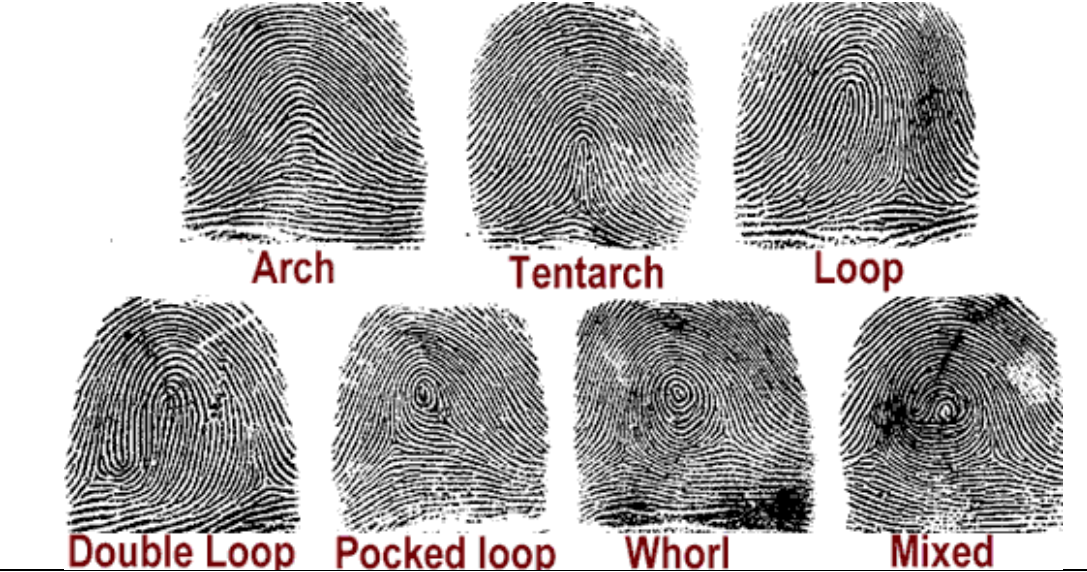
Patterns of fingerprints
Arch - The fingerprint pattern that has ridges beginning at one side of the fingerprint and running completely to the other side of the fingerprint without a backwards turn.
Loop - The fingerprint pattern that contains ridge lines that enter on one side of the fingerprint, run towards the middle of the print, and then curve backwards to exit on the same side from which they entered the pattern.
Whorl - The fingerprint pattern where the ridges complete at least one 360° “circuit”, although not always forming a regular circular pattern.
How many minutiae are required for a match in federal court
14-16 matched minutiae
IAFIS
The “Intergrated Automated Fingerprint Identification System” run by the FBI, a completely digital fingerprint system for submission, storage, & search
NGI
“Next Generation Identification System” fingerprints, eye-scans, and facial imaging systems to permit expanded capabilities to identify ppl quickly (Upgrade of IAFIS)
What body parts leave prints
Fingers, ears, lips, tongue, and teeth
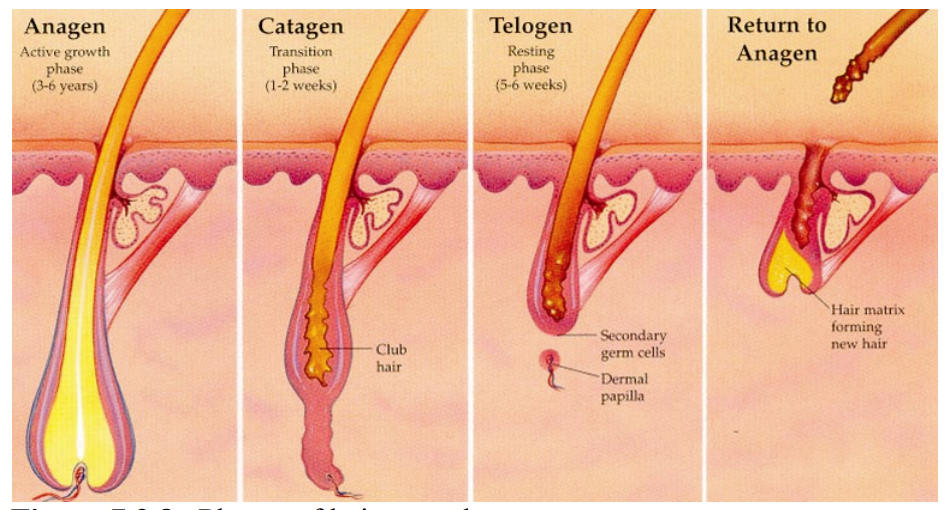
Stages of growth in hair cycle
Anagen - The active growth period for hair formation.
Catagen - The transitional phase in hair growth when the hair stops growing and the portion of the follicle surrounding the hair root shrinks considerably.
Telogen - The resting period for the follicle in the hair growth cycle.
What keeps hair from decaying
Keratin, a tough, durable, and fiburous protein (keratin & melanin make up ab 80-90% of hair)
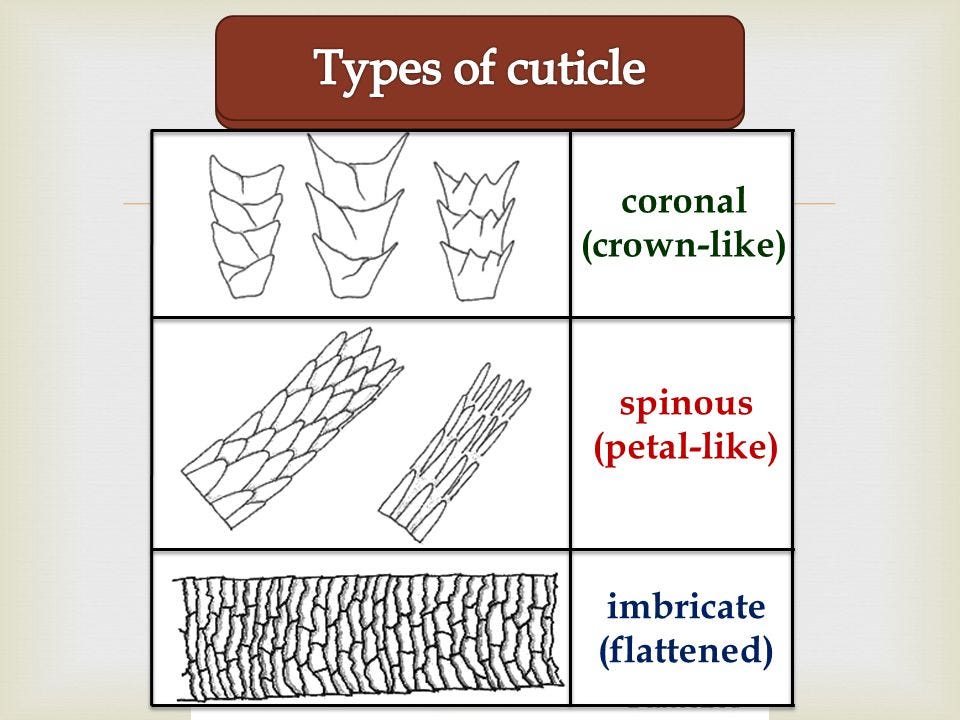
Best way to diferentiate human & animal hair
The scale patterns of the cuticle (coronal “crown-like” for rodents, spinous “petal-like” for cats&mink, and imbricate “shingle-like” for humans)
Why is hair that has been forcibly removed better
It still has some tissue from the follicle (follicular tag) and therefore contains DNA
Cuticle
The outermost translucent protective layer of a hair shat that appears as overlapping plates
Cortex
The inner portion of a hair fiber that makes up most of the bulk of the hair shat and gives hair elasticity
Root
In the skin and extends down to the deeper layers of skin
Follicular tag
Tissue from a hair follicule that is still attached to the root
Medulla
The central part of the hair fiber that is characterized by either very spongy cells or no cells at all, forming a canal-like structure in the center of the shaft (medullary canal), when present
Fibers totally derived from an animal or plant
Natural (EX: Wool, silk, cotton, asbestos)
Fibers solely manufactured from chemicals
Synthetic (Polyesters. polyamides)
Coroner
Primary function is to investigate deaths (no offical medical or forensic training) (elected offical)
Medical examiner (pathologist)
Specially trained medical physician charged w/ investigating deaths to cause and manner of death
Death investigators
Go to actual location, take photos, examine body, and take charge of remains b4 bringing it back to the medical examiner’s office
Manner of death
The fashion and circumstances that resulted in death (homocide, suicide accidental, natural, or undetermined) [EX: homocide]
Cause of death
The specific medical reason, agent, or event that causes a death (ex: old age, heartattack) [EX: Blunt force trauma]
Mechanism of death
Actual biochemical or physiological means by which a person dies [EX: exsanguination (loss of blood)]
Postmortem interval
Time elapsed b/w an actual death and when the body is found
Rigor mortis
A stiffening of the muscles and joints in the body after death (from 4-6 hrs to 72 hrs, relaxation after)
Livor mortis
Discoloration of parts of the body after death from the settling of blood (settles during 8-12 hrs)
Algor mortis
The cooling of the body after death (1.5° to 2.0° F (0.8 to 1.1 °C) per hour averaged over the first twelve hours.)
When is an autopsy necessary
Any unattended or unexplained death when a physician is not available or is unwilling to sign a death certificate
Any unexpected death that takes place under unusual, unexplained, or suspicious circumstances suggesting foul play
Any death resulting from homicide, suicide, or certain types of accidents (e.g., vehicle accidents, falls, drowning, burning, ingestion of poisons, etc.)
Any death from a disease or other agent that could pose a risk to the public health, including contagious diseases and toxins
Any death that takes place while the person is in legal custody, incarcerated, or in confinement
Any employment or occupational-related death
Any death of an institutionalized person for reasons other than illness or known disease
Any death from a standard “lower-risk” medical procedure (e.g., anesthesia, surgery, dental procedures, standard therapies, etc.)
Any hospital death when the person is pronounced dead on arrival or occurring within the first 24 hours of being admitted to the hospital unconscious
Any death that appears to be the delayed result of a previous injury, especially when the injury resulted from criminal actions against the person (e.g., assault resulting in seizures, pulmonary embolism, heart attack, poisoning, etc.)
Any death where the body will be cremated and not available for future exhumation.
Major organ systems investigated during autopsy
Circulatory, digestive, urinary, lymph, reproductive, and nervous system
Heart, brain, lungs, liver + gall bladder, stomach + intestines, kidneys, bladder, spleen, pancreas, esophagus, tongue, thyroid, uterus, and prostate
Major types of trauma
Penetrating - projectile wounds (bullets, arrows, & flying debris) and sharp force trauma (knives, glass, etc.)
Non-penetrating - blunt force trauma (vehicular accidents, falls, assaults) and asphyxia (strangulation or suffication)
Alternative to physical autopsy
Virtual autopsy (Virtopsy) - A non-invasive autopsy method that uses many types of biomedical imaging to produce and manipulate both external and internal images of the body
(CT & MRI used)
(CT scanner shows dense inside [bones])