ECE 192 - Cash Flow Analysis
 Call Kai
 Learn
Learn Practice Test
 Spaced Repetition
 Match
Match Flashcards
 Knowt Play
1/20

There's no tags or description
Looks like no tags are added yet.
Name | Mastery | Learn | Test | Matching | Spaced | Call with Kai | Chat |
|---|
No analytics yet
Send a link to your students to track their progress
21 Terms
single cash flow definition/examples =
non-recurring costs:
purchasing equipment, salvage value, investments
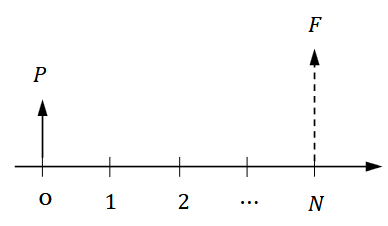
compound amount factor =
(F/P, i, N) = (1 + i)N
gives the future amount F given:
P = present amount
i = interest rate
N = # periods to go to F
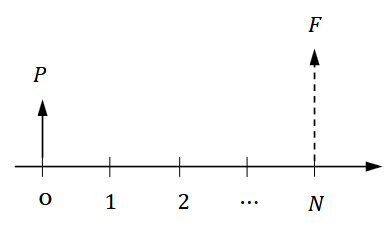
present worth factor =
P(F, i, N) = 1/(1 + i)N
gives the present amount P given:
F = future amount
i = interest rate
N = # periods to go BACK to P
compound amount factor is the inverse of =
present worth factor
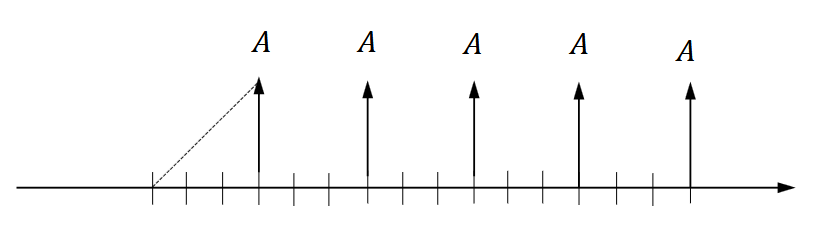
annuity definition/examples =
uniform series of cash flows over N periods (starts at end of 1st period)
receipts (money in)
rent income
stock dividends
pension
disbursements (money out)
insurance premiums
mortgages
operations and maintenance costs
NOTE: receipt/disbursements represent a SINGLE payment out of the ANNUITY
uniform series compound amount factor =
(F/A, i, N) = [(1 + i)N - 1]/i
gives the future value F for an annuity given:
A = amount of a single payment
i = interest rate
N = # of periods
![<p>(F/A, i, N) = [(1 + i)<sup>N</sup> - 1]/i</p><p></p><p>gives the future value F for an annuity given:</p><ul><li><p>A = amount of a single payment</p></li><li><p>i = interest rate</p></li><li><p>N = # of periods</p></li></ul><p></p>](https://assets.knowt.com/user-attachments/9768c2b9-cbf0-44d4-999a-18746d733c7e.png)
sinking fund factor
(A/F, i, N) = i/[(1 + i)N - 1]
gives the size of the receipt/disbursement A that is equivalent to F given:
F = future amount
i = interest rate
N = # of periods
![<p>(A/F, i, N) = i/[(1 + i)<sup>N</sup> - 1]</p><p></p><p>gives the size of the receipt/disbursement A that is equivalent to F given:</p><ul><li><p>F = future amount</p></li><li><p>i = interest rate</p></li><li><p>N = # of periods</p></li></ul><p></p>](https://assets.knowt.com/user-attachments/eb914fe2-44ad-45d5-b047-4acfde94fb2c.png)
uniform series compound factor is the inverse of =
sinking fund factor
capital recovery factor =
(A/P, i, N) = [i(1 + i)N] / [(1 + i)N - 1]
gives the size of receipt/disbursement A equivalent to P given:
P = present amount
i = interest rate
N = # of periods
“What N payments of A is worth the same as a lump sum of P today, given i% interest yearly?”
![<p>(A/P, i, N) = [i(1 + i)<sup>N</sup>] / [(1 + i)<sup>N</sup> - 1]</p><p></p><p>gives the size of receipt/disbursement A equivalent to P given:</p><ul><li><p>P = present amount</p></li><li><p>i = interest rate</p></li><li><p>N = # of periods </p></li></ul><p></p><p>“What N payments of A is worth the same as a lump sum of P today, given i% interest yearly?”</p>](https://assets.knowt.com/user-attachments/99d276d9-c410-49f2-9df9-96f28306a16b.png)
series present worth factor =
(P/A, i, N) = [(1 + i)N - 1] / [i(1 + i)N]
gives the present amount P equivalent to A given:
A = size of receipt/disbursement
i = interest rate
N = # periods
“What lump sum P today is worth the same as N payments of A, given i% interest yearly?”
![<p>(P/A, i, N) = [(1 + i)<sup>N</sup> - 1] / [i(1 + i)<sup>N</sup>] </p><p></p><p>gives the present amount P equivalent to A given:</p><ul><li><p>A = size of receipt/disbursement</p></li><li><p>i = interest rate</p></li><li><p>N = # periods</p></li></ul><p></p><p>“What lump sum P today is worth the same as N payments of A, given i% interest yearly?”</p>](https://assets.knowt.com/user-attachments/6deb6391-585d-450b-ba5d-b9da70d6dfbb.png)
capital recovery factor is the inverse of =
series present worth factor
bisection and linear approximation method to find is =
get function for f(is) = P(is) - P
bisection method
find two intervals that have f(is1) > 0 and f(is2) < 0 respectively
evaluate f([is2 + is1]/ 2)
if > 0, then lower bound is [is2 + is1]/ 2
if < 0, then upper bound is [is2 + is1]/ 2
repeat until f(is) ≈ 0
linear approximation method:
x* = x₁ + (x₂ − x₁) × [y* − y₁] / [y₂ − y₁]
x = Compound interest rate is
y = f(x) = f(is)
y* = 0
can use bisection → linear approximation to save time
![<p>get function for f(i<sub>s</sub>) = P(i<sub>s</sub>) - P</p><p></p><p> bisection method</p><ul><li><p>find two intervals that have f(i<sub>s1</sub>) > 0 and f(i<sub>s2</sub>) < 0 respectively</p></li><li><p>evaluate f([i<sub>s2 </sub>+ i<sub>s1</sub>]/ 2)</p><ul><li><p>if > 0, then lower bound is [i<sub>s2 </sub>+ i<sub>s1</sub>]/ 2</p></li><li><p>if < 0, then upper bound is [i<sub>s2 </sub>+ i<sub>s1</sub>]/ 2</p></li></ul></li><li><p>repeat until f(i<sub>s</sub>) ≈ 0</p></li></ul><p></p><p>linear approximation method:</p><ul><li><p>x* = x₁ + (x₂ − x₁) × [y* − y₁] / [y₂ − y₁]</p><ul><li><p>x = Compound interest rate i<sub>s</sub></p></li><li><p>y = f(x) = f(i<sub>s</sub>)</p></li><li><p>y* = 0</p></li></ul></li></ul><p></p><p>can use bisection → linear approximation to save time</p>](https://assets.knowt.com/user-attachments/6e4e7a73-f068-4b4b-b21f-9520fe4dc061.png)
arithmetic gradient series =
series of constantly increasing receipts/disbursements
end of 1st period = 0
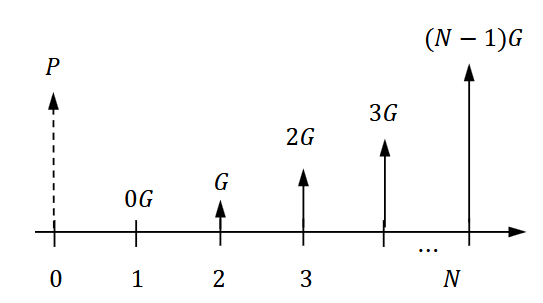
arithmetic gradient present value factor =
(P/G, i, N) = [(1+i)N − iN − 1] / [i²(1+i)N]
gives the present amount P equivalent to constantly increasing G per period given:
G = constant increase in receipt/disbursement
i = interest rate
N = # of periods
“What lump sum P is worth the same as a series of payments that starts at 0 in period 1 and increases by a constant amount G each period after, given interest rate i per period over N periods?"
![<p>(P/G, i, N) = [(1+i)<sup>N</sup> − iN − 1] / [i²(1+i)<sup>N</sup>]</p><p></p><p>gives the present amount P equivalent to constantly increasing G per period given:</p><ul><li><p>G = constant increase in receipt/disbursement</p></li><li><p>i = interest rate</p></li><li><p>N = # of periods</p></li></ul><p></p><p>“What lump sum P is worth the same as a series of payments that starts at 0 in period 1 and increases by a constant amount G each period after, given interest rate i per period over <span>N</span> periods?"</p>](https://assets.knowt.com/user-attachments/93b5c21a-5e5f-4dc1-a27e-e9519c5b8dd0.png)
arithmetic gradient uniform series factor =
(A/G, i, N) = [1/i] − [N/((1+i)N − 1)]
gives the annuity A equivalent to arithmetic gradient series G given:
G = constant increase in receipt/disbursements
i = interest rate
N = # of periods
“What annuity A is worth the same as a series of payments that start at 0 in period 1 and increases by a constant G each period after, given interest rate i per period over N periods?”
![<p>(A/G, i, N) = [1/i] − [N/((1+i)<sup>N </sup>− 1)]</p><p></p><p>gives the annuity A equivalent to arithmetic gradient series G given:</p><ul><li><p>G = constant increase in receipt/disbursements</p></li><li><p>i = interest rate</p></li><li><p>N = # of periods</p></li></ul><p></p><p>“What annuity A is worth the same as a series of payments that start at 0 in period 1 and increases by a constant G each period after, given interest rate i per period over N periods?”</p>](https://assets.knowt.com/user-attachments/797ce49b-0d35-4c56-9441-1f5d213bff44.png)
combined annuity =
AT = A' + G[1/i − N/((1+i)N − 1)]
gives the annuity AT equivalent to an annuity A’ and arithmetic gradient series G given:
A’ = annuity
G = constant increase in receipts/disbursements
i = interest rate
N = # of periods
“What total annuity is worth the same as the sum of an annuity and a series of payments that start at 0 and increase by a constant G each period after, given interest rate i and per period over N periods?”
![<p>A<sub>T</sub> = A' + G[1/i − N/((1+i)<sup>N</sup> − 1)]</p><p></p><p>gives the annuity A<sub>T</sub> equivalent to an annuity A’ and arithmetic gradient series G given:</p><ul><li><p>A’ = annuity</p></li><li><p>G = constant increase in receipts/disbursements</p></li><li><p>i = interest rate</p></li><li><p>N = # of periods</p></li></ul><p></p><p>“What total annuity is worth the same as the sum of an annuity and a series of payments that start at 0 and increase by a constant G each period after, given interest rate i and per period over N periods?”</p>](https://assets.knowt.com/user-attachments/442b615b-87a8-47e6-923a-aafc6fcdf80f.png)
geometric gradient series =
series of cash flows that increase/decrease by a % each period
ex.) inflation/deflation, productivity improvement
base value = A
rate of growth = g
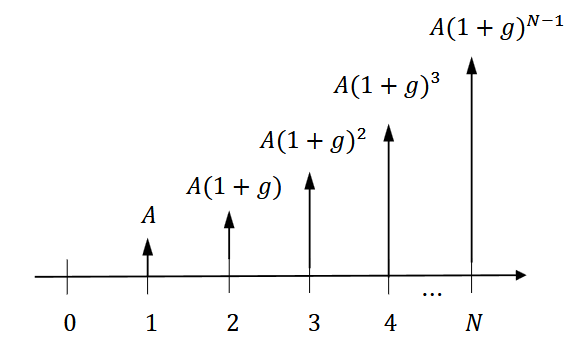
growth adjusted interest rate =
i° = (1+i)/(1+g) − 1
interest rate with growth rate accounted for:
can be used to convert to annuity problem
geometric gradient → present worth factor =
i° = (1+i)/(1+g) − 1
(P/A, g, i, N) = [(P/A, i°, N)] / (1+g) = [((1+i°)N − 1) / (i°(1+i°)N)] × [1/(1+g)]
gives the present amount P equivalent to a geometric gradient series g given:
A = base value of geometric gradient series
g = rate of growth
i = interest rate
N = # of periods
“What lump sum P is worth the same as a geometric gradient series with interest rate i and per period over N periods?”
![<p>i° = (1+i)/(1+g) − 1</p><p>(P/A, g, i, N) = [(P/A, i°, N)] / (1+g) = [((1+i°)<sup>N</sup> − 1) / (i°(1+i°)<sup>N</sup>)] × [1/(1+g)]</p><p></p><p>gives the present amount P equivalent to a geometric gradient series g given:</p><ul><li><p>A = base value of geometric gradient series</p></li><li><p>g = rate of growth</p></li><li><p>i = interest rate</p></li><li><p>N = # of periods</p></li></ul><p></p><p>“What lump sum P is worth the same as a geometric gradient series with interest rate i and per period over N periods?”</p><p></p>](https://assets.knowt.com/user-attachments/27c670af-47b2-490b-a7ee-34f16597fcb0.png)
what happens if compounding and payment periods dont match =
non-standard annuities/gradients
ex.)
interest compounds monthly, but you only make payments quarterly
interest compounds daily, but you make payments annually
3 methods to solve non-standard annuities/gradients =
treat each cash flow in the annuity/gradient individually
convert to standard annuity/gradient by changing compounding period
convert to standard annuity/gradient by finding equivalent standard annuity/gradient for the compounding period