Aromatic chemistry
 Call Kai
 Learn
Learn Practice Test
 Spaced Repetition
 Match
Match Flashcards
 Knowt Play
1/49

There's no tags or description
Looks like no tags are added yet.
Name | Mastery | Learn | Test | Matching | Spaced | Call with Kai | Chat |
|---|
No analytics yet
Send a link to your students to track their progress
50 Terms
What is an arene?
Hydrocarbons based on benzene, C6H6 which is the simplest one
What is the simple structure and bond angle of benzene?
Hexagonal planar structure with each bond angle of carbon being 120 degrees.
How to draw the skeletal formula of benzene?
Hexagon with a circle on the inside.
What is the empirical formula of benzene?
CH
Why did it take scientists a long time to discover benzene’s true structure?
In spite of it being highly unsaturated it does not readily undergo addition reactions (like an alkene) and is stable
All carbon atoms are equivalent, implying the C-C bonds are the same, which does not suggest there are alternating single and double bonds.
What does intermediate mean in terms of benzene?
That each C-C bond is intermediate between a single and a double bond, so is neither one or another.
What does delocalisation mean?
That electrons are spread over more than two atoms (in benzene’s case 6 atoms of the ring).
Describe how the carbon electrons are bonded in a benzene ring, and how they overlap:
Each carbon has 3 covalent bonds - one to hydrogen and two to carbon. The 4th is in a p orbital - there are 6 in total in a benzene ring. These overlap laterally to form a pi system and their electrons are delocalised, forming a region of electron density above and below the plane.
Why is the delocalisation system important in benzene?
It makes benzene very stable (aromatic stability)
What was Kekule’s structure of benzene?
Proposed in 1865, where the benzene ring has 6 carbon atoms with alternating single and double bonds
Why would Kekule’s structure not work for benzene?
All bond lengths and angles are the same, if the bonds were alternate the angles would be slightly different, but they are all 120 degrees.
How does thermochemical evidence support the delocalisation structure of benzene?
It takes more energy to break the bonds in benzene because it has a higher enthalpy value than for Kekule’s proposed structure, showing that benzene is more stable due to the overlapping p-orbitals above and below the ring forming the delocalised pi system.
What state is benzene in at room temperature?
It is a colourless liquid.
Why does benzene have a higher melting point than hexane even though the boiling point is similar?
It’s flat hexagonal molecules pack together very well in the solid state, so have stronger van der Waals forces of attraction between molecules that require more energy to break.
What do arenes mix well with?
Other hydrocarbons and non-polar solvents.
Why do arenes burn with smoky flames?
They have a high carbon- hydrogen ratio compared with alkanes, and there is usually unburnt carbon remaining when they burn in air, producing soot (smoky flame). The unreacted carbon particles heat up and glow, causing the flame to be yellow/luminous.
What factors are important in the reactivity of benzene?
The high election density that is attacked by electrophiles
Stability of the ring, as energy is required to break it
Why does the carbon ring in benzene almost always stay intact when attacked?
Because energy is required to break the ring before the system can be destroyed
What reaction does benzene commonly undergo?
Electrophilic substitution
Outline the general process of electrophilic substitution in benzene:
The delocalised system of the aromatic ring has a high electron density that attracts electrophiles, and the electrons are attracted to the electrophile
A bond forms between one of the carbon atoms and the electrophile, using electrons from the delocalised system that destroys the aromatic system
The carbon loses a H+ ion, and the electron in the C-H bond returns to the delocalised system.
Draw the general mechanism for the electrophilic substitution of benzene:

What are the rules when drawing a horseshoe in the Wheland intermediate for electrophilic substitution?
Must cover at least 3 carbons, must be opposite the 4 bonded carbon, and the positive charge must be within the horseshoe.bg
What is nitration in benzene reactions?
The substitution of an NO2 group for one of the hydrogen atoms on an arene ring.
How is the NO2 electrophile generated?
The electrophile +NO2 is generated in the reaction mixture of concentrated nitric and concentrated sulfuric acids.
Write the equation of the generation of the +NO2 electrophile:
H2SO4 + HNO3 →HSO4- + H2O + NO2
Draw the mechanism for the electrophilic substitution of benzene with +NO2:

What is the product of electrophilic substitution with NO2?
A nitrobenzene
What happens to the hydrogen ion generated in the electrophilic substitution with NO2?
It reacts with the HSO4- to regenerate H2SO4, so sulfuric acid is a catalyst.
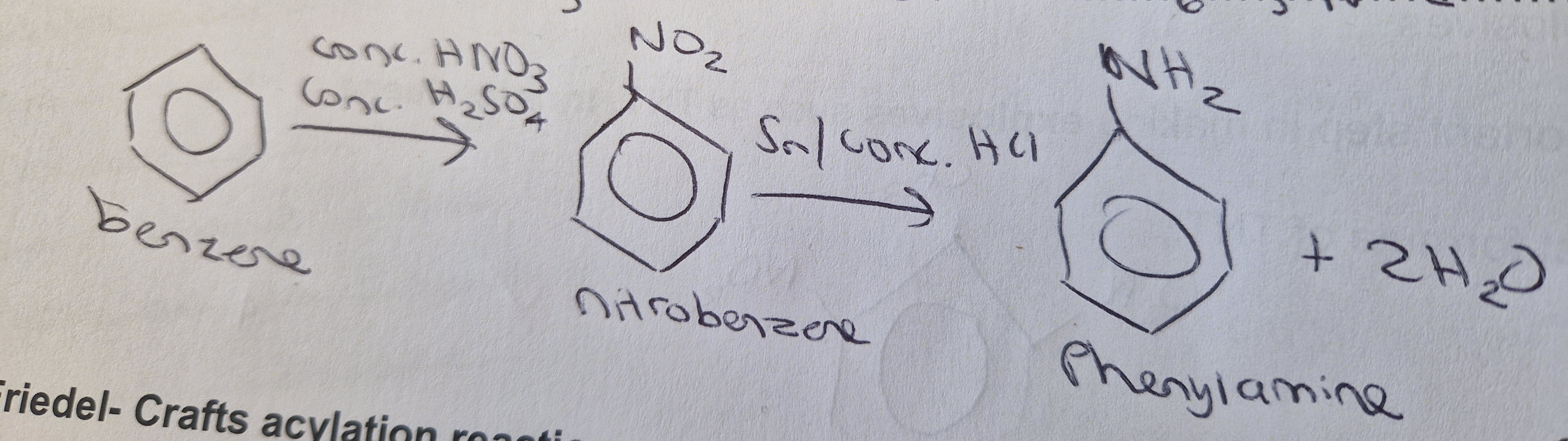
Draw the overal reaction for benzene with HNO3 and H2SO4:

What are the two main uses of nitrated arenes?
Making explosives, nitration is an important step in making explosives like TNT (trinitrotoluene)
Making dyes - nitration is an important step in making aromatic amines like phenylamine which are used to make industrial dyes.
What are the two main steps to making phenylamine?
Benzene reacted with concentrated nitric and concentrated sulfuric acid to make nitrobenzene
Nitrobenzene is reduced to phenylamine using tin and concentrated HCL as the reducing agent.
How is nitrobenzene reduced by tin and HCl?
Tin and HCl react to form hydrogen, reducing the nitrobenzene by removing oxygen atoms of the NO2 group and replacing them with hydrogen atoms.
Write the equation for production of phenylamine from nitrobenzene in structural and skeletal formulae:

What is formed from phenylamine and HCl
The salt C6H5NH3+Cl- because HCl reacts in an acid-base reaction
Give the equation for the formation of a salt from phenylamine and HCl:
C6H5NH2 + HCl → C6H5NH3+Cl-
What is added to the salt formed from phenylamine to reproduce phenylamine again?
NaOH
Give the equation for the formation of phenylamine after adding NaOH to the salt:
C6H5NH3+Cl- + NaOH → C6H5NH2 + H2O + NaCl
Draw a simplified diagram of the overall formation of phenylamine from benzene:
What do Friedel- Crafts acylation reactions use as a catalyst?
Aluminium chloride
Who discovered Friedel Crafts reactions?
Charles Friedel and James Crafts
What is the mechanism type for acylation?
Electrophilic substitution
Draw the general structure of an acyl chloride:

What is the suffix ending for naming acyl chlorides?
-oyl chloride
What is produced when acyl chlorides react with AlCl3?
AlCl4- and RCO+
What is the equation for the formation of the R+CO electrophile?
RCOCl + AlCl3 → R+CO + AlCl4-
Why is AlCl3 a catalyst in the acylation reaction?
It is regenerated by the reaction of AlCl4- with H+ from benzene ring.
Give the equation for the regeneration of the AlCl3 catalyst:
AlCl4- + H+ → AlCl3 + HCl
Give the general mechanism for the Friedel-Crafts acylation reaction:

What are the products in the Friedel-Crafts acylation reaction?
Acyl-substituted arenes
Give the general overall reaction for the production of acyl-substituted arenes in skeletal formula:
