SCIENCE
 Call Kai
 Learn
Learn Practice Test
 Spaced Repetition
 Match
Match Flashcards
 Knowt Play
1/31

There's no tags or description
Looks like no tags are added yet.
Name | Mastery | Learn | Test | Matching | Spaced | Call with Kai | Chat |
|---|
No analytics yet
Send a link to your students to track their progress
32 Terms
A cart begins at rest and receives a quick push. Its speed rises until about 0.40 s, then becomes nearly constant with a slight downward slope. Which evidence most strongly identifies when the hand lost contact?
Near 0.40 s, the graph changes from a steep positive slope to an almost flat, slightly negative slope
A cart slows from 1.20 m/s to 0.60 m/s in 2.0 s on a rough surface. What is its average speed-time slope during this interval?
Answer: -0.30 m/s²
Two balls have the same mass. Ball X is moving faster than Ball Y. What conclusion is supported by the Unit EM evidence rule?
Ball X has greater kinetic energy, although the information does not establish a numerical factor.
A moving cart collides with a stationary cart. The first cart slows, the second begins moving, the bumpers warm slightly, and a sound is heard. Which statement gives the most complete account?
The first cart's kinetic energy decreases; the second cart's kinetic energy increases; and some energy reaches thermal stores and sound receivers.
Two identical suitcases enter different surfaces with the same initial speed and both eventually stop. The suitcase on the rug stops in half the time required on the smooth floor. Which conclusion is best supported?
Both suitcases have the same total kinetic energy decrease, but the rug produces the greater average rate of energy transfer.
A hand continues pushing a toy car across carpet, but the car is slowing. What does the observed speed change imply about the two interactions?
: The carpet interaction's tendency to decrease the car's kinetic energy is greater than the hand interaction's tendency to increase it.
A 22-degree-C metal spoon is placed in 70-degree-C soup. During the first minute, which description is correct?
The soup is the energy giver, the spoon is the receiver, and conduction is the main mechanism through the spoon.
Which sequence correctly matches the main heat-transfer mechanism to each situation: touching a warm mug, warm air rising from a vent, and feeling a campfire across an open gap?
Conduction; convection; infrared radiation.
During a short interval, a hot cup loses 72 J of thermal energy. A hand has a net thermal-energy increase of 18 J, and all remaining energy reaches the surroundings. How much thermal energy do the surroundings gain?
54 J
Immediately after a battery-bulb circuit is closed, both components are warming, the bulb emits light, and both are already warmer than the room. Which account is most complete?
: Battery CPE decreases; battery, bulb, and surroundings thermal energy increase; and light receivers gain energy.
The same battery and bulb later remain at constant operating temperatures while the bulb continues to glow. Which terms should be omitted as continuing net energy changes?
Increases in battery thermal energy and bulb thermal energy.
A cyclist applies the brakes. The bicycle slows while the brake pads and wheel rims warm. Which energy description is correct?A cyclist applies the brakes. The bicycle slows while the brake pads and wheel rims warm. Which energy description is correct?
The moving bicycle-rider system is the energy giver; its kinetic energy decreases while thermal energy increases in the pads, rims, and other supported receivers.
A person pulls a suitcase at constant speed across a rough floor. Which statement correctly compares a suitcase-only system with a person-suitcase-floor system?
For the suitcase alone, energy enters through the pull and leaves through friction; for the larger system, person CPE decreases while thermal energies increase and suitcase kinetic energy has no net change.
Classify these statements: (1) "A harder push will produce a steeper rising speed-time graph." (2) "Speed rose from 0 to 1.2 m/s in 0.5 s." (3) "The slope change marks when the hand lost contact."
Prediction; observation/measurement; inference.
Four identical carts are released with the same speed on four tracks. Their post-release speed-time slopes are P = -0.06 m/s², Q = -0.22 m/s², R = -0.12 m/s², and S = 0 m/s². Which conclusion is best supported?
Track Q produces the greatest rate of speed decrease, while Cart S maintains constant speed.
A block enters a moderately rough section at 1.50 m/s and slows at 0.10 m/s each second for 3.0 s. It then slows at 0.40 m/s each second for 2.0 s on a rougher section before entering a frictionless section for 4.0 s. What speeds should it have at the three section endpoints?
1.20 m/s; 0.40 m/s; 0.40 m/s
A cup of coffee at 65 degrees C and a sealed water bottle at 10 degrees C are placed in the same 22-degree-C room. Before either reaches room temperature, which description is correct?
The coffee gives energy to the surroundings, while the surroundings give energy to the bottle; coffee thermal energy decreases and bottle thermal energy increases.
The same metal sample cools from 80 degrees C to 70 degrees C during one minute and from 70 degrees C to 64 degrees C during the next minute. Which statement is supported by the data?
The magnitude of the temperature-time slope is greater during the first minute, but cooling continues during both minutes.
Compared with an infrared image taken before a coin is spun, an image taken after it stops shows warmer regions on the coin and table. Which statement correctly distinguishes observation from inference?
Warmer regions are observations supporting thermal energy increases; the energy pathway is inferred using those observations and the motion change.
After a ceiling fan is switched off, its blades slow, the motor housing warms, nearby air moves briefly, and a faint sound is heard. Which energy account is complete
Fan kinetic energy decreases while motor thermal energy, air kinetic energy, and energy of sound receivers increase.
A 0.40 kg cart receives a brief hand push, crosses a low-friction section, and then enters a rough section. Its measured data are:(0, 0)
(0.5, 1.2)
(2.0, 1.2)
(3.0, 0.6)
(4.0, 0)
Speed
1.2 | ●────────────●
| / \
0.8 | / \
| / \
0.4 | / \
| / \
0.0 | ●────────────────────────●
+----------------------------
0 .5 2 3 4 Time
Identify the hand-contact and rough-surface intervals, citing graph evidence for each.
The hand-contact interval is 0.0–0.5 s because the speed increases from 0 to 1.2 m/s, producing a positive slope.
The rough-surface interval is 2.0–4.0 s because the speed decreases from 1.2 m/s to 0, producing a negative slope.
. Calculate the average speed-time slope during the hand push and during the rough-surface interval. Include units and compare the slope magnitudes.
Answer:
The hand-push slope has the greater magnitude.
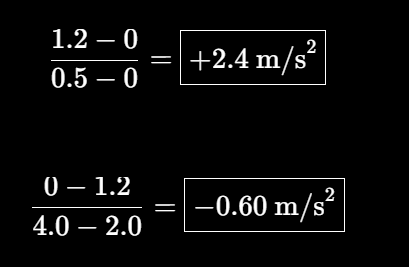
Write a conservation statement for the cart-plus-track system during the rough-surface interval and identify the observed evidence for each energy change.
The cart's kinetic energy decreases while the thermal energy of the cart and track increases, so total energy is conserved.
Evidence:
Cart slows from 1.2 m/s to 0 m/s → kinetic energy decreases.
Cart wheels and rough track become warmer → thermal energy increases.
A person holds a hot metal cup with a cooler hand. Both the cup and the hand are warmer than the room. During a short interval, the cup loses 90 J of thermal energy, the hand has a net thermal-energy increase of 25 J, and all remaining energy reaches the surroundings.
INSERT PIC
Identify the heat-transfer mechanism mainly illustrated between the cup and hand.
r: Conduction
Calculate the surroundings' thermal-energy increase and write the numerical energy balance.

Explain how the hand can be both an energy receiver and an energy giver while its thermal energy still increases.
Answer:
The hand receives more energy from the hot cup than it gives to the surroundings, so its net thermal energy increases.
A battery operates a motor with fan blades. The battery and motor have reached constant operating temperatures, the blades rotate at constant speed, and air leaving the fan moves faster than air entering it. Treat sound as negligible.
insert pic
abel the continuing energy changes. State which possible battery or motor/fan energy changes should not be shown as net increases under the stated steady conditions.
The air's kinetic energy increases and the surroundings' thermal energy increases.
The battery's and motor/fan's thermal energies should NOT be shown as continuing net increases because their temperatures are constant.
The blades' kinetic energy should NOT be shown as increasing because they rotate at constant speed.
Write a conservation-of-energy statement for the entire system.
Answer:
The battery's stored energy decreases while the air's kinetic energy and the surroundings' thermal energy increase by the corresponding amount, so total energy is conserved.
The battery's stored energy decreases while the air's kinetic energy and the surroundings' thermal energy increase by the corresponding amount, so total energy is conserved.
Energy can continue to flow through the system even when the blade speed and temperatures remain constant because energy entering the system is continuously transferred to the air and surroundings.