Nobel concepts towards a sustainable future
 Call Kai
 Learn
Learn Practice Test
 Spaced Repetition
 Match
Match Flashcards
 Knowt Play
1/20

Earn XP
Description and Tags
Name | Mastery | Learn | Test | Matching | Spaced | Call with Kai | Chat |
|---|
No analytics yet
Send a link to your students to track their progress
21 Terms
Lecture 1
Who discovered Supramolecular chemistry?
-Prof. Dr. Jean-Marie Lehn,
-Nobel Laureate 1987 in Chemistry
-Born: September 30th 1939, Rosheim, Alsace, France.
-Affiliations when obtained the award:
University of Strasbourg, France.
Collège de France, Paris, France.
-Prize motivation: Development and use of molecules
with structure-specific interactions of high selectivity.
Alongside Donald J. Cram and Charles J. Pedersen.
What is some background and achievements of Jean-Marie Lehn’s ?
He was born one month before the begining of WW2.
• He studied both chemistry and philosophy.
• He obtained his PhD at the age of 24
• He did a postdoc in the group of Prof. Dr. Robert B. Woodward, Nobel Laureate in 1965 (University of Harvard).
• He became full professor at the age of 31.
• He was awarded the Nobel Prize at the age of 48.
• Multiple awards, among them:
-Honorary doctorate in > 60 universities worldwide.
-French « National Commender of Legion of Honour », one of the highest distinction in the country.
Whats the background of Supramolecular chemistry?
Supramolecular chemistry, also known as “chemistry beyond the molecule”, focuses on the study of molecular recognition and high-order assemblies formed by noncovalent interactions.
What is the difference between Molecular and supramolecular chemistry?
Molecular chemistry: chemistry of isolated molecules → covalent interactions
Supramolecular chemistry: beyond molecular chemistry → refers mostly to assemblies: what a population of molecules is doing.
While molecular chemistry concentrates on the covalent bond, supramolecular chemistry studies the weaker and reversible non-covalent interactions between molecules: hydrogen bonding, metal coordination, hydrophobic forces, van der Waals forces, pi–pi interactions, electrostatic effects.
What makes water’s breakdown hard in Supramolecular chemistry?
As a rule of thumb, the boiling points of liquids increases with its molecular mass.
H-bonding, in order to break, requires a high energy,H-bonding is considered as a weak interaction.However, several H-bondings together become very
robust.
Supramolecular chemistry is widely found in nature.
Supramolecular chemistry is responsible for several effects in
nature.
Who discovered Crown Ether?
Charles John Pedersen (1967)
What is the crown Ether and how does it help?
Metal ions (e.g. salts) are not soluble in low polarity organic solvents.
The crown ether binds the metal cation, and the resulting complex is soluble,
i.e. the salt is solid.
Crown ethers are used to help ionic salts, needed for organic reactions,
to dissolve in organic solvents.
How does molecular recognition in macrocycles work?
Based on the fact that each « molecule » (host) has a particular affinity for one specific other « molecule » (guest).
Crown-ethers
• Synthesis: requires very high dilution techniques that favors
intramolecular reaction.
• Template synthesis of crown-ethers,
using the metal ion.
Who discovered Cryptands and provide some info about them?
Jean-Marie Lehn, 1969
3D analogues of crown-ethers that have one additional binding chain
providing better and more selective coordination than crown ethers.
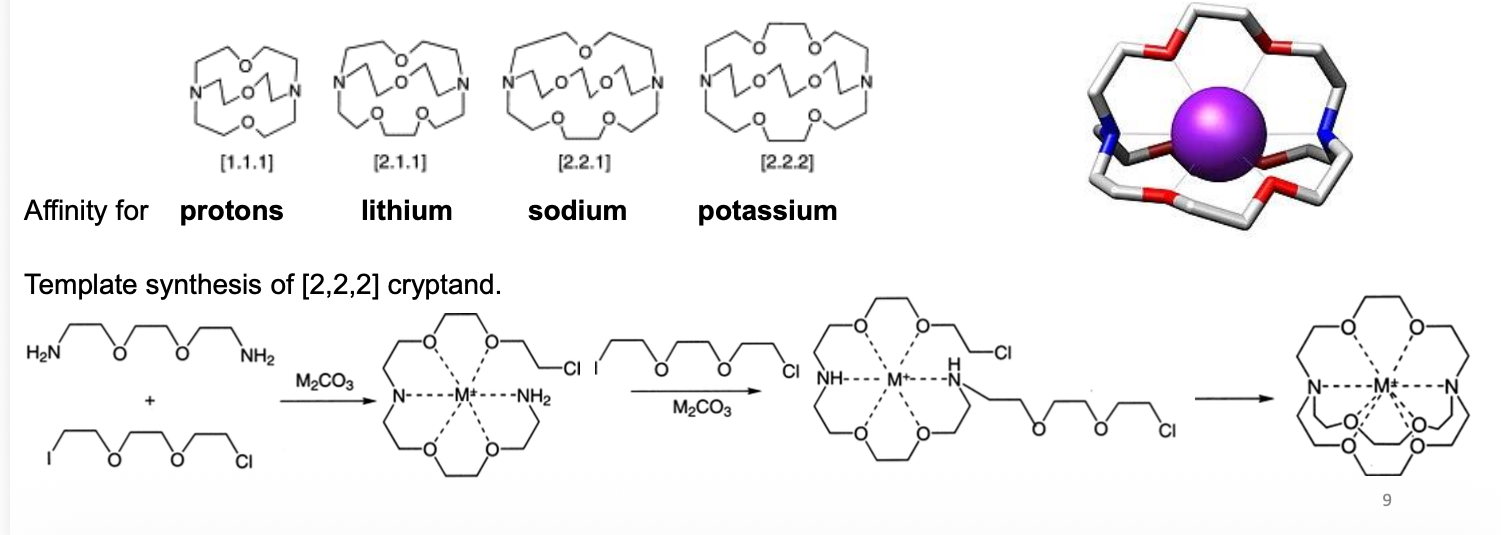
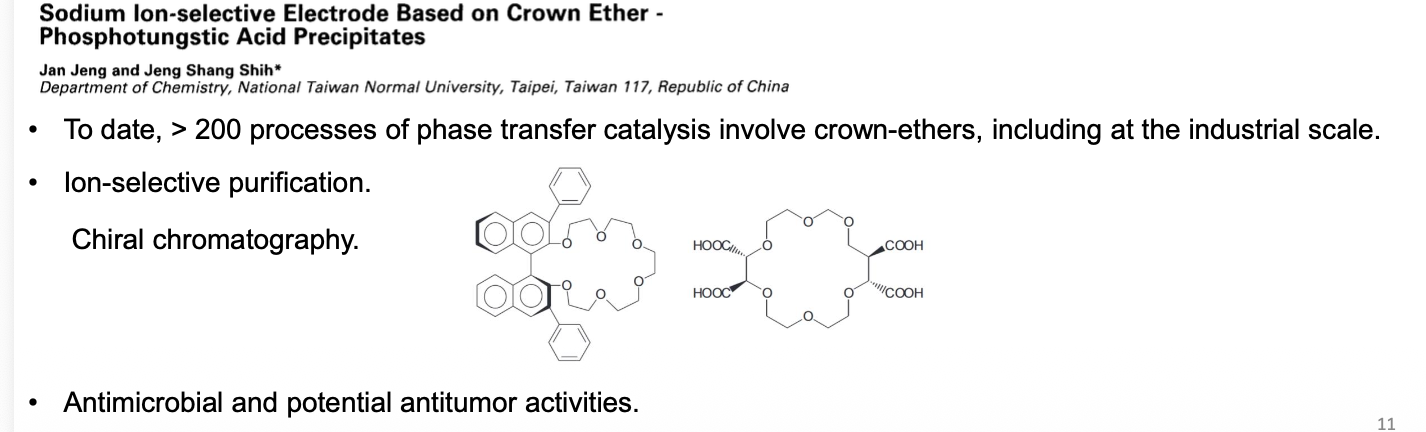
What are some applications of macrocycles?
Macrocycles have the ability to bind certain metallic atoms in the middle of their ring. The metallic atoms can then be released in organic solvents, something that had been difficult before. This opened up possibilities for bringing about chemical reactions in laboratories and synthesizing a wide quantity chemical compounds.
• Extraction: metals, solvents, molecules.
Phase transfer catalysis.
It promotes the reaction between mutually immiscible reagents as the hydrophobic ring in the crown ethers is used for increasing the solubility of alkali metal salts in polar solvent,e.g. water.
To date, > 600 industrial processes involve phase transfer catalysis.

What are the sensors in macrocycles?
An ion-selective electrode (ISE), also known as a specific ion electrode (SIE), is a simple membrane-based potentiometric device which measures the activity of ions in solution. It is a sensor that converts the change in the concentration of a specific ion dissolved in a solution into an electrical potential.
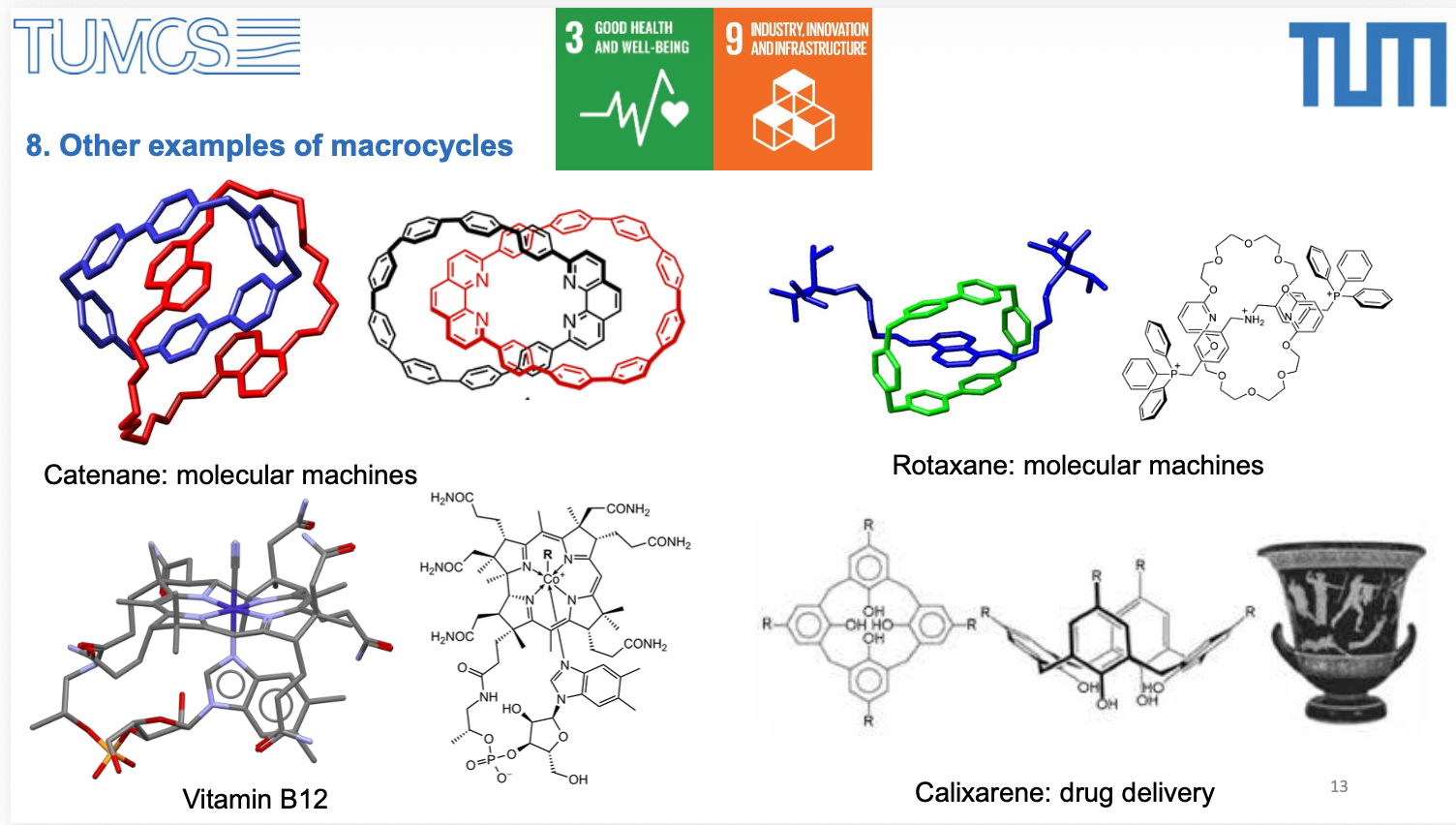
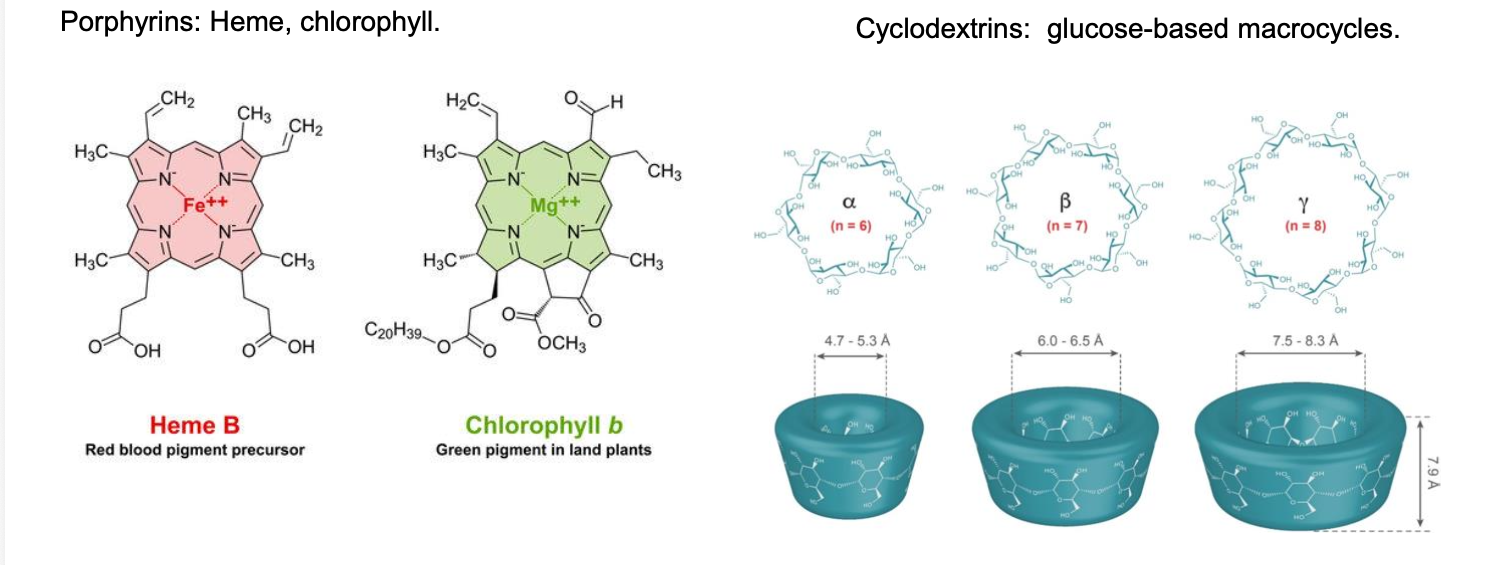
What macrocycles are present in nature?
What is the relationship between the Nobel concept and sustainability?
Pros
• The potential applications, including sensors, rare-earth metals capture, catalysis.
• More generally, supramolecular chemistry, considered as a field of chemistry per se, is studied and applied to an enormous scope of applications related to catalysis.
What is a Cryptate?
cryptand-metal ion system ( e.g. cryptands 222 and K+).
What is a super molecule?
super-molecule is to supramolecular chemistry what a molecule is to molecular chemistry. (e.g. 18-crown-6 and K+)
What are host guest systems?
systems that are composed of at least two molecules or ions that are held together through interactions other than covalent bonds
(e.g. Iron porphyrin).
What are macrocycles?
They are often described as molecules containing a ring of twelve or more
atoms.
What is the template effect?
When a metal ion acts as a template to bring reactive sites in close proximity. In the absence of the metal ion, the same reaction would proceed to form a different product.
Lecture 2
Who discovered asymetric organa- catalysis?
-Prof. Dr. Benjamin List
-Nobel Laureate 2021 in Chemistry
Born: January 11th 1968, Frankfurt, Germany.
Affiliations when obtained the award: University of Cologne &
Max Planck Institute for Coal Research, Mülheim an der Ruhr, Germany
Hokkaido University, Japan
Prize motivation: Development of asymmetric organocatalysis
Alongside David MacMillan.
What is some background and achievements of Prof. Benjamin List?
Age 29 (1997): PhD Thesis: Synthesis of a Vitamin B 12 Semicorrin - Goethe University
Frankfurt
• He did a postdoc at the Scripps Research Institute Department of Molecular Biology in La
Jolla, US
• Age 35 (2003): group leader in the Max-Planck-Institute for coal research
• Age 37 (2005): head of the department of catalysis and one of the institute director
• Since 2018: Professor position at Hokkaido University, Japan
• Age 53 (2021) : Nobel Prize
• Multiple awards (e.g. Novartis Chemistry Lectureship Award, AstraZeneca Award in Organic Chemistry, Web of Science Citation Laureate in Chemistry, etc.)
• In summer 2004, he was in Thailand with his family and they all survived the earthquake and the tsunami. He ever since expresses his deep gratitude for everything he has got.
He is not the pioneer of asymmetric organocatalysis
But his implication in its development, notably the
understanding of the mechanism, is a breakthrough in the field