11 ib bio exam hl
 Call Kai
 Learn
Learn Practice Test
 Spaced Repetition
 Match
Match Flashcards
 Knowt Play
1/34

There's no tags or description
Looks like no tags are added yet.
Name | Mastery | Learn | Test | Matching | Spaced | Call with Kai | Chat |
|---|
No analytics yet
Send a link to your students to track their progress
35 Terms
capillary action
the movement of water through a narrow passageway often in an opposing direction than the force of gravity
adhesion
the attraction of water molecules to other polar or charged molecules.
solvation
the interaction between a solvent and its dissolved solute
buoyancy
the upward force applied to an object when immersed in a liquid
if the force of the liquid is greater than the object, it will be buoyant and float
viscosity
the measure of the tendency of a liquid to flow
cause: the effect of the friction of the liquid molecules as they slide over each other
effect: the efficiency of transport in the liquid
specific heat capacity
the quantity of heat energy needed to raise the temperature of a chemical per unit mass
osmolarity
refers to the concentration of solute particles in a solution measured in osmoles per liter
isotonic
have equal solute concentrations
four major classes of compounds in living organisms
lipids
proteins
carbohydrates
nucleic acids
monomers
the basic building block molecules that are capable of being linked together to form larger structures
relativiely small compared to macrmolecules
can from chemical bonds w other monomer to form a chain
combines through condensation reactions to create biological polymers
examples: nucleotides, monosaccharides, amino acids
polymers
large molecules that are composed of repeating monomers
examples: nucleic acids, polysaccharides, polypeptides
macromolecules made from many monomers that can serve various biological functions
condensation reactions
build complex molecules such as building polymers from monomers
requires energy input
is an anabolic process
produces water as a byproduct
utilizes enzymes that are catalysts and lower the activation energy
hydrolysis reaction
the process of breaking down polymers into monomers by adding water
releases energy and is a catabolic process
exergonic — releases more energy than they use in the process
provide energy that the cells requires for cellular work
monosaccharides
the simplest carbohydraters consisting of singular sugar units that cannot be hydrolyzed into smaller carbohydrate molecules
ranging from 3 to 7 carbons
cellulose microfibrils
due to the hydroxyl groups of the glucose it can form hydrogen onds with neighboring chains and holding chains firmly together
creates side-by-side structures called microfibrils
makes up a rigid fiber structure in the cell wall
triglyceride
a glycerol molecule bonded to three fatty acid chains
fats and oils
generalized structure of a fatty acid
~12-20 carbon atoms in a hydrocarbon chain and a carboxyl group at one end
essential amino acids
the nine amino acids that are vital for human functions however we do not synthesize individually
therefore, must be ingested from food because human metabolism alone is insufficient for what is needed
non-esssential amino acids
the eleven amino acids that we can synthesize from other compounds, including other amino acids, carbs and fats
we have the metabolic machiney to produce these on our own though
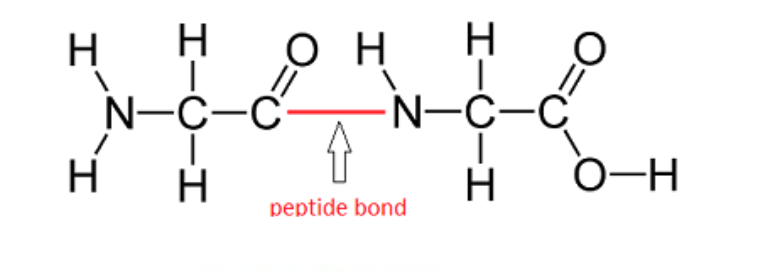
dipeptide
a simple peptide bond molecule consisting of exactly two amino acids joined by a singular peptide bond
oligopeptide
consists of 3-20 amino acids linked together by peptide bonds
representing short chains that serves as hormones, neurotransmitters, or signaling molecules
polypeptide
a long chain of amino acids, typically consisting of more than 20 amino acids linked together by peptide bonds, and can fold into functional proteins.
enable the diverse functions of proteins in living systems
location of cell polypeptide formation
occurs in the ribosomes during protein synthesis, where amino acids are assembled into polypeptides based on mRNA sequences.
backbone of a polypeptide
composed of a repeating sequence of peptide bonds linking amino acids, providing the structural framework for the polypeptide.
excludes the R-groups
protein conformation
the specific three dimensional shape of a protein molecule
its most biologically active
vital for protein function
primary structure
the unique sequence of amino acids in a polypeptide chain, which determines the protein's specific properties and functionality.
involves transcription, translation, protein
secondary structure
the local folding patterns of a polypeptide chain, commonly including alpha helices and beta sheets, stabilized by hydrogen bonds between backbone atoms.
does not involve the R-groups
tertiary structure
the overall three-dimensional shape of a protein that results from the interactions between the R groups of amino acids.
crucial for the protein's functionality and stability.
involves
H-bonds (for polar R-groups)
ionic bonds (for charged ions)
disulfide covalent bonds (cysteine amino acids)
and hydophobic interactions (for non-polar R-groups)
quaternary structure
multiple polypeptide chains that associate to form a single functional protein complex
non-conjugated protein complex
folded polypeptides without any additional chemical groups attached
derive all their structural and functional properties from the 20 standard amino acids and their various interactions
performs diverse functions
conjugated proteins
contain one or more non-protein components called prosthetic groups
metal ions
organic molecules
carbohydrate groups
lipid groups
possible modifications of polypeptides to form functional protein
proteolysis; breaking of polypeptides through hydrolysis of peptide bonds
phosphorylation: movement of phosphate group to protein
glycosylation: adding carbohydrate chain to protein
ubiquitination: attachment of small protein callled ubiquitin which acts as a destroy signal
lipidation: a lipid molecule is attached to a protein