Understanding Stroke Types and Management Strategies
 Call Kai
 Learn
Learn Practice Test
 Spaced Repetition
 Match
Match Flashcards
 Knowt Play
1/64

There's no tags or description
Looks like no tags are added yet.
Name | Mastery | Learn | Test | Matching | Spaced | Call with Kai | Chat |
|---|
No analytics yet
Send a link to your students to track their progress
65 Terms
Ischemic Stroke
Blocked blood flow deprives brain of oxygen.
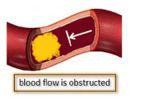
Hemorrhagic Stroke
Ruptured blood vessels leak blood into brain.
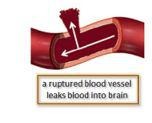
MCA
Middle Cerebral Artery; affects upper extremities.
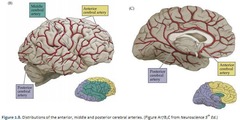
PCA
Posterior Cerebral Artery; affects vision and memory.
ACA
Anterior Cerebral Artery; affects lower extremities.
Contralateral Hemiparesis
Weakness on opposite side of stroke.
Contralateral Hemisensory Loss
Loss of sensation on opposite side.
Urinary Incontinence
Inability to control urination.
Apraxia
Difficulty with motor planning and execution.
Spasticity
Increased muscle tone and resistance to movement.
Synergy
Coordinated movement patterns, often abnormal.
Unilateral Neglect
Lack of awareness of one side of body.
Homonymous Hemianopsia
Loss of half of the visual field.
Broca's Aphasia
Impaired speech production, comprehension intact.
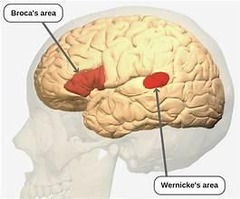
Wernicke's Aphasia
Impaired comprehension, fluent but nonsensical speech.
Global Aphasia
Severe impairment in both speech and comprehension.
Central Post Stroke Thalamic Pain
Chronic pain following thalamic stroke.
Visual Agnosia
Inability to recognize objects despite intact vision.
Prosopagnosia
Inability to recognize faces.
Dyslexia
Difficulty reading without writing issues.
Topographical Disorientation
Inability to navigate familiar environments.
Posterior Cerebral Artery
Supplies blood to the occipital lobe.
Hemiparesis
Weakness on one side of the body.
Hemisensory loss
Loss of sensation on one side.
Visual-perceptual impairments
Difficulty interpreting visual information.
Neglect
Inattention to one side of the visual field.
Aphasias
Language disorders affecting communication.
Homonymous Hemianopsia
Loss of half the visual field in both eyes.
Spasticity
Increased muscle tone leading to stiffness.
Synergy
Coordinated muscle patterns during movement.
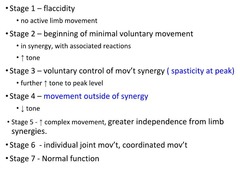
Brunnstrom Stages
Stages of motor recovery post-stroke.
Flexion synergy
Pattern of flexion in upper extremities.
Extension synergy
Pattern of extension in upper extremities.
Upper extremity spasticity pattern
Scapula retraction, shoulder adduction, elbow flexion.
Lower extremity spasticity pattern
Hip adduction, knee extension, ankle plantarflexion.
Obligatory synergy patterns
Involuntary movement patterns post-stroke.
Cautious behavior
Slow and careful actions due to risk.
Impulsive behavior
Quick actions without considering consequences.
Intellectual rigidity
Inflexibility in thought processes.
Highly distractible
Easily diverted attention from tasks.
Emotional processing difficulty
Challenges in managing emotional responses.
Positioning strategies for spasticity
Techniques to manage muscle tone.
Case scenario analysis
Evaluating patient conditions for therapy planning.
L MCA infarct
Left middle cerebral artery stroke affecting brain function.
Spasticity
Increased muscle tone causing stiffness and tightness.
Flexion synergy
Pattern of muscle activation during upper extremity movement.
Brunnstrom staging
Classification of motor recovery stages post-stroke.
Stage III
Voluntary movement possible, but with synergy patterns.
Stage IV
Movement combinations begin to emerge, less synergy.
Stage V
Independently controlled movements, minimal synergy influence.
ADLs
Activities of daily living, essential self-care tasks.
Standing tolerance
Ability to maintain standing position without support.
Standing balance
Ability to maintain stability while standing.
Minimal assist
Requires slight help for mobility tasks.
Moderate assist
Needs significant help for mobility tasks.
Non-fluent aphasia
Difficulty in speech production, but comprehension intact.
Shoulder external rotation
Rotating shoulder away from the body.
Shoulder internal rotation
Rotating shoulder towards the body.
Elbow flexion
Bending the elbow joint.
Elbow extension
Straightening the elbow joint.
Forearm supination
Rotating forearm so palm faces up.
Forearm pronation
Rotating forearm so palm faces down.
Thumb adduction
Moving thumb towards the palm.
Thumb abduction
Moving thumb away from the palm.
Standing balance assessment
Evaluating stability while standing.