Unit 1: Principles of Chemistry Chp 7. Ionic bonding Chp 8 Covalent bonding, Chp 9 Metallic bonding
 Call Kai
 Learn
Learn Practice Test
 Spaced Repetition
 Match
Match Flashcards
 Knowt Play
1/19

There's no tags or description
Looks like no tags are added yet.
Name | Mastery | Learn | Test | Matching | Spaced | Call with Kai | Chat |
|---|
No analytics yet
Send a link to your students to track their progress
20 Terms
OBJQ
The state relation of group numbers and their ion patterns
Group 1 → (1)+ ions
Group 2 → 2+ ions
Group 3 → 3+ ions
Group 5 → 3- ions
Group 6 → 2- ions
Group 7 → (1)- ions
OBJQ
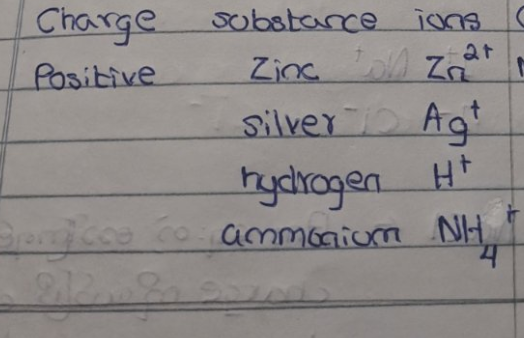
Zinc, silver, hydrogen, ammonia ion pattern
OBJQ
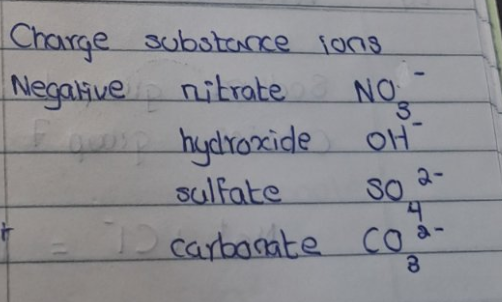
Hydroxide, carbonate, nitrate and sulphate ion patterns
OBJQ
Define 'ionic bond' in terms of electrostatic attraction.
Strong electrostatic attraction between positive and negative ions.
FAQ
Explain how metals form metal ions.
A metal atom has (...) electrons in its outer shell. It loses (...) electrons to form (...) ions (depending on electrons lost to get a stable electronic structure)
FAQ
Explain how non-metals form negative ions.
A non-metal atom has (...) electrons in its outer shell. It gains (...) electrons to form (...) ions (depending on electrons gained to get a stable electronic structure)
FAQ
Explain how a metal and a non-metal form compounds in terms of electron transfer and electrostatic force.
(metal) has (...) electrons in the outer shell, and (non-metal) has (...) electrons in the outer shell. (...) numbers of electrons are transferred from (metal) to (non-metal) to form (metal ions and non-metal ions). (compound) is formed by strong electrostatic attraction between (metal ions) and (non-metal ions).
FAQ
Explain how ionic compounds form through electron transfer within unmatched outer shells?
Electronic configuration of (metal and non-metal) is (...).
(numbers of electrons) are transferred from the outer shell of the metal’s atom to non-metal atoms (depending on the valence electrons in the outer shell of the metal). EXAMPLE: 2.8.8.2 → 2 electrons transfer to 2 non-metal atoms.
(metal atom) formed (metal ion and non-metal ion)
(ionic compound is formed by strong electrostatic attraction between the (metal ion and non-metal ion)
What is a lattice, and define ionic lattice
Lattice: Regular arrangement of particles
Ionic lattice: Regular arrangement of positive and negative ions.
How to describe the structure of an ionic compound?
(ionic compound) contains (positive ion) and (negative ion). A lattice of alternating (positive ion) and (negative ion) is held together by strong ionic bonds.
OBJQ
Why do ionic compounds have high melting point and boiling point?
They have a giant ionic structure.
Forces of attraction between positive ions and negative ions are strong.
Lots of energy has to be supplied to break the strong forces of attraction between oppositely charged ions in a giant ionic structure.
Why does (ionic compound 1) have a higher melting point than (ionic compound 2)?
Ionic compound 1 and ionic compound 2 are both ionic compounds. They both have a giant lattice structure.
Ionic compound 1 has (+-) ions and ionic compound 2 has (+-) ions
Forces of attraction between ionic compound 1 is stronger than ionic compound 2.
So more energy is supplied to break down the forces of attraction between ionic compound 1.
Thus, ionic compound 1 has a higher melting point than ionic compound 2.
State the relationship between melting/ boiling point and forces of attraction
Higher melting and boiling point → stronger forces of attraction
Explain the properties of an ionic compound.
High melting and boiling point
Tend to be crystalline
Tend to be brittle
Insoluble in organic solvents
Soluble in water
Explain why organic crystals are brittle
Because a small distortion of the crystal will bring ions with the same charge alongside each other. Same charges will repel, so the crystal splits itself.
OBJQ
Explain why ionic compounds don’t conduct electricity in the solid state but in the liquid state
In the solid state, ions are fixed in position and not free to move around. But in the liquid state, when they are molten (melted) or dissolved in water (aqueous solution), ions become free to move around.
OBJQ
Define covalent bond in terms of electrostatic attraction.
Strong electrostatic attraction between the shared pair of electrons and the nuclei of both atoms.
OBJQ
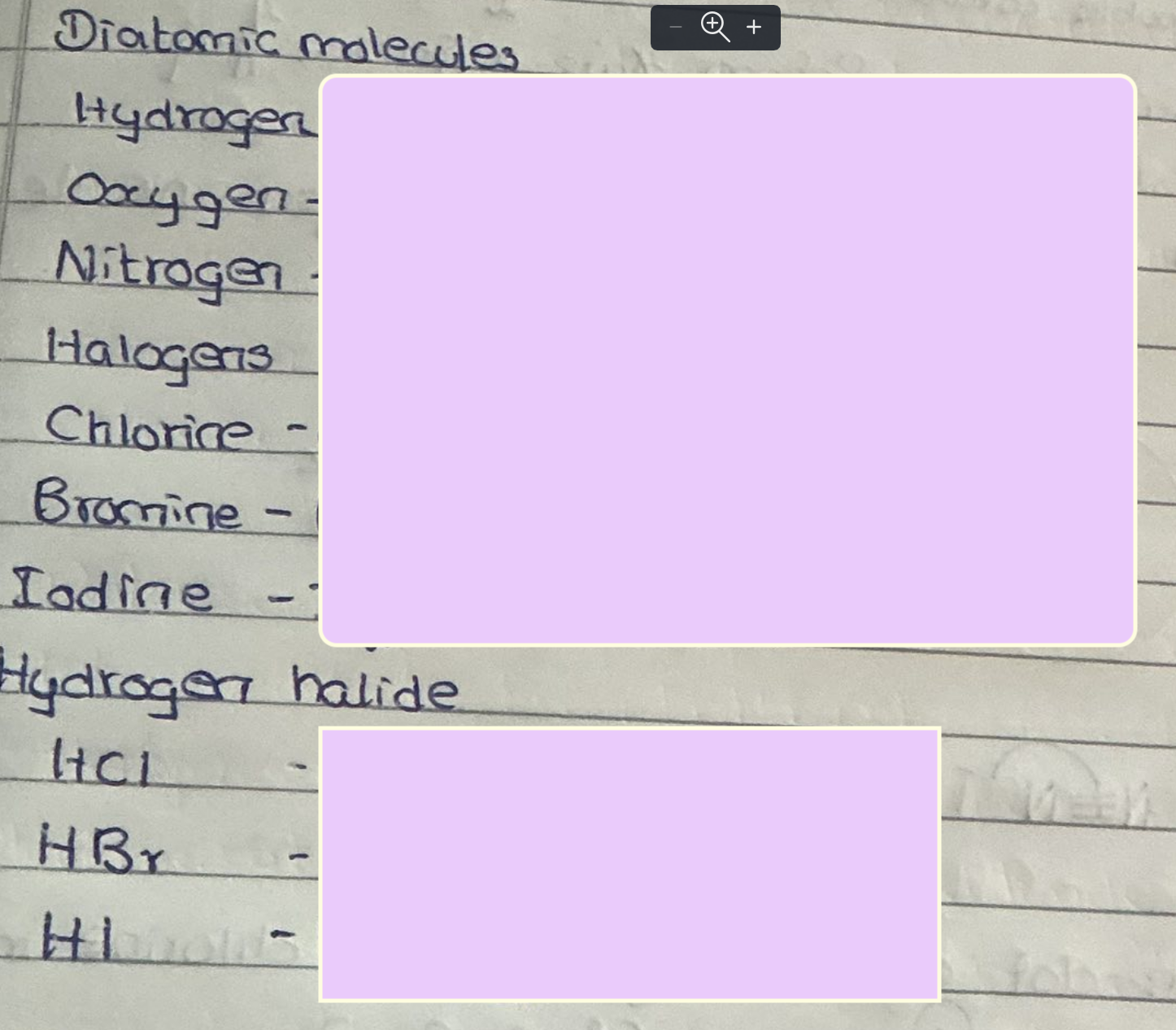
Name the diatomic molecules
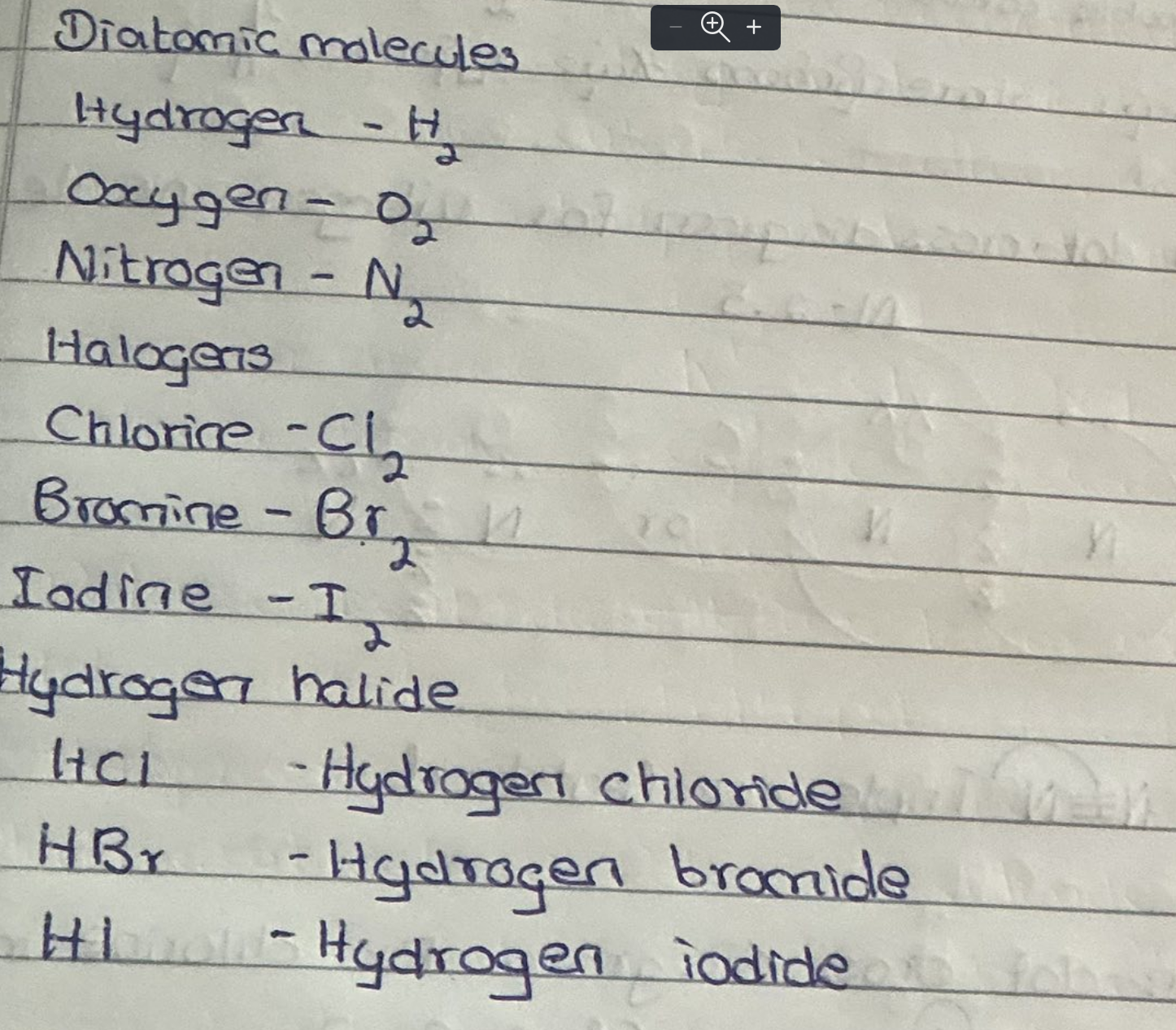
OBJQ
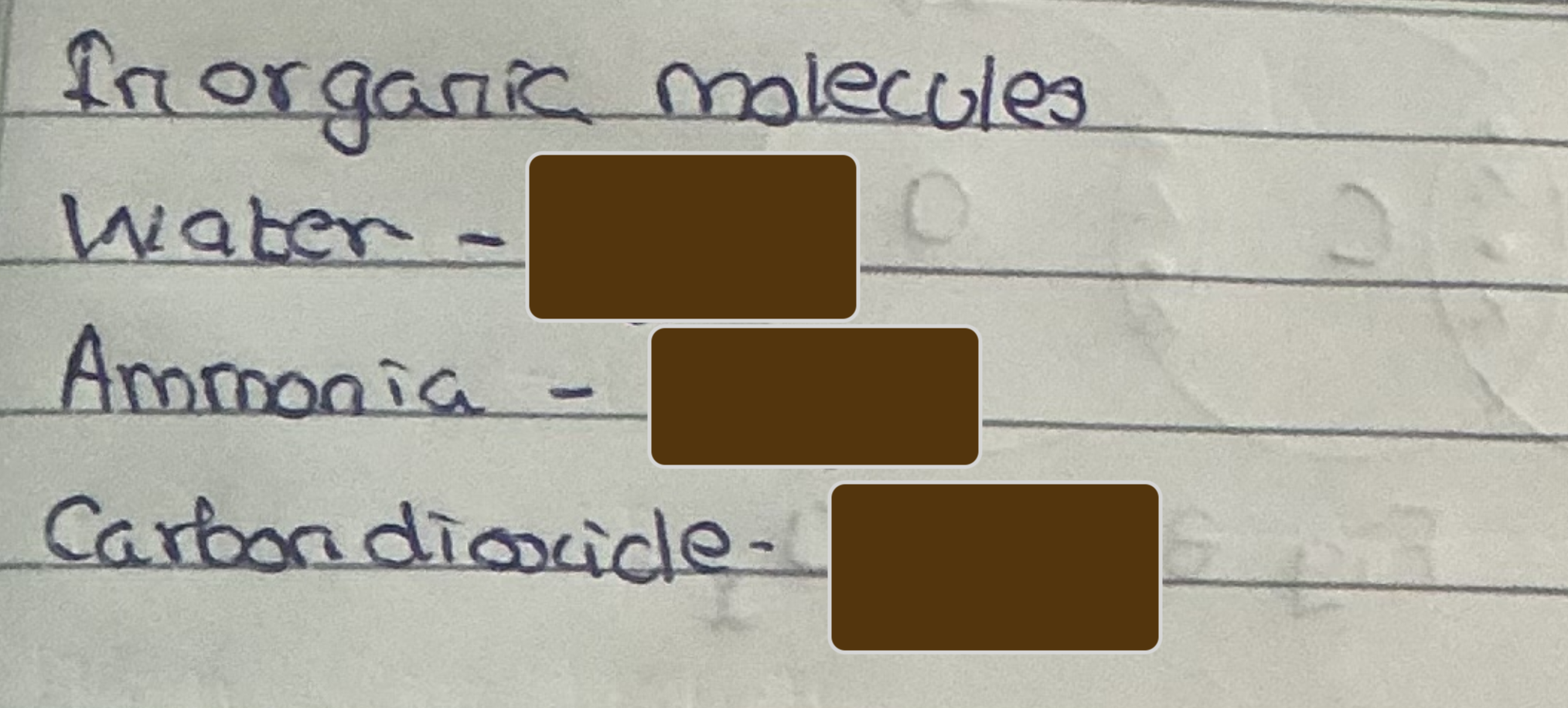
Name the inorganic molecules
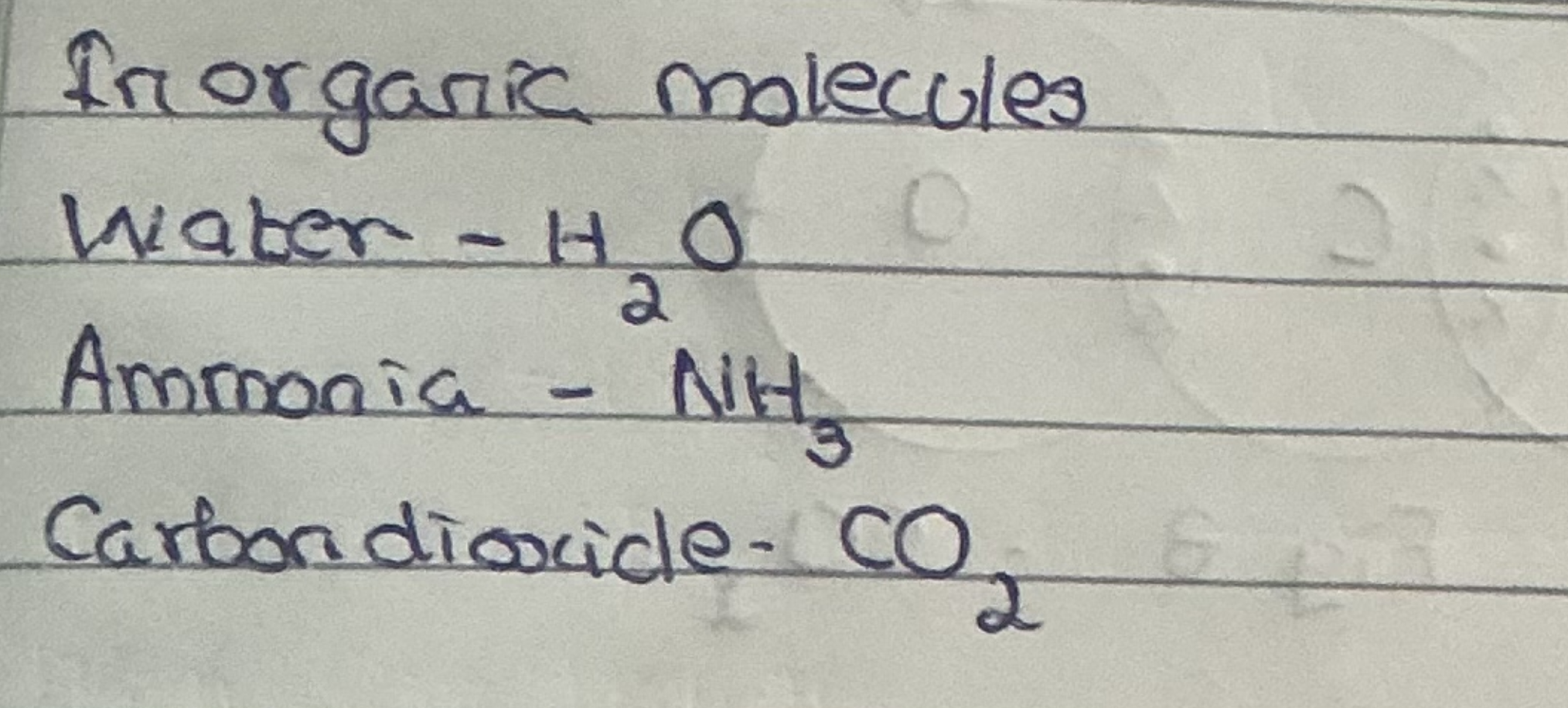
OBJQ
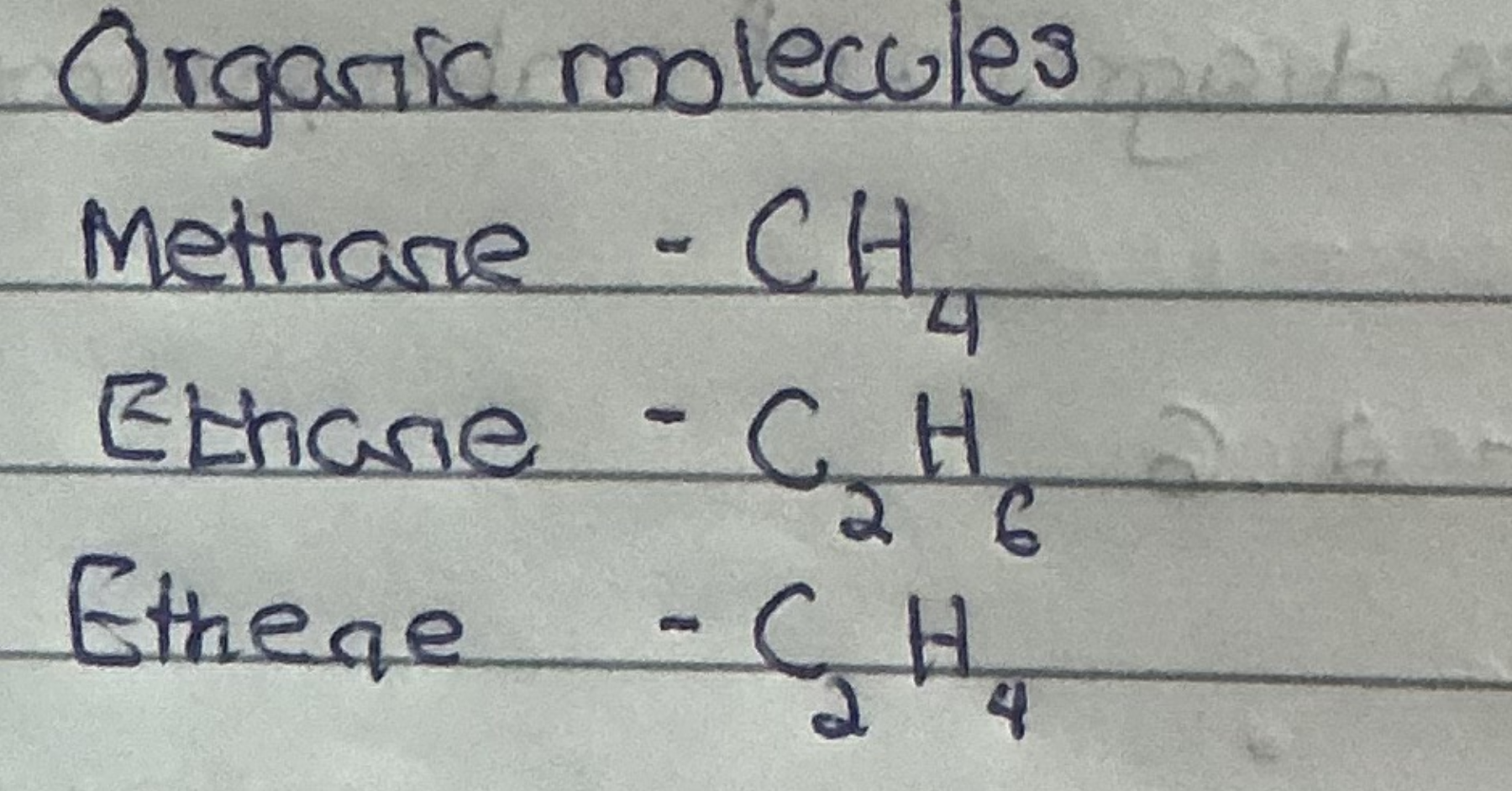
Name the organic molecules