Bio Lesson 5 - Cell Transport
 Call Kai
 Learn
Learn Practice Test
 Spaced Repetition
 Match
Match Flashcards
 Knowt Play
1/17

There's no tags or description
Looks like no tags are added yet.
Name | Mastery | Learn | Test | Matching | Spaced | Call with Kai | Chat |
|---|
No analytics yet
Send a link to your students to track their progress
18 Terms
Cell Transport
Mechanisms that cells use to transport across the cell membrane
Creates a set of internal conditions different from the surroundings — i.e. homeostasis
Passive Transport
Requires no additional energy
moves ALONG the concentration gradient—from high to low concentration
Simple Diffusion
Small, hydrophobic molecules pass through the phospholipid bilayer
Facilitated Diffusion
molecules transported by channel proteins
Osmosis
movement of a solvent from low solute concentration to high solute concentration
basically, the movement of water to balance out the concentration
Levels of Tonicity
describes how the solute concentration of a solution compares to the concentration of the cell
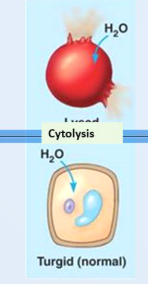
Hypotonic
Lower concentration outside the cell caused water to diffuse into the cell which swelled up
Movement: Water moves into the cell
Animal cells: Cytolysis (Bursts)
Plant cells: Turgid (Normal/Firm)
Isotonic
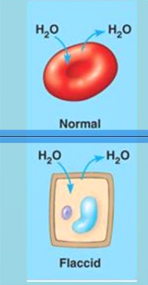
Equal concentration in and out the cell caused no net movement, change in cell size nor shape
Movement: Balanced; water still moves
Animal cells: Normal (Healthy)
Plant cells: Flaccid (Limp)
Hypertonic
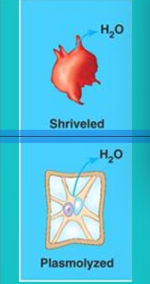
Higher concentration outside the cell caused water to diffuse out of the cell, which shrunk
Movement: Water leaves the cell
Animal cells: Shriveled (Shrinks)
Plant cells: Plasmolyzed/Plasmolysis (Membrane shrinks away)
ATP
Adenosine Triphosphate
the primary energy-carrying molecule that acts as the "rechargeable battery" of the cell, powering almost every cellular activity and chemical reaction.
Active Transport
Requires energy in the form of ATP
moves AGAINST the concentration gradient—from low to high concentration
Protein pumps
proteins on the membrane pump molecules in or out of the cell
Bulk transport
mechanisms of cell transport in very large quantities or sizes
Exocytosis
exit of materials from the cell
Endocytosis
entry of materials into the cell
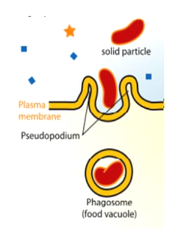
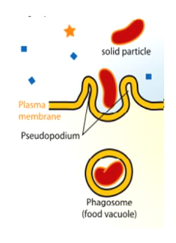
Phagocytosis
“cell eating”
engulfs solid material
The cell membrane extends outward using pseudopodia ("false feet") to surround, trap, and engulf large solid particles or whole bacteria.
pseudopodia: temporary, arm-like extensions of a cell’s membrane and cytoplasm that are used for movement and capturing food.
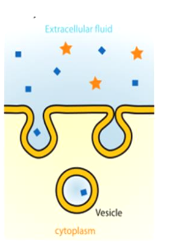
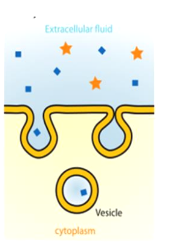
Pinocytosis
“cell drinking”
engulfs liquid material
The cell membrane folds itself inward to suck in extracellular liquid and whatever random materials happen to be floating in it.
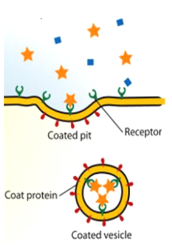
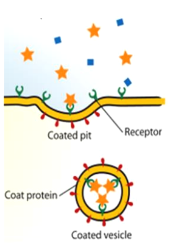
Receptor-mediated
very specific pinocytosis
engulfs material that requires receptors
The cell membrane has receptor proteins that wait for specific target molecules to land on them, which triggers the membrane to fold inward and suck them in.
receptor proteins: specialized chemical receivers embedded in a cell's membrane (or sitting inside the cell) that pick up molecular signals from the outside world and tell the cell how to respond.