Module 3 (Week 4) - Chapter 6: The Simplest Short-Run Macro Model
 Call Kai
 Learn
Learn Practice Test
 Spaced Repetition
 Match
Match Flashcards
 Knowt Play
1/86

There's no tags or description
Looks like no tags are added yet.
Name | Mastery | Learn | Test | Matching | Spaced | Call with Kai | Chat |
|---|
No analytics yet
Send a link to your students to track their progress
87 Terms
Define desired aggregate expenditure (AE).
The sum of desired expenditures or planned spending on domestically produced output by households, firms, governments, and foreign purchasers
What are the 4 main groups of decision makers?
Households
Firms
Governments
Foreign purchasers
What is the formula for calculating desired aggregate expenditure (AE)?
AE = C + I + G + (X — IM)
C: consumption (households)
I: investment (firms)
G: government purchases
X: exports
IM: imports
True or False: Desired expenditure is not always equal to actual expenditure, either in total or in any individual category.
True
Define autonomous expenditures.
Components of aggregate expenditure that do not systematically change with national income
Define induced expenditures.
Components of aggregate expenditure that do systematically change with national income
Desired investment is typically an ______ expenditure. Desired consumption is typically an ______ expenditure.
Desired investment is typically an autonomous expenditure. Desired consumption is typically an induced expenditure.
In the simplest possible model of national income determination, what are the 3 simplifying assumptions?
Closed economy (no trade with other countries)
No government (no taxes)
Price level is constant
Define disposable income.
The amount of income that households receive after paying taxes
Define saving.
All disposable income that is not spent on consumption
In a simple model with no government and no taxation, aggregate disposable income (YD) is ______ national income (Y).
A) Greater than
B) Less than
C) Equal to
C) Equal to
By definition, there are only 2 possible uses of disposable income: ______ and ______.
By definition, there are only 2 possible uses of disposable income: consumption and saving.
Define consumption function.
The relationship between the total desired consumption of all households and the factors influencing desired consumption (such as disposable income)
What is the equation for the consumption function?
C = a + bYD
a: autonomous consumption
b: marginal propensity to consume (MPC)
0 < b < 1
YD: disposable income
What are the 4 key factors influencing desired consumption?
Disposable income
Wealth
Interest rates
Expectations about the future
Holding constant other determinations of desired consumption, an increase in disposable income leads to a(n) ______ in desired consumption.
Holding constant other determinations of desired consumption, an increase in disposable income leads to a(n) increase in desired consumption.
Define average propensity to consume (APC).
The proportion of disposable income that households want to consume
Ratio of desired consumption expenditure to disposable income
What is the formula for calculating average propensity to consume (APC)?
APC = C / YD
APC = Desired Consumption Expenditure / Disposable Income
Define marginal propensity to consume (MPC).
The measurement of how much of one additional dollar of income gets spent on consumption
Ratio of the change in desired consumption to the change in disposable income
What is the formula for calculating marginal propensity to consume (MPC)?
MPC = Δ C / Δ YD
MPC = Change in Desired Consumption / Change in Disposable Income
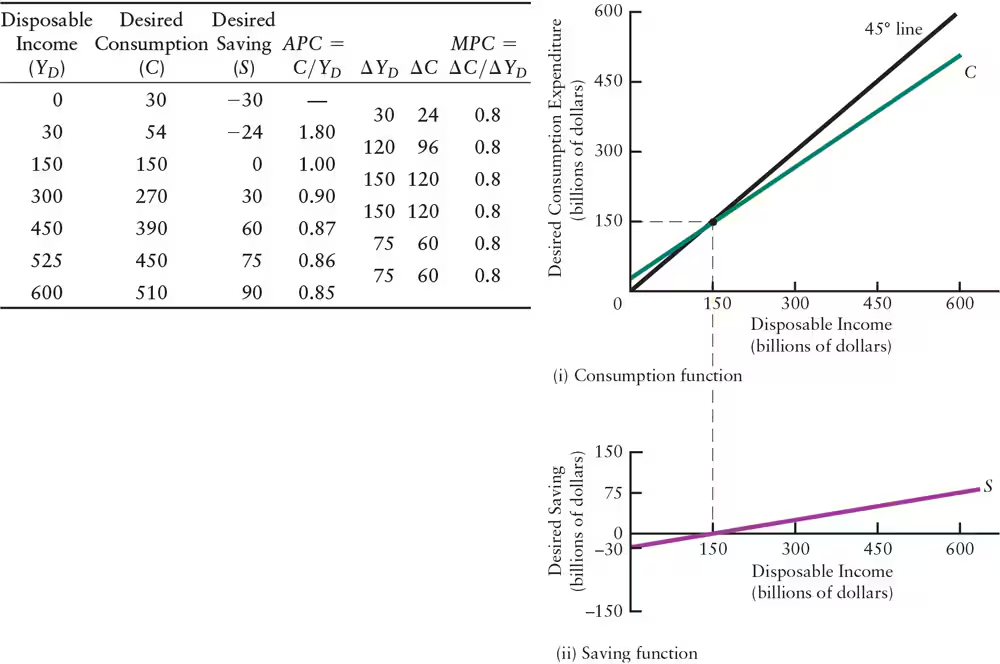
The consumption function has a slope of ______, which is, by definition, the ______ propensity to consume.
The consumption function has a slope of Δ C / Δ YD (change in desired consumption / change in disposable income), which is, by definition, the marginal propensity to consume.
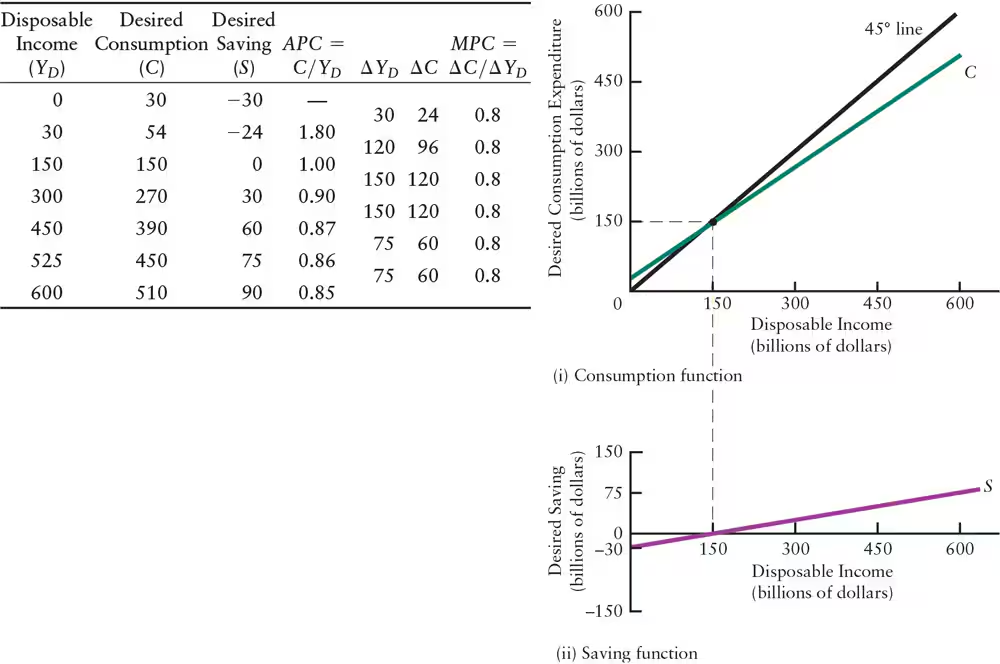
The positive slope of the consumption function shows that the marginal propensity to consume (MPC) is ______: increases in disposable income lead to ______ in desired consumption expenditure.
The positive slope of the consumption function shows that the marginal propensity to consume (MPC) is positive: increases in disposable income lead to increases in desired consumption expenditure.
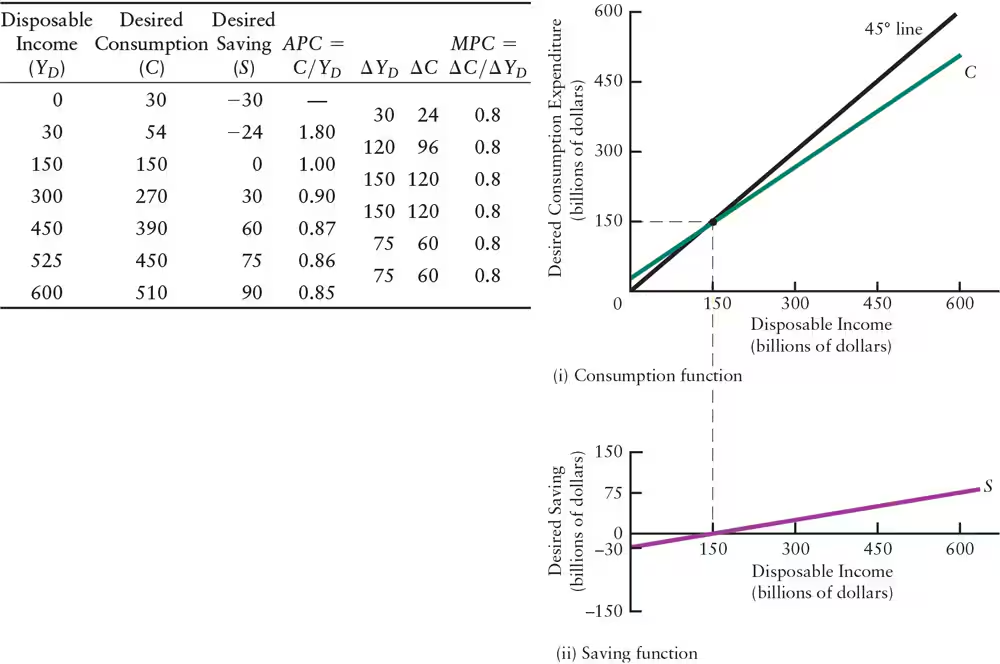
True or False: The constant slope of the consumption function shows that the MPC (marginal propensity to consume) is the same at any level of disposable income.
True
Define break-even level of income.
The level of disposable income at which desired consumption is equal to disposable income
Desired saving is zero
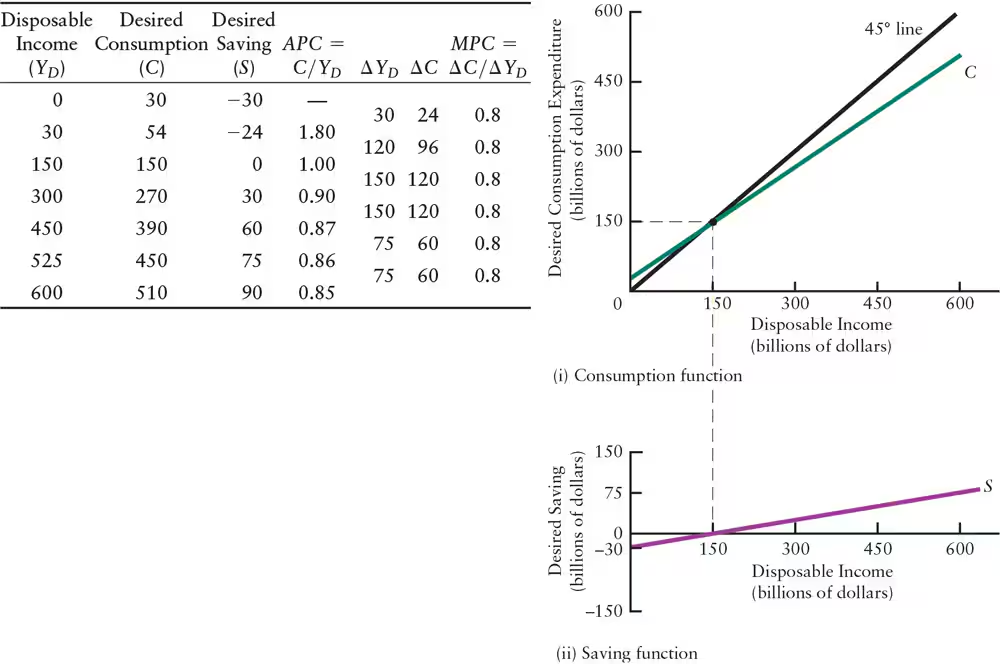
The consumption function intersects the 45° line (C = YD) when income is $150 billion. This is called the ______.
The consumption function intersects the 45° line (C = YD) when income is $150 billion. This is called the break-even level of income.
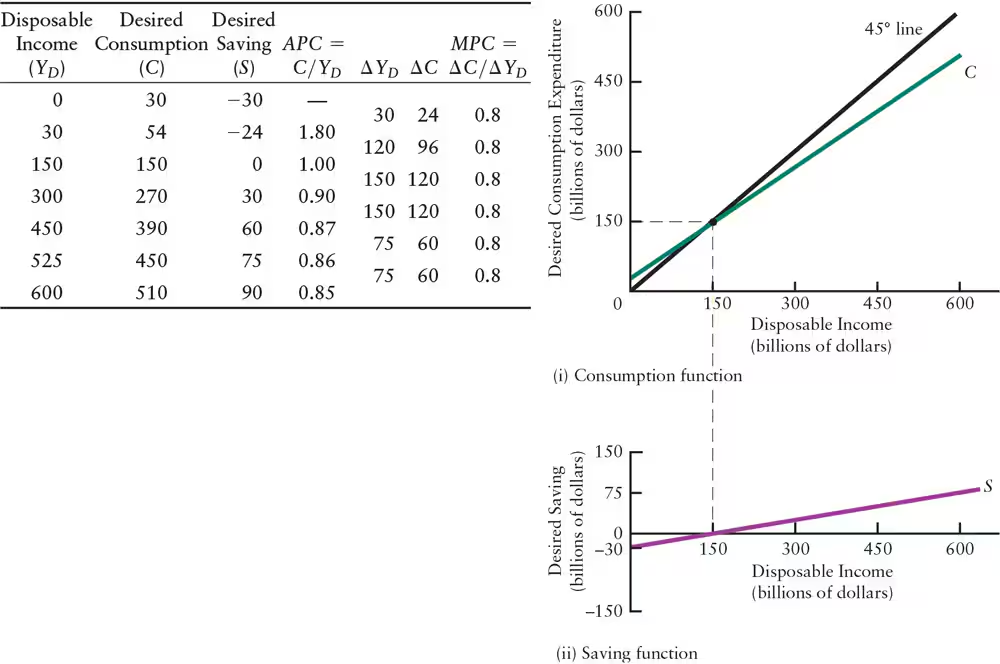
When disposable income is less than $150 billion, desired consumption is ______ disposable income, and thus, desired saving is ______. When disposable income is greater than $150 billion, desired consumption is ______ disposable income, and thus, desired saving is ______.
When disposable income is less than $150 billion, desired consumption is greater than disposable income, and thus, desired saving is negative. When disposable income is greater than $150 billion, desired consumption is less than disposable income, and thus, desired saving is positive.
Define average propensity to save (APS).
The proportion of disposable income that households want to save
Ratio of desired saving to disposable income
What is the formula for calculating average propensity to save (APS)?
APS = S / YD
APS = Desired Saving / Disposable Income
Define marginal propensity to save (MPS).
Ratio of the change in desired saving to the change in disposable income
What is the formula for calculating marginal propensity to save (MPS)?
MPS = Δ S / Δ YD
MPS = Change in Desired Saving / Change in Disposable Income
Explain the relationship between average propensity to consume (APC) and average propensity to save (APS).
APC + APS = 1
Explain the relationship between marginal propensity to consume (MPC) and marginal propensity to save (MPS).
MPC + MPS = 1
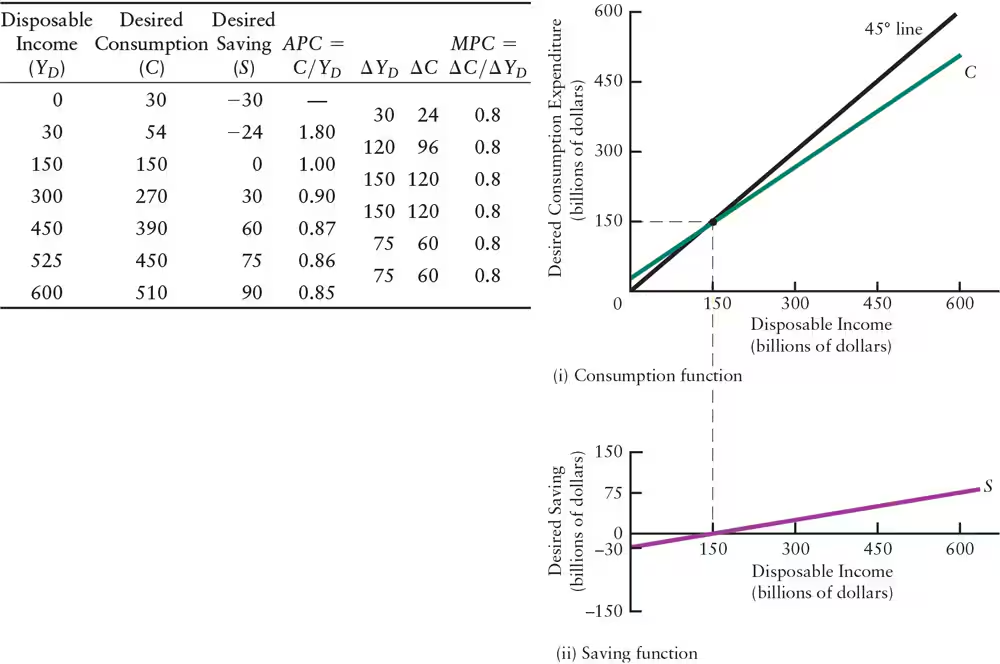
The saving function is ______ sloped, indicating that an increase in disposable income will lead to a(n) ______ in desired saving.
The saving function is positively sloped, indicating that an increase in disposable income will lead to a(n) increase in desired saving.
Changes in ______ lead to movements along the consumption function. Changes in ______, ______, and ______ lead to shifts of the consumption function.
Changes in disposable income lead to movements along the consumption function. Changes in wealth, interest rates, and households’ expectations lead to shifts of the consumption function.
Define household wealth.
The value of all accumulated assets minus the value of all accumulated debts
Assets:
Ex: savings accounts, ownership of homes, stocks or bonds, Registered Retirement Savings Plans (RRSPs), Tax Free Savings Accounts (TFSAs)
Debts:
Ex: home mortgages, car loans, credit-card debt, personal lines of credit
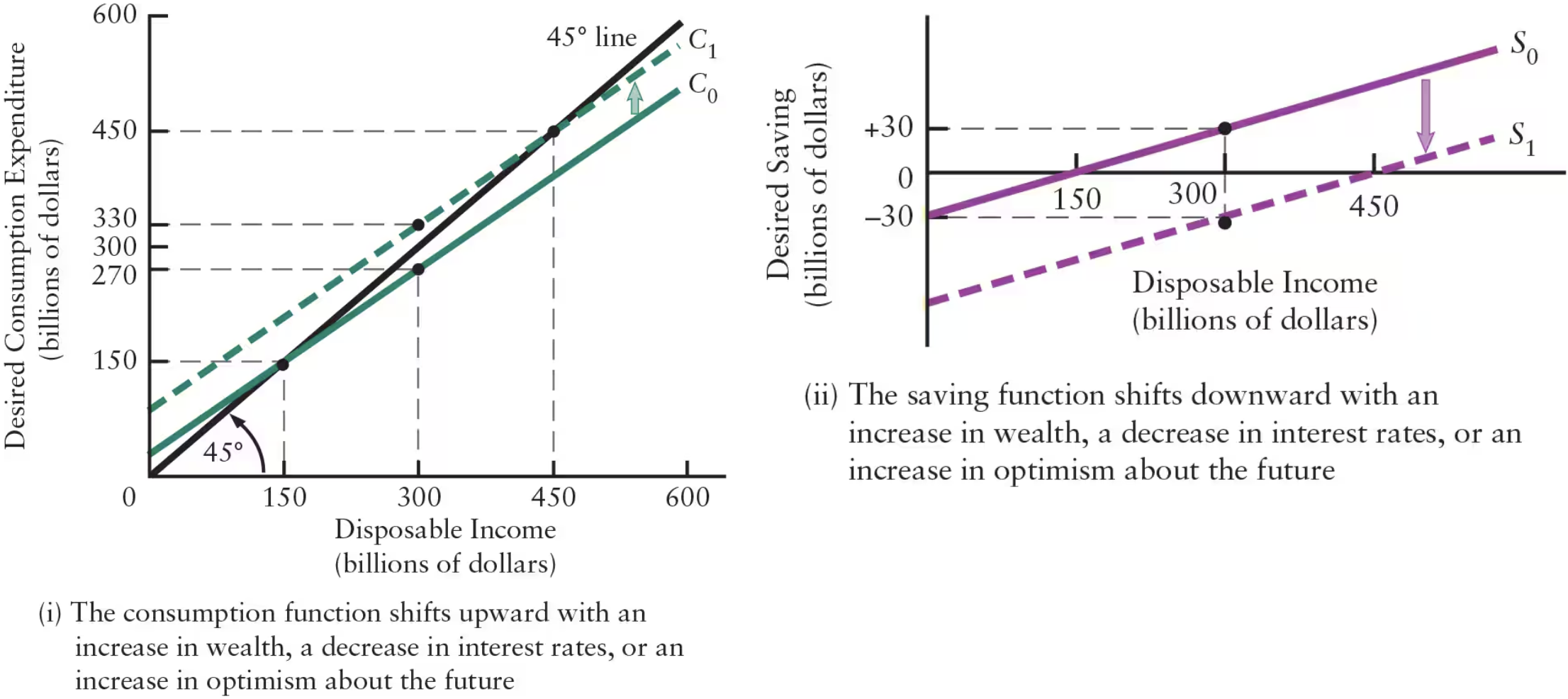
An increase in household wealth shifts the consumption function ______ at any level of disposable income. A decrease in household wealth shifts the consumption function ______.
An increase in household wealth shifts the consumption function upward at any level of disposable income. A decrease in household wealth shifts the consumption function downward.
Household consumption can be divided into consumption of ______ goods (goods that deliver benefits for several years—cars, furniture, household appliances) and ______ goods (goods that deliver benefits for only short periods of time—groceries, clothing).
Household consumption can be divided into consumption of durable goods (goods that deliver benefits for several years—cars, furniture, household appliances) and non-durable goods (goods that deliver benefits for only short periods of time—groceries, clothing).
A fall in interest rates (reduction in the cost of borrowing) leads to a(n) ______ in desired consumption, and thus, the consumption function shifts ______.
A fall in interest rates (reduction in the cost of borrowing) leads to a(n) increase in desired consumption, and thus, the consumption function shifts upward.
A rise in interest rates (rise in the cost of borrowing) leads to a(n) ______ in desired consumption, and thus, the consumption function shifts ______.
A rise in interest rates (rise in the cost of borrowing) leads to a(n) decrease in desired consumption, and thus, the consumption function shifts downward.
Expectations about the future state of the economy often influence desired consumption. Optimism leads to a(n) ______ shift in the consumption function. Pessimism leads to a(n) ______ shift in the consumption function.
Expectations about the future state of the economy often influence desired consumption. Optimism leads to a(n) upward shift in the consumption function. Pessimism leads to a(n) downward shift in the consumption function.
A movement along the consumption function shows changes in ______ consumption (disposable income). A shift of the consumption function shows changes in ______ consumption (wealth, interest rates, expectations about the future).
A movement along the consumption function shows changes in induced consumption (disposable income). A shift of the consumption function shows changes in autonomous consumption (wealth, interest rates, expectations about the future).
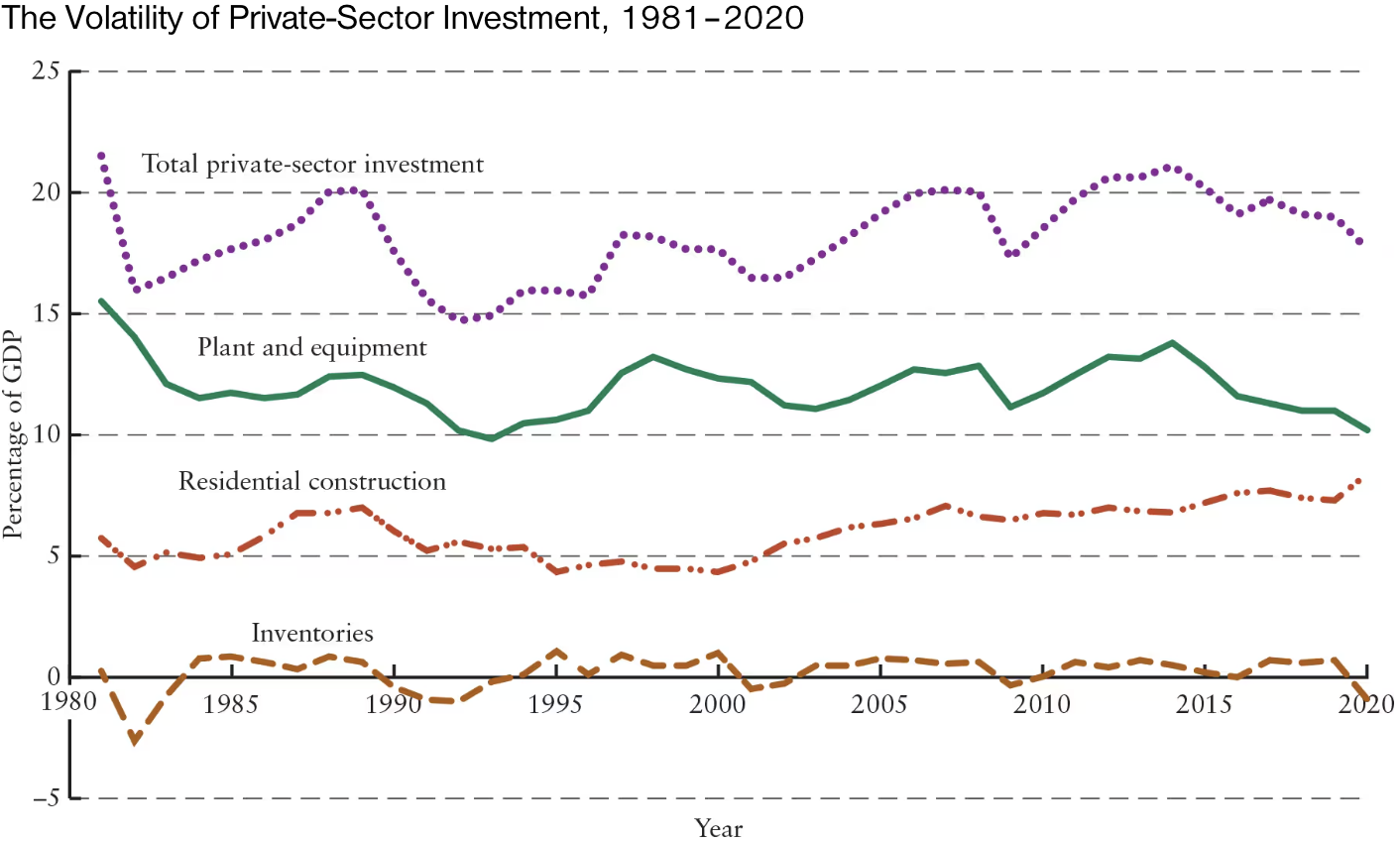
True or False: Investment expenditure is the most volatile component of GDP, and changes in investment are strongly associated with short-run fluctuations in national income.
True
What are the 3 determinants of desired investment expenditure?
Real interest rate
Changes in the level of sales
Business confidence
The real interest rate reflects the ______ associated with investment (whether in inventories, residential construction, or new plant and equipment). The higher the real interest rate, the ______ the opportunity cost, and thus, the ______ the amount of desired investment.
The real interest rate reflects the opportunity cost associated with investment (whether in inventories, residential construction, or new plant and equipment). The higher the real interest rate, the higher the opportunity cost, and thus, the lower the amount of desired investment.
The higher the average level of sales, the ______ the desired stock of inventories (investment).
The higher the average level of sales, the higher the desired stock of inventories (investment).
Investment depends on firms’ expectations about the future state of the economy. Optimism leads to ______ desired investment. Pessimism leads to ______ desired investment.
Investment depends on firms’ expectations about the future state of the economy. Optimism leads to higher desired investment. Pessimism leads to lower desired investment.
True or False: Since most investment takes time to complete and is long-lasting, the current level of real GDP is not an important determinant of desired investment.
True
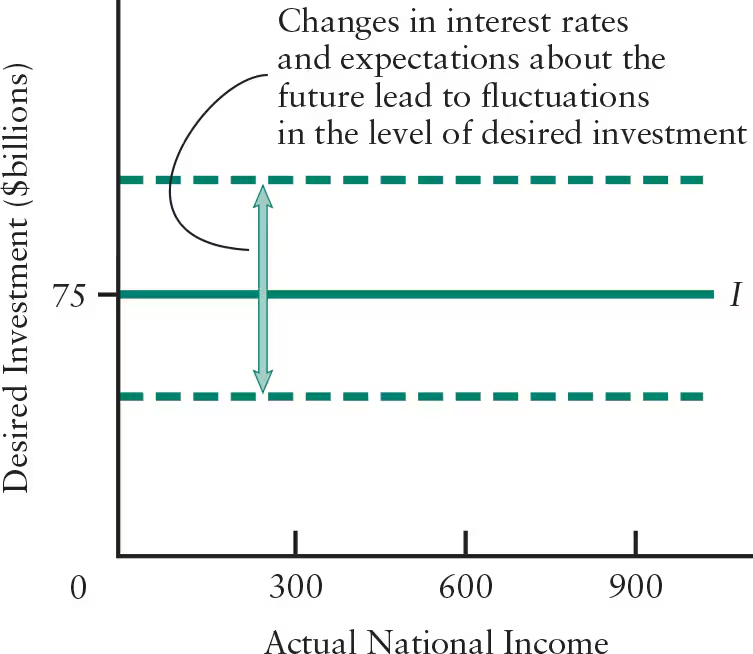
Desired investment is assumed to be ______ with respect to national income. Therefore, changes in interest rates or business confidence will lead to upward or downward ______ in the investment function.
A) Autonomous; movements
B) Autonomous; shifts
C) Induced; movements
D) Induced; shifts
B) Autonomous; shifts
Define aggregate expenditure (AE) function.
A function that represents desired aggregate expenditure on the vertical axis and actual national income on the horizontal axis
The AE function shows, for any given level of actual national income, the total amount of desired spending in the economy
What is the formula for calculating aggregate expenditure (AE) function in a simplified economy?
AE = C + I
AE = Desired Consumption + Desired Investment
In a simplified economy without government and international trade, there is no G or (X — IM)
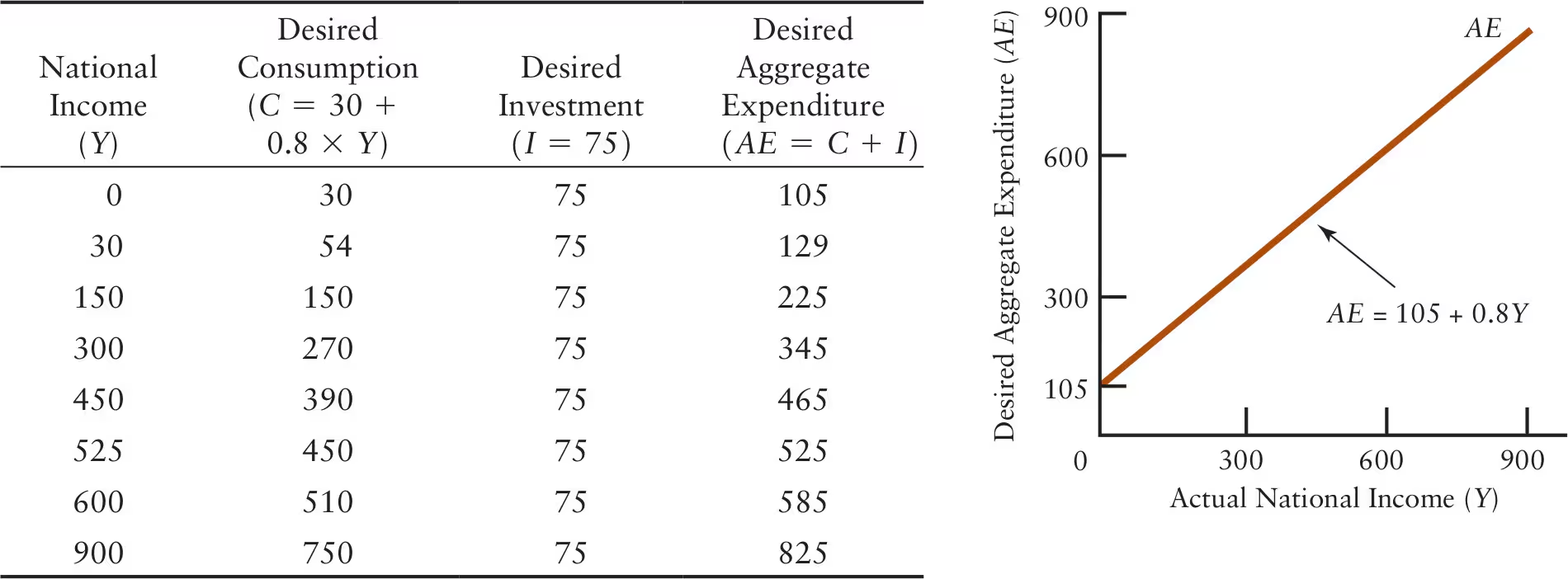
When the national income is equal to zero, both desired investment ($75 billion) and desired consumption ($30 billion) are ______. Therefore, total ______ expenditure is ______.
When the national income is equal to zero, both desired investment ($75 billion) and desired consumption ($30 billion) are autonomous. Therefore, total aggregate expenditure is $105 billion.
Define marginal propensity to spend.
The fraction of any increment to national income that is spent on domestic output
This is the slope of the aggregate expenditure function
What is the formula for calculating marginal propensity to spend?
Marginal Propensity to Spend = Δ AE / Δ Y
Marginal Propensity to Spend = Change in Desired Aggregate Expenditure / Change in National Income
The marginal propensity to spend is the amount of extra total ______ induced when national income rises by $1, whereas the marginal propensity to consume is the amount of extra ______ induced when households’ disposable income rises by $1.
The marginal propensity to spend is the amount of extra total expenditure induced when national income rises by $1, whereas the marginal propensity to consume is the amount of extra consumption induced when households’ disposable income rises by $1.
Define demand-determined output.
The assumption that firms are able and willing to produce any amount of output demanded, and that changes in production levels do not require changes in product prices
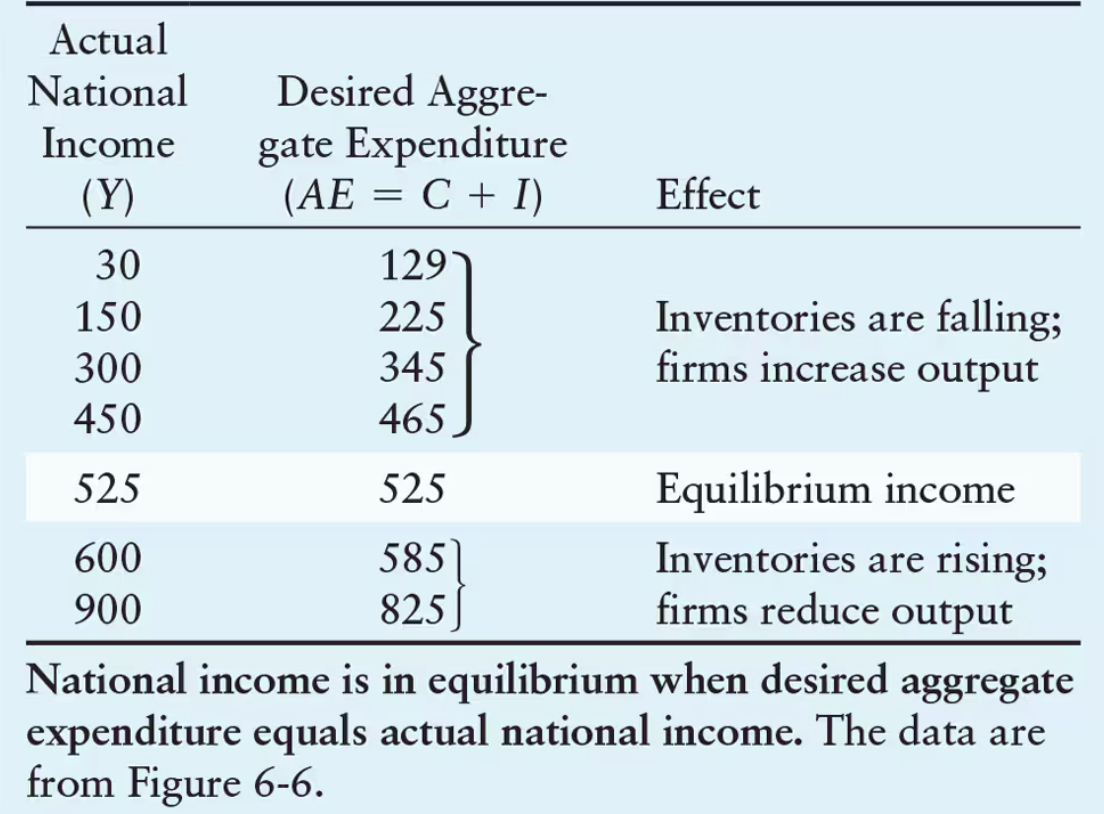
If firms are producing a final output of $300 billion, actual national income is ______.
If firms are producing a final output of $300 billion, actual national income is $300 billion.
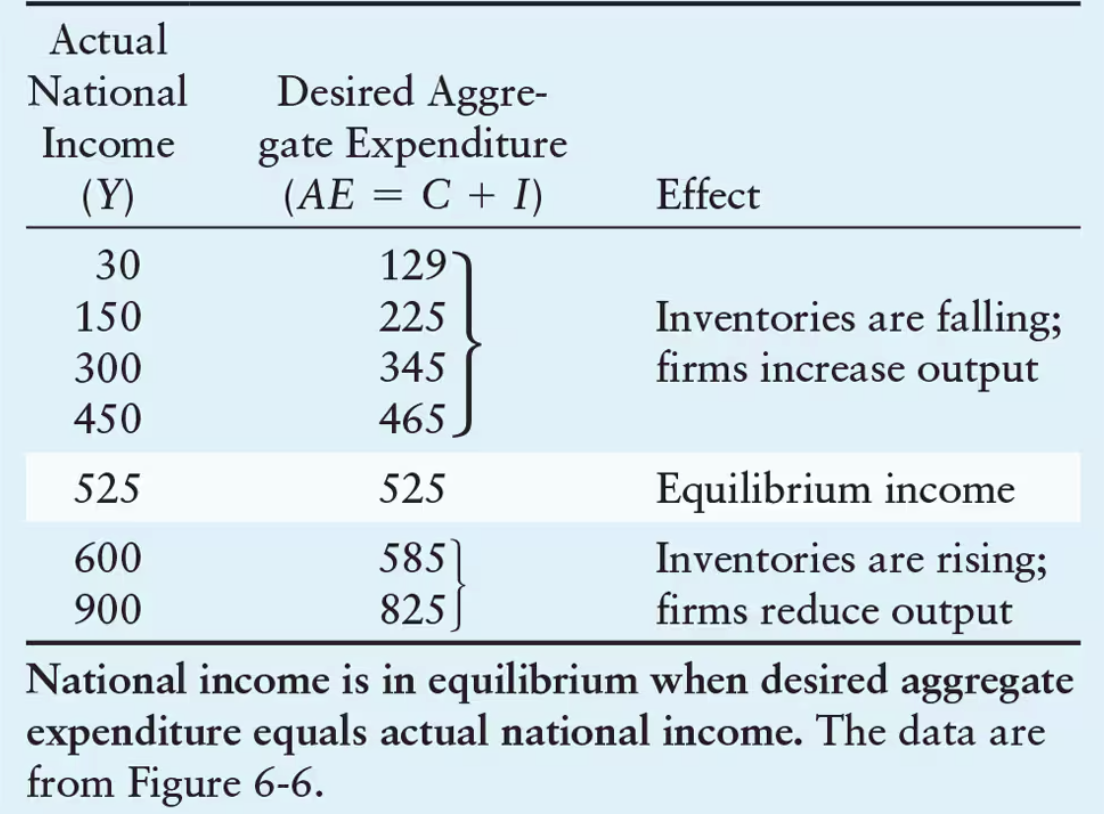
When actual national income is $300 billion, desired aggregate expenditure is ______.
When actual national income is $300 billion, desired aggregate expenditure is $345 billion.
For any level of national income at which desired aggregate expenditure exceeds actual income, there will be pressure for national income to ______.
For any level of national income at which desired aggregate expenditure exceeds actual income, there will be pressure for national income to rise.
For any level of income at which desired aggregate expenditure is less than actual income, there will be pressure for national income to ______.
For any level of income at which desired aggregate expenditure is less than actual income, there will be pressure for national income to fall.
The ______ level of national income occurs when desired aggregate expenditure is equal to actual national income.
The equilibrium level of national income occurs when desired aggregate expenditure is equal to actual national income.
If desired aggregate expenditure is greater than actual national income, firms’ decisions to ______ output will lead to a(n) ______ in national income (GDP).
If desired aggregate expenditure is greater than actual national income, firms’ decisions to increase output will lead to a(n) increase in national income (GDP).
If desired aggregate expenditure is less than actual national income, firms’ decisions to ______ output will lead to a(n) ______ in national income (GDP).
If desired aggregate expenditure is less than actual national income, firms’ decisions to reduce output will lead to a(n) decrease in national income (GDP).
In algebraic terms, what is the equilibrium condition?
AE = Y
Desired Aggregate Expenditure = Actual National Income
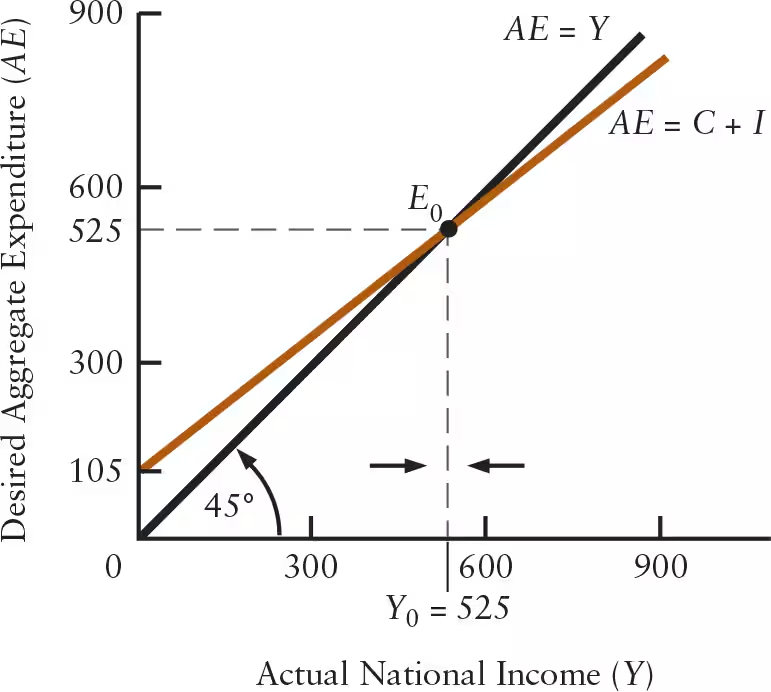
The equilibrium condition is often referred to as the ______ line.
The equilibrium condition is often referred to as the 45° line.
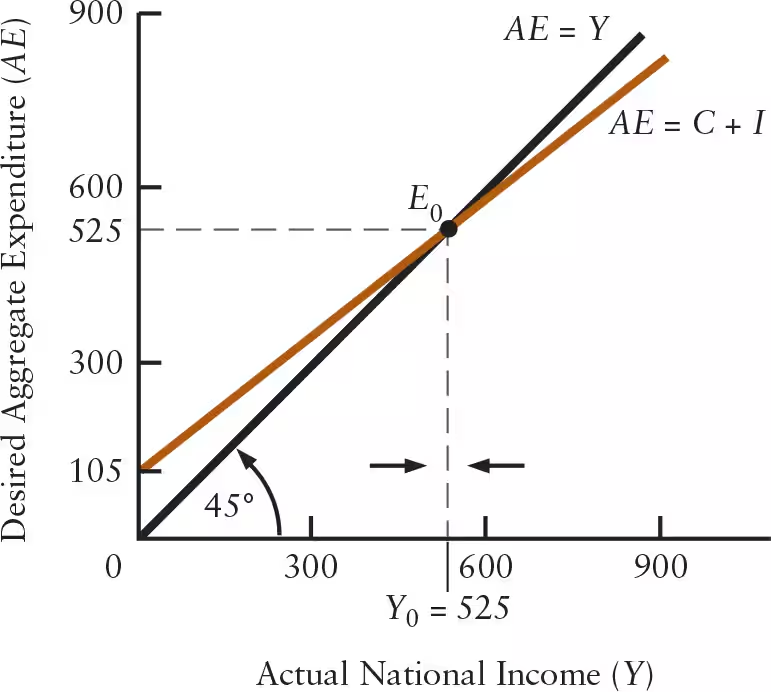
If actual national income is below Y0, desired aggregate expenditure will be ______ than national income, and output will ______.
If actual national income is below Y0, desired aggregate expenditure will be greater than national income, and output will rise.
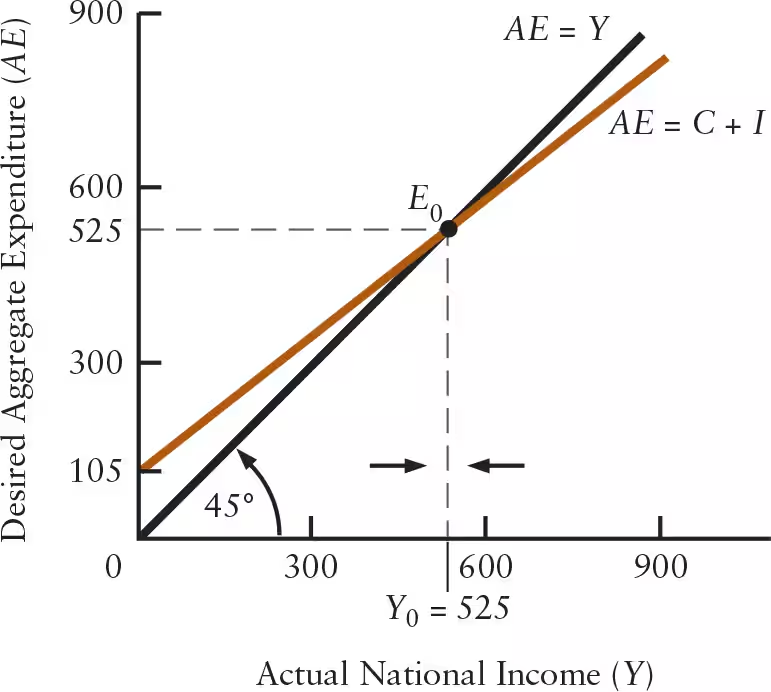
If actual national income is above Y0, desired aggregate expenditure will be ______ than national income, and output will ______.
If actual national income is above Y0, desired aggregate expenditure will be less than national income, and output will fall.
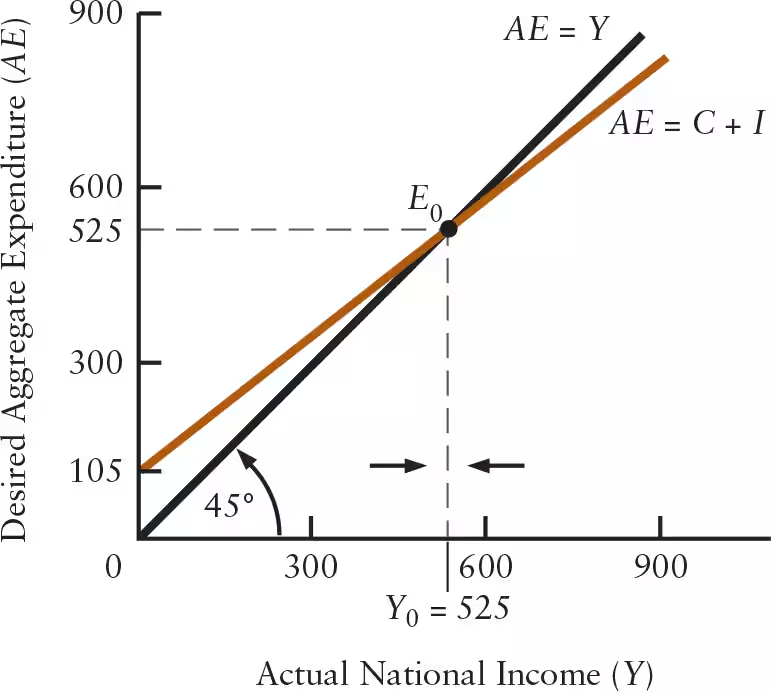
Only when national income is equal to ______ will the economy be in equilibrium, as shown at ______.
Only when national income is equal to Y0 will the economy be in equilibrium, as shown at E0.
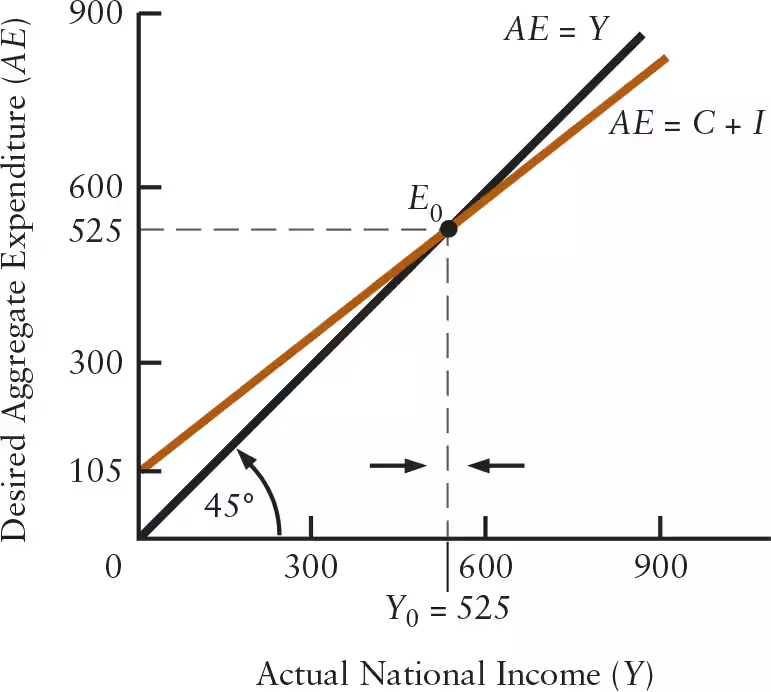
Graphically, ______ occurs at the level of income at which the AE line intersects the 45° line.
Graphically, equilibrium occurs at the level of income at which the AE line intersects the 45° line.
The AE function shifts when there is a shift in the ______ function or the ______ function.
The AE function shifts when there is a shift in the consumption function or the investment function.
What are the 2 types of shifts in aggregate expenditure (AE) function?
Parallel Shift in AE: if the same increase or decrease in expenditure occurs at all levels of income, the AE function shifts parallel to itself
Change in the Slope of AE: if there is an increase in the marginal propensity to spend, the AE function becomes steeper
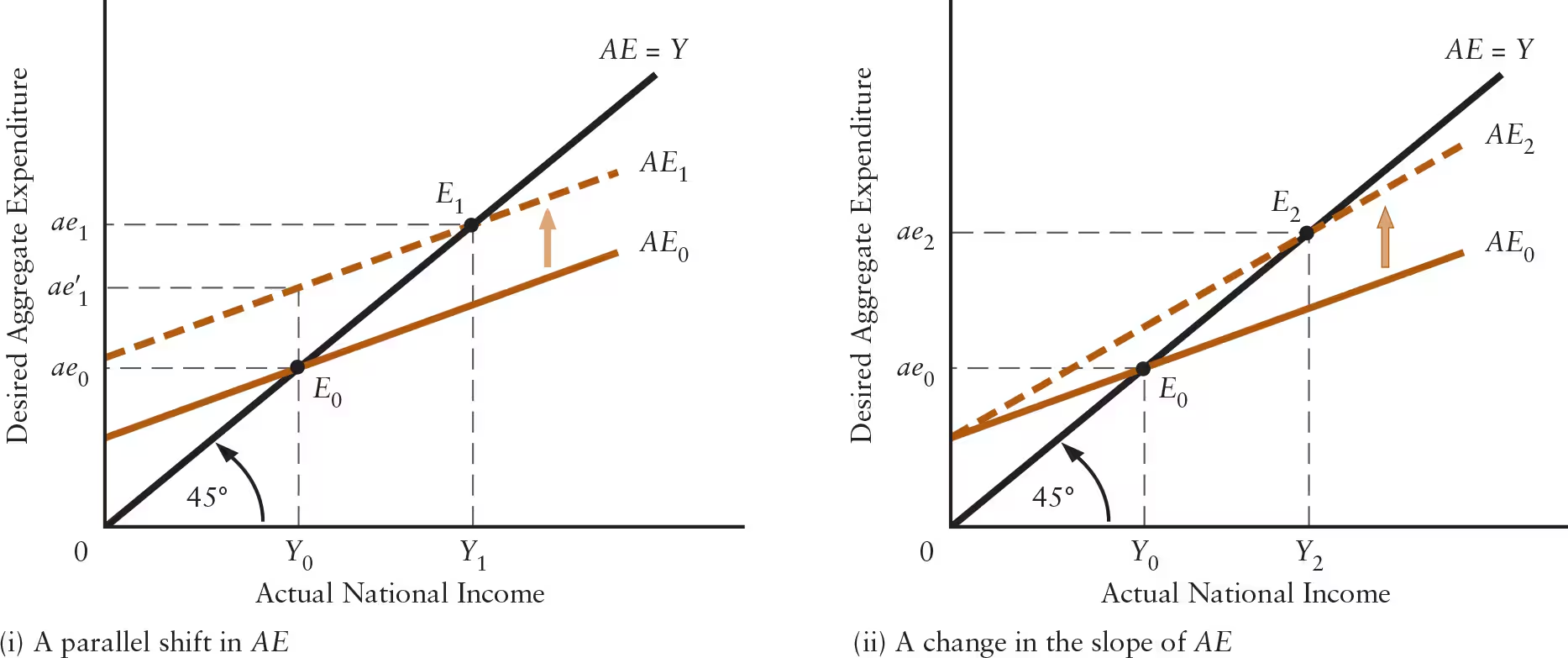
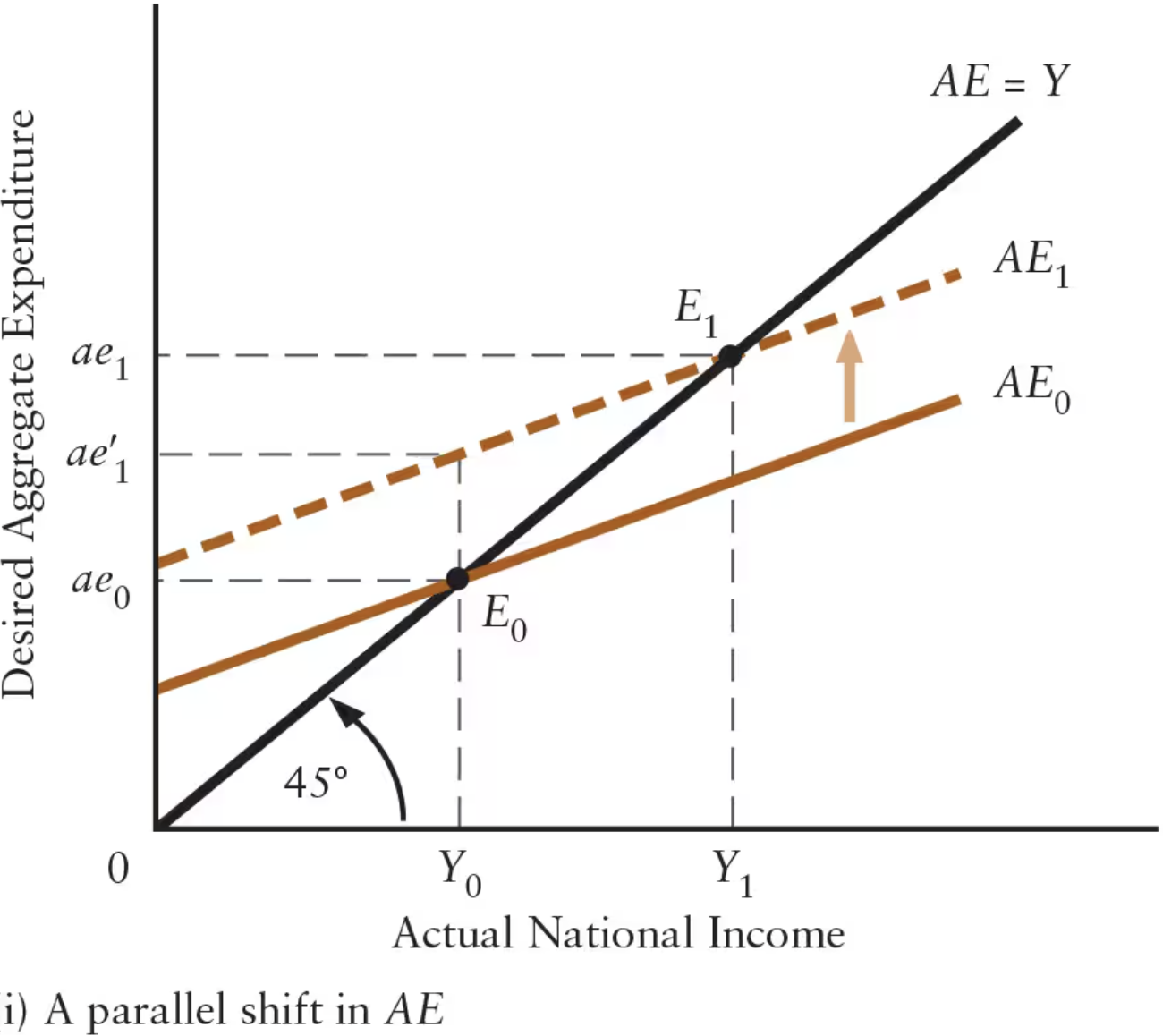
Upward shifts in the aggregate expenditure (AE) function ______ equilibrium income. Downward shifts in the AE function ______ equilibrium income.
Upward shifts in the aggregate expenditure (AE) function increase equilibrium income. Downward shifts in the AE function decrease equilibrium income.
A rise in desired aggregate expenditure at each level of national income will shift the AE curve ______ and ______ equilibrium national income.
A rise in desired aggregate expenditure at each level of national income will shift the AE curve upward and increase equilibrium national income.
A fall in desired aggregate expenditure at each level of national income will shift the AE curve ______ and ______ equilibrium national income.
A fall in desired aggregate expenditure at each level of national income will shift the AE curve downward and reduce equilibrium national income.
A(n) ______ in the marginal propensity to spend, z, steepens the AE curve and increases equilibrium national income.
A(n) increase in the marginal propensity to spend, z, steepens the AE curve and increases equilibrium national income.
A(n) ______ in the marginal propensity to spend, z, flattens the AE curve and decreases equilibrium national income.
A(n) decrease in the marginal propensity to spend, z, flattens the AE curve and decreases equilibrium national income.
Define multiplier.
A measure of the magnitude of changes in national income due to changes in autonomous expenditure
Ex: a change in autonomous expenditure increases equilibrium national income by a multiple of the initial change in autonomous expenditure
Change in national income is larger than the initial change in desired expenditure
The ______ is the change in equilibrium national income divided by the change in autonomous expenditure. In the simple macro model, the ______ is greater than ______.
The multiplier is the change in equilibrium national income divided by the change in autonomous expenditure. In the simple macro model, the multiplier is greater than 1.
Define simple multiplier.
A measure of the change in equilibrium national income that occurs in response to a change in autonomous expenditure when the price level is constant
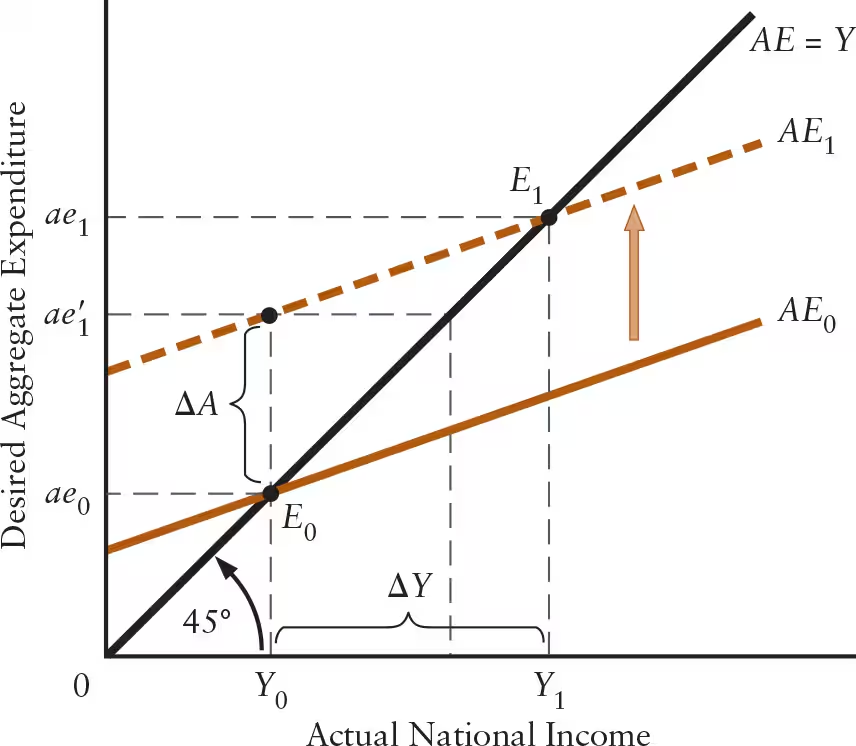
True or False: Since Δ Y is greater than Δ A, the simple multiplier is greater than 1.
True
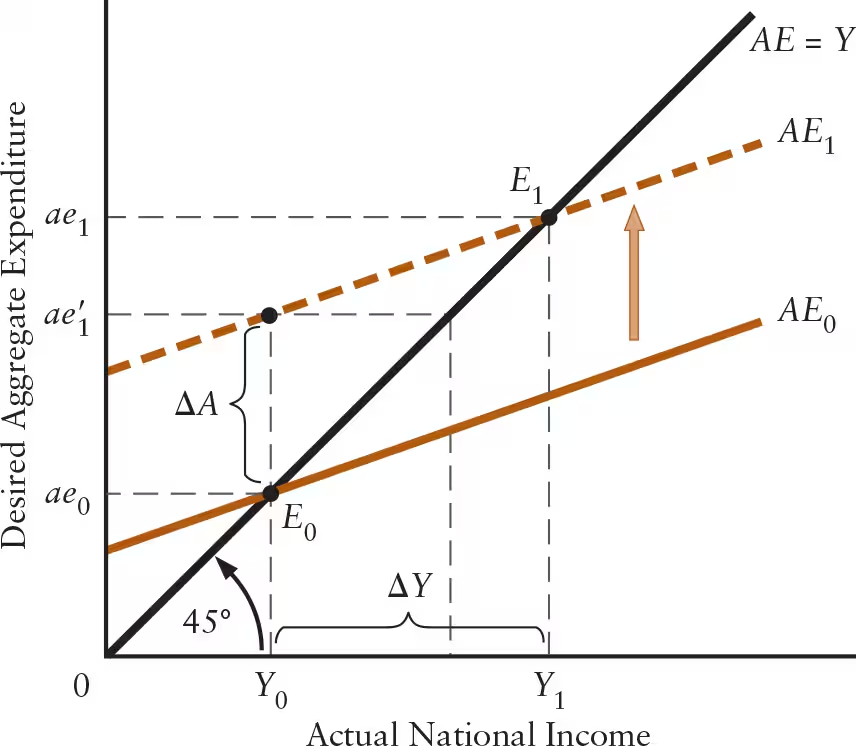
An increase in autonomous aggregate expenditure ______ equilibrium national income by a multiple of the initial increase.
An increase in autonomous aggregate expenditure increases equilibrium national income by a multiple of the initial increase.
The size of the simple multiplier depends on the slope of the AE function—that is, on the ______, z.
The size of the simple multiplier depends on the slope of the AE function—that is, on the marginal propensity to spend, z.
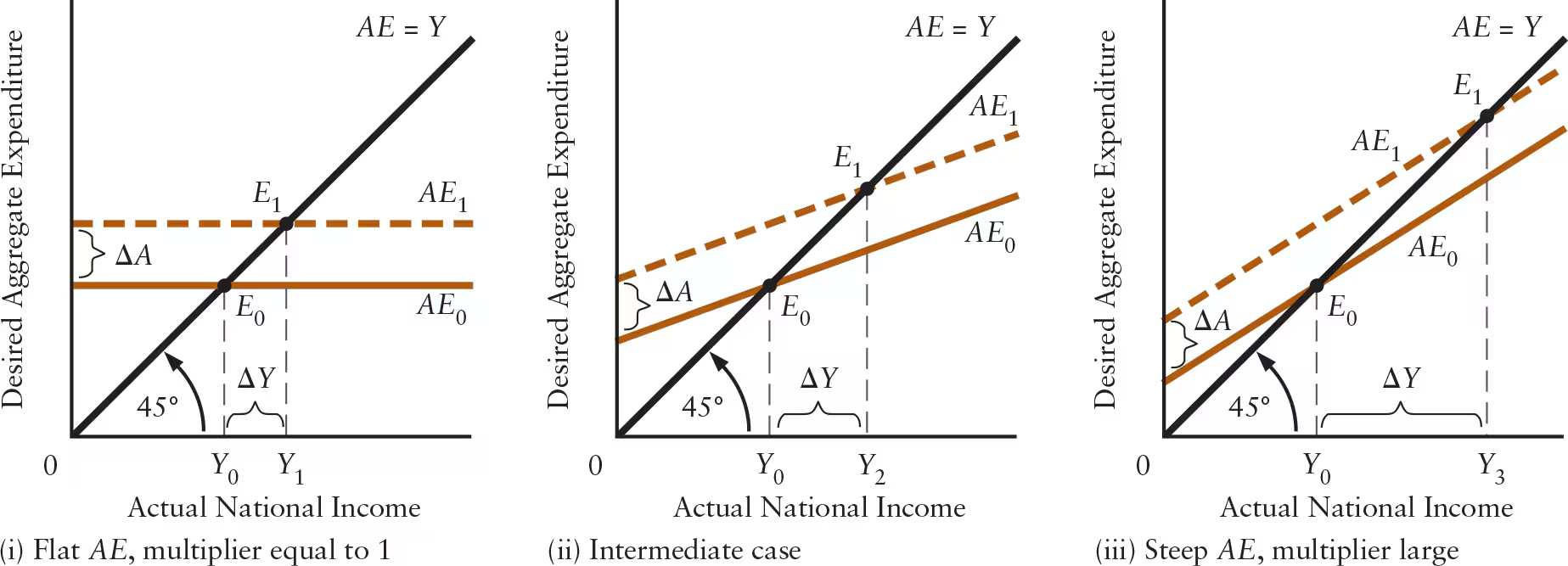
The larger the marginal propensity to spend out of national income (z), the ______ the AE curve and the ______ the simple multiplier.
The larger the marginal propensity to spend out of national income (z), the steeper the AE curve and the larger the simple multiplier.
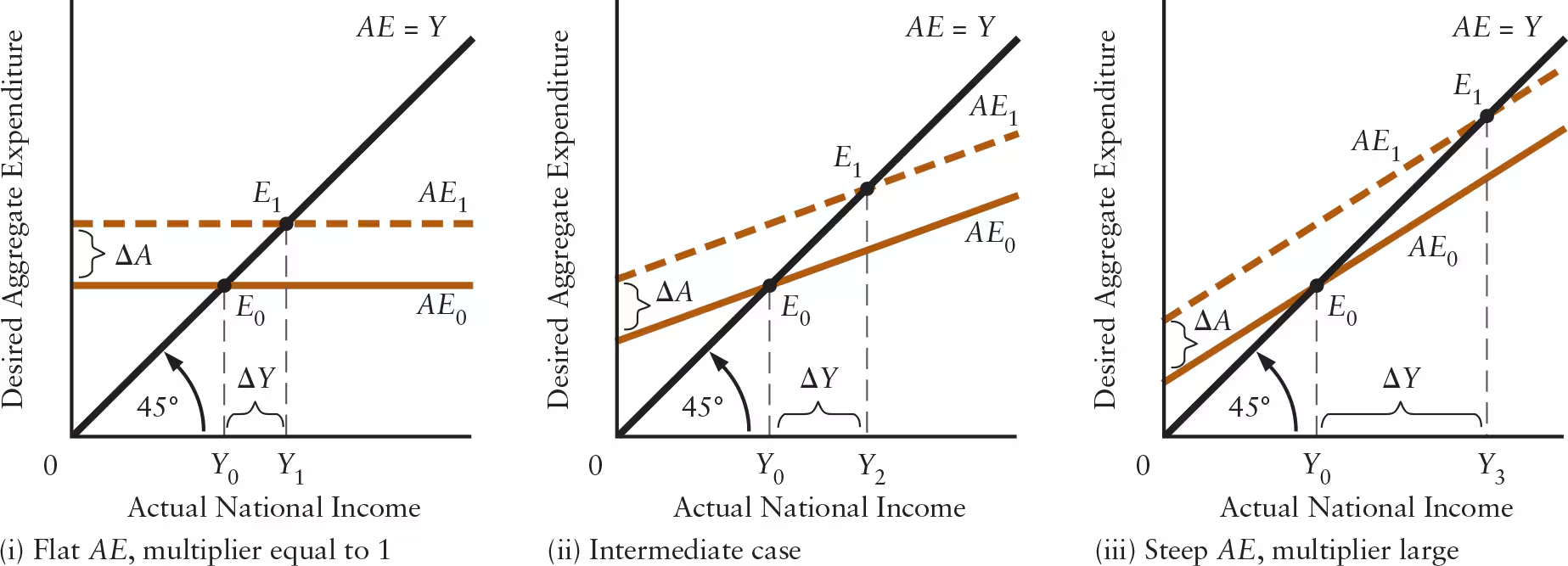
When the AE function is horizontal, marginal propensity to spend (z) is ______. The change in equilibrium income (Δ Y) is only due to the increase in ______ expenditure because there is no ______ expenditure in response to the initial increase in income.
When the AE function is horizontal, marginal propensity to spend (z) is zero. The change in equilibrium income (Δ Y) is only due to the increase in autonomous expenditure because there is no induced expenditure in response to the initial increase in income.
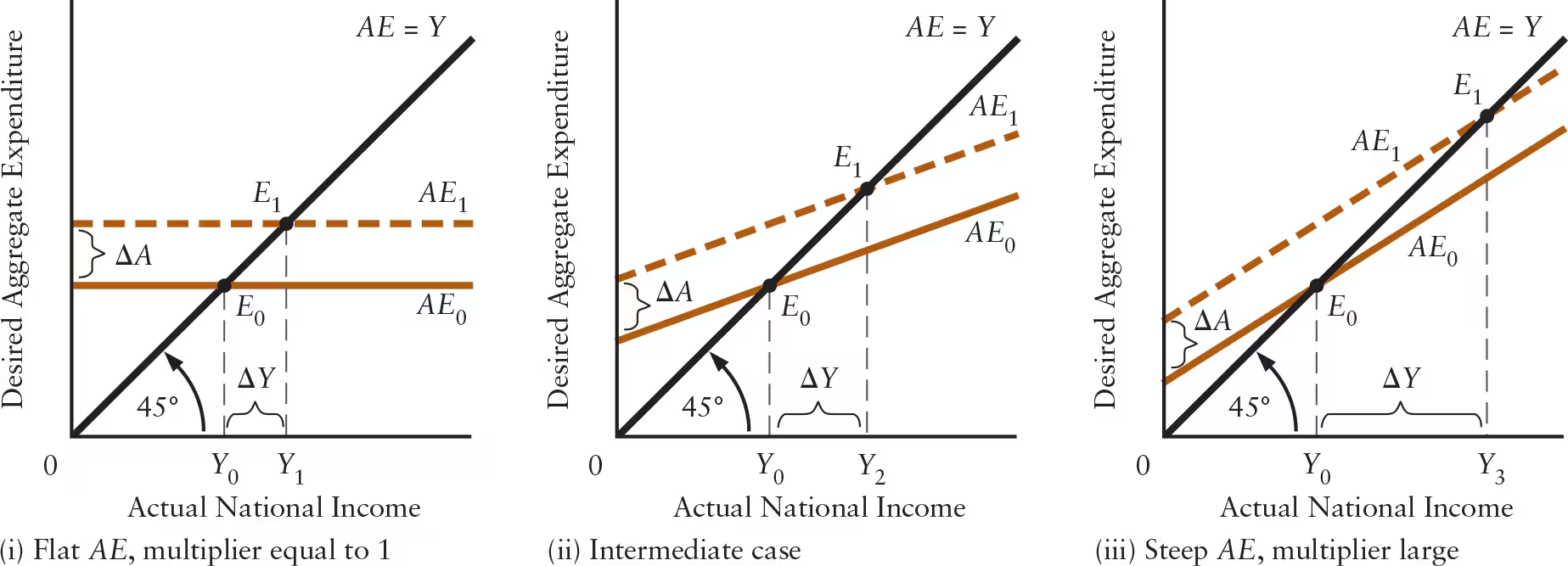
When the AE function is horizontal and the marginal propensity to spend is zero, the simple multiplier is equal to ______.
When the AE function is horizontal and the marginal propensity to spend is zero, the simple multiplier is equal to 1.
What is the formula for calculating the simple multiplier?
Simple Multiplier = Δ Y / Δ A
Simple Multiplier = Change in Equilibrium National Income / Change in Autonomous Expenditure
Simple Multiplier = 1 / (1 — z)
Simple Multiplier = 1 / (1 — Marginal Propensity to Spend)

What is the equation for the aggregate expenditure (AE) curve?
AE = A + zY
A: autonomous expenditure
A is the vertical intercept
zY: induced expenditure
z: marginal propensity to spend
z is the slope
Y: national income
If marginal propensity to spend (z) is equal to 0.8, what is the simple multiplier?
Simple Multiplier = 1 / (1 — z)
Simple Multiplier = 1 / (1 — 0.8)
Simple Multiplier = 5
Therefore, a $1 million increase in autonomous expenditure leads to a $5 million increase in equilibrium national income