ERM 1.2 Midterm
 Call Kai
 Learn
Learn Practice Test
 Spaced Repetition
 Match
Match Flashcards
 Knowt Play
1/54

There's no tags or description
Looks like no tags are added yet.
Name | Mastery | Learn | Test | Matching | Spaced | Call with Kai | Chat |
|---|
No analytics yet
Send a link to your students to track their progress
55 Terms
beta cell function? C-peptide function? excess?
insulin → lower blood glucose via promote uptake (muscle, fat, liver) + stimulating glycogenesis, lipogenesis, protein synthesis
dec. lipolysis, GNG
C-peptide released w/ endogenous insulin (via process/utilize)
low w/ exogenous insulin (since no processing)
excess insulin → neuroglycemia + whipple triad (hypoglycemic Sx, <50 mg/dL blood glucose, fixed w/ glucose admin)
alpha cells function? delta cell function? excess?
glucagon → raise glucose + FA via glycolysis, glycogenolysis, gluconeogenesis
glucagonoma → excess glucagon (5Ds: diabetes, depression, dec. weight, dermatitis, DVT)
somatostatin → inhibit insulin > glucagon + GH (dec. glucose uptake via hypoglycemia)
somatostatinoma → excess somatostatin (achlorhydria, steatorrhea, hyperglycemia)
PP cell function? D1 cell + excess? enterochromaffin cell?
pancreatic polypeptide → regulate GI enzyme + motility
VIP → induce glycogenolysis = hyperglycemia + inc. GI fluid sec. (involved in sec. diarrhea)
excess → watery diarrhea, hypokalemia
EC → serotonin synthesis
G cells function? fed state? fasting state?
@ pyloric antrum, stimulate gastric acid secretion (digestion)
excess → peptic ulcers
fed → source = carbs; inc. insulin, dec. glucagon
fasting → source = glycogenolysis (liver), GNG (AA, glycerol), lipolysis (adipose tissue → FFA + glycerol); dec. insulin, inc. glucagon
type 1 DM etiology? susceptibility? symptoms? labs?
failure of self-tolerance in T cells for pancreatic islet B-cell antigens → autoantibodies = leukocytic infiltration insulitis
type IV sensitivity
MHC II HLADR3 or DR4 genes
polyuria, polydipsia, polyphagia, weight loss despite hunger, infections, slow healing wounds, fatigue
dec. C-peptide (no endogenous prod.), inc. ketones (DKA risk), HbA1c >6.5% + anti-islet antibodies
type 1 DM induced DKA?
stress → E → inc. glucagon → lipolysis → FFA → ketones → acidosis, hyperkalemia (but lost so dec.= hypokalemia)
lymphocytic infiltration of pancreatic islets
fruity breath, dehydration, coma, glucose (500-700 mg/dL), kussmal resp. (met. acidosis = deep/rapid→ dec. CO2)
type 2 DM etiology? cause? symptoms? labs?
insulin resistance (dec. GLUT4) + B cell dysfxn (via B cell compensation)
result of lipotoxicity + glucotoxicity → truncal/visceral obesity + metabolic syndrome = risk factor (inc. adiponectin)
fatigue, blurred vision, polyuria, polydipsia, polyphagia
dec. incretin (GLP-1, GIP), amyloid deposition in islets
might see normal/high C-peptide (body makes insulin but there is insulin resistance)
hyperosmolar hyperglycemic coma → severe dehydration, glucose >550 mg/dL (via infection of MI), NO ketones
chronic complications (NEG) of T1DM and T2DM?
microvascular (pericyte + schwann take up glucose w/o insulin = sorbitol → osmotic damage)
retinopathy → non proliferative or proliferative (sorbitol in pericyte = BV rupture, cataracts, glaucoma)
nephropathy → albuminuria, glomerulosclerosis (proteinuria)
neuropathy → glove-stocking pattern, autonomic dysfxn (sorbitol in schwan cell)
macrovascular → atherosclerosis (CAD, MI, stroke) or peripheral arterial disease (gangrene, RAD, claudication, ulcer)
diabetes screening?
blood glucose conc., glucose tolerance, glycosylated Hbg level, fructosamine, urine glucose conc., urine protein conc., ketone bodies
HbA1C inc.(via NEG) → check 3-4 months
other conditions affecting RBC turnover can effect A1C
ketone bodies → acetoacetate, B-hydroxybutyrate, acetone
insulin secretagogues? MOA? side effects?
sulfonylureas + meglitinides
inc. insulin sec. via inhibiting B cell K ATP channels (open Ca channels/Ca influx → insulin sec)
hypoglycemia + weight gain
glucagon Tx hypoglycemia via Gs CPR
insulin analogs? MOA? side effects?
types:
lispro, aspart, glulisine → rapid; used in CII (2-4 hrs)
regular → short (<8 hrs)
NPH → intermediate (10-20 hrs)
glargine, demerit, degludec → long (24 hrs)
similar fxn as insulin (target = TKR); can be rapid to ultra long acting
hypoglycemia + weight gain
sulfonylureas? MOA? side effects?
1st gen (-mide) or 2nd gen (glipizide, glyburide, glimepiride)
close ATP-sensitive K channels → inc. insulin sec. independent of glucose levels (+ dec. glucagon sec.)
hypoglycemia (esp. w/ metformin) + weight gain
biguanides? MOA? side effects?
metformin
insulin sensitizer → stim. AMPK + inhibit mit. GNG, dec. hepatic glucose prod. + inc. peripheral glucose uptake
diarrhea, lactic acidosis (high lactate, low pH, deep/rapid breath = expel CO2., renal failure), weight loss (anorexia)
thiazolidinediones? MOA? side effects?
pioglitazone
activate nuclear PPAR-y → transcription of insulin-responsive genes (GLUT4)
edema, heart failure, weight gain
GLP-1 agonists? MOA? side effects?
exenatide, liraglutide
pramlintide → amylin analog (only dec. glucagon sec. + Tx T1/2DM)
inc. glucose-dependent insulin sec., dec. glucagon sec., dec. gastric emptying (= anti hyperglycemic)
pancreatitis, weight loss, GI (nausea, vomit, diarrhea)
DPP-4 inhibitors? MOA? side effects?
sitagliptin, saxagliptin
inc. endogenous GLP-1 + GIP (inc. insulin, dec. glucagon, dec. gastric emptying)
nasopharyngitis, joint pain
a-glucosidase inhibitors? MOA? side effects?
acarbose, miglitol
dec. intestinal disaccharide absorption (manage postprandial blood glucose w/ T2DM)
diarrhea, flatulence
SGLT2 inhibitors? MOA? side effects?
canagliflozin, dapagliflozin
inc. renal glucose excretion
SGLT2 → RA glucose @ PCT
UTI, hypotension
adrenal zones? function?
zona glomerulosa: aldosterone → Na retention, K/H sec., inc. BP (salt)
zona fasciculata: cortisol → inc. ABIG (BP, insulin resistance, GNG), dec. FIB (fibroblasts, inflammation, bone formation) (stress)
inc. GNG → inc. proteolysis + lipolysis, hyperglycemia
zona reticularis: DHEA, androstenedione → minor androgens, virilization (sex)
medulla: epinephrine, norepinephrine → fight or flight
primary adrenal insufficiency (addison) defect? symptoms?
adrenal cortex destruction via autoimmune adrenalitis, TB, AIDS or metastatic cancer → dec. cortisol (dec. Na, inc. K, hypovolemia), dec. aldosterone, inc. ACTH
if acute → DIC → AG necrosis → dec. cortisol → hypotension
hyperpigmentation, hypotension, salt craving, weight loss, hyponatremia
secondary adrenal insufficiency defect? symptoms?
exogenous steroid use, pituitary, hypothalamic disease → dec. ACTH + cortisol
weakness, fatigue, dizziness, GI symptoms
adrenal crisis defect? symptoms?
abrupt cessation of prednisone or acute cortisol deficiency → dec. cortisol
fix via inc. dexamethasone (glucocorticoid)
shock, dehydration, coma, CV collapse
hypercortisolism (cushing) defect? symptoms?
inc. cortisol (24-hr urine + midnight salivary cortisol), inc. or dec. ACTH
1mg DST = inc. cortisol via endogenous cortisol (suppress in normal) w/ adrenal hyperplasia (ZF/ZR)
8mg DST = dec. cortisol in cushing/pit. adenoma (pit. kinda listens), not suppressed in ectopic ACTH OR adrenal tumor (ACTH indep.)
exogenous → suppress ACTH + endogenous cortisol w/ cortical atrophy (ZF/ZR)
HTN (via inc. a1 → inc. E), DM, moon face, buffalo hump, truncal obesity (inc. glucose → inc. insulin → inc. fat storage), striae (insulin impairs collagen), cortisol = inc. BIG + dec. FIB
inc. blood sugar via muscle breakdown = muscle weakness + thin extremities
primary hyperaldosteronism (conn) defect? symptoms?
aldosterone-producing adenoma → inc. aldosterone + dec. renin (inc. Na + H2O follows; dec. K + H) → inc. BV @ kidney → dec. renin)
2ndary HTN, hypernatremia, hypokalemia (muscle cramping), met. alkalosis via K + H exc. (hypoventilation = want to inc. CO2)
secondary hyperaldosteronism defect? symptoms?
dec. flow to kidney (e.g renal artery stenosis) → inc. renin (thinks low BP)→ inc. aldosterone (RAAS)
HTN, edema
congenital adrenal hyperplasia (CAH) defect? symptoms?
21-H def. → dec. aldosterone, dec. cortisol, inc. androgen = Na wasting, hyperkalemia, hypovolemic; hypoglycemia; virilization
11 B-H def. → inc. aldosterone precursor, dec. cortisol, inc. androgen = HTN; hypoglycemia; virilization
Tx w/ metyrapone
17 a-H def. → inc. aldosterone precursor, dec. cortisol, dec. androgen = HTN; hypoglycemia; sexual infantilism
hyperplastic adrenal gland
pheochromocytoma defect? symptoms?
adrenal medulla tumor → inc. catecholamines, inc. metanephrines (vanillylmandelic acid)
can be @ bladder wall = episodic HTN w/ urination
5Ps (2ndary pressure, palpitations, perspiration, pain, pallor), brown tumor
MEN syndromes defect? symptoms?
MEN1 (MENIN) → pit., parathyroid, pancreatic (PPP) = werner syndrome
headache/vision + prolactinoma/acromegaly, hypercalcemia/kidney stone
MEN2A (RET) → med. thyroid carcinoma, pheochromocytoma, parathryoid
inc. calcitonin + mass effect, 5P
MEN2B (RET) → med. thyroid carcinoma, pheochromocytoma, mucosal neuroma, marfanoid habitus
nerve tissue @ skin/mouth
function of adrenal gland secretions?
mineralocorticoids (aldosterone) → Na-retaining
glucocorticoids (cortisol) → bind cytoplasmic receptors
adrenal androgens (DHEA) → inc. GNG, protein + lipid catabolism, body resistance to stress
adrenal gland drugs function?
anti-inflammatory (inhibit leukocyte migration, prod/release of cytokine, PG, leukotrienes) + immunosuppressant
stabilize lysosomal membrane + cause VC
avoid cessation after long term admin → taper dose for withdrawal
corticosteroid indications? contraindications?
stressful incident → begin glucocorticoid or inc. corticoid dose if on (e.g dexa) → suppress ACTH
CI for corticosteroid → peptic ulcer, heart disease, HTN, infectious disease (varicella, TB), psychoses, diabetes, osteoporosis, glaucoma
prednisone MOA? use? AE/interaction?
glucocorticoid agonist (Nf-kB)
anti-inflammatory, immunosuppressant, organ transplant, hematologic cancer
adrenal suppression/atrophy, growth inhibition, muscle wasting, osteoporosis, Na retention, glucose intolerance, behavior changes
exogenous glucocorticoid dec. CRH, corticotropin, cortisol; mineralocorticoid aldosterone mostly regulated by RAAS
mifepristone MOA? use? AE/interaction?
glucocorticoid receptor antagonist
etomidate = cortisol antagonist → don’t give to addison
medical abortion
vaginal bleeding, abdominal pain, GI upset, diarrhea, headache
fludrocortisone MOA? use? AE/interaction?
mineralocorticoid agonist (immunosuppressant)
adrenal insufficiency (addison); supplements hydrocortisone (cortisol/glucocorticoid + mineralocorticoid) → Tx CAH
Na + H2O retention w/ K excretion, CHF, signs + symptoms of glucocorticoid excess
spironolactone MOA? use? AE/interaction?
mineralocorticoid receptor antagonist
aldosteronism (conn), hypokalemia, HTN, post MI
hyperkalemia, gynecomastia, menstrual irregularities
ketaconazole, fluconazole MOA? use? AE/interaction?
steroid synthesis inhibitors
cushing syndrome (inc. cortisol)
hepatic dysfxn, drug interaction (CYP450), gynecomastia
phenoxybenzamine, phentolamine MOA? use? AE/interaction?
irr vs reversible
a-blocker (follow w/ B-blocker)
pheochromocytoma
reflex tachy, dizziness, headache, orthostatic hypotension, nasal congestion
fibrocystic changes characteristics?
non-proliferative
hormone-driven development of blue domed cysts, fibrosis, apocrine metaplasia (non malignant); ductal epithelial hyperplasia
sclerosing adenosis/calcification (2x risk)

mastitis characteristics?
non-proliferative
lactation-related (postpartum); S. aureus (abscess = mass) or strep infection (cellulitis)
microscopy → neutrophilic exudate + liquefactive necrosis
symptoms → pain, erythema, fever, purulent discharge
Tx via drain + antibiotic (dicloxacillin)

fat necrosis characteristics?
non-proliferative (mimic cancer)
inter-lobular stroma; trauma related
stages: acute (hemorrhage, fat necrosis), late (giant cells, painless mass/calcification), heal (scarring)
duct ectasia characteristics?
non-proliferative (mimics cancer);@ lactiferous sinus + large duct
multiparous, post-menopausal (50-60)
periductal inflammation/fibrosis (plasma cell, lymphocytes) + dilation of subareolar duct (foamy histiocytes)
symptoms → irregular palpable peri areolar mass, nipple discharge (inflammatory debris → green/brown), retraction

squamous metaplasia of lactiferous duct/SMOLD (zuska) characteristics?
non-proliferative
recurrent subareolar abscess or periductal mastitis (via keratinizing squamous metaplasia of nipple ducts = granulomatous response)
ass. w/ smoking
nipple retraction + fistula tract at areolar edge

ductal/epithelial hyperplasia characteristics?
proliferative (1.5-2x risk)
proliferation of epithelial (luminal) + myoepithelial cells distend/fill lumen → irregular, slit-like lumen
gynecomastia → inc. ducts (lobule form. absent)

papilloma characteristics?
proliferative (1.5-2x risk); @ lactiferous sinus + large duct
fibrovascular projection w/ epithelial + myoepithelial (benign/intraductal)
pre-menopausal
large duct → solitary + blood-stained nipple discharge
small duct → multiple, peripheral ducts, small palpable mass; densities or calcification on mammogram

sclerosing adenosis characteristics? complex sclerosing lesion?
proliferative (1.5-2x risk)
proliferation of acini + stroma → acini are compressed + distorted via dense stroma (mimics cancer= palp. mass, calcification)
myoepithelial cells
radial scar closely mimics malignant lesion
central nidus of small tubules entrapped in dense fibrous stroma
myoepithelial cells
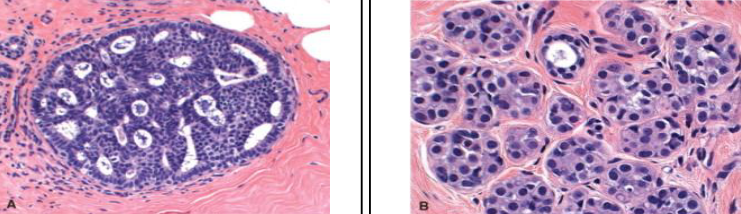
proliferative with atypia breast disorders?
inc. risk for malignant transformation 4-5x (w/o atypia only 1.5-2x)
atypical ductal hyperplasia (ADH) → histo resemblance to DCIS (dec. ME, calcification)
highest risk of breast cancer
atypical lobular hyperplasia (ALH) → histo resemblance to LCIS (dyscohesive cells)
neoplastic breast disorders cause? survival? imaging?
30% (BRCA1/2 mut; also ovarian/pancreatic); 70% (sporadic → inc. estrogen = faster proliferation of breast cells → inc. mut. chance)
ER+/PR+ (highest rate) > HER2+ > triple negative (aggressive)
mammography guided needle biopsy (40+ pt, older = more adipose = easier to see); US guided needle biopsy (premenopausal women)
benign neoplasm conditions? characteristics?
intra-lobular stroma (phyllodes can be periductal)
fibroadenoma (pre-menopausal) → ER sensitive (changes size during cycle); mobile + well-circumscribed
phyllodes tumor (post-menopausal) → recur locally, leaf-like architecture (cellular stroma w/ inc. mitosis); pleomorphism w/ atypia of ductal or stromal elements
can be malignant
ductal carcinoma in situ (DCIS) type? characteristics? invasive ductal carcinoma (IDC)/invasive carcinoma of no special type?
malignant neoplasm; term. duct
confined, microscopic; ME absent/reduced
patterns → calcification, comedo carcinoma, cribiform, papillary
paget (@ lactiferous sinus + large duct) → DCIS extension w/in ductal system to nipple epidermis (eczematous lesion + palpable mass)
firm + irregular w/ desmoplasia (chalky), spiculated margins, calcification → advanced (skin dimple, retraction, peau d’orange)
invasive ductal carcinoma (IDC) categorization? characteristics?
medullary → soft/fleshy, well-circumscribed; syncytium-like sheets of large cells w/ pleomorphic nuclei + prominent nucleoli
colloid/mucinous → soft/rubbery, gelatinous (good prognosis)
inflammatory → erythema swelling, warmth, peau d’orange; extensive plug of lymphovascular space of dermis, diffusely infiltrative, bloody discharge
tubular → ME cells absent (excellent prognosis)
lobular carcinoma in situ (LCIS) type? characteristics? invasive lobular carcinoma (ILC)?
malignant neoplasm; lobular unit
confined, microscopic; uniform dyscohesive cells (loss of E-cadherin/CDH1)
always incidental finding (no mass/calcifcation)
loss of E-cadherin/CDH1; single file infiltration; bilateral + multicentric w/in same breast
tamoxifen MOA? AE?
selective estrogen receptor modulator (SERM)
ER antagonist in breast (block ER+ cancer), partial agonist in bone/endometrium (dec. resoprtion + inc. uterine thickening)
thromboembolic disorder, endometrial cancer
fulvestrant MOA? AE? anastrozole? exemestane?
competitive estrogen receptor antagonist/degrader
selective nonsteroidal reversible aromatase inhibitors (inhibit androgen → estrogen)
irreversible aromatase inhibitor
osteoporotic fracture, thrombophlebitis
trastuzumab MOA? AE? atezolizumab?
inhibits RAS-MAPK + PI3K-AKT path → inc. HER2 degradation → dec. cancer cell proliferation
dilated cardiomyopathy
monoclonal antibody against PDL1 → inc. RBP → inc. T cell killing of tumor cells (triple negative)
peripheral edema
palbociclib MOA? AE? -parib?
cyclin-dependent kinase (CDK4/6) inhibitor (halts G1/S)
poly-ADP-ribose polymerase (PARP) inhibitor
myelosuppression, edema