Chapter 6: Weathering
0.0(0)
Studied by 0 people Call Kai
 Learn
Learn Practice Test
 Spaced Repetition
 Match
Match Flashcards
 Knowt Play
Card Sorting
1/29

Earn XP
Description and Tags
Last updated 8:28 AM on 3/29/23
Name | Mastery | Learn | Test | Matching | Spaced | Call with Kai | Chat |
|---|
No analytics yet
Send a link to your students to track their progress
30 Terms
1
New cards
Endogenic Processes
What is the geological processes that originate inside of the Earth’s crust?
2
New cards
Exogenic Processes
What are geomorphic processes that originate at/or near the Earth’s surface?
(Mass wasting, weathering, erosion and deposition of materials by fluvial, glacial, coastal, aeolian processes)
(Mass wasting, weathering, erosion and deposition of materials by fluvial, glacial, coastal, aeolian processes)
3
New cards
Weathering
What is the set of exogenic processes that alter the physical and chemical state of rock material at or near the Earth’s surface?
4
New cards
Erosion
What is the pick up and transport of material (usually weathered to some extent) by some agent such as water, wind, ice, gravity and waves?
5
New cards
Physical weathering
What type of weathering is
* mechanical breakage of rock by stress, thermal expansion and contraction, frost wedging, etc.
* dominant in cold and dry environments?
* mechanical breakage of rock by stress, thermal expansion and contraction, frost wedging, etc.
* dominant in cold and dry environments?
6
New cards
Chemical weathering
What type of weathering is
* decomposition of rock structure by chemical reactions that result in chemical changes to the rock
* dissolution and clay production
* dominant in hot and wet environments
* much faster rates than its counterpart?
* decomposition of rock structure by chemical reactions that result in chemical changes to the rock
* dissolution and clay production
* dominant in hot and wet environments
* much faster rates than its counterpart?
7
New cards
Quite resistant to physical and chemical weathering, so they end up becoming clastic rocks
What happens to quartz when weathered?
8
New cards
Turn into clays with ions carried away in the process
What happens to feldspars when chemically weathered?
9
New cards
Less stable than their counterpart mineral
Undergo more chemically weathering, producing clay minerals and iron oxides
Undergo more chemically weathering, producing clay minerals and iron oxides
What happens to mafic minerals when weathered?
10
New cards
Dissolved and ions carried in solution
What happens to calcite, gypsum and halite when weathered?
11
New cards
Weaken rock structure
Provide greater surface area for other processes
Provide greater surface area for other processes
Why do joints and fractures occur in rocks when weathering happens?
12
New cards
More surface area
What does more weathering equal?
13
New cards
* Disintegration of rock, stresses along pre-existing joints or fractures
* No chemical alteration
* Smaller particles from larger
* Often results in angular surfaces
* Thus resultant particles reflect original texture and structure of rock
* Happens in cold and dry environments
* No chemical alteration
* Smaller particles from larger
* Often results in angular surfaces
* Thus resultant particles reflect original texture and structure of rock
* Happens in cold and dry environments
What are the features of physical weathering?
14
New cards
1. sheet jointing
2. frost wedging
3. thermal expansion
4. salt crystal growth
5. plant wedging
What are the processes of physical weathering?
S
F
T
S
P
S
F
T
S
P
15
New cards
Sheet joining/unloading
What is the type of physical weathering where
* uplift and erosion result in a vertical expansion of the rock surface and the formation of fractures as the overlying confining pressure is reduced
* fractures parallel to the surface form **exfoliation sheets**
* uplift and erosion result in a vertical expansion of the rock surface and the formation of fractures as the overlying confining pressure is reduced
* fractures parallel to the surface form **exfoliation sheets**
16
New cards
Spheroidal weathering (onion skin)
What type of weathering has
* smaller scale unloading processes likely acting in concert with other weathering processes, such as hydration or thermal expansion
* smaller scale unloading processes likely acting in concert with other weathering processes, such as hydration or thermal expansion
17
New cards
Frost wedging
What type of physical weathering has
* Ice crystal growth (ppt or sublimation)
* 10% increase in water volume upon freezing
* pressure (100 lb/sq in) on surrounding surfaces
* Exploits existing joints
* A common process in climates with freeze-thaw cycles, alpine areas, arctic areas,
* Block fields (felsenmeer) surface with angular blocks likely due to weathering in situ
* Talus slopes
* Ice crystal growth (ppt or sublimation)
* 10% increase in water volume upon freezing
* pressure (100 lb/sq in) on surrounding surfaces
* Exploits existing joints
* A common process in climates with freeze-thaw cycles, alpine areas, arctic areas,
* Block fields (felsenmeer) surface with angular blocks likely due to weathering in situ
* Talus slopes
18
New cards
Thermal expansion
What type of physical weathering has
* Heating and cooling results in differential expansion and contraction
* Changes in the volume of rock material leads to stresses in the rock and eventual breakage of the bonds within the rock
* Heating and cooling results in differential expansion and contraction
* Changes in the volume of rock material leads to stresses in the rock and eventual breakage of the bonds within the rock
19
New cards
Salt crystal growth
What type of physical weathering has
* salt crystallization as water evaporates in pores and fractures exert mechanical stress that weathers rock and monuments
* most effective in arid regions, marine coastlines
* salt crystallization as water evaporates in pores and fractures exert mechanical stress that weathers rock and monuments
* most effective in arid regions, marine coastlines
20
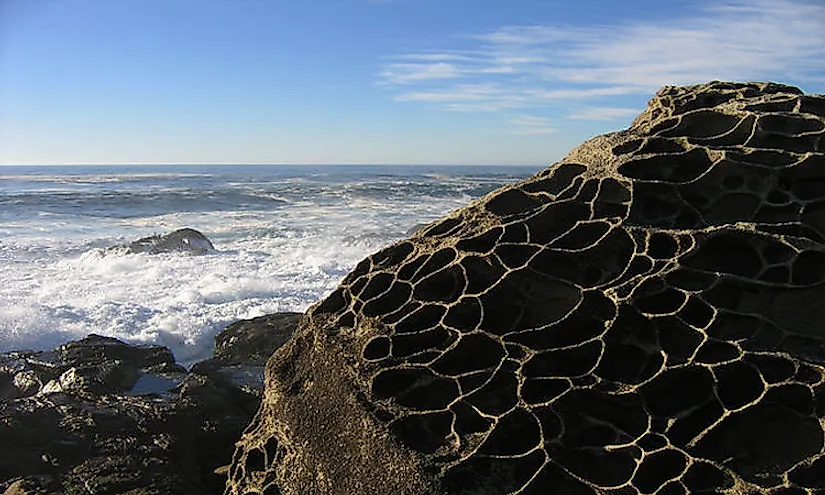
New cards
Tafoni weathering
What type of salt crystal growth weathering has
* Natural rock cavities are often found in the arid environment or coastal areas
* Various mechanisms of formation, but salt heaving is a common mechanism
* Natural rock cavities are often found in the arid environment or coastal areas
* Various mechanisms of formation, but salt heaving is a common mechanism
21
New cards
Plant wedging
What type of physical weathering
* numerous biological forces including growth of plant roots
* Seed exploits crack in rock, as root grows, it exerts force on surrounding rock,
* Wind can blow over the tree, resulting force blasts rock apart
* numerous biological forces including growth of plant roots
* Seed exploits crack in rock, as root grows, it exerts force on surrounding rock,
* Wind can blow over the tree, resulting force blasts rock apart
22
New cards
* Formation of new substances, often softer
* Finer, particle sizes
* More soluble
* Occupy larger volume than original
* Usually occurs along planes of weakness, joints or fractures
* Results in rounded surfaces
* Most occur in the presence of water or air (hot, wet environments)
* Finer, particle sizes
* More soluble
* Occupy larger volume than original
* Usually occurs along planes of weakness, joints or fractures
* Results in rounded surfaces
* Most occur in the presence of water or air (hot, wet environments)
What are the features of chemical weathering?
23
New cards
1. Solution
2. Hydration
3. Hydrolysis
4. Oxidation
5. Chelation
What are the processes of chemical weathering?
(SHHOC)
(SHHOC)
24
New cards
Solution
Which process of chemical weathering is
* water dissolving some minerals that are naturally soluble
* Rainwater is weakly acidic but SO2 and N2 produce stronger acids that are effective in dissolving minerals
* involves a CaCO3 equation
* water dissolving some minerals that are naturally soluble
* Rainwater is weakly acidic but SO2 and N2 produce stronger acids that are effective in dissolving minerals
* involves a CaCO3 equation
25
New cards
Hydration
Which process of chemical weathering is
* a mineral absorbing water molecules and changing the chemical bonds to produce a different structure
* a mineral absorbing water molecules and changing the chemical bonds to produce a different structure
26
New cards
Hydrolysis (1)
Which process of chemical weathering is
* involving chemical reactions (H+ and OH-) from water to enter the crystal lattice and replace other ions, changing the composition and forming a new mineral
* ions are freed from the crystal lattice, and go into solution, resulting in minerals being often weaker and more soluble
* makes them least resistant to weathering
* involving chemical reactions (H+ and OH-) from water to enter the crystal lattice and replace other ions, changing the composition and forming a new mineral
* ions are freed from the crystal lattice, and go into solution, resulting in minerals being often weaker and more soluble
* makes them least resistant to weathering
27
New cards
Hydrolysis (2)
What chemical weathering process makes feldspars into clay minerals?
28
New cards
The water splits into hydrogen (H) and hydroxide (OH). These two change the chemical composition and size of minerals in a rock. In feldspar, the water + orthoclase, are in a dissolution equation, turning them into kaolinite (clay), silicic acid and potassium (K). This forms clay!
How does hydrolysis turn feldspars into clay?
29
New cards
Oxidation
What is the chemical weathering process where:
* minerals combine with O2, resulting in a loss of electrons
* minerals combine with O2, resulting in a loss of electrons
30
New cards
Acid Rock Drainage
What is the oxidation of rocks with sulfide minerals