2.8 The Phillips Curve
 Call Kai
 Learn
Learn Practice Test
 Spaced Repetition
 Match
Match Flashcards
 Knowt Play
1/12

There's no tags or description
Looks like no tags are added yet.
Name | Mastery | Learn | Test | Matching | Spaced | Call with Kai | Chat |
|---|
No analytics yet
Send a link to your students to track their progress
13 Terms
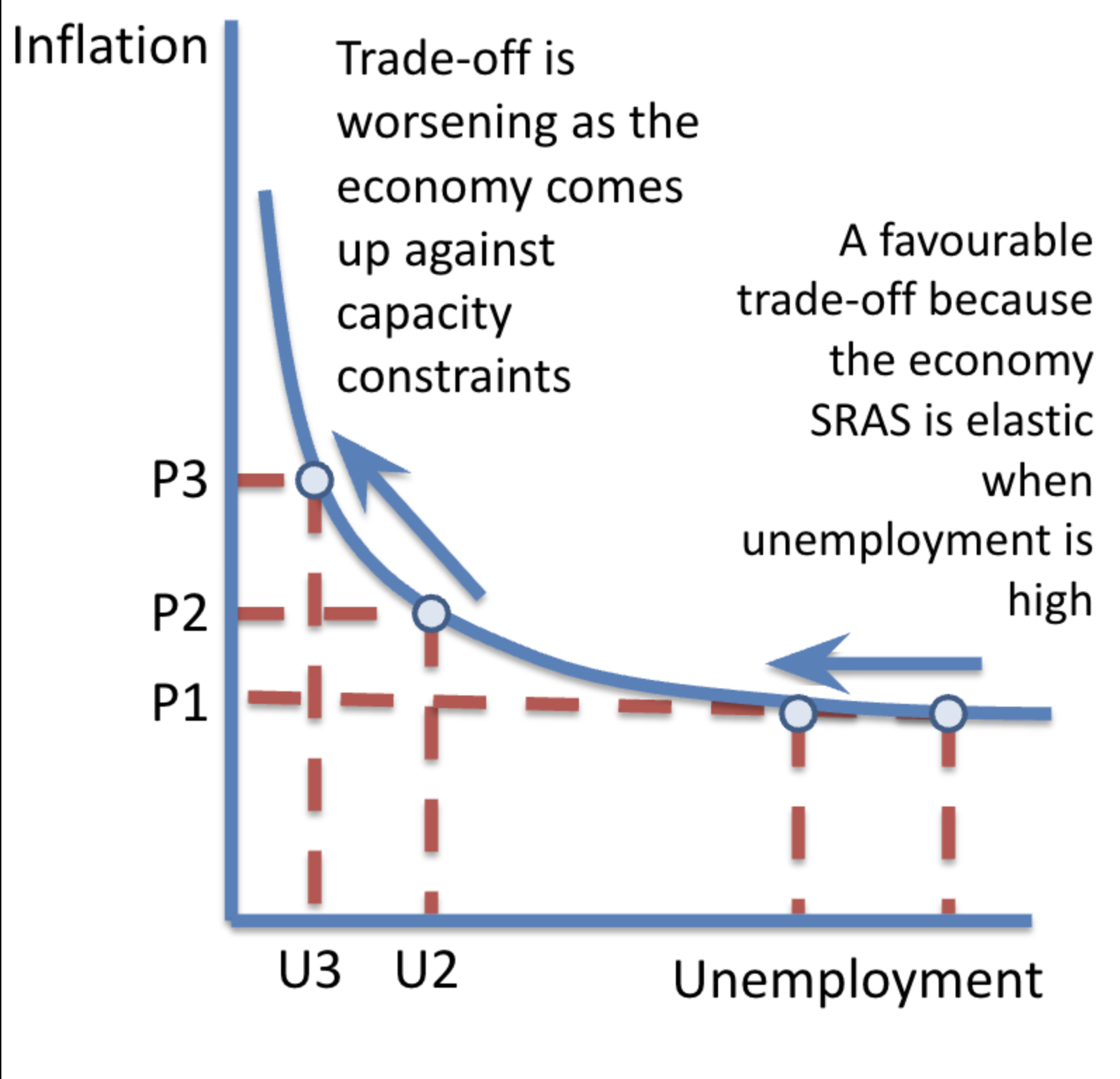
The Phillips curve
Relationship which suggests there is a trade off between unemployment and inflation
Natural rate of unemployment (NRU)
Rate of unemployment when the labour market is in equilibrium (labour demand is equal to labour supply)
Non-accelerating inflation rate of unemployment (NAIRU)
Rate of unemployment in an economy that is consistent with a constant rate of inflation
Possible Conflicts between Growth and Inflation
An overheating (fast-growing) economy may suffer accelerating inflation which then has negative effects on trade performance, business profits and jobs
Unemployment
A situation that occurs when a number of people in an economy are able and willing to work but are unable to gain employment
Full employment
The level of employment as a result of everyone who is able and willing to work having a job, with the exception of those who are frictionally employed
Natural rate of unemployment
The natural rate of unemployment is defined as the equilibrium rate of unemployment i.e. the rate of unemployment where real wages have found their free market level and where the aggregate supply of labour is in balance with the aggregate demand for labour.
At the natural rate, all those wanting to work at the prevailing real wage rate have found employment and there is no involuntary unemployment
The Phillips Curve concept
States that inflation and unemployment have a stable and inverse relationship
According to the Phillips curve, the lower an economy's rate of unemployment, the more rapidly wages paid to labour increase in that economy. This can be because people expect the higher wages and unions have more bargaining power.
Policy trade-off is needed.
Curve
Curve shows a trade-off between inflation and unemployment. A demand-side policy to reduce unemployment could conflict with price stability
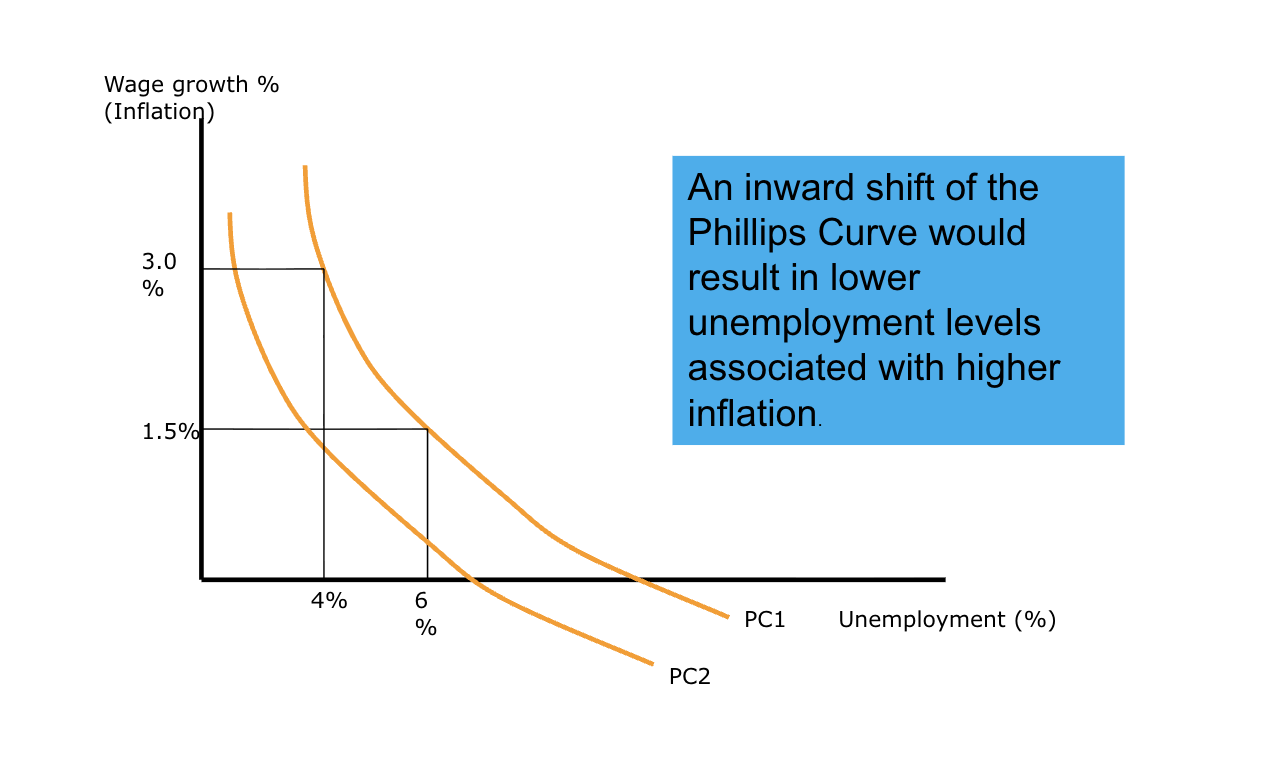
Shift in the Phillips Curve
An inward shift of the Phillips Curve would result in lower unemployment levels associated with higher inflation
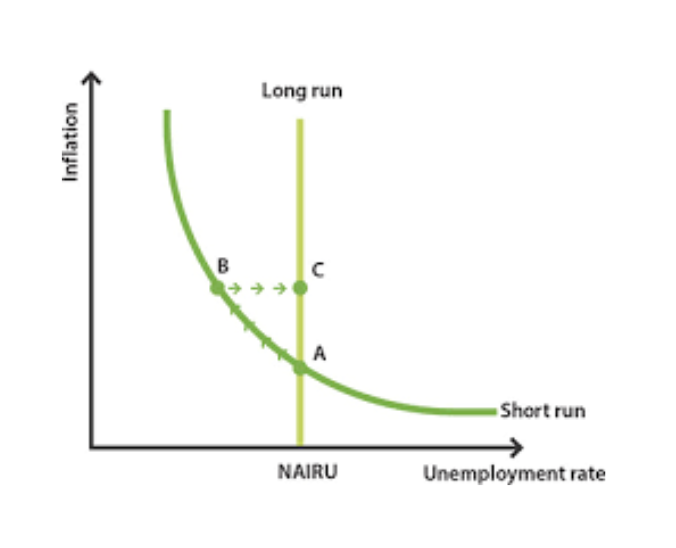
NAIRU on Phillips Curve
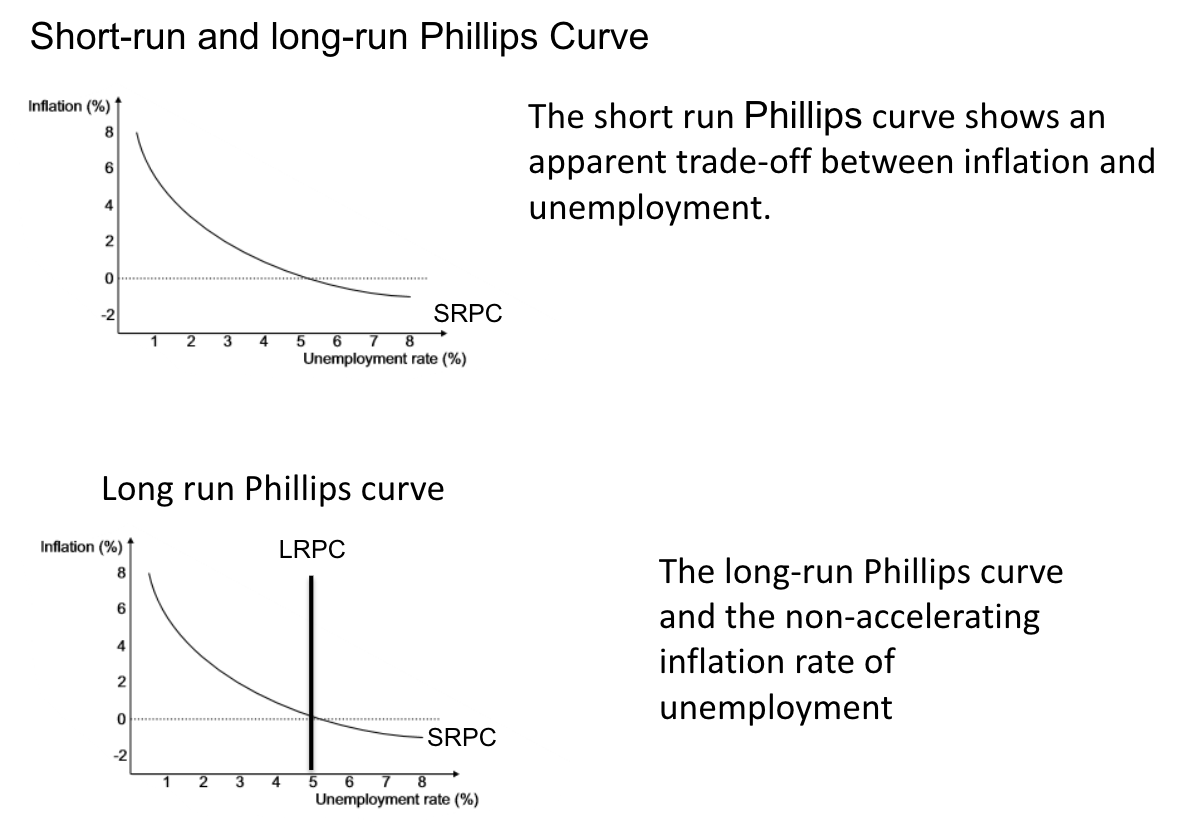
Where the long run Phillips Curve cuts the horizontal axis would be the rate of unemployment at which inflation was constant – the Non-Accelerating Inflation Rate of Unemployment (NAIRU)
Short-run vs long-run Phillips Curve
Why is there a potential trade-off between unemployment and inflation?
An increase in aggregate demand (AD to AD2) causes higher real GDP (Y1 to Y2). Therefore firms employ more workers and unemployment falls.
However, as the economy gets closer to full capacity, we see an increase in inflationary pressures. With lower unemployment, workers can demand higher money wages, which causes wage inflation. Also, firms can put up prices due to rising demand.
Therefore, in this situation, we see falling unemployment, but higher inflation